Your Journey Begins: Understanding BPMN
Welcome to your comprehensive guide on Business Process Modeling Notation (BPMN). Whether you’re a business analyst, process owner, software developer, or stakeholder, this journey will equip you with the knowledge to model, analyze, and improve business processes effectively.
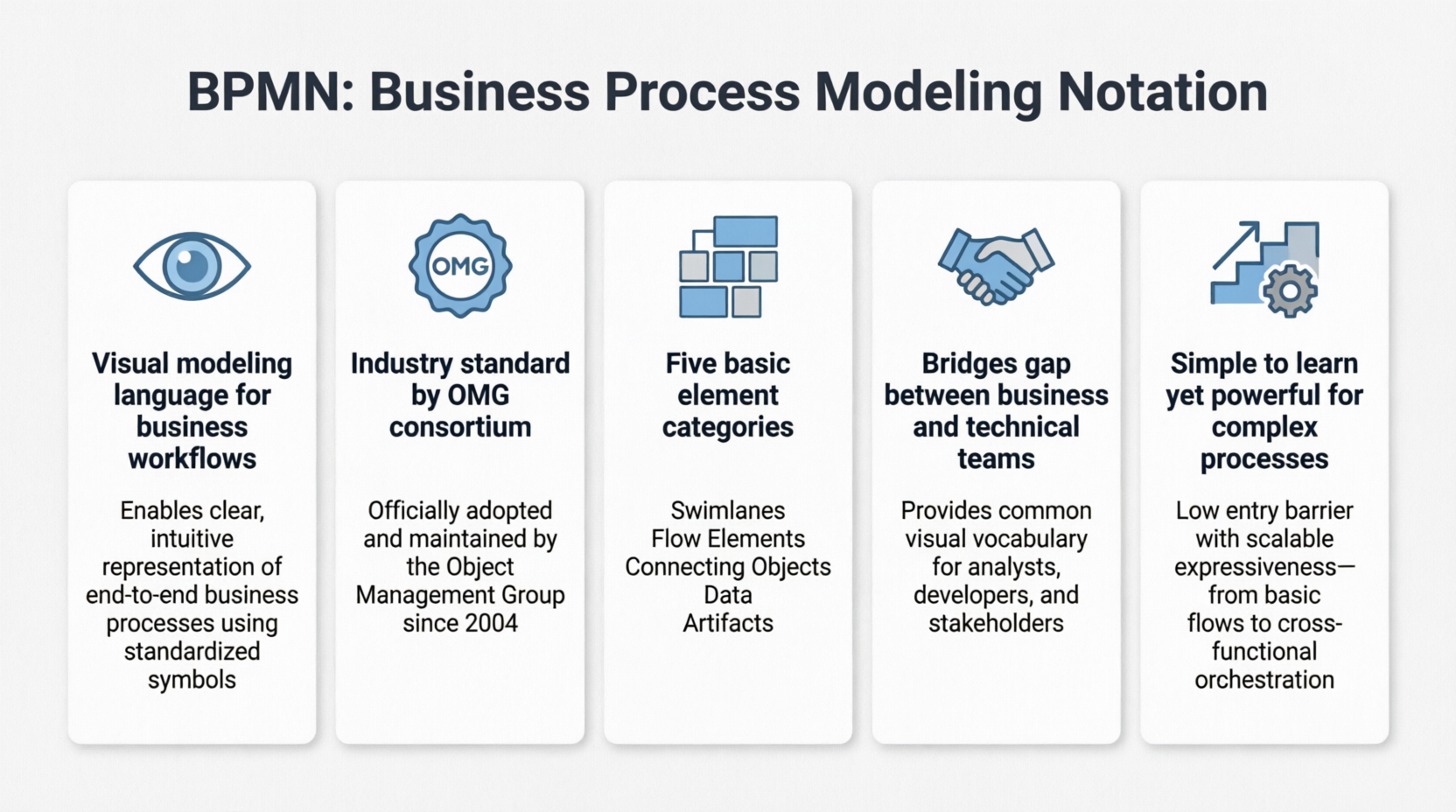
BPMN is a visual modeling language for business analysis applications and specifying enterprise process workflows, which is an open standard notation for graphical flowcharts that is used to define business process workflows [[1]]. It is a popular and intuitive graphic that can be easily understood by all business stakeholders, including business users, business analysts, software developers, and data architects.
Chapter 1: The Evolution of BPMN – A Historical Perspective
Your First Stop: Understanding the Origins
Your journey through BPMN begins with understanding its rich history. BPMN is derived from the synthesis of multiple business modeling notations, creating a unified standard that has transformed how organizations document their processes.
Key Milestones:
-
2004: Originally published by the Business Process Management Initiative (BPMI)
-
2005: BPMI merged with OMG (Object Management Group)
-
February 2006: OMG released the first BPMN Specification document
-
2010: Version 2.0 of BPMN was developed
-
December 2013: The actual version of the specification was released
-
Current: The latest version (BPMN 2.0.2) has been formally published by ISO as the 2013 edition standard: ISO/IEC 19510
This evolution demonstrates BPMN’s commitment to continuous improvement and standardization, making it the gold standard for business process modeling worldwide.
Chapter 2: Why BPMN Matters – The Benefits Journey
Discovering the Value Proposition
As you progress on your BPMN journey, you’ll discover why organizations worldwide adopt this standard. BPMN allows us to capture and document business processes of an organization in a clear and consistent way that ensures relevant stakeholders, such as process owners and business users are involved in the process.
Your Organization Will Gain:
-
Industry Standard Credibility: An industry standard developed by the OMG consortium, a not-for-profit industry group
-
Process Clarity: Provides businesses with the capability of defining and understanding their procedures through Business Process Diagrams
-
Universal Understanding: To provide a standard notation that is readily understandable by all business stakeholders
-
Bridged Communication: To bridge the communication gap that frequently occurs between business process design and implementation
-
Balanced Complexity: Simple to learn yet powerful enough to depict the potential complexities of a business process
BPMN provides comprehensive and yet rich notations that can easily be understood by both technical and non-technical stakeholders. Thus, the team can respond to any issues identified in the processes more effectively.
Chapter 3: Who Benefits from BPMN – Stakeholder Journey
Meeting the Key Players
Your BPMN journey involves understanding who benefits from this powerful notation:
The Three Primary Travelers:
-
Technical Experts: Responsible for process implementation
-
Business Analysts: Who create and improve the processes
-
Managers: Who monitor and control the processes
Each stakeholder brings unique perspectives and needs, and BPMN serves as the common language that connects them all.
Chapter 4: Understanding Business Operations – The Foundation
Your Critical First Step
Knowing how the business operates is the first and the most critical step of business process improvement. Business Process Model and Notation (BPMN) provides a graphical representation of business workflows that anyone, from business analyst to stakeholder, can easily understand; aiding in business process analysis and business process improvements.
Any process described with BPMN is represented as a number of steps (activities) that are performed consequently or at the same time according to certain business rules.
Chapter 5: The BPMN Notation Toolkit – Your Essential Elements
Exploring the Five Basic Categories
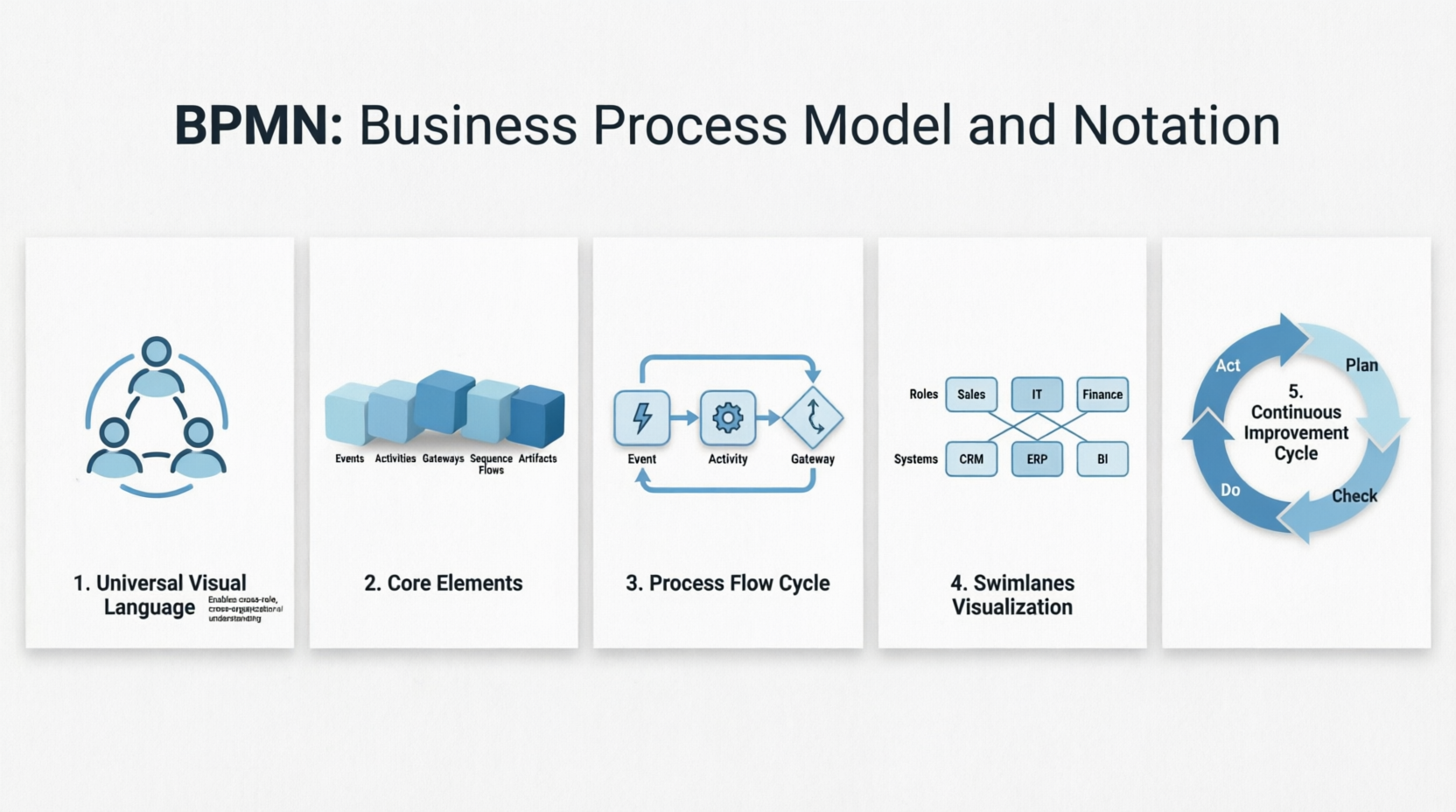
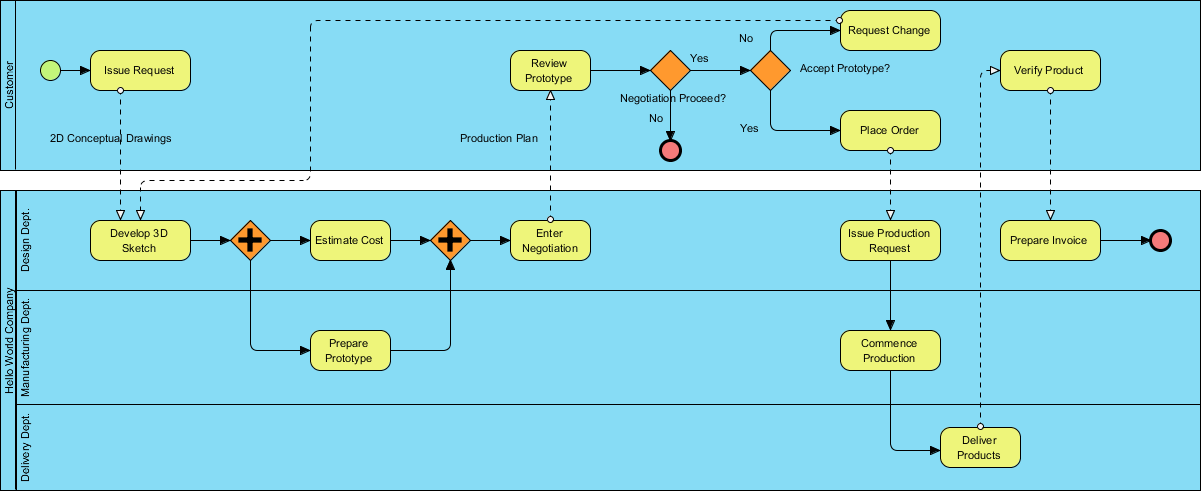
In BPMN, the processes are described by means of diagrams with a series of graphic elements. Such visual presentation makes it easy for the users to understand the logic of a process. BPMN has been primarily developed to design and read both simple and complex diagrams of business processes.
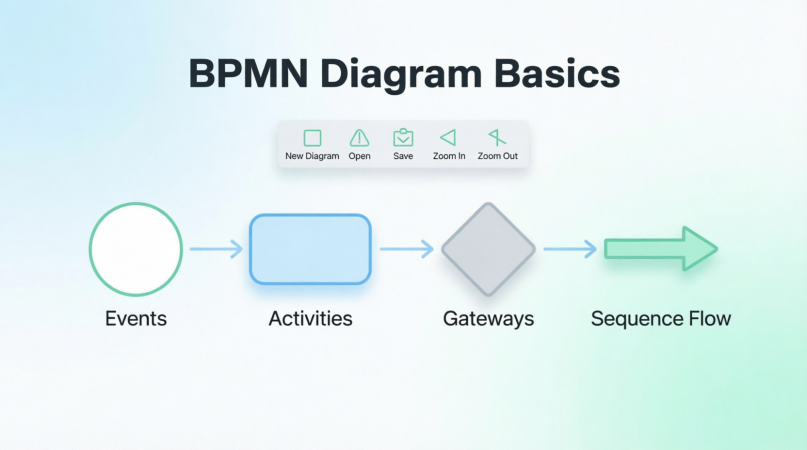
The BPMN standard classifies the graphic elements by categories, making the elements easily recognized by the users who work with business process diagrams.
Chapter 6: Swimlanes – Mapping Process Participants
Understanding Who Does What
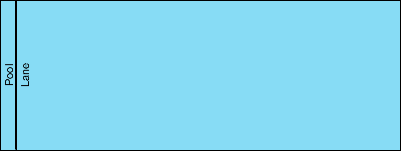
Swimlanes are your first major tool in the BPMN toolkit. Swimlanes are graphical containers that represent participants of a process. There are two types of swimlanes – pools and lanes.
BPMN Swimlanes Deep Dive
Swimlane objects (aka: Swimlanes) in BPMN are rectangular boxes that represent participants of a business process. A swimlane may contain flow objects that are performed by that lane (participant), except for black box that must have an empty body. Swimlanes may be arranged horizontally or vertically. They are semantically the same but just different in representation. For horizontal swimlanes, process flows from left to right, while process in vertical swimlanes flow from top to bottom. Examples of swimlanes include Customer, Account Department, Payment Gateway and Development Team.
There are two kinds of swimlanes:
Pools: The Primary Participants
Pools represent participants in a business process. It can be a specific entity (e.g. department) or a role (e.g. assistant manager, doctor, student, vendor).
Inside a pool, there are flow elements. They represent the works that the pool needs to perform under the process being modeled. However, there is one kind of pool that has no content at all. It is known as the blackbox pool. Blackbox pool is often used when modeling entities external to the business process. As it is external, its internal flow does not have any impact on the process being modeled, hence can be skipped, producing a blackbox.
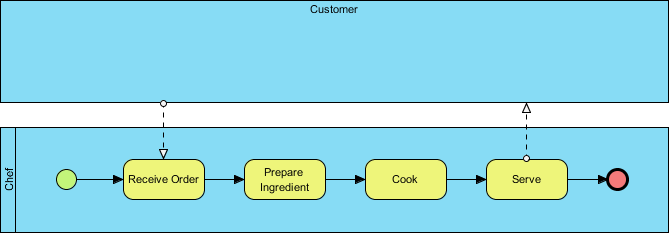
The following BPD (business process diagram) gives you an example of a blackbox pool. Customer is a blackbox. Since the process focuses on how the chef prepares a meal, what the customer does is none of the process’ interest. The use of blackbox depends on the perspective the process takes. If you need to model the process of how a customer places an order, the flow of Customer will be modeled, making the Chef pool a blackbox.
Lanes: Sub-Partitions for Detail
Lanes are sub-partition of pools. For instance, when you have a pool Department, you may have Department Head and General Clerk as lanes. Same as pools, you can use lanes to represent specific entities or roles who are involved in the process.
Lanes may contain other lanes to form a nested structure when needed. However, BPMN helps you primarily on modeling business process. Do not try to build nested lanes just for modeling the structure of your organization. If you want to model the organization structure, use the organization chart instead.
Chapter 7: Flow Elements – The Heart of Your Process
Activities: The Work That Gets Done
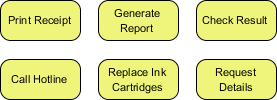
Activities are works that are performed within a business process. They are shown as rounded-rectangle, with names describing the works to perform.
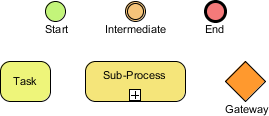
There are two types of activities: Task and Sub-Process. When we want to model an atomic work which cannot be further broken down or makes no sense to do so, we use a task.
On the other hand, when we want to model a non-atomic, complex work that can be elaborated into smaller works, we use a sub-process. A sub-process can be broken down into another level of details. For this reason, a sub-process usually contains another BPD modeling its details.
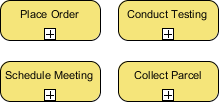
Note: The selection of task or sub-process is not just about how complex a work can be but also about how detailed you need to know about the work. If you are a customer, you probably don’t want to know how your payment is being processed. However, if you are the shop, how to process customer’s payment becomes important.
Events: What Happens Along the Way
Events are something that happen and may have impacts on a business process. An event can be either external or internal. As long as they can influence the process being modeled, they should be modeled. Events are shown as circles. In some cases, there are icons within the circles to represent the type of the event trigger.
There are three types of events:
-
Start Event: Every process should have a start event to show the beginning of business process. It allows readers to locate in BPD where the process begin.
-
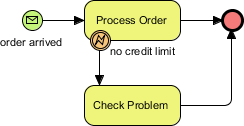
Intermediate Event: Responsible for driving business flow based on the event it specifies. Intermediate event can be attached to an activity for modeling an event that may happen DURING the execution of that activity and it may also be connected by a connecting object for modeling an event that may happen AFTER the execution of the flow element before.
-
End Event: Used to indicate where a business process completes.
Trigger can be specified for each of them to indicate under what condition an event is being triggered.
Take a look at the following example. It would give you some ideas on how events work. Basically, the diagram is saying when we receive an order, we begin to process it. If and only if there is no credit limit remained, we check on the problem. Process ends when the order has been processed or the problem has been identified.
Gateways: Controlling the Flow
Gateways are responsible for controlling how a business process flows. They are shown as diamond shapes. In a process, the work to do and the output may vary under different external or internal conditions. For example, a discount will only be offered to a VIP buyer but not to anyone else. Gateway is where conditions are evaluated and the decision is made.
Here are some typical types of gateways:
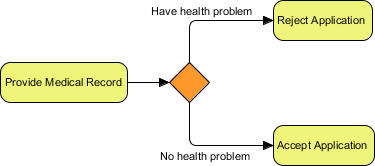
Data-Based Exclusive Gateway
Also known as exclusive gateway is used to control process flow based on given process data. Each outgoing flow which is connected from gateway corresponds to a condition. The flow with satisfied condition is traversed. Only one flow will be traversed.
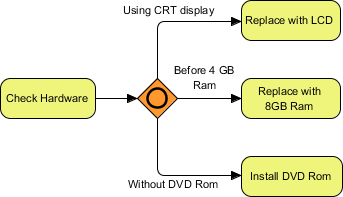
Inclusive Gateway
Inclusive Gateway can be used to create parallel paths. The conditions of all outgoing flow are evaluated. All flows with positive result will be traversed. Therefore, it may result in executing multiple flows if multiple conditions are satisfied.
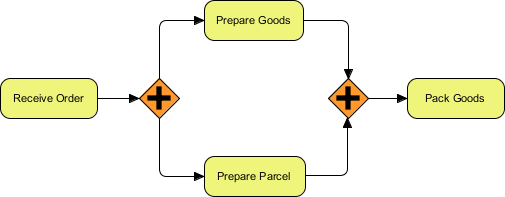
Parallel Gateway
Parallel Gateway is used to model the execution of parallel flows without the need of checking any conditions. In other words, all outgoing flows must be executed at the same time.
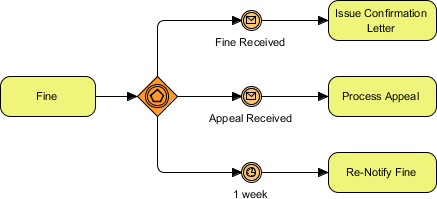
Event-Based Gateway
Event-Based Gateway is used to model alternative paths that are based on events. For example, to wait for someone’s reply, either Yes or No is needed to determine the path to traverse. The gateway is therefore followed by two connected intermediate events with message triggers, with one representing Yes message and another one for No. When any ONE of the events is triggered, then the flow that follows that event will be taken. All the other events and their followed flows will no longer be valid.
Chapter 8: Connecting Objects – Linking Your Process
Sequence Flows: The Order of Operations
Sequence flow is used to connect flow elements. It is shown in solid line with an arrowhead. It shows the order of flow elements.

Important Rule: You can only use sequence flow to connect flow elements within the same pool: either within the same pool/lane, or across lanes in the same pool. If you want to connect elements across pools, you cannot use sequence flow but message flow instead.
Message Flows: Communication Across Boundaries
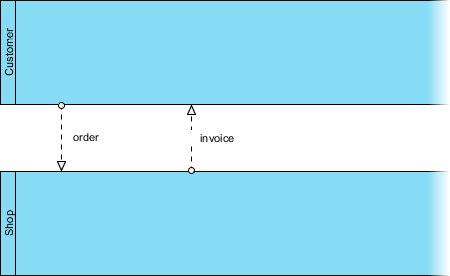
In BPMN, the communication between pools is achieved by the use of message. Message flow is used to show the flow of messages between pools or flow elements between pools. A message flow is shown in dotted line with an arrow head. Some examples of message that flows between pools: fax, telephone, email, letter, notice, command.
Chapter 9: Data – Information That Drives Process
Managing Process Data
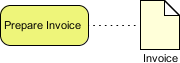
Very often, when executing a business process, there may be data produced, either during or after the end of the process. For example, a successful execution of the Place Order task will produce data like purchase order, invoice, receipt, etc. In BPMN, data can be modeled by several types of ‘data’ objects such as data objects, data inputs, data outputs and data stores. There is a well-defined way to manage the states of data, like instantiation, completed, deleted, etc.
Four kinds of data:
-
Data objects
-
Data inputs
-
Data outputs
-
Data stores
Chapter 10: Artifacts – Adding Context and Clarity
Groups: Organizing Your Diagram
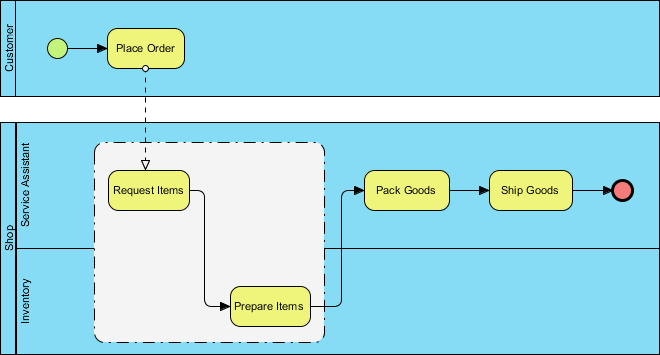
A group is a box with dotted line border, providing modelers a mechanism to group shapes by different categories.
Text Annotations: Providing Additional Detail
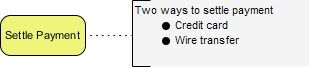
A text annotation can be used to add extra detail to flow objects in a BPD. It does not affect the flow but gives details about objects within a flow.
Chapter 11: Real-World Application – The True Aqua Distilled Water Company Journey
Your Practical BPMN Experience
Let’s apply everything you’ve learned through a real-world scenario. The True Aqua Distilled Water Company is a young distilled water supplier in the city. They sell distilled water for business and for home use. Now, the True Aqua Distilled Water Company wants to increase their market share from 5% to 10% in the next 12-18 months. To reach this objective, they are trying to find ways to increase operating efficiency and to fulfill higher level of customers’ satisfaction.
As a result, the True Aqua Distilled Water Company has decided to improve their distilled water ordering process. Now, you are a business analyst who is responsible for this mission. After meeting with the True Aqua Distilled Water Company, you have collected the following information about the ordering process.
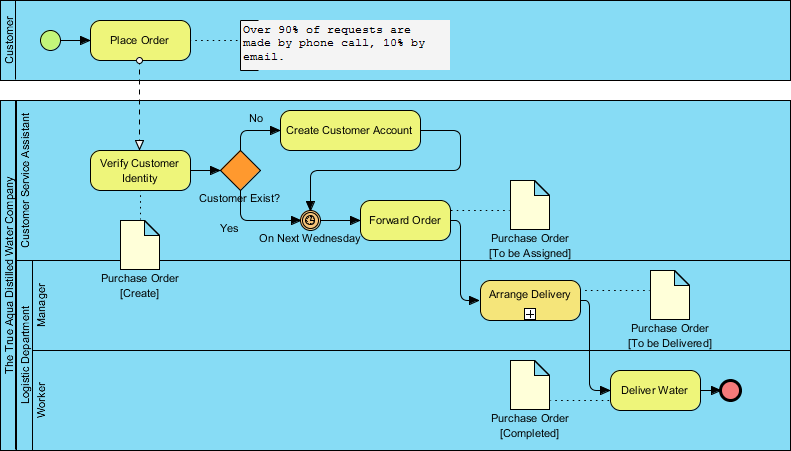
The figure below is the Business Process Diagram of the distilled water delivering process of The True Aqua Distilled Water Company.
Analyzing the Process
According to the diagram, the customers can either call the ordering hotline or send us Email to order distilled water. Currently, 90% of the orders come from phone calls, while 10% orders are placed by Email. The customer service assistant who receives the order will check whether the customer is an existing customer or a new one. If the customer has never placed order before, the customer service assistant will create a customer account for him or her prior to processing the order.
The delivery of distilled water is carried out once a week on every Wednesday. So, on every Wednesday morning, the customer service assistant will forward orders to the Logistics Department for delivery. Once the manager in the Logistics Department has received the orders, he will arrange the delivery by assigning workers to manage different orders, printing and posting the schedule. The workers receive the calls and deliver water to the customer accordingly.
What This Diagram Teaches Us
This real-world example demonstrates:
-
Multiple entry points (phone and email)
-
Decision points (new vs. existing customer)
-
Sequential activities (order processing → delivery scheduling → delivery)
-
Clear swimlanes (Customer, Customer Service Assistant, Logistics Manager, Workers)
-
Scheduled events (weekly Wednesday delivery)
Your Journey Continues: Next Steps
Congratulations! You’ve completed your comprehensive journey through BPMN. You now understand:
-
The history and evolution of BPMN as an industry standard
-
The benefits BPMN brings to organizations
-
The key stakeholders who benefit from BPMN
-
The five basic categories of BPMN elements
-
How to model swimlanes, activities, events, and gateways
-
How to connect process elements using sequence and message flows
-
How to manage data within your processes
-
How to add context with groups and annotations
-
How to apply BPMN to real-world business scenarios
Tools to Continue Your Journey
To put your BPMN knowledge into practice, consider using professional BPMN modeling tools that will help you create, analyze, and share your business process diagrams effectively.
References
- BPMN Specification – Business Process Model and Notation: Official BPMN resource providing the most accurate and up to date information about BPMN 2.0
- Object Management Group (OMG): The not-for-profit industry consortium that maintains the BPMN standard
- BPMN 2.0.2 Specification: The latest version of the BPMN specification document
- ISO/IEC 19510:2013: International standard for Business Process Model and Notation (BPMN)
- Professional BPMN Process Modeling Tool: Professional BPMN diagram and tools for creating business process models
Try Visual Paradigm FREE: Download and try Visual Paradigm’s BPMN modeling tools for free
Your BPMN mastery journey has just begun. Start modeling, keep practicing, and transform how your organization understands and improves its business processes!
This post is also available in Deutsch, Español, فارسی, Français, English, Bahasa Indonesia, 日本語, Polski, Portuguese, Ру́сский, Việt Nam, 简体中文 and 繁體中文.