


Introduction
In the fast-paced world of software engineering, documentation often lags behind development. Traditional UML modeling, while powerful, frequently becomes a bottleneck due to its reliance on manual, drag-and-drop interfaces. As object-oriented domain models evolve rapidly, keeping diagrams up-to-date can feel like a Sisyphean task, leading to outdated architecture references and misaligned team understanding.
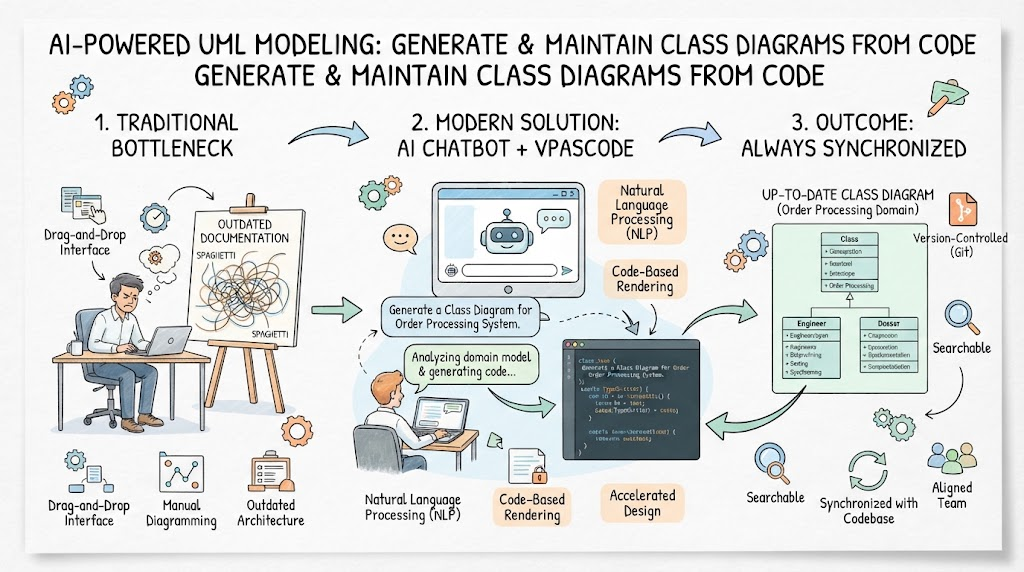
This guide explores a modern solution to this challenge: integrating Visual Paradigm’s AI Chatbot with the VPasCode Platform. By leveraging natural language processing and code-based rendering, engineering teams can generate, refine, and maintain complex class diagrams without ever touching a mouse. This approach not only accelerates the design phase but also ensures that architectural documentation remains version-controlled, searchable, and inherently synchronized with the codebase.
Key Concepts
1. The Shift from GUI to Code-Based Modeling
Traditional tools rely on graphical user interfaces (GUIs) where every element must be manually placed. Code-based modeling, using syntax like Mermaid, treats diagrams as code. This allows for:
-
Version Control: Diagrams can be committed to Git, allowing for diffing, branching, and merging.
-
Reproducibility: A diagram is generated from a text file, ensuring it looks identical on every developer’s machine.
-
Automation: Diagrams can be generated automatically during CI/CD pipelines.
2. Visual Paradigm AI Chatbot
The AI component acts as the “architectural translator.” Instead of struggling with syntax or layout, engineers describe their system in plain English. The AI interprets these descriptions, identifies entities, attributes, and relationships, and outputs structured Mermaid syntax.
3. VPasCode Platform
VPasCode serves as the rendering engine and integration hub. It takes the raw Mermaid code generated by the AI and instantly visualizes it. More importantly, it integrates into the development workflow, allowing teams to store diagrams alongside their source code in repositories.
Mermaid Class Diagram Syntax Cheatsheet
To effectively communicate with the AI or manually refine generated diagrams, familiarity with core Mermaid syntax is essential.
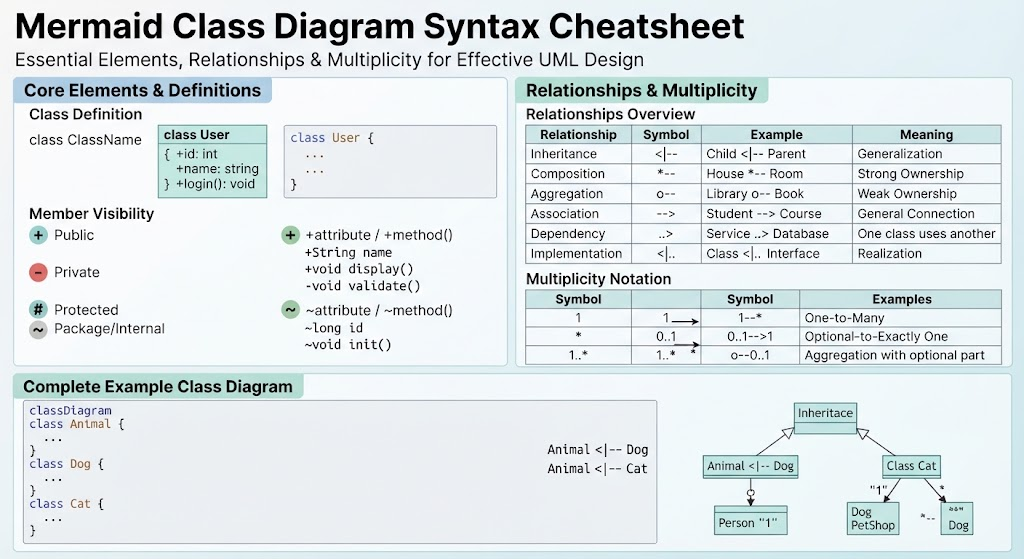
Core Elements
| Element | Syntax | Description |
|---|---|---|
| Class Definition | class ClassName |
Defines a new class entity. |
| Public Member | +attribute / +method() |
Visible to all other classes. |
| Private Member | -attribute / -method() |
Visible only within the class. |
| Protected Member | #attribute / #method() |
Visible to the class and its subclasses. |
| Package/Internal | ~attribute / ~method() |
Visible within the same package. |
Relationships & Multiplicity
| Relationship | Symbol | Example | Meaning |
|---|---|---|---|
| Inheritance | `< | –` | `Child < |
| Composition | *-- |
House *-- Room |
Strong ownership; parts cannot exist without the whole. |
| Aggregation | o-- |
Library o-- Book |
Weak ownership; parts can exist independently. |
| Association | --> |
Student --> Course |
General connection between classes. |
| Dependency | ..> |
Service ..> Database |
One class uses another temporarily. |
| Implementation | `< | ..` | `Class < |
Multiplicity Notation: Place numbers or symbols before the relationship line end.
-
1: Exactly one -
*: Many -
0..1: Zero or one -
1..*: One or many
Case Study Examples
1. Basic Class Structure
A fundamental model showing visibility modifiers and data types. This is often the starting point for any domain model.
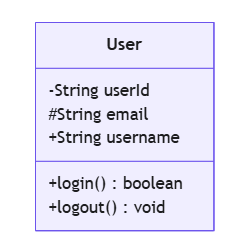
classDiagram
    class User {
        -String userId
        #String email
        +String username
        +login() boolean
        +logout() void
    }
2. Relationships and Multiplicity
This example illustrates how different accounts relate to a bank, showcasing inheritance and aggregation.
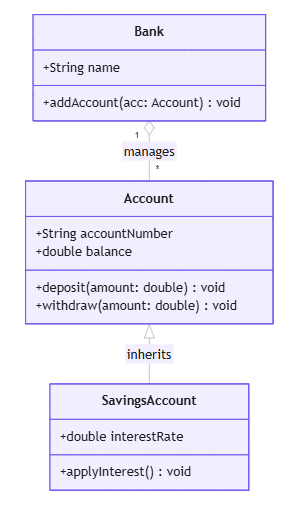
classDiagram
    class Account {
        +String accountNumber
        +double balance
        +deposit(amount: double) void
        +withdraw(amount: double) void
    }

    class SavingsAccount {
        +double interestRate
        +applyInterest() void
    }

    class Bank {
        +String name
        +addAccount(acc: Account) void
    }

    Account <|-- SavingsAccount : inherits
    Bank "1" o-- "*" Account : manages
3. Advanced E-Commerce Domain Model
A production-grade example generated via VPasCode, demonstrating complex interactions including enumerations, interfaces, and composition.
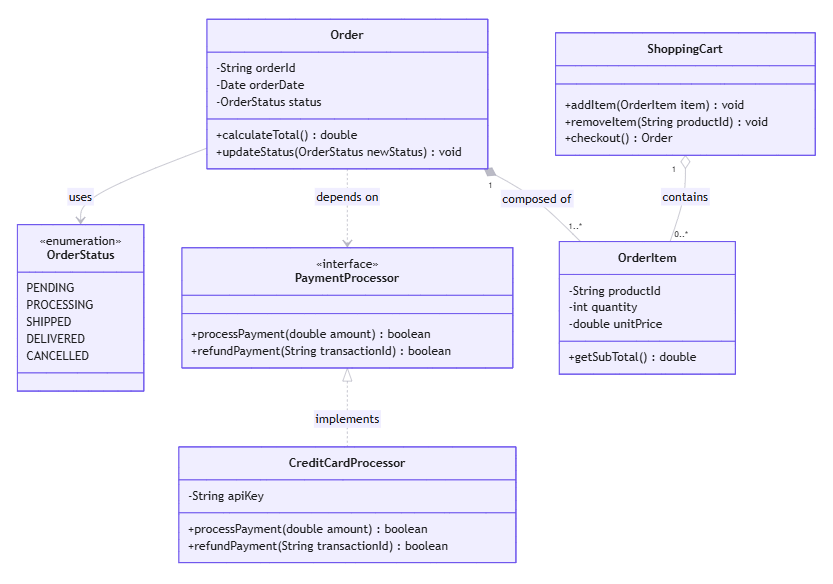
classDiagram
    direction TB

    class OrderStatus {
        <<enumeration>>
        PENDING
        PROCESSING
        SHIPPED
        DELIVERED
        CANCELLED
    }

    class PaymentProcessor {
        <<interface>>
        +processPayment(double amount) boolean
        +refundPayment(String transactionId) boolean
    }

    class CreditCardProcessor {
        -String apiKey
        +processPayment(double amount) boolean
        +refundPayment(String transactionId) boolean
    }

    class Order {
        -String orderId
        -Date orderDate
        -OrderStatus status
        +calculateTotal() double
        +updateStatus(OrderStatus newStatus) void
    }

    class OrderItem {
        -String productId
        -int quantity
        -double unitPrice
        +getSubTotal() double
    }

    class ShoppingCart {
        +addItem(OrderItem item) void
        +removeItem(String productId) void
        +checkout() Order
    }

    PaymentProcessor <|.. CreditCardProcessor : implements
    Order "1" *-- "1..*" OrderItem : composed of
    ShoppingCart "1" o-- "0..*" OrderItem : contains
    Order --> OrderStatus : uses
    Order ..> PaymentProcessor : depends on
Workflow Benefits: Visual Paradigm AI + VPasCode
-
Prompt-to-Diagram: Engineers interact with the Visual Paradigm AI Chatbot using natural language prompts (e.g., “Generate an e-commerce class diagram with Orders, Items, and Payment Interfaces”).
-
Instant Code Generation: The AI processes the request and outputs clean, syntax-valid Mermaid code, eliminating manual typing errors.
-
Seamless Rendering & Integration: VPasCode instantly renders the code into a visual diagram. Because the output is code, it can be directly committed to your repository, ensuring your documentation pipeline remains automated and up-to-date.
Conclusion
The integration of Visual Paradigm AI with the VPasCode platform represents a significant leap forward in architectural documentation. By moving away from static, manual drag-and-drop tools toward dynamic, code-based generation, teams can ensure their UML diagrams are not just afterthoughts, but living artifacts of the development process. This workflow reduces friction, enhances accuracy, and allows product managers and engineers alike to focus on high-level design logic rather than low-level formatting details. As systems grow in complexity, adopting AI-assisted, version-controlled diagramming will become less of a luxury and more of a necessity for maintaining clear, actionable technical documentation.
This post is also available in Deutsch, Español, فارسی, Français, English, Bahasa Indonesia, 日本語, Polski, Portuguese, Ру́сский, Việt Nam, 简体中文 and 繁體中文.