
For years, architects, software engineers, business analysts, and project managers have wrestled with a fragmented digital toolkit. Valuable desktop models lived in isolation on local hard drives, cloud-based whiteboard sessions remained disconnected from formal documentation, and jumping between business strategy, agile planning, and system architecture meant juggling dozens of separate applications, logins, and file formats.
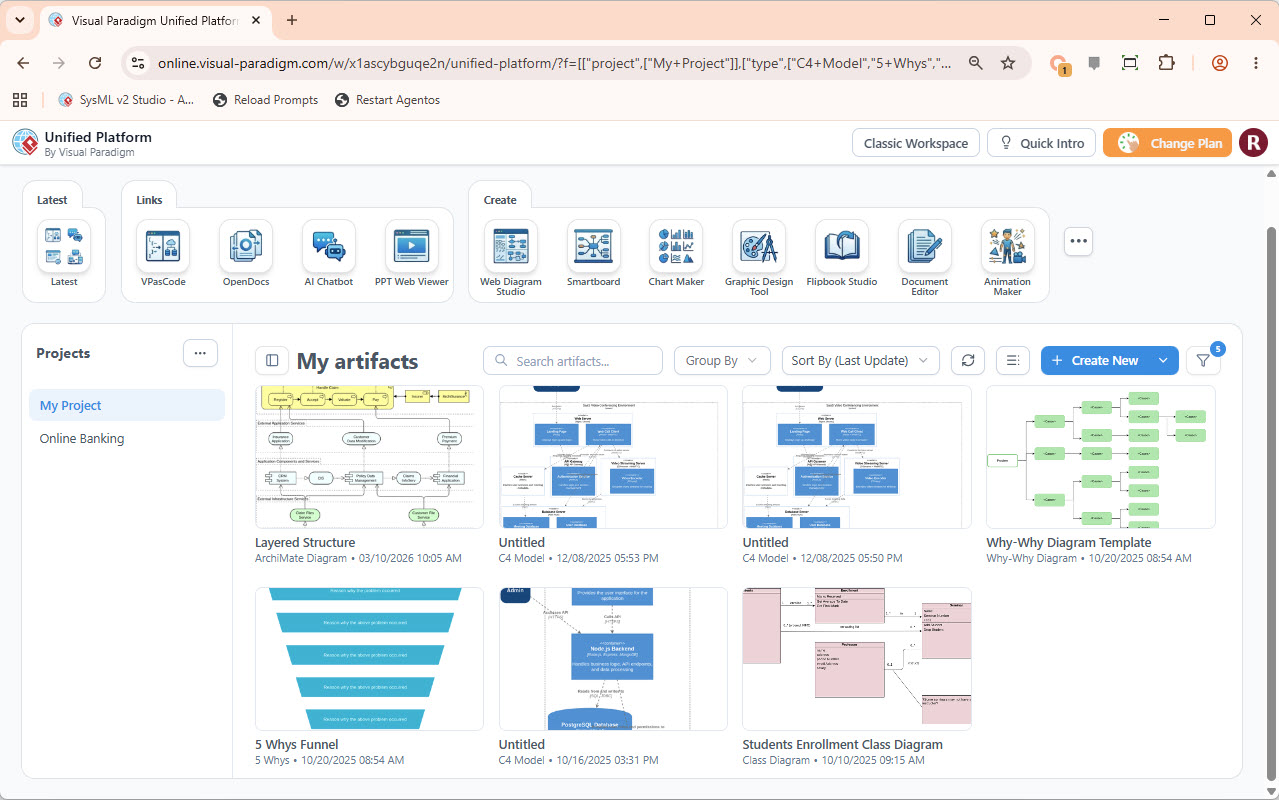
The Visual Paradigm Unified Platform fundamentally transforms this landscape. Designed as a centralized command center and integration layer, it brings together heavy-duty desktop modeling, lightweight browser-based tools, and artificial intelligence into a single, cohesive ecosystem.
1. The Core Purpose: Eliminating Silos and Tool-Switching
The primary goal of the Unified Platform is to solve the friction of fragmented workflows. Instead of treating desktop software, cloud storage, and specialized apps as separate silos, the platform acts as an orchestration hub.
Key pain points addressed by the platform include:
-
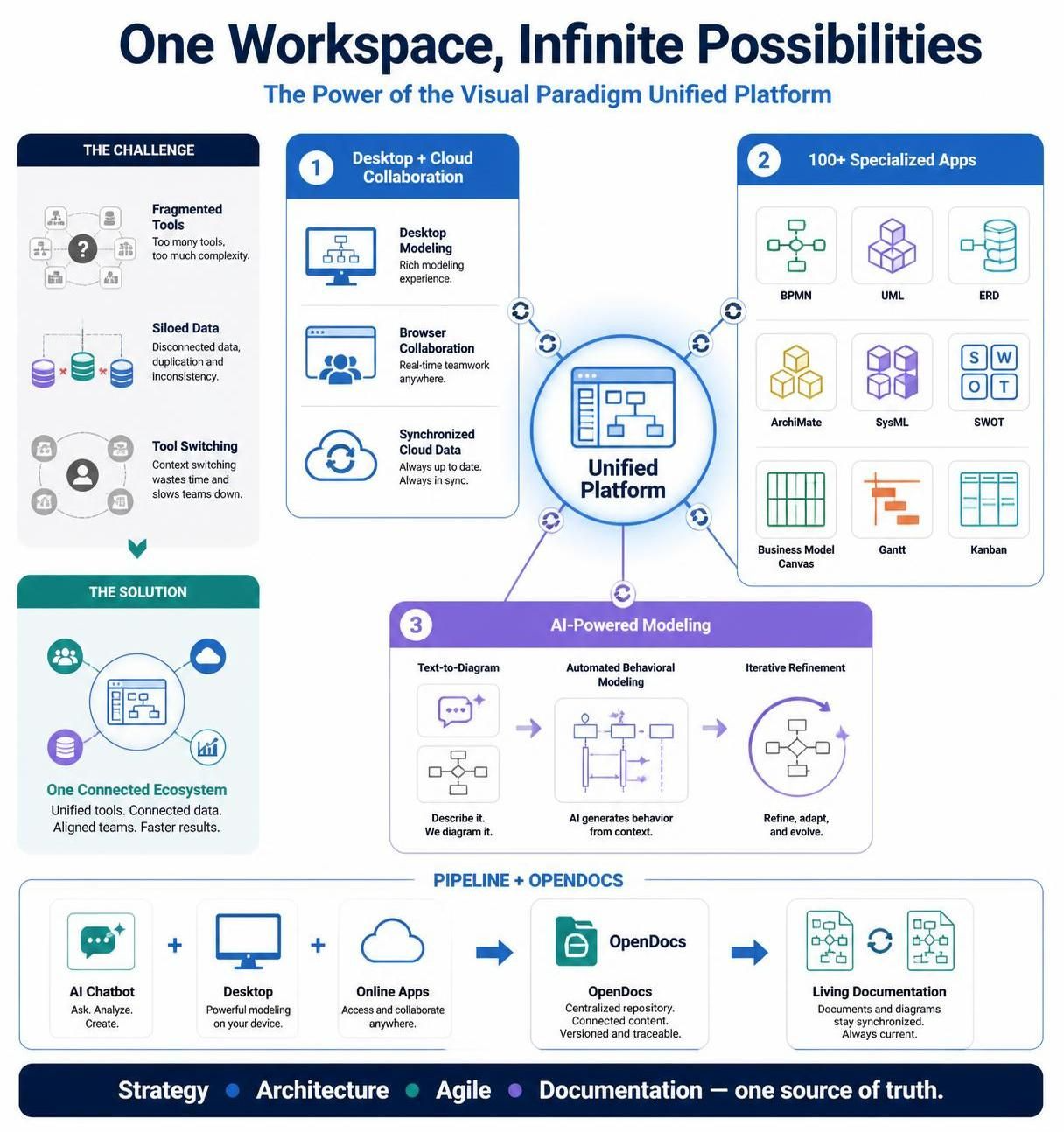
Siloed Data: Eliminates the divide where online apps and desktop projects store data in disconnected locations.
-
Fragmented Discovery: Provides a unified drive-like view and application launcher so users can easily find the right tool for any task—whether it is BPMN process mapping, UML design, or Agile backlog planning.
-
Bridging Local and Cloud Work: Allows desktop users to open an embedded browser view of the platform, seamlessly combining local modeling power with cloud collaboration.
2. Integration with the Visual Paradigm Ecosystem
The Unified Platform does not replace existing tools; rather, it weaves them together into a powerful, synchronized network. Its ecosystem is anchored by several key components:
-
Visual Paradigm Desktop & VP Online: The platform links heavy-duty desktop engineering with lightweight, remote-friendly browser tools, ensuring that teams can collaborate regardless of their environment.
-
The 100+ Specialized Apps: From enterprise architecture (ArchiMate, SysML) and software design (UML, ERD) to business strategy (SWOT, Business Model Canvas) and Agile management (Gantt charts, Kanban), everything is accessible from a single launcher.
-
The Pipeline and OpenDocs: Acting as the high-speed connective tissue, the Pipeline allows users to instantly send diagrams and artifacts from the AI chatbot, desktop, or online apps directly into OpenDocs (Visual Paradigm’s knowledge management platform). This creates “living documentation” that stays automatically synchronized with your latest technical models.
3. The AI Revolution: From Text to Intelligent Architecture
Artificial intelligence is not treated as an afterthought in the Unified Platform; it is deeply embedded across the entire workspace to accelerate creation and reduce repetitive overhead.
-
Text-to-Diagram Generation: Using natural language prompts, users can instruct the AI Chatbot or VPasCode engine to instantly generate complex sequence diagrams, class models, flowcharts, or architecture blueprints.
-
Automated Behavioral Modeling: The platform can parse structured text—such as a use case’s “Flow of Events”—and automatically map it into 1:1 synchronized sequence and activity diagrams, maintaining strict project traceability.
-
Iterative Refinement: Through conversational prompts (e.g., “Add error handling to this flow”), modelers can iteratively refine, expand, or audit their diagrams for missing actors and logical gaps.
Conclusion
The Visual Paradigm Unified Platform represents a paradigm shift from tool-centric management to workflow-centric intelligence. By breaking down the barriers between desktop power, cloud collaboration, and generative AI, it gives individuals the freedom to focus on ideas rather than software administration. For teams and enterprises, it delivers a unified source of truth where strategy, architecture, and documentation evolve hand in hand.
Related posts:
 AI State Machine Diagram Case Study for Microwave Lifecycle
Comprehensive Step-by-Step Guide: Creating a 3D Printer UML State Machine Diagram Using Visual Paradigm AI Chatbot
AI State Machine Diagram Case Study for Microwave Lifecycle
Comprehensive Step-by-Step Guide: Creating a 3D Printer UML State Machine Diagram Using Visual Paradigm AI Chatbot
 Best AI-Powered Visual Modeling Software in 2026: Why Visual Paradigm Leads the Way
 Fast-Track Use Case Diagrams with Visual Paradigm AI Chatbot