


Introduction
Business Process Model and Notation (BPMN) has established itself as the universal language for business process modeling. Whether you are a business analyst, software developer, or stakeholder, understanding BPMN is essential for effectively communicating workflow designs. At the heart of every BPMN diagram lies the Activity. Activities represent the “work” performed within an organization, ranging from simple atomic tasks to complex, decomposable sub-processes.
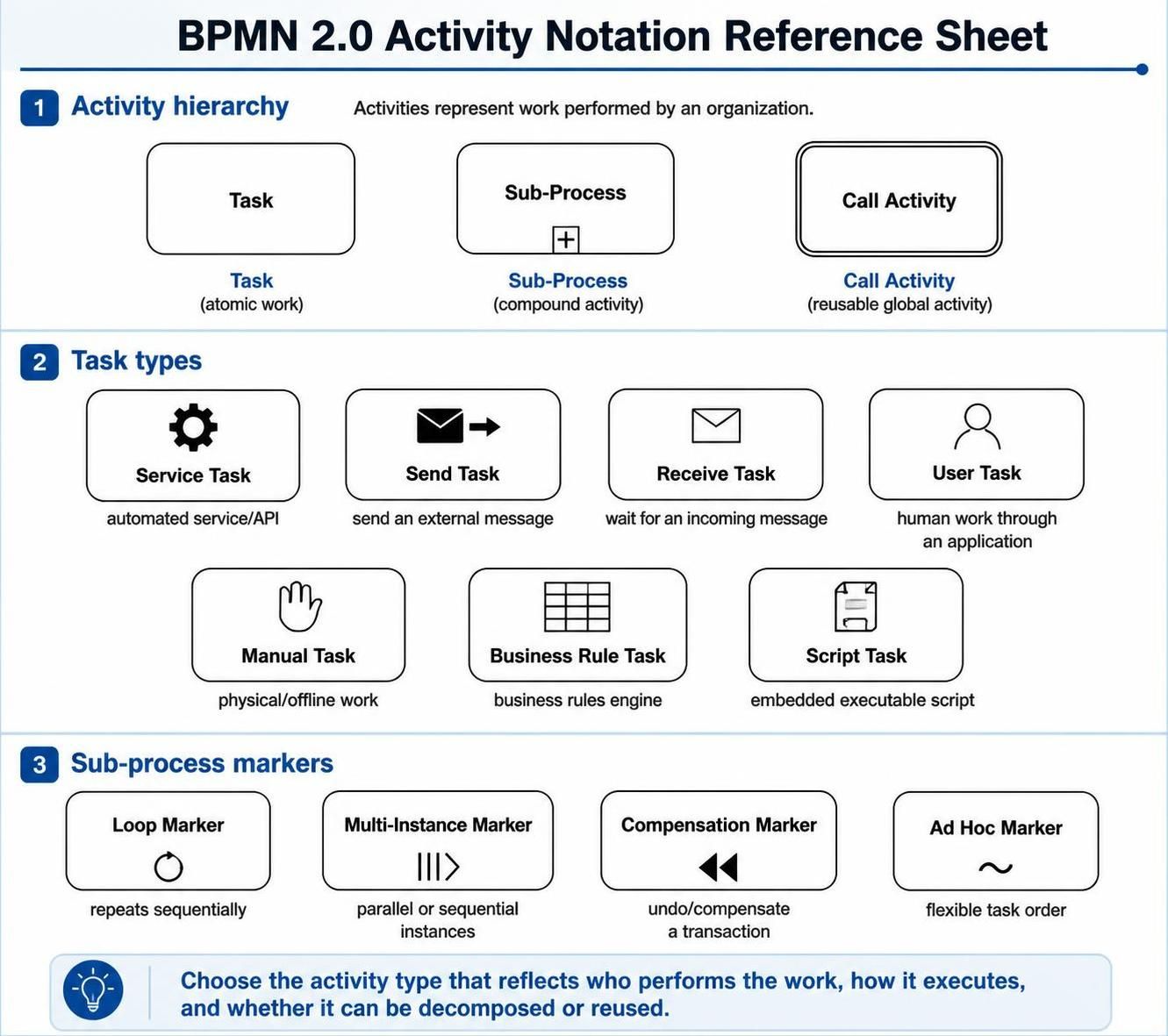
Creating accurate and readable BPMN diagrams requires more than just knowing the symbols; it requires understanding when and how to apply specific activity types to reflect real-world business logic accurately. This guide provides a comprehensive overview of BPMN 2.0 activity types, complete with key concepts, practical examples, and insights into using Visual Paradigm to bring your process models to life.
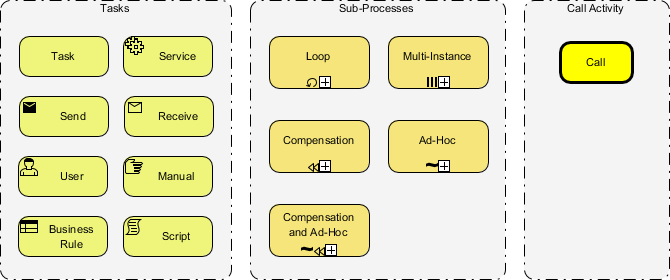
Understanding BPMN and Activities
What is BPMN?
BPMN is a standardized graphical notation designed to be intuitive for all stakeholders. It bridges the gap between technical implementation and business strategy by providing a set of visual elements that everyone can understand. This shared vocabulary facilitates effective communication and ensures that process workflows are designed correctly before implementation.
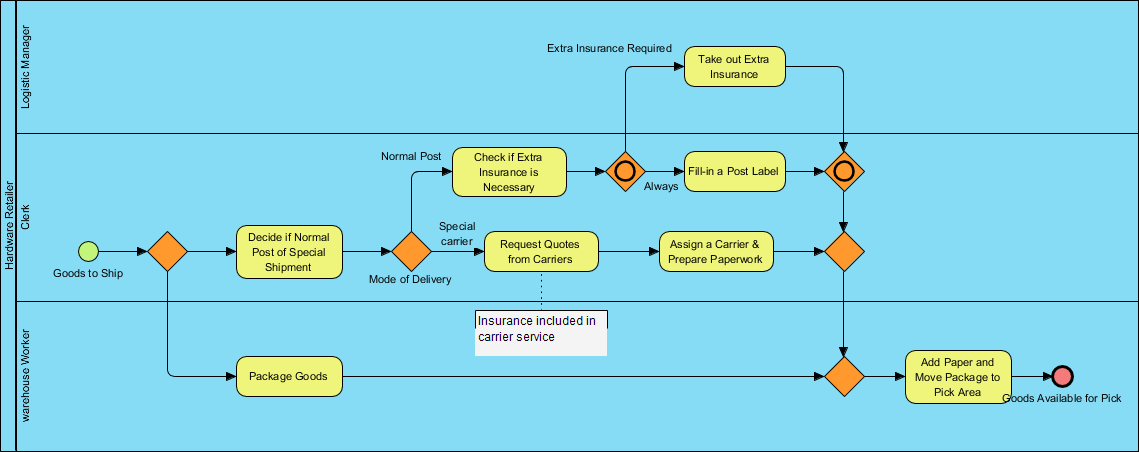
Defining BPMN Activities
In BPMN, an Activity is a generic term for work that a company or organization performs. Activities are categorized based on their granularity and behavior:
-
Atomic: Cannot be broken down further (Tasks).
-
Compound: Can be decomposed into smaller activities (Sub-Processes).
There are three primary categories of BPMN activities:
-
BPMN Task
-
BPMN Sub-Process
-
BPMN Call Activity
Deep Dive: BPMN Tasks
A Task is the most fundamental unit of work in BPMN. It represents an atomic activity where no further detail is shown in the current model. In BPMN 2.0, tasks are differentiated by “task types” to specify the nature of the work being performed.

Service Task
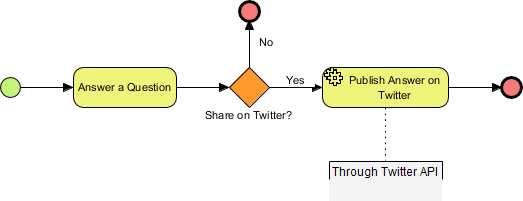
A Service Task represents work performed by an automated service, such as a web service, API call, or application function. It implies no direct human interaction during execution.
-
Key Concept: Automation and system-to-system interaction.
-
Example: Publishing content to social media platforms via an API.

Send Task
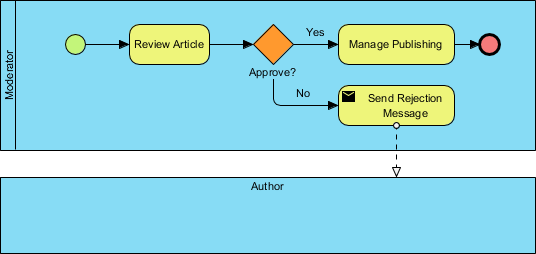
A Send Task is used when a message needs to be sent to an external participant or another pool. The task is considered complete once the message has been dispatched.
-
Key Concept: Outbound communication trigger.
-
Example: Sending a rejection notification to an author after article review.

Receive Task
Conversely, a Receive Task indicates that the process must pause and wait for an incoming message to proceed. Completion occurs only upon receipt of the expected message.
-
Key Concept: Process synchronization and waiting states.
-
Example: Waiting for a customer pickup request before initiating logistics.


User Task
A User Task represents work performed by a human actor, typically facilitated by a software application or user interface. This is distinct from manual tasks because it involves system support.
-
Key Concept: Human-in-the-loop with software assistance.
-
Example: A buyer approving an order through a procurement dashboard.


Manual Task
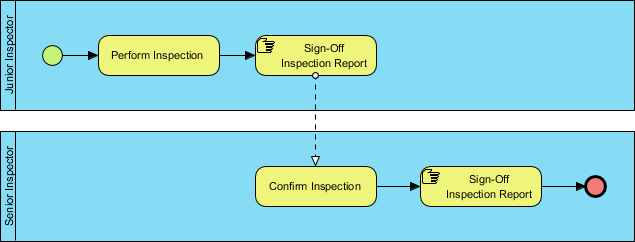
A Manual Task is performed entirely outside of any business process execution engine or software system. These are often physical actions or offline administrative duties.
-
Key Concept: Unmanaged, physical, or offline work.
-
Example: Physical inspection of goods or signing paper documents.

Business Rule Task
Introduced in BPMN 2.0, this task interacts with a Business Rules Engine (BRE). The process provides input data, and the BRE returns a decision or calculation result.
-
Key Concept: Decoupled decision logic and policy enforcement.
-
Example: Analyzing survey data to generate sentiment scores using predefined rules.


Script Task
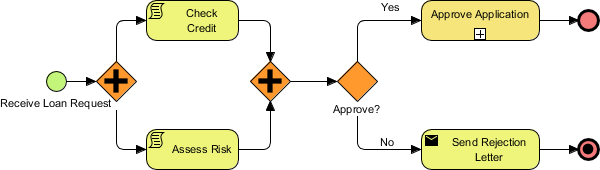
A Script Task contains executable code (e.g., JavaScript, Python) that is interpreted directly by the process engine. It is useful for simple calculations or data transformations without calling external services.
-
Key Concept: Embedded lightweight logic.
-
Example: Running a credit check script during loan approval.

Managing Complexity: BPMN Sub-Processes
Sub-processes are compound activities that contain other flows. They are essential for managing complexity, allowing modelers to hide detailed logic behind a single node and create hierarchical process views.
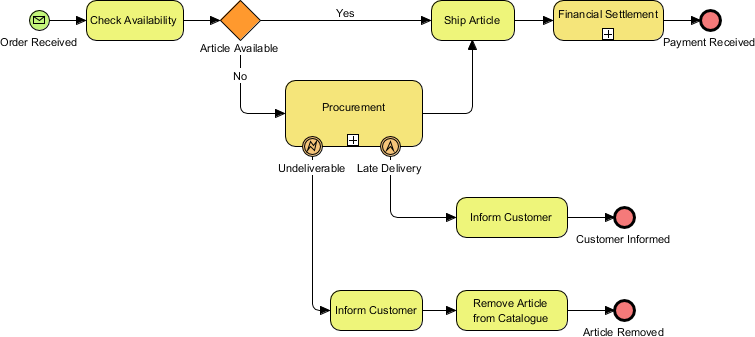
BPMN defines specific markers to indicate special behaviors for sub-processes:

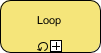
Loop Marker
Indicates that the sub-process repeats sequentially based on a condition.
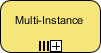
Multi-Instance Marker
Indicates that multiple instances of the sub-process run simultaneously (parallel) or sequentially. This is common for batch processing or handling multiple approvals at once.
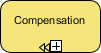
Compensation Marker
Represents a specialized sub-process triggered only if a previous transaction fails and needs to be undone or compensated.
Ad Hoc Marker
Represents a flexible collection of tasks where the order of execution is determined dynamically by the performers rather than a predefined flow. Useful for case management or unstructured problem solving.

Reusability: BPMN Call Activities
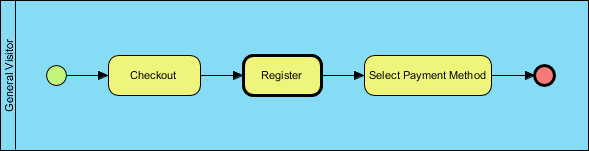
A Call Activity references a globally defined process or task that exists outside the current diagram. This promotes reusability and standardization across an organization. Instead of redrawing a common procedure (like “Employee Onboarding”) in every department’s workflow, you simply call the global definition.
-
Key Concept: Modular design and enterprise-wide standardization.
-
Visual Indicator: Thick border around the activity shape.
Tooling Spotlight: Visual Paradigm
Modeling these activity types manually can be error-prone. Visual Paradigm serves as a comprehensive platform for creating standards-compliant BPMN 2.0 diagrams. Key features relevant to activity modeling include:
-
Intuitive Palette: Drag-and-drop access to all task types, sub-process markers, and call activities.
-
AI-Powered Generation: Convert natural language descriptions into structured BPMN diagrams, automatically selecting appropriate activity types.
-
Hierarchical Navigation: Seamlessly drill down from high-level sub-processes to detailed task flows.
-
Standards Compliance: Ensures your models adhere strictly to BPMN 2.0 specifications for interoperability.
Conclusion
Mastering BPMN activity types is fundamental to creating business process models that are both accurate and actionable. By distinguishing between automated service tasks, human-centric user tasks, and reusable call activities, organizations can capture the true nature of their operations. Tools like Visual Paradigm streamline this process, offering AI assistance and robust editing capabilities that allow analysts to focus on process optimization rather than notation mechanics. Whether documenting existing workflows or designing future states, a solid grasp of these activity types ensures your BPMN diagrams serve as effective blueprints for business success.
Recommended Resources
- Comprehensive Guide to BPMN, Visual Paradigm Tooling, AI, and Ecosystem: Official blog outlining VP AI ecosystem pillars with practical BPMN examples like Employee Onboarding.
- Mastering Business Process Modeling: Complete Guide to BPMN and AI-Powered Diagram Generation: Step-by-step guide on using the AI Business Process Diagram generator with feature comparisons.
- From Text to Process Flow: Hands-On Review of Visual Paradigm’s AI-Powered BPMN Generator: Independent review testing the generator across e-commerce, IT support, and banking scenarios.
- AI BPMN Diagram Generator: Professional BPD Tool: Product page explaining text-to-diagram features and standard compliance benefits in VP Desktop.
- BPMN、Visual Paradigm 工具、人工智能与生态系统全面指南: Chinese version of the comprehensive guide covering BPMN fundamentals and AI-driven generation case studies.
- From Text to Process Flow: Hands-On Review of Visual Paradigm’s AI-Powered BPMN Generator: Case study on hardware retailer shipment processes demonstrating AI handling of gateways and swimlanes.
- AI BPMN图生成器:专业BPD工具: Chinese product guide detailing AI generator capabilities including automatic pool and lane inclusion.
- 我的亲身体验:利用 Visual Paradigm 的 AI 驱动 BPMN 改变工作流程文档: First-hand review of AI generator performance on employee onboarding and loan approval scenarios.
- BPMN 2.0 商业流程建模新手实战指南:运用 Visual Paradigm 与 AI 轻松打造专业流程图: Practical tutorial with prompt writing strategies and advanced optimization techniques using AI Chatbot.
- BPMN 完整实战教程:Visual Paradigm 体验、AI 功能与生态系统深度指南: Article series covering AI-powered BPMN generator launch with deep dives into ecosystem integration.
This post is also available in Deutsch, Español, فارسی, Français, English, Bahasa Indonesia, 日本語, Polski, Portuguese, Ру́сский, Việt Nam, 简体中文 and 繁體中文.