
Introduction
In today’s rapidly evolving business landscape, organizations must continuously adapt to remain competitive. Business Process Improvement (BPI) is not just a buzzword; it is a strategic necessity. At the heart of successful BPI lies the ability to accurately understand where an organization currently stands and clearly envision where it needs to go. This is achieved through As-Is and To-Be process modeling.
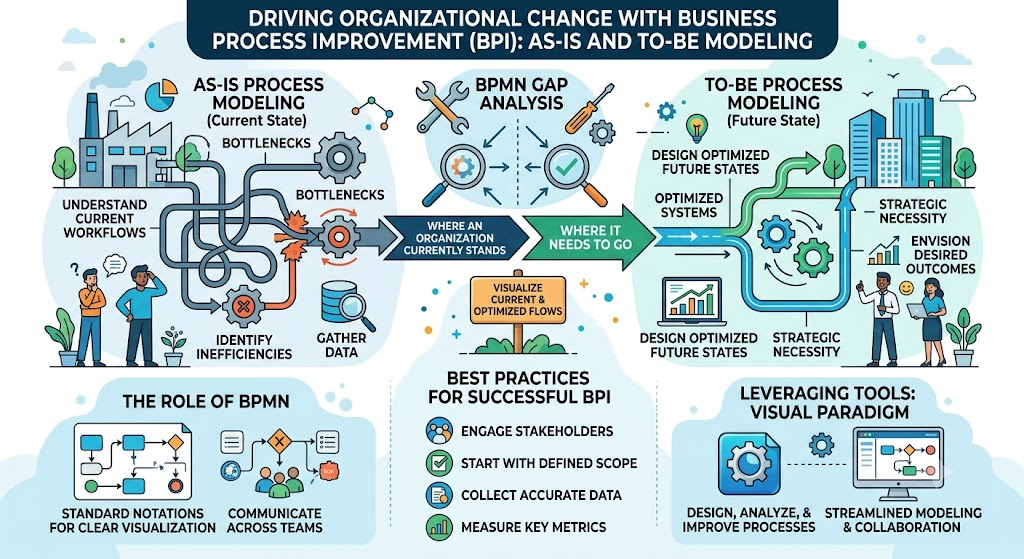
By leveraging standard notations like Business Process Modeling Notation (BPMN), companies can visualize current workflows, identify inefficiencies, and design optimized future states. This guide provides a comprehensive overview of As-Is and To-Be analysis, explores the role of BPMN in gap analysis, and highlights best practices and tools—specifically Visual Paradigm—to help you drive meaningful organizational change.
Understanding As-Is and To-Be Processes
Modeling As-Is and To-Be processes is a critical aspect of business process management that allows organizations to analyze current operations and design future improvements.
As-Is Process Modeling
Definition: The As-Is process represents the current state of a business process. It captures how the process operates in its existing form, including all activities, roles, inputs, outputs, and decision points.
Purpose:
-
Understanding Current Operations: Provides a clear picture of how processes function currently, identifying inefficiencies and bottlenecks.
-
Baseline for Improvement: Serves as a reference point for measuring the impact of changes made in the To-Be process.
Key Elements:
-
Activities: Tasks performed within the process.
-
Roles: Individuals or groups responsible for executing tasks.
-
Flow: The sequence of activities and decision points, often represented visually using BPMN diagrams.
To-Be Process Modeling
Definition: The To-Be process outlines a future state of the business process after improvements have been implemented. It represents the desired outcome and how processes should function to achieve organizational goals.
Purpose:
-
Vision for Improvement: Helps stakeholders visualize what the improved process will look like and how it aligns with strategic objectives.
-
Guiding Change Initiatives: Acts as a roadmap for implementing changes, ensuring that all necessary steps are included to achieve the desired state.
Key Elements:
-
Enhanced Activities: Tasks may be restructured or optimized based on analysis from the As-Is model.
-
New Roles or Responsibilities: Changes in who performs tasks may be necessary to improve efficiency.
-
Streamlined Flow: The sequence of activities may be altered to eliminate redundancies or improve speed.
Comparison Table
| Feature | As-Is Process | To-Be Process |
|---|---|---|
| Focus | Current state | Future state |
| Objective | Identify inefficiencies | Design improvements |
| Visualization Tool | BPMN diagrams | BPMN diagrams |
| Stakeholder Involvement | Current users and roles | Future users and roles |
| Outcome Measurement | Baseline for performance metrics | Target performance metrics |
The Strategic Importance of As-Is and To-Be Analysis
Business process improvement (BPI) is a strategic approach that organizations employ to enhance their processes, increase efficiency, and achieve better outcomes. A crucial part of BPI is the analysis of current processes (As-Is) compared to desired future processes (To-Be).
Why is As-Is and To-Be Analysis Important?
-
Identifying Inefficiencies: As-Is analysis helps organizations pinpoint specific areas that require improvement. Understanding current pain points is vital for effective change.
-
Setting Clear Objectives: By defining the To-Be state, organizations can set clear, measurable goals for what they wish to achieve through process improvement.
-
Alignment with Strategic Goals: This analysis ensures that process improvements align with broader business objectives, enhancing overall performance and customer satisfaction.
-
Facilitating Change Management: Having a clear understanding of the current and desired states helps in managing change effectively, reducing resistance from stakeholders.
When to Conduct As-Is and To-Be Analysis?
-
Before Implementing New Technologies: When integrating new systems or software, understanding existing processes is crucial to ensure compatibility and optimize functionality.
-
During Organizational Change: Mergers, acquisitions, or restructuring often necessitate a reevaluation of processes to ensure alignment with new goals.
-
When Facing Performance Issues: If an organization is experiencing declining performance or customer dissatisfaction, an analysis can uncover root causes.
-
Periodically for Continuous Improvement: Regularly revisiting processes helps maintain efficiency and adapt to changing market conditions.
Who Should Be Involved?
-
Process Owners and Stakeholders: Individuals who own or are significantly impacted by the processes should be actively involved to provide insights and perspectives.
-
Cross-Functional Teams: Engaging representatives from different departments fosters collaboration and ensures a holistic view of processes.
-
Business Analysts: Skilled analysts can facilitate the process, using tools and methodologies to map current processes and design future states.
-
Leadership: Involvement from top management is crucial for support and to ensure that the analysis is aligned with strategic objectives.
How to Conduct As-Is and To-Be Analysis: A Step-by-Step Guide
1. Define Objectives
Clearly outline what you aim to achieve with the analysis. This could include reducing costs, improving quality, or enhancing customer satisfaction.
2. Map the As-Is Process
-
Gather data through interviews, document reviews, and observations.
-
Create flowcharts or diagrams to visualize current workflows.
-
Identify pain points, redundancies, and bottlenecks.
3. Analyze the As-Is State
-
Evaluate the efficiency and effectiveness of current processes.
-
Use techniques such as root cause analysis to understand underlying issues.
4. Design the To-Be Process
-
Brainstorm potential improvements and innovations.
-
Develop new process maps that illustrate improved workflows.
-
Consider the use of technology to enhance efficiency.
5. Evaluate the To-Be Process
-
Assess the feasibility of the proposed changes.
-
Involve stakeholders for feedback and validation.
6. Implement Changes
-
Develop an implementation plan that includes timelines, responsibilities, and resource allocation.
-
Communicate changes to all affected employees and provide necessary training.
7. Monitor and Review
-
After implementation, continuously monitor the new processes to ensure they meet objectives.
-
Be prepared to make adjustments based on feedback and performance metrics.
Case Study: Business Process Improvement at XYZ Manufacturing
XYZ Manufacturing, a mid-sized company specializing in automotive parts, faced challenges with production efficiency and customer satisfaction. Despite a strong market presence, the company experienced delays in order fulfillment and high operational costs. To address these issues, XYZ Manufacturing decided to embark on a Business Process Improvement (BPI) initiative using As-Is and To-Be analysis.
Objectives
The primary objectives of the BPI initiative were to:
-
Reduce Lead Time: Decrease the time taken from order placement to delivery.
-
Improve Quality: Enhance product quality by minimizing defects.
-
Increase Customer Satisfaction: Achieve a higher customer satisfaction score through timely deliveries and quality products.
As-Is Analysis
Data Gathering
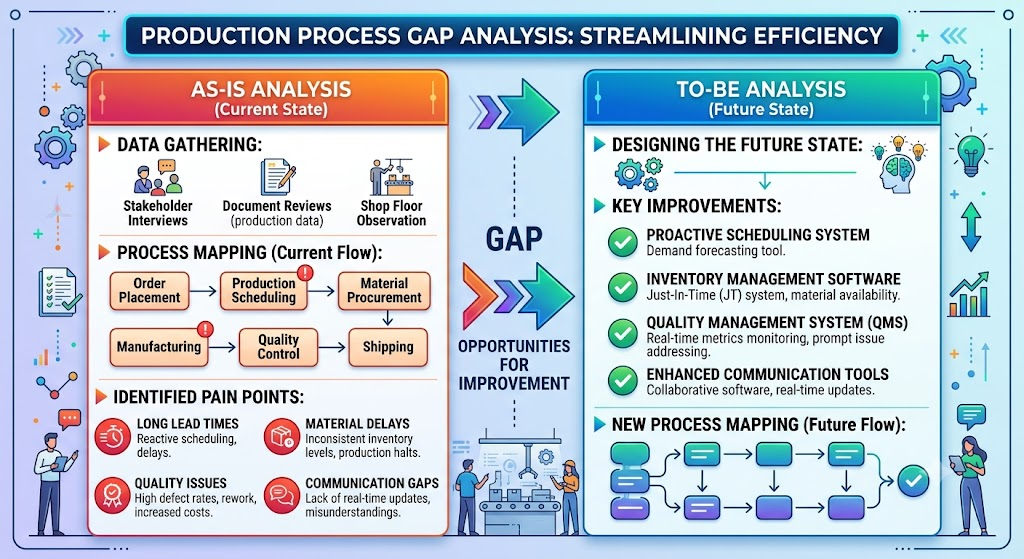
The project team conducted interviews with key stakeholders, including production managers, quality control personnel, and logistics staff. They also reviewed production data and observed workflows on the shop floor.
Process Mapping
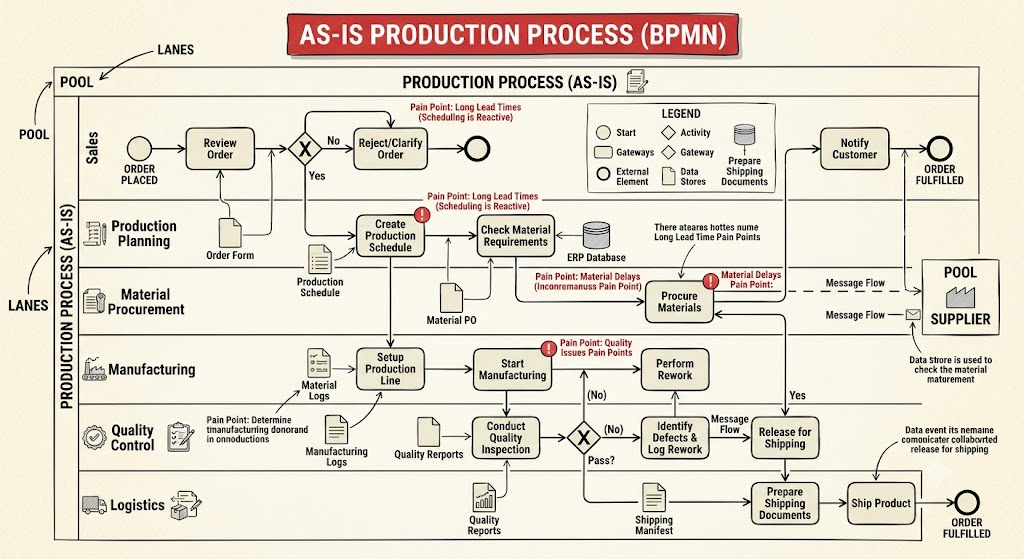
The team created flowcharts to visualize the current production process, which consisted of the following steps:
-
Order Placement
-
Production Scheduling
-
Material Procurement
-
Manufacturing
-
Quality Control
-
Shipping
Identified Pain Points
During the As-Is analysis, several inefficiencies were identified:
-
Long Lead Times: Production scheduling was reactive rather than proactive, leading to delays.
-
Material Delays: Inconsistent inventory levels resulted in production halts.
-
Quality Issues: High defect rates during manufacturing caused rework and increased costs.
-
Communication Gaps: Lack of real-time updates between departments led to misunderstandings and delays.
To-Be Analysis
Designing the Future State
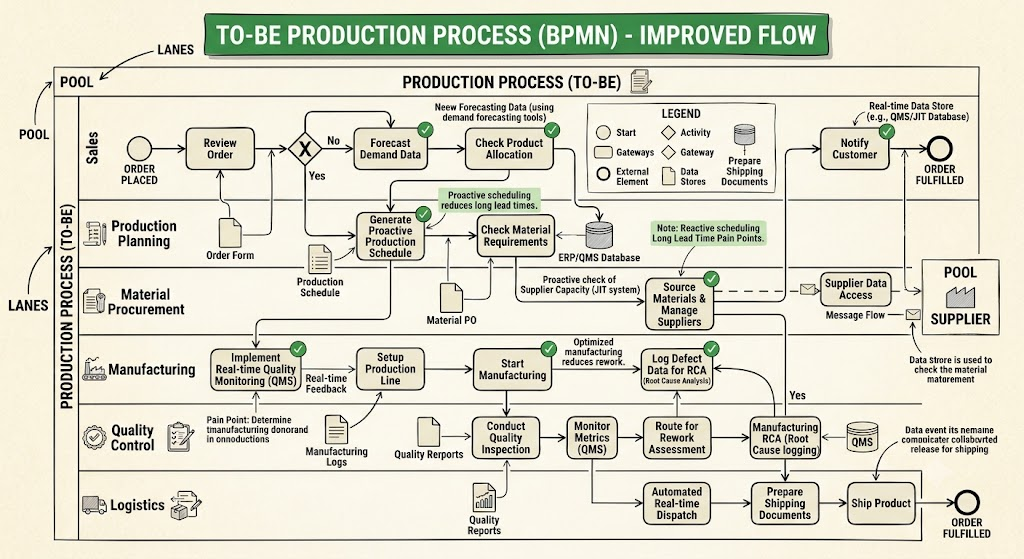
Based on the findings from the As-Is analysis, the team held brainstorming sessions to design the To-Be process. Key improvements included:
-
Proactive Scheduling System: Implementing a demand forecasting tool to improve production scheduling.
-
Inventory Management Software: Adopting a just-in-time inventory system to ensure materials were available when needed.
-
Quality Management System (QMS): Introducing a QMS to monitor quality metrics in real-time and address issues promptly.
-
Enhanced Communication Tools: Utilizing collaborative software to provide real-time updates across departments.
New Process Mapping
The To-Be process was mapped out to reflect the proposed changes, emphasizing streamlined workflows and reduced handoffs.
Implementation and Results
Action Plan
An implementation plan was developed, outlining a phased approach over six months, assigning responsibilities, and providing training sessions for staff on new systems and processes.
Performance Metrics
After six months, XYZ Manufacturing evaluated the impact of the BPI initiative:
-
Lead Time Reduction: Lead times decreased by 30%, leading to faster order fulfillment.
-
Quality Improvement: Defect rates dropped by 40%, significantly reducing rework costs.
-
Customer Satisfaction: Customer satisfaction scores improved from 75% to 90%.
Business Process Modeling and Gap Analysis with BPMN
Business process modeling is a means of representing the business activities, the information flow, and decision logic in business processes. It externalizes business knowledge to agree and bind all stakeholders in a representation that is shared within an organization and reflected in its information systems.
Business Process Management vs. Modeling vs. Analysis
It is easy to get confused by terminology. Here is the distinction:
-
Business Process Modeling: The activity of representing processes of an enterprise so that the current process may be analyzed, improved, and automated. Typically performed by business analysts.
-
Business Analysis: The discipline of identifying business needs and determining solutions.
-
Business Process Improvement (BPI): A continual process aiming at attaining efficiency by reiterating processes. You move from the problematic As-Is state to the improved To-Be state.
-
Business Process Reengineering (BPR): A radical approach aiming to redesign the process almost from scratch based on customer value propositions.
-
-
Business Process Management (BPM): A holistic management approach focused on aligning all aspects of an organization with client needs, promoting effectiveness, efficiency, and continuous improvement.
The BPM Lifecycle (DMEMO)
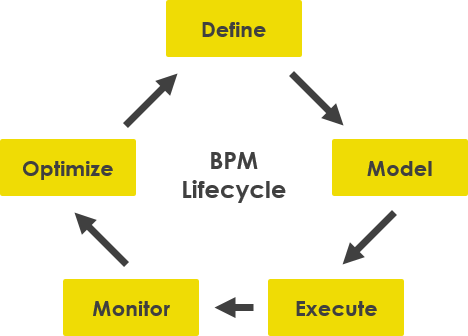
A standard BPM methodology follows these life-cycle phases:
-
Define: As-is and to-be modeling.
-
Model: Analyze the process, perform “what if” analysis, and compare simulations to determine optimal improvements.
-
Execute: Select and implement improvements.
-
Monitor: Periodically monitor the process against established metrics such as SLAs or defect rates.
-
Optimize: Iterate for continuous improvement.
Applying As-Is and To-Be Analysis with BPMN
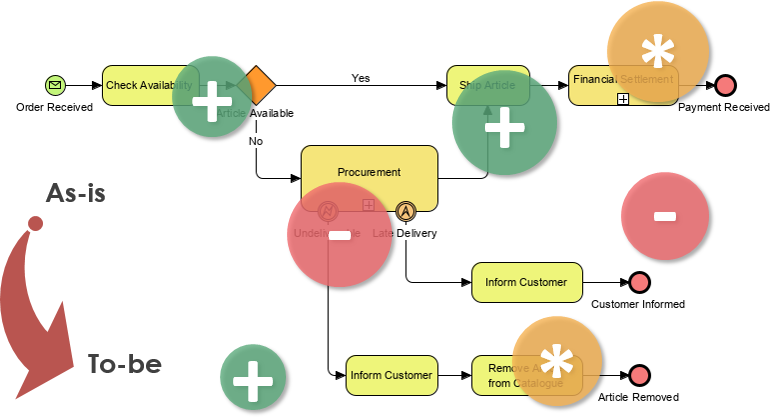
One effective technique for transforming vision into results is to develop and populate As-Is and To-Be BPMN diagrams. The As-Is diagram describes the present state of the organization’s process, culture, and capabilities. The To-Be diagram describes the future state. Studying the difference between these two states identifies the “gap,” which is central to any business process reengineering or improvement initiative.
Example: Online Shop Process
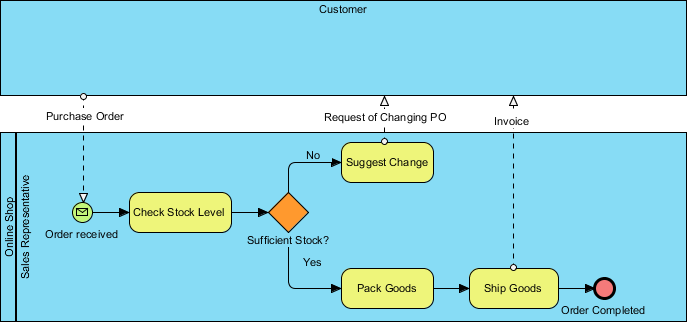
Capture the Current Process (As-Is)
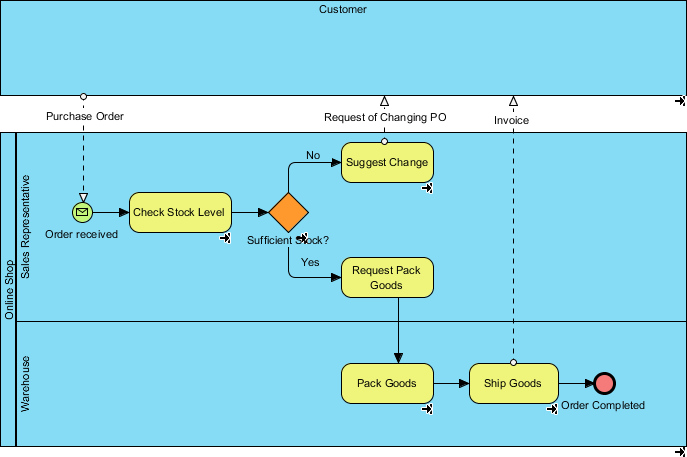
In this example, the process begins when a sales representative receives a purchase order. They check stock levels. If stock is sufficient, they pack and ship the items with an invoice. If stock is insufficient, they suggest the customer amend the order.
Create Improvement Actions (To-Be)
Assume the business has grown and now utilizes a warehouse. The To-Be process is redesigned to better allocate these new resources, streamlining the workflow.
Recommended Tool: Visual Paradigm for BPMN
Visual Paradigm is recognized as one of the leading tools for creating BPMN diagrams, offering a range of features that enhance the modeling experience.
Key Features of Visual Paradigm for BPMN
-
User-Friendly Interface: Intuitive drag-and-drop interface simplifies creation for beginners and experts alike.
-
Comprehensive BPMN Support: Supports all BPMN elements (events, activities, gateways, flows) for detailed and accurate models.
-
Collaboration Tools: Enables multiple users to work on the same diagram simultaneously, essential for distributed teams.
-
Integration Capabilities: Integrates with various development environments and tools.
-
Documentation and Reporting: Generates comprehensive documentation from diagrams for compliance and improvement initiatives.
-
Version Control: Tracks changes made to diagrams over time.
Advanced Editor Features
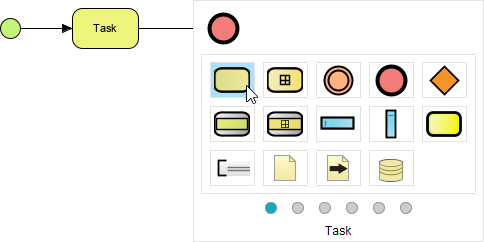
Resource Catalog
Create new shapes quickly and accurately through drag-and-drop.
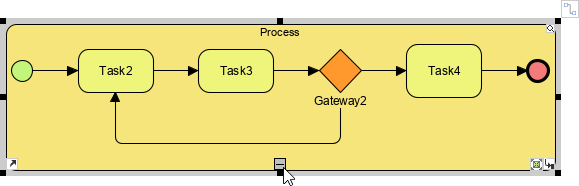
Expandable Sub-Process
Expand and collapse sub-process shapes to show or hide internal process content.
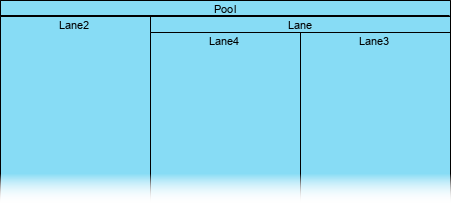
Nested Pools and Lanes
Create multiple levels of pools and lanes to reflect the actual organizational structure.
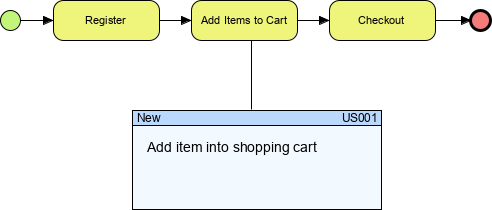
User Story Integration
Discover and record requirements from the business process model by creating and integrating user stories with tasks and sub-processes.
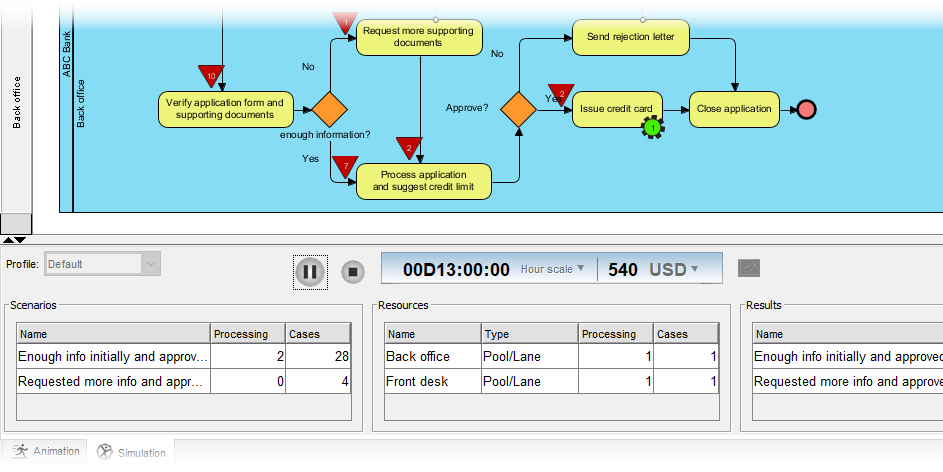
BPMN Process Simulation
Visually simulate the execution of the business process for studying resource consumption throughout a process.
Comparison with Other Tools
While there are many BPMN modeling tools available, Visual Paradigm stands out due to its combination of user-friendliness, comprehensive feature set, and strong support for collaboration.
-
Camunda: Focuses on executable BPMN models but may require more technical expertise.
-
Bizagi Modeler: Offers a free version but has limitations in advanced features.
-
Lucidchart: Known for simplicity but lacks some advanced BPMN-specific functionalities.
Best Practices for Success
-
Engage Stakeholders: Involve those directly impacted by both the As-Is and To-Be processes to gather insights and ensure buy-in.
-
Use BPMN Effectively: Utilize BPMN notation to clearly represent both states, making it easier for stakeholders to understand complex processes.
-
Iterate and Validate: Continuously review both models with stakeholders to validate assumptions and refine processes based on feedback.
Conclusion
As-Is and To-Be analysis is a fundamental component of business process improvement. By methodically evaluating current processes and designing improved future states, organizations can enhance efficiency, reduce costs, and achieve strategic goals. Leveraging robust tools like Visual Paradigm and adhering to structured methodologies like the DMEMO lifecycle ensures that process improvements are not only effective but also sustainable. Embracing this analysis as a regular practice allows organizations to remain agile and competitive in an ever-evolving business landscape.
References
- Visual Paradigm Official Documentation: Extensive documentation covering basic to advanced BPMN concepts and modeling techniques.
- Online Tutorials and Webinars: Resources designed to help users become proficient in using Visual Paradigm for BPMN modeling.
- BPMN Activity Types Explained: Guide explaining different types of activities in BPMN and their usage in process modeling.
- BPMN Orchestration vs Choreography vs Collaboration: Resource comparing different BPMN diagram types and their differences.
- How to Develop As-Is and To-Be Business Process: Tutorial on conducting As-Is and To-Be analysis for business process improvement.
Related posts:
 Business Process Model and Notation: A Definitive Overview for Teams Moving Beyond Basic Flowcharts
 Business Process Model and Notation: A Guide to Handling Exception Flows Without Breaking Logic
 Business Process Model and Notation: Why Your Current Diagrams Are Failing and How to Fix Them
 Business Process Model and Notation: From Concept to Execution in Modern Software Delivery Pipelines