


In the landscape of contemporary software engineering, the gap between abstract requirements and deployed code is bridged by structured orchestration. Business Process Model and Notation (BPMN) stands as a critical standard in this domain, translating complex business logic into executable workflows. When integrated into software delivery pipelines, BPMN transforms static requirements into dynamic, automated processes. This guide explores the mechanics of BPMN, its application in continuous integration and deployment, and the strategic advantages of formal process modeling in engineering teams.
Understanding BPMN Fundamentals 🧩
BPMN serves as a universal language for business analysts and developers. It provides a graphical representation of business processes, ensuring clarity across technical and non-technical stakeholders. Unlike coding languages that require specific syntax, BPMN relies on intuitive symbols to depict flow, logic, and decision points.
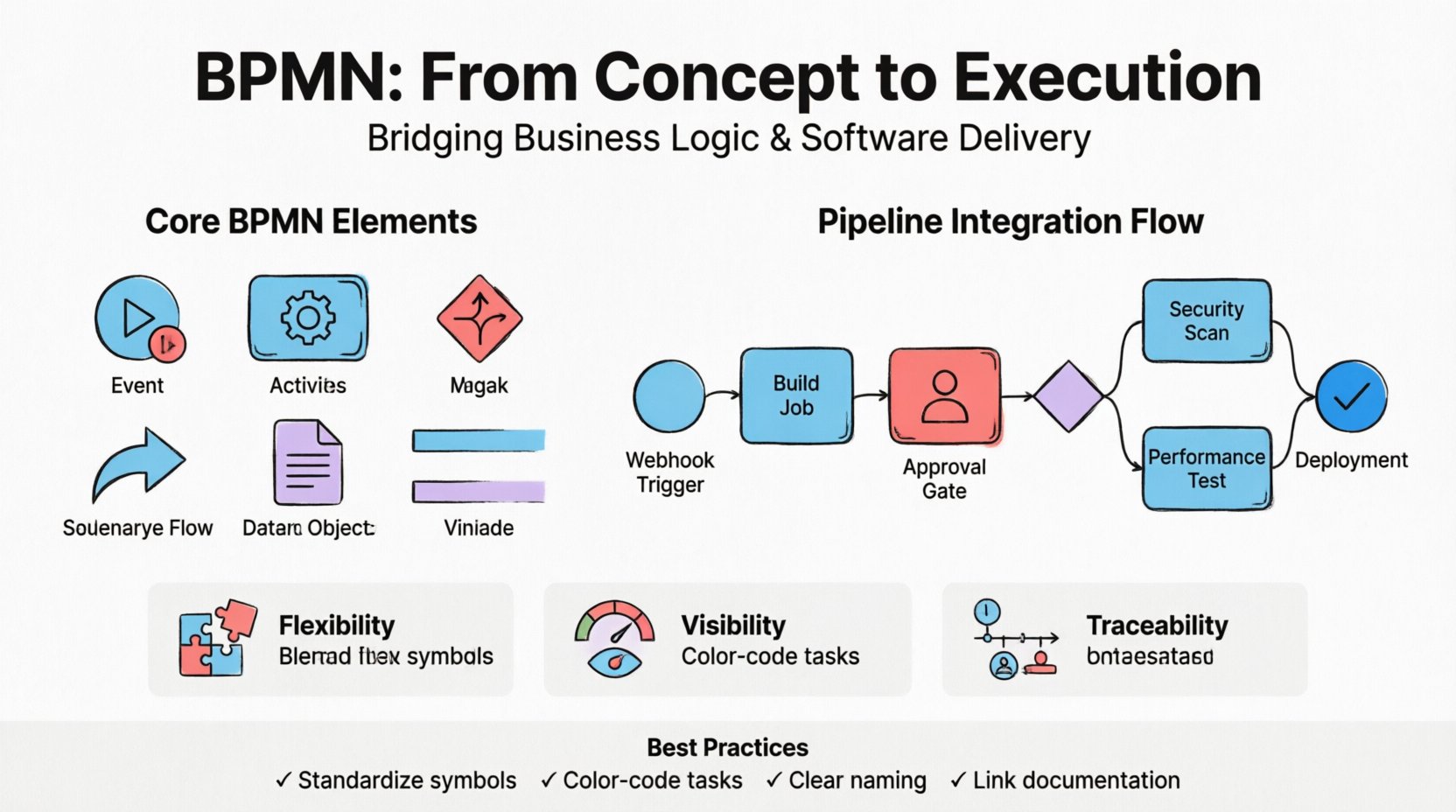
The standard defines a set of core elements that construct a process diagram:
- Events: Circles that indicate something happening (start, end, or intermediate). These trigger the flow.
- Activities: Rectangles representing work to be performed. These can be manual tasks or automated service calls.
- Gateways: Diamonds that control the flow of the process. They determine branching paths based on conditions.
- Sequence Flows: Arrows connecting elements, defining the order of execution.
- Data Objects: Documents or information used or produced during the process.
- Swimlanes: Containers that assign responsibilities to specific roles or systems.
By standardizing these visual components, teams avoid ambiguity. A developer understands exactly what condition triggers the next step, reducing the risk of misinterpretation during implementation.
Integrating BPMN into Software Delivery Pipelines 🔄
Modern software delivery pipelines rely on automation to move code from version control to production. BPMN fits into this ecosystem by modeling the orchestration layer. Instead of hardcoding logic into scripts, teams define the workflow structure in BPMN, which then executes within a process engine.
This separation of concerns offers several advantages:
- Flexibility: Business rules can change without altering the underlying codebase.
- Visibility: Stakeholders can view the status of a process in real-time through dashboards.
- Traceability: Every step in the pipeline is logged against the defined model.
Consider a typical deployment scenario. A developer pushes code to a repository. A webhook triggers the pipeline. A BPMN process engine receives the event. It routes the task to a testing environment, waits for a quality assurance sign-off, and then proceeds to the staging environment. If a test fails, the gateway directs the flow to a rollback sequence. This logic is visualized in the model, making the pipeline behavior transparent.
Mapping Process Elements to Pipeline Stages
| BPMN Element | Pipeline Equivalent | Function |
|---|---|---|
| Start Event | Webhook / Trigger | Initiates the workflow upon code push or schedule. |
| Service Task | Build / Compile Job | Executes automated compilation or packaging. |
| User Task | Approval Gate | Requires human intervention for release authorization. |
| Exclusive Gateway | Condition Check | Determines next path based on test results. |
| Parallel Gateway | Parallel Execution | Runs multiple jobs simultaneously (e.g., security scan and performance test). |
| End Event | Deployment Complete | Finalizes the process and notifies stakeholders. |
The Role of Human Collaboration in Automation 🤝
Automation is not merely about replacing humans; it is about augmenting them. BPMN excels at defining where human intervention is necessary within an automated flow. This is crucial in software delivery where regulatory compliance or risk management requires a sign-off.
In a BPMN model, a User Task represents a point where the system pauses and waits for a person. This could be a senior engineer reviewing a pull request or a product owner approving a feature for production. The model ensures that this step is not skipped. Once the human action is recorded, the process engine resumes the flow automatically.
This approach prevents “ghost approvals” where tasks are marked complete without proper review. It enforces a governance structure directly into the delivery mechanism. Furthermore, it allows for context transfer. The person performing the task sees the specific details of the change, the associated requirements, and the risk profile, all linked within the workflow context.
Governance, Compliance, and Audit Trails 📜
In regulated industries, software delivery is subject to strict auditing. Every change must be traceable. BPMN provides a structured framework for compliance. Because the process is modeled explicitly, the audit trail is not an afterthought but a native feature of the execution.
Key aspects of governance in this context include:
- Version Control of Processes: Just as code is versioned, process models must be. Changes to the workflow logic should be tracked, reviewed, and approved before deployment.
- Role-Based Access: The model defines who can perform specific tasks. This prevents unauthorized changes to critical deployment steps.
- Exception Handling: Models should account for failures. If a deployment fails, the process must define the recovery path clearly.
Without a formal model, audit logs become fragmented across different tools. With BPMN, the log is a record of the process instance moving through the defined states. This simplifies compliance reporting and reduces the time spent gathering evidence for audits.
Common Challenges in Implementation ⚠️
While the benefits are clear, integrating BPMN into software delivery pipelines introduces complexity. Teams must navigate technical and cultural hurdles to succeed.
Over-Modeling
A frequent mistake is creating overly complex diagrams. If a process model is too detailed, it becomes difficult to maintain. Developers may spend more time updating the diagram than writing code. The goal is to model the what and the why, not every minor technical detail.
- Focus on decision points and major milestones.
- Use sub-processes to encapsulate complex logic.
- Keep the high-level flow visible for stakeholders.
Absorption of Logic
Another pitfall is moving too much logic into the model. If the model becomes a script, it loses its flexibility. Business logic should remain in the model, while technical logic stays in the code. For example, a BPMN model should define that “Testing is required,” but the code should define how the test runs.
Tool Integration
Connecting the modeling tool to the execution engine requires configuration. Data mapping between the business process and the engineering tools is often manual. Teams must ensure that variables passed between the pipeline and the process engine are correctly typed and scoped.
Best Practices for Process Modeling 📐
To maximize the value of BPMN in software delivery, teams should adhere to established modeling conventions. Consistency ensures that diagrams are readable by any team member.
- Standardize Symbols: Ensure every team member uses the BPMN specification correctly. Avoid custom symbols unless absolutely necessary.
- Color Coding: Use colors to distinguish between automated tasks and manual tasks. This provides instant visual cues.
- Naming Conventions: Use clear, action-oriented names for tasks. Instead of “Task 1,” use “Run Security Scan” or “Approve Release”.
- Documentation: Link the diagram to the requirements. If a process changes, update the requirement documentation simultaneously.
Future Trends: Process Mining and AI 🌐
The evolution of BPMN is moving towards data-driven optimization. Process mining tools analyze logs from execution engines to compare the actual process flow against the modeled flow. Discrepancies highlight bottlenecks or deviations.
Artificial Intelligence is also influencing this space. AI can suggest optimizations in the workflow. For instance, if a specific gateway always leads to the same path, the model might be simplified. AI can also predict delays. By analyzing historical data, the system can warn stakeholders about potential delays in a deployment pipeline before they happen.
This shift from static modeling to dynamic optimization is significant. It allows organizations to continuously refine their delivery pipelines based on empirical evidence rather than assumptions.
Conclusion 🏁
Business Process Model and Notation provides a robust framework for managing complexity in software delivery. By visualizing the flow of work, teams gain clarity on dependencies, risks, and responsibilities. When integrated into modern pipelines, BPMN bridges the gap between business intent and technical execution.
Success requires discipline. Teams must avoid over-complicating models and ensure that human tasks are clearly defined. With proper governance and integration, BPMN becomes more than a diagramming tool; it becomes the backbone of a reliable, compliant, and efficient delivery system. The investment in modeling pays off in reduced errors, faster resolution of issues, and a culture of transparency across the organization.
This post is also available in Deutsch, Español, فارسی, Français, English, Bahasa Indonesia, 日本語, Polski, Portuguese, Ру́сский, Việt Nam, 简体中文 and 繁體中文.