


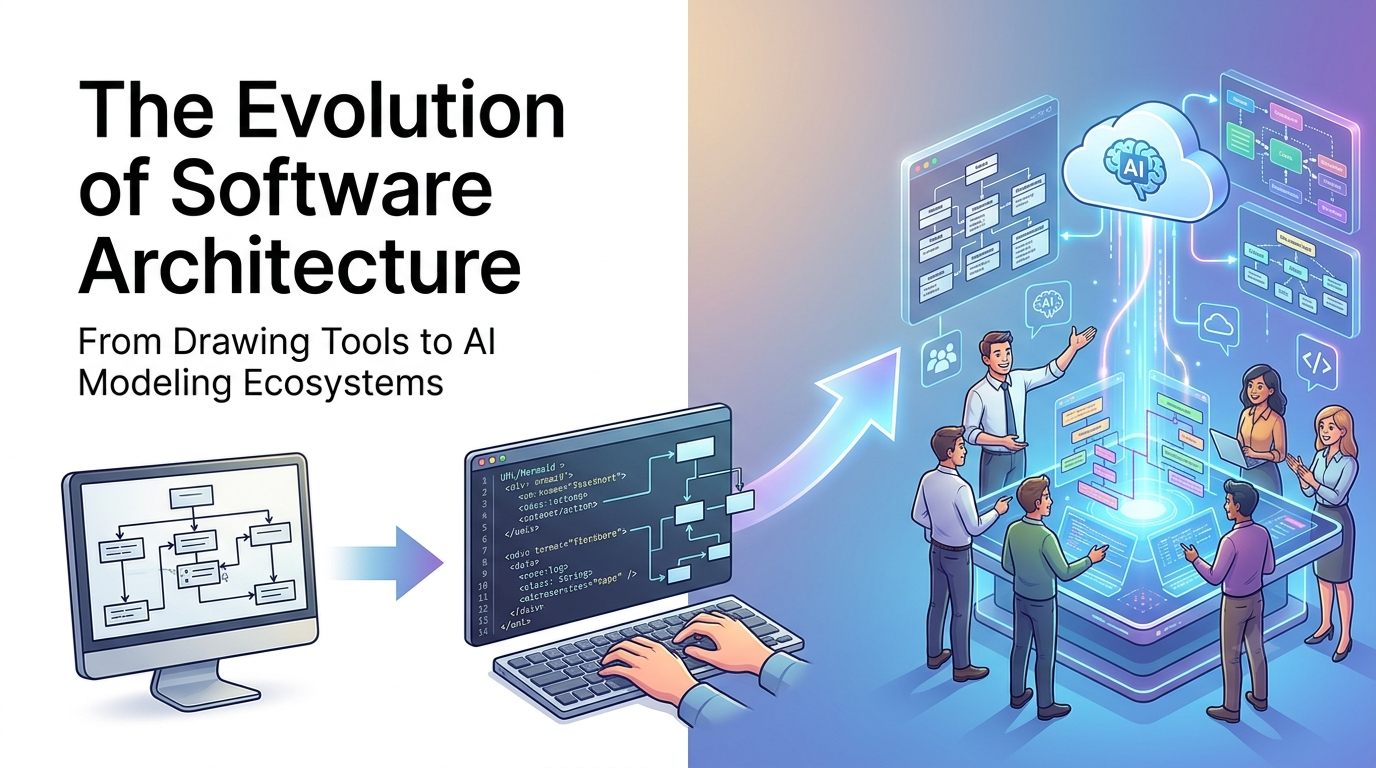
Software development has evolved dramatically over the past three decades, but one challenge has remained constant: how to effectively communicate system design. As systems grew from monolithic desktop applications to distributed cloud services and microservices architectures, the tools engineering teams used to visualize their designs had to keep pace.
We have transitioned from manual, static visual drawing tools to text-based diagramming, and now into modern AI-powered modeling ecosystems. Understanding this evolution helps engineering managers, CTOs, and software architects choose the right documentation strategy for modern development workflows.
Phase 1: The Era of Static Canvas & Drawing Tools
In the early days of software engineering, system design visualization was dominated by general-purpose drawing tools and static vector editors. Tools like Microsoft Visio, early CAD tools, and basic whiteboarding apps allowed architects to manually drag boxes onto a canvas, type labels, and connect them with line shapes.
The Limitations of Static Drawing Tools
- No Semantic Intelligence: Drawing tools treat diagrams as collections of generic visual shapes rather than structured software models. A rectangle is just a box, not a class or a database node.
- High Maintenance Costs: Whenever an architectural decision changed or new code was written, diagrams had to be manually redrawn, leading to rapid documentation decay.
- Zero Traceability: There was no connection between visual diagrams, project requirements, and actual source code files.
Phase 2: The Rise of Diagram-as-Code
To overcome the inefficiencies of manual canvas editing, developers shifted toward “Diagram-as-Code” solutions like PlantUML, Graphviz, and Mermaid.js. This era aligned visual documentation with modern developer practices by allowing architects to define diagram structures using plain text markup within Git repositories.
Key Benefits & Remaining Gaps
Diagram-as-Code brought version control, diff tracking, and quick code-driven rendering to technical documentation. However, it also introduced new challenges:
- Syntax learning curves meant non-technical stakeholders (such as product managers and business analysts) were excluded from reading or updating models.
- Complex systems resulted in bloated, unmaintainable markup files that were difficult to refactor.
- Diagrams remained isolated visual snapshots rather than connected enterprise models.
Phase 3: Modern AI-Powered Modeling Ecosystems
Today, software engineering is entering a new paradigm: integrated AI modeling platforms. Rather than choosing between manual drag-and-drop mechanics or raw markup syntax, modern engineering teams leverage artificial intelligence to bridge conversational requirement gathering, code generation, and visual modeling.
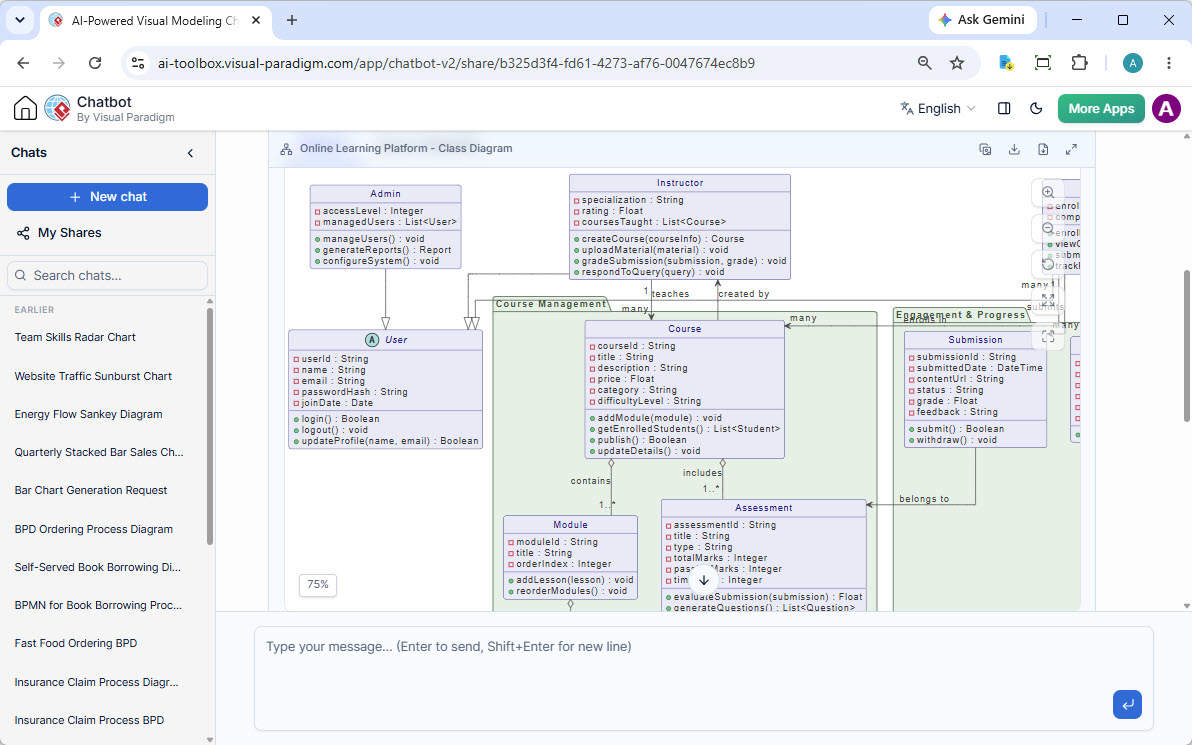
In an AI-powered architecture workflow, generative models handle the initial heavy lifting of translating natural language specifications into structured Unified Modeling Language (UML) diagrams, business process models (BPMN), or cloud architecture maps.
Why Engineering Teams are Transitioning to AI Platforms
- Conversational Requirements Analysis: Architects can describe architectural challenges in plain English and let AI generate initial sequence or class diagrams instantly.
- Multi-Format Flexibility: Developers can seamlessly switch between conversational AI prompts, code syntax (such as Visual Paradigm VPasCode), and visual canvas editing depending on their current task.
- Full-Lifecycle Model Traceability: Modern platforms link high-level AI-generated concepts to concrete data models, reverse-engineered source code, and living documentation.
Rather than relying on basic drawing utilities or isolated code scripts, enterprise development teams utilize an integrated AI UML tool and modeling platform to maintain absolute model consistency from initial sprint ideation through to system deployment.
Comparing the Eras of Software Visualization
| Capability | Static Drawing Tools | Diagram-as-Code | AI Modeling Ecosystems |
|---|---|---|---|
| Primary Input | Manual Drag & Drop | Text Syntax / Markup | Natural Language & Conversational AI |
| Model Intelligence | Low (Shapes only) | Medium (Syntax rules) | High (Semantic UML understanding) |
| Maintenance Effort | Very High | Moderate | Low (Automated & Conversational) |
| Stakeholder Accessibility | High (Visual) | Low (Developer-only) | High (Conversational & Visual) |
| System Traceability | None | Limited (Git-based) | Full (Requirements to Code) |
Conclusion: The Future of System Design
As software systems continue to grow in complexity, relying on outdated static drawing tools or isolated markup scripts creates friction and documentation drift. The future of software architecture lies in intelligent ecosystems where artificial intelligence accelerates the design process while professional modeling tools maintain structural integrity and team alignment.
This post is also available in Deutsch, Español, فارسی, Français, English, Bahasa Indonesia, 日本語, Polski, Portuguese, Ру́сский, Việt Nam, 简体中文 and 繁體中文.