


Enterprise architecture is often described as the bridge between business strategy and IT implementation. Yet, in many organizations, this bridge is riddled with gaps, misunderstandings, and silos. Business leaders speak in terms of value streams, capabilities, and outcomes. IT teams speak in terms of applications, servers, and code. Without a standardized framework, these two worlds often drift apart, leading to misaligned investments, redundant systems, and stalled initiatives. This is where ArchiMate enters the conversation. As a modeling language for enterprise architecture, it provides a common vocabulary that transcends departmental boundaries.
This guide explores how ArchiMate facilitates communication across teams. It is not merely a diagramming tool; it is a structured approach to describing, analyzing, and visualizing an organization’s architecture. By adopting this standard, organizations can ensure that everyone from the C-suite to the development floor speaks the same language. We will delve into the core layers, the importance of views and viewpoints, and practical strategies for implementation without relying on specific software tools.
🧩 The Foundation of a Shared Language
Communication breakdowns usually stem from ambiguity. When a business analyst defines a “capability,” they might mean a department function. When an architect defines the same term, they might mean a specific software module. ArchiMate resolves this by providing precise definitions for every concept used within the architecture. It standardizes the terminology so that a concept means the same thing regardless of who is discussing it.
Consider the scenario where a strategic initiative requires a new application. In a chaotic environment, the business team might request a “cloud solution” while the technical team interprets this as a specific set of microservices. The result is a mismatch in expectations. With ArchiMate, the request is mapped to a specific Business Application or Application Service. This clarity reduces the back-and-forth iterations and ensures that the final deliverable matches the original intent.
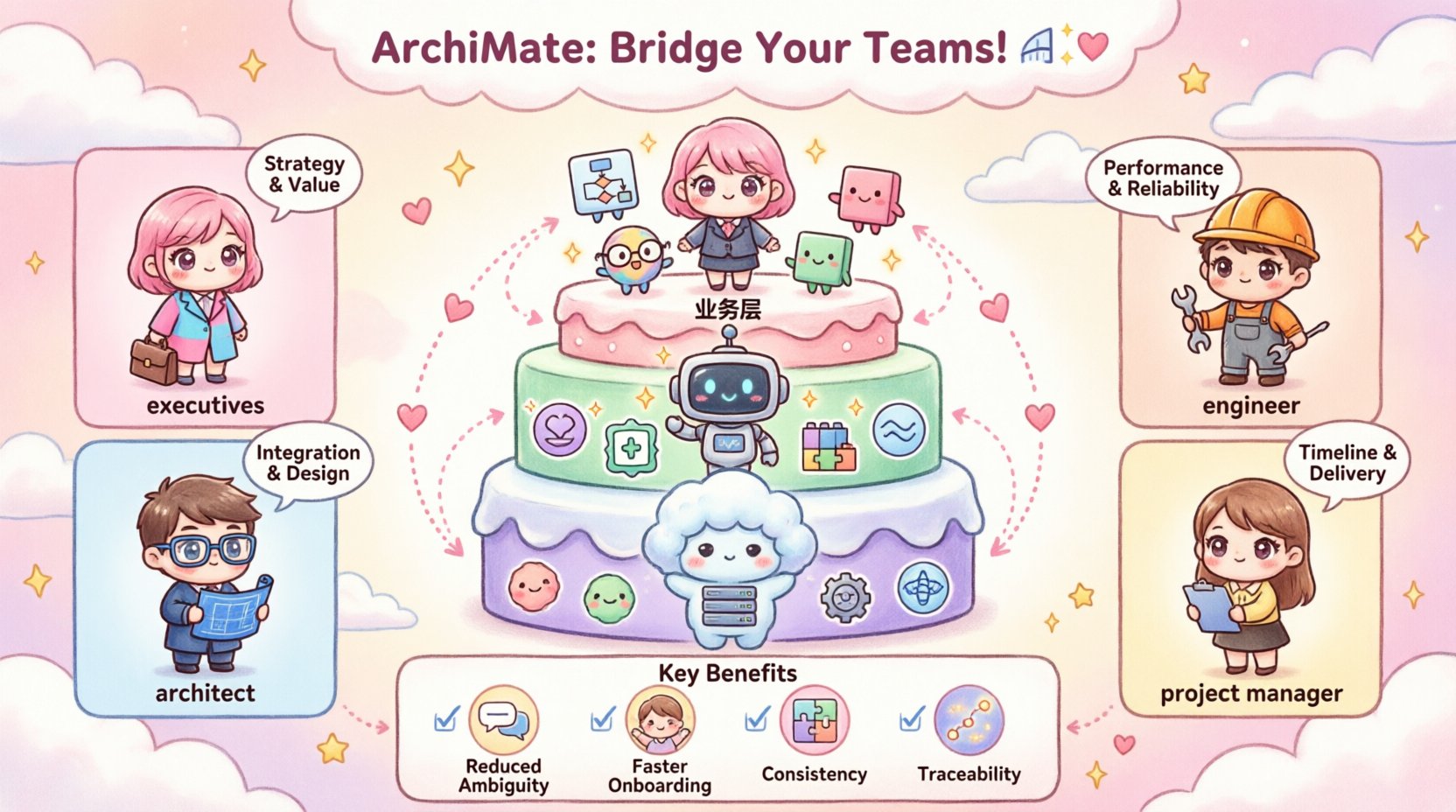
Key benefits of a shared language include:
- Reduced Ambiguity: Terms like “Process,” “Function,” and “Service” have distinct definitions.
- Faster Onboarding: New team members can understand the architecture without years of tribal knowledge.
- Consistency: Documentation remains consistent across different projects and departments.
- Traceability: You can trace a business goal all the way down to the underlying infrastructure.
🏛️ The Three Core Layers Explained
One of the most significant contributions of ArchiMate is its layered approach to architecture. This structure prevents the overwhelming complexity of trying to model everything at once. Instead, it separates concerns into three primary layers: Business, Application, and Technology. This separation allows different teams to focus on their specific areas while maintaining visibility into how they interact.
1. The Business Layer
This layer describes the enterprise from a business perspective. It focuses on what the organization does, not how it does it technically. Key concepts here include:
- Business Role: A person or group performing activities.
- Business Process: A set of related activities that produce a specific result.
- Business Function: A collection of activities that are necessary to achieve a certain goal.
- Business Object: Data or information that is created or used within a process.
By modeling the business layer, leaders can identify inefficiencies in workflows without getting bogged down in technical details. It answers the question: “What capabilities do we need to achieve our strategy?”
2. The Application Layer
The Application layer represents the software systems that support the business. It acts as the bridge between business logic and technical infrastructure. Key concepts include:
- Application Service: A set of functionality provided by an application.
- Application Component: A modular part of an application system.
- Application Interface: A point where an application connects with another system.
This layer is crucial for IT architects. It helps them understand which applications are critical for business processes and which are redundant. It also helps in planning migrations, such as moving from legacy monolithic systems to modern service-oriented architectures.
3. The Technology Layer
The Technology layer describes the physical and logical infrastructure that supports the applications. This is where the actual hardware and network reside. Key concepts include:
- Node: A physical or virtual computing resource.
- Device: A physical node, such as a server or router.
- System Software: Software that manages the node, like an operating system.
- Communication Network: The medium through which components communicate.
Understanding the technology layer ensures that the infrastructure can support the applications required by the business. It prevents situations where a critical application is deployed on hardware that cannot handle the load.
🔗 Bridging the Gap Between Stakeholders
While layers separate concerns, the true power of ArchiMate lies in the connections between them. These connections are called relationships. They show how the business layer drives the application layer, and how the application layer relies on the technology layer. This mapping creates a complete picture of the enterprise.
For example, consider a requirement to improve customer satisfaction. In the Business Layer, this might be a goal. In the Application Layer, this might require a new CRM system. In the Technology Layer, this might require a database upgrade. ArchiMate allows you to link these elements together explicitly. When a change occurs in the Technology Layer, you can immediately see the impact on the Business Layer.
This traceability is vital for risk management. If a server fails, you can trace the failure up to the specific business process that is affected. This allows for faster incident response and better prioritization of IT work.
Key Stakeholders and Their Focus:
- Business Executives: Focus on the Business Layer. They care about capabilities and value streams.
- Architects: Focus on the Application Layer. They care about integration and modularity.
- Engineers: Focus on the Technology Layer. They care about performance and reliability.
- Project Managers: Focus on the connections between layers. They care about delivery and timeline.
👁️ Views and Viewpoints for Specific Audiences
Presenting a complete model of an enterprise to every stakeholder is ineffective. A developer does not need to see the high-level business strategy, just as a CEO does not need to see the network topology. ArchiMate addresses this through views and viewpoints.
A viewpoint defines the concerns of a specific stakeholder group. It determines what aspects of the architecture are relevant to them. A view is the actual representation of the architecture tailored to that viewpoint. This ensures that communication is targeted and relevant.
Example Viewpoints:
- Strategic Viewpoint: For executives. Focuses on business goals, capabilities, and value streams.
- Operational Viewpoint: For process owners. Focuses on business processes and interactions.
- Development Viewpoint: For developers. Focuses on application components and interfaces.
- Deployment Viewpoint: For infrastructure teams. Focuses on nodes, devices, and networks.
By creating specific views, you reduce cognitive load. Stakeholders can digest information that matters to them without being distracted by irrelevant details. This increases engagement and decision-making speed.
🚀 Practical Application in DevOps and Strategy
The application of ArchiMate extends beyond static documentation. It is highly effective in dynamic environments like DevOps and strategic planning. In DevOps, the focus is on speed and reliability. Architecture models can help automate deployment pipelines by defining the dependencies between components.
In strategic planning, the model serves as a baseline. When the organization decides to pivot, the model can be updated to reflect the new direction. This allows for impact analysis. If the strategy changes to focus on mobile-first experiences, the model shows which applications and technologies need to be updated or replaced.
Integration with Agile:
- Backlog Management: User stories can be linked to architectural elements. This ensures that every feature supports a business goal.
- Sprint Planning: Teams can see how their work fits into the larger architecture, preventing technical debt accumulation.
- Release Management: Dependencies defined in the model help identify risks before deployment.
🛡️ Maintaining Consistency Over Time
One of the biggest challenges in architecture is maintaining the model as the organization evolves. If the model is not kept up to date, it becomes a source of misinformation rather than a tool for understanding. Consistency requires governance and a culture of documentation.
To maintain consistency, organizations should adopt the following practices:
- Regular Reviews: Schedule periodic reviews of the architecture model with key stakeholders.
- Change Management: Link architectural changes to the formal change management process. No significant change should occur without updating the model.
- Version Control: Treat architecture models like code. Use versioning to track changes over time.
- Training: Ensure that team members understand the language. Misuse of concepts leads to inconsistent models.
Consistency also means avoiding redundancy. If a business capability is defined in one project, it should be reused in another. This promotes standardization across the enterprise.
🚫 Common Pitfalls to Avoid
While ArchiMate is powerful, it is not without risks. Organizations often fall into traps that undermine its effectiveness. Understanding these pitfalls is crucial for success.
1. Over-Modeling
Trying to model every single detail is a recipe for failure. A model that is too complex will be ignored. Focus on the elements that drive decision-making. Less is often more.
2. Ignoring the Business Layer
Many IT teams jump straight to the Application or Technology layer. This disconnects technology from business value. Always start with the Business Layer to ensure alignment.
3. Lack of Stakeholder Engagement
Creating a model in a silo guarantees it will be wrong. Involve stakeholders early and often. Their feedback ensures the model reflects reality.
4. Tool Dependency
While tools help manage models, the focus should remain on the concepts. Do not let the tool dictate the architecture. The language is standard; the tool is just a container.
📊 Summary of Benefits
To summarize the advantages of using ArchiMate for cross-team communication, consider the following comparison of scenarios with and without a standardized language.
| Aspect | Without Standardized Language | With ArchiMate |
|---|---|---|
| Communication | Ambiguous terms lead to misunderstandings. | Clear definitions ensure shared understanding. |
| Alignment | IT and Business goals often diverge. | Traceability links IT to Business strategy. |
| Speed | Rework due to misinterpretation slows delivery. | Clear requirements reduce rework and delays. |
| Visibility | Impact of changes is unknown until too late. | Impact analysis is possible before changes. |
| Documentation | Documentation is scattered and inconsistent. | Documentation is centralized and standardized. |
💡 Final Thoughts on Architecture Communication
Effective communication is the backbone of successful enterprise transformation. It is not enough to have good technology or a solid strategy; these must be communicated clearly to those who execute them. ArchiMate provides the structure needed to translate complex architectural concepts into understandable visualizations.
By adopting this language, organizations can break down silos. Business leaders can see the technical implications of their strategy. IT teams can understand the business value of their work. This alignment leads to better decisions, faster delivery, and a more resilient organization.
The journey to architectural maturity takes time. It requires commitment from leadership and participation from teams. However, the payoff is a unified view of the enterprise that empowers everyone to contribute to the organization’s success. Start small, focus on the layers that matter most, and expand as the culture of shared understanding grows.
Remember, the goal is not just to create diagrams. The goal is to facilitate understanding. When the model serves the people, it becomes an asset. When it serves only itself, it becomes a burden. Choose to build a model that bridges gaps, connects teams, and drives value.
This post is also available in Deutsch, Español, فارسی, Français, English, Bahasa Indonesia, 日本語, Polski, Portuguese, Ру́сский, Việt Nam, 简体中文 and 繁體中文.