
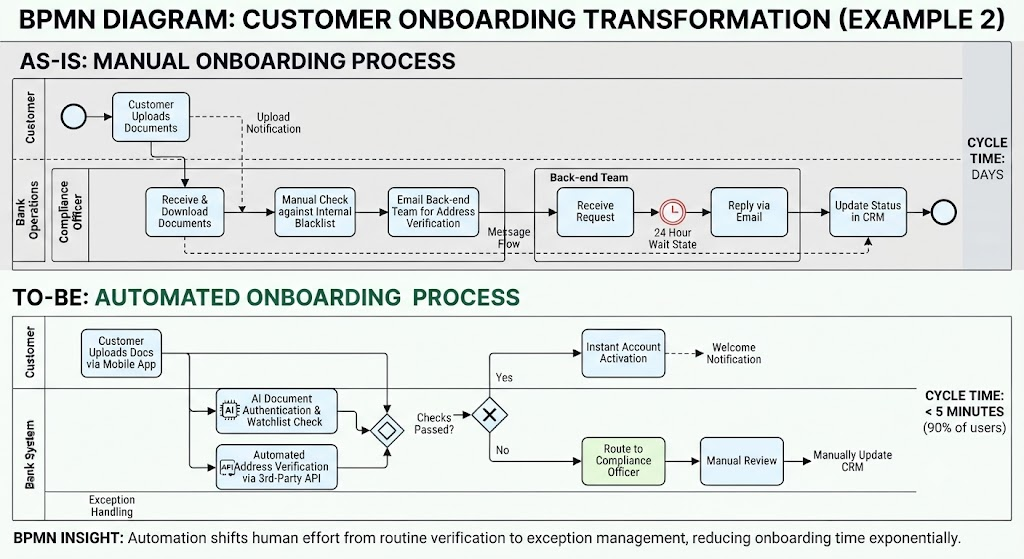
In the modern financial sector, the speed of customer onboarding is often the deciding factor between customer retention and churn. The transition from manual, days-long verification processes to AI-driven, instant activation is not just a technological upgrade—it is a fundamental architectural shift. This tutorial explores the design of a Customer Onboarding Transformation workflow, demonstrating how to model complex decision logic, parallel processing, and exception handling using BPMN 2.0 standards within Visual Paradigm.
Understanding the Architecture: From Manual to Automated
When modeling business processes, the “To-Be” state is where the true value of automation is realized. By analyzing the As-Is vs. To-Be architecture, we can see a clear reduction in cycle time and human intervention. The architecture relies on three core pillars:
- Customer Initiation: The process begins with the user uploading documents via a mobile application.
- Automated Verification: A “Bank System” lane executes parallel checks, utilizing AI for authenticity and third-party APIs for address verification.
- Exception Handling: A decision gate routes the flow based on the results of the automated checks.
The Parallel Gateway: Maximizing Efficiency
In the To-Be process, notice the diamond-shaped gateway with the double lines. In BPMN 2.0, this represents a Parallel Gateway (AND-split). This is a critical architectural pattern for performance.
Instead of checking the AI document authenticity and then checking the address (sequential), the system triggers both the AI Document Authentication and the Automated Address Verification simultaneously. This architectural decision is the primary driver for reducing the cycle time from “Days” to “Minutes.”
Modeling Decision Logic and Exception Handling
Automation is not foolproof. A robust architecture must account for failure states. This is modeled using a Exclusive Gateway (the diamond with an ‘X’ inside), which acts as the traffic controller for the workflow.
- The Decision Point: The system asks, “Checks Passed?”
- The Success Path (Yes): If the answer is true, the flow moves to Instant Account Activation, followed by a Welcome Notification.
- The Exception Path (No): If the answer is false, the flow diverts to the Route to Compliance Officer lane. This is the essence of “Exception Management”—humans are only involved when the machine cannot make a decision.
Visualizing the BPMN Flow in Visual Paradigm
When constructing this diagram in Visual Paradigm, it is essential to maintain the correct swimlane hierarchy. The separation between the Customer and the Bank System is crucial for understanding the boundary between the user interface and the backend logic.
The following pseudo-code representation illustrates the logic structure used to generate the diagram’s flow:
1. Start Event: Customer Uploads Docs
2. Parallel Split:
   - Branch A: AI Document Authentication & Watchlist Check
   - Branch B: Automated Address Verification via 3rd-Party API
3. Parallel Join (Wait for both branches to complete)
4. Exclusive Gateway (Decision):
   IF (Checks Passed == True):
       -> Activate Account
       -> Send Welcome Notification
   ELSE (Checks Passed == False):
       -> Route to Compliance Officer (Human Exception)
       -> Manual Review
       -> Update CRM
Best Practices for Automated Onboarding Models
When designing similar financial workflows, ensure that your “To-Be” diagram clearly distinguishes between the Bank System (automated tasks) and the Compliance Officer (human tasks). This visual distinction helps stakeholders immediately understand where the automation is saving time and where human oversight is still required for regulatory compliance.
Conclusion
By shifting the human effort from routine verification to exception management, as shown in this architectural model, organizations can reduce onboarding time to under 5 minutes for 90% of users. This diagram serves as a blueprint for digital transformation, illustrating how BPMN 2.0 can effectively model the logic behind AI-driven financial services.