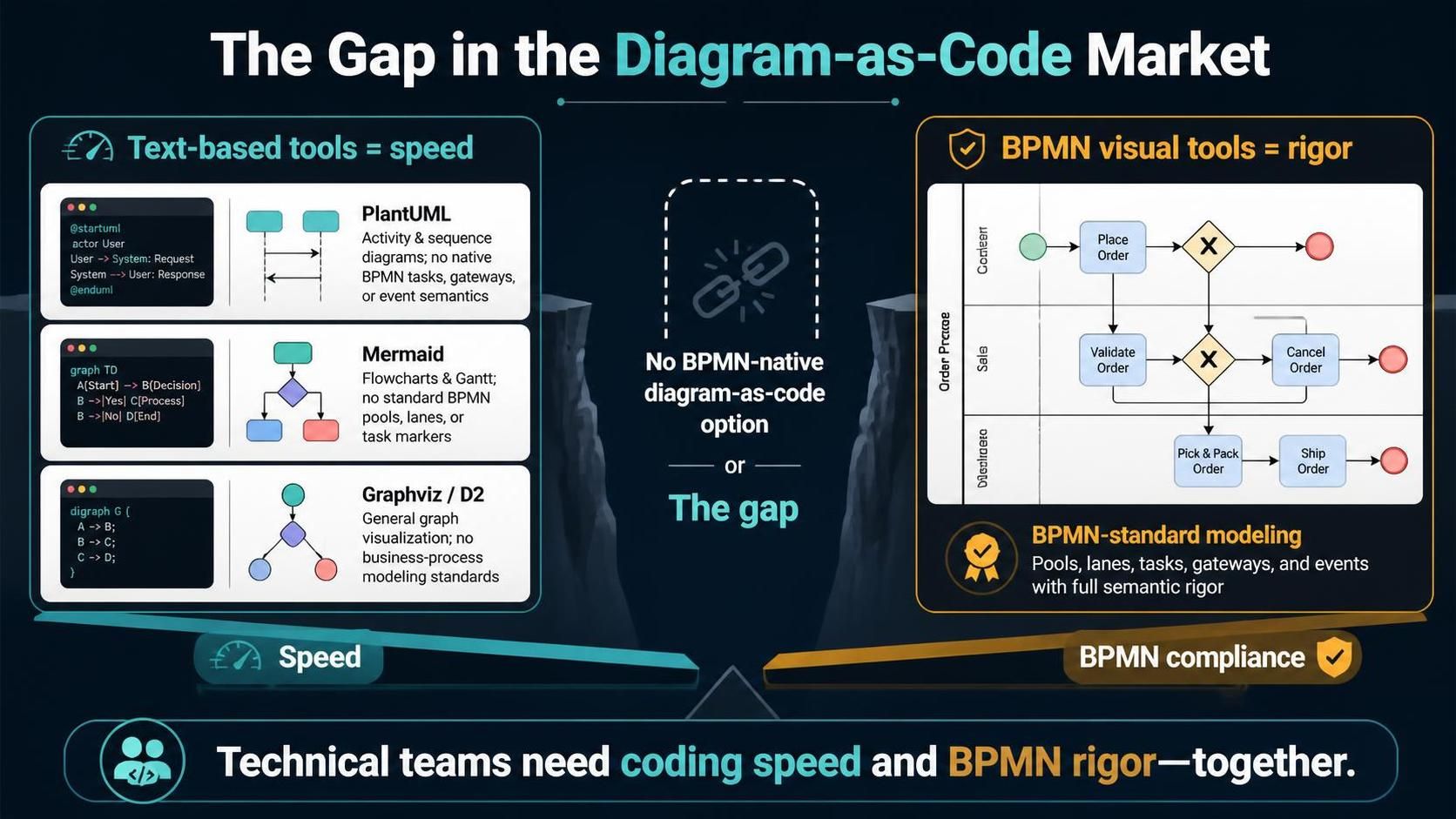
In the modern software development lifecycle, the choice between speed and rigor has historically been a false dichotomy. On one side, you have text-based tools like PlantUML, Mermaid, and Graphviz, which offer rapid iteration but lack the specific semantic depth of Business Process Model and Notation (BPMN). On the other side, you have traditional visual modeling tools that enforce strict BPMN standards but often lack the integration and speed required by agile technical teams.
This tutorial explores how to resolve this conflict using the Visual Paradigm (VP) AI Chatbot + VPasCode ecosystem. We will demonstrate how to model a complex business process with full BPMN compliance—including pools, lanes, and gateways—entirely through text, bridging the gap between coding velocity and business process accuracy.
The Challenge: The “Diagram-as-Code” Void
For years, technical teams have faced a significant gap in the market. While general graphing tools are excellent for high-level logic, they fail to capture the nuances required by business stakeholders.
- PlantUML: While powerful for sequence and activity diagrams, it lacks native BPMN task types (like Service Tasks vs. User Tasks), specific gateways, and event semantics.
- Mermaid: Great for flowcharts and Gantt charts, but it cannot render standard BPMN pools, lanes, or the specific markers required to distinguish between a “User Task” and a “Service Task.”
- Graphviz/D2: These are excellent for general graph visualization but are completely devoid of business process modeling standards.
Without a solution, teams are forced to choose: they can either have the speed of text-based coding or the compliance of visual BPMN, but rarely both.
The Solution: VPasCode Architecture
VPasCode is a specialized Domain Specific Language (DSL) designed to solve this problem. It allows you to write code that is semantically identical to a BPMN diagram, which the Visual Paradigm engine then renders into a compliant visual diagram.
By using the VP AI Chatbot, you can describe your process in natural language, and the system will generate the precise VPasCode syntax required to render the diagram correctly.
Step-by-Step: Modeling the “Order Process”
Let’s walk through creating a robust “Order Process” diagram. This example demonstrates the critical need for BPMN standards: we must separate the “Customer” from the “Sales” team and the “Warehouse” to show distinct responsibilities (Swimlanes).
1. Define the Structure (Pools and Lanes)
In standard BPMN, a “Pool” represents the overall process, while “Lanes” represent the specific actors. In VPasCode, we define this hierarchy explicitly. Notice how we use Pool and lane keywords to create the visual grid structure.
Process "Order Process" {
    Pool "Order Processing" {
        lane "Customer" {
            StartEvent "Start" -> Task "Place Order" -> Gateway "Check Order"
        }
        lane "Sales" {
            Task "Validate Order" -> Gateway "Decision Point"
        }
        lane "Warehouse" {
            Task "Pick & Pack Order" -> Task "Ship Order"
        }
    }
}
2. Implement BPMN Semantics (Gateways and Events)
This is where text-based tools often fail. A standard “diamond” shape can be confusing without semantics. Is it a split? Is it a join? In BPMN, we distinguish between Exclusive Gateways (X) and Inclusive Gateways (I). In our code, we define the logic explicitly.
For the “Decision Point,” we need to handle the logic: if the order is valid, we ship; if not, we cancel. VPasCode handles the routing logic automatically based on the flow.
Process "Order Process" {
    Pool "Order Processing" {
        lane "Customer" {
            StartEvent "Start" -> Task "Place Order" -> Gateway "Check Order"
        }
        lane "Sales" {
            Task "Validate Order" -> Gateway "Decision Point" -> [Yes] Task "Pick & Pack Order"
            Gateway "Decision Point" -> [No] Task "Cancel Order"
        }
        lane "Warehouse" {
            Task "Pick & Pack Order" -> Task "Ship Order" -> EndEvent "Done"
        }
    }
}
3. Refining the Visuals with VPasCode
The true power of VPasCode lies in its ability to handle the visual properties of BPMN elements while you focus on the logic. You can specify task types (User, Service, Manual) and event types (Start, Intermediate, End) directly in the text.
Here is the refined, production-ready VPasCode snippet that generates the diagram shown in the visual guide:
Process "Order Process" {
    Pool "Order Processing" {
        lane "Customer" {
            StartEvent "Start" -> Task "Place Order" -> Gateway "Check Order"
        }
        lane "Sales" {
            Task "Validate Order" -> Gateway "Decision Point"
            Gateway "Decision Point" -> [Yes] Task "Pick & Pack Order"
            Gateway "Decision Point" -> [No] Task "Cancel Order"
        }
        lane "Warehouse" {
            Task "Pick & Pack Order" -> Task "Ship Order"
        }
    }

    Gateway "Check Order" -> [Valid] Task "Validate Order"
    Gateway "Check Order" -> [Invalid] Task "Cancel Order"

    Task "Cancel Order" -> EndEvent "Cancel"
    Task "Ship Order" -> EndEvent "Ship"
}
Key Takeaways for Technical Teams
By adopting VPasCode, technical teams regain the ability to iterate quickly (using text editors or version control) while delivering diagrams that meet strict business standards. You no longer have to sacrifice the rigor of BPMN to keep up with the speed of code.