Modern AI models can perform impressive tasks. They can explain complex concepts, summarize documents, draft reports, generate ideas and help people solve problems through natural-language conversations.
However, when an organization introduces AI into its daily operations, a significant limitation quickly becomes apparent: a general-purpose AI model does not automatically know the organization itself.
It may understand common business practices, but it does not necessarily know the company’s internal policies, project history, product specifications, customer procedures, organizational terminology or decisions made by its employees.
This is why connecting an AI model to company knowledge matters. By making approved organizational information available to an AI application, businesses can move beyond general-purpose conversations and build AI-assisted workflows that are more relevant to their actual operations.
General AI Knowledge Is Not the Same as Company Knowledge
A language model learns patterns and information from the data used during its training. This gives it broad capabilities, but it does not mean that the model knows the latest or private information of every organization using it.
Consider a few examples:
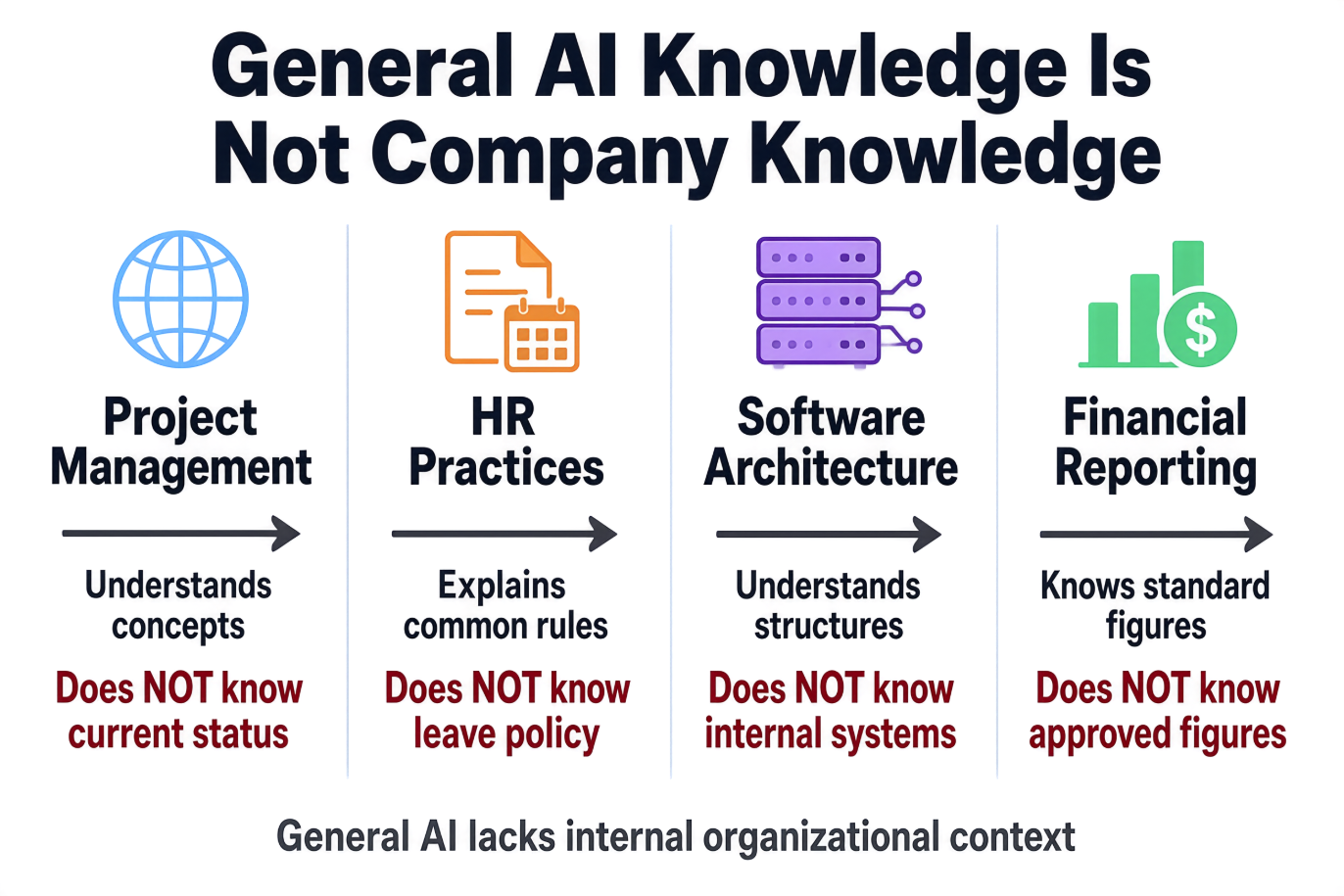
- A general AI model may understand project management, but it does not automatically know the status of your company’s current projects.
- It may explain common HR practices, but it does not necessarily know your organization’s leave policy or employee handbook.
- It may understand software architecture, but it does not automatically know how your company’s internal systems are structured.
- It may understand financial reporting, but it does not know your organization’s internal reporting procedures or approved figures.
These are not necessarily weaknesses in the model. They reflect the difference between general knowledge and information that belongs to a particular organization.
For business applications, the distinction is important. Employees often need answers that reflect how their organization actually works, not simply answers that would be reasonable for a typical business.
What Does It Mean to Connect AI to Company Knowledge?
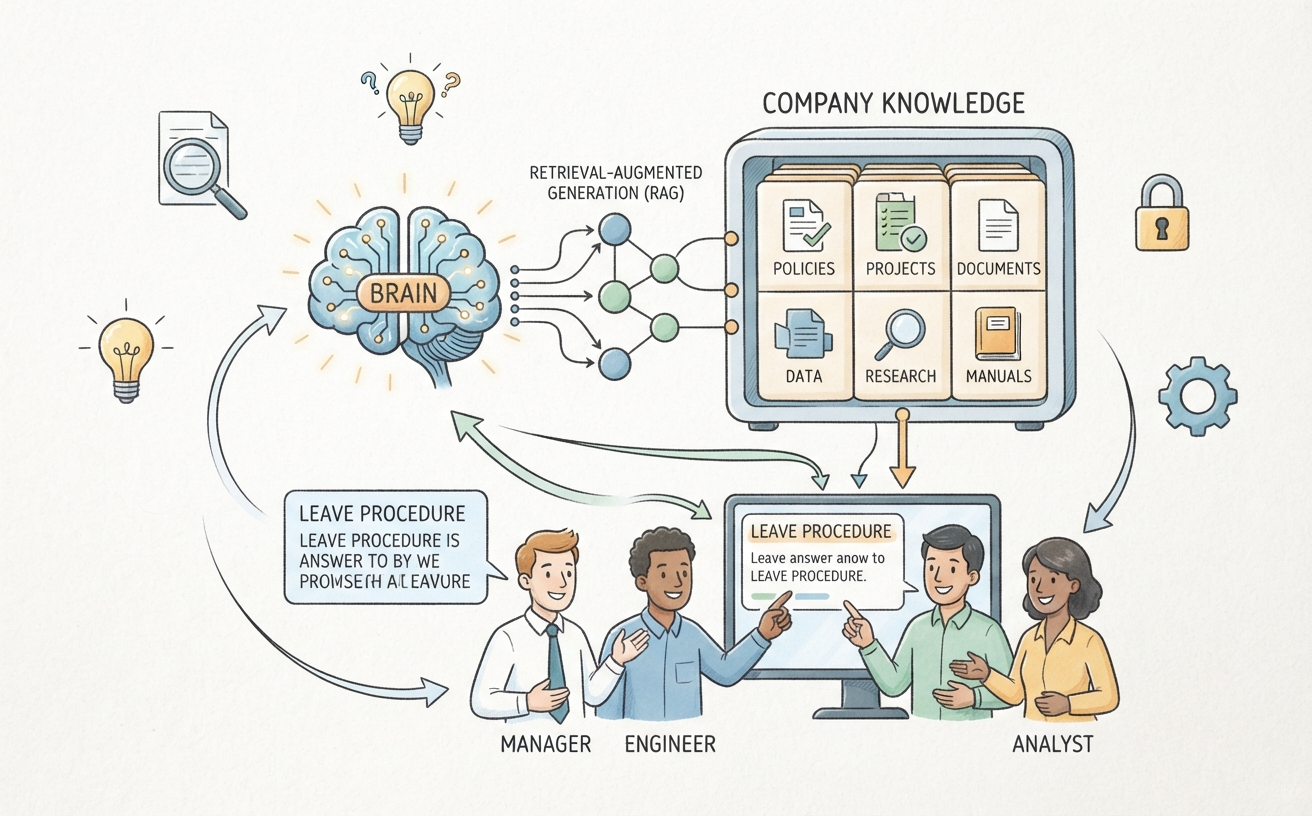
Connecting AI to company knowledge means giving an AI application access to selected organizational information so that it can use that information when assisting users.
Company knowledge can come from many sources, including:
- Policies, employee handbooks and internal guidelines.
- Business procedures and operational manuals.
- Project documents, requirements and meeting notes.
- Product specifications and technical documentation.
- Reports, research and business analysis.
- Frequently asked questions and internal knowledge articles.
- Architecture models, diagrams and other structured project information.
Instead of relying only on its general training, the AI application can retrieve or otherwise access relevant information from these sources when responding to a user.
One common approach is Retrieval-Augmented Generation (RAG). In a RAG-based application, the system searches connected knowledge sources for relevant information and supplies the retrieved content to the language model as context for generating an answer.
Other forms of integration may involve APIs, structured data queries, application connectors or specialized tools. The appropriate method depends on the information source and the task the AI application needs to perform.
Six Reasons Why Company Knowledge Integration Matters
1. Get Answers That Reflect How Your Organization Actually Works
Generic answers are not always useful in a business environment.
For example, an employee asking how to request annual leave does not need a general explanation of leave management. The employee needs to know the organization’s actual procedure, including the relevant approval steps and documentation.
When an AI assistant can retrieve the approved internal policy, it can provide guidance based on the organization’s documented practices.
The same principle applies to technical teams, project managers, customer support staff and other departments. Access to company knowledge helps the AI application address questions in the context of the organization rather than relying entirely on general assumptions.
2. Make Existing Business Information Easier to Find
Organizations accumulate large amounts of information over time. Unfortunately, useful knowledge is often scattered across shared drives, document repositories, project folders, emails, internal websites and individual notes.
Employees may spend considerable time locating the right document or identifying which section contains the information they need.
An AI assistant connected to selected knowledge sources can provide a more natural way to explore this information. Employees can ask questions using their own words instead of knowing the exact document title or search terminology.
For example, a project manager might ask:
Which requirements were agreed upon during the previous project review?
If the relevant meeting notes and requirements documents are available to the application, it may retrieve the passages that address the question and summarize the recorded information.
This makes existing knowledge more accessible without requiring employees to read every document from beginning to end.
3. Preserve Organizational Knowledge
Not all company knowledge exists in formal manuals. Some of it is accumulated through experience, project discussions, historical decisions and lessons learned.
When experienced employees leave or change roles, the organization may lose valuable context if that knowledge has not been documented.
Connecting AI to a well-maintained knowledge repository can help employees explore documented organizational history.
For example, a new team member might ask why a particular project decision was made, what challenges occurred during an earlier implementation or which lessons were recorded after a previous initiative.
The AI assistant can help locate relevant notes, reports and decision records, making organizational knowledge easier to reuse.
This does not mean AI can recover information that was never recorded. Businesses still need good documentation and knowledge-sharing practices.
4. Support More Consistent Workflows
Employees often perform similar tasks using information maintained in different documents and systems. Without easy access to approved guidance, different teams may interpret procedures differently or recreate work that has already been completed.
An AI application connected to company knowledge can help employees retrieve the same approved instructions, reference materials and templates.
For example, it might help employees:
- Find the correct procedure for handling a business request.
- Retrieve the latest approved report template.
- Summarize the documented steps in an internal workflow.
- Locate relevant project requirements before preparing a specification.
- Find supporting information when preparing a business proposal.
This can make routine work more consistent, although organizations should still maintain clear ownership of official procedures and ensure that employees use current approved sources.
5. Improve the Relevance of AI-Assisted Analysis
AI can help analyze information, but analysis is more useful when it takes the organization’s actual context into account.
Suppose a business wants to review a proposed operational change. A general-purpose AI model can discuss common considerations, but it may not know the company’s existing procedures, documented constraints or previous decisions.
If relevant company information is available, an AI application can help users:
- Summarize information from several internal documents.
- Compare current requirements with earlier decisions.
- Identify statements that appear inconsistent.
- Locate missing information that may need clarification.
- Prepare a draft analysis based on selected source material.
These capabilities can help employees investigate a topic more efficiently. They should be treated as analytical assistance rather than a substitute for verification and professional judgment.
6. Create More Useful AI-Driven Business Outputs
Connecting AI to company knowledge can support more than question answering. It can also provide context for creating business and technical artifacts.
For example, an organization might use AI to help prepare:
- Business reports based on existing project information.
- Requirement specifications derived from stakeholder notes.
- Process descriptions based on documented operating procedures.
- Technical summaries based on architecture documentation.
- Visual models and diagrams based on written requirements.
The AI application can use relevant internal information as input, while specialized tools help users refine, validate and present the resulting artifacts.
This creates an opportunity to connect knowledge retrieval with the actual work employees need to complete.
How Does an AI Knowledge Integration Workflow Work?
Although implementation details vary, a typical workflow involves several stages.
Step 1: Identify the Knowledge Sources
Begin by identifying the information employees need to access. This might include internal policies, project documentation, technical manuals, reports or knowledge articles.
It is better to begin with a clearly defined collection of useful, approved sources than to connect every available document without reviewing its relevance.
Step 2: Organize and Prepare the Information
Review the selected documents for accuracy, completeness, duplication and version status. Establish which sources are authoritative and who is responsible for maintaining them.
Depending on the integration method, documents may need to be extracted, converted, divided into searchable sections and indexed.
Step 3: Establish Access Permissions
Not every employee should have access to every company document. Information may be restricted by department, project, role or other business requirements.
The AI application should respect the organization’s access rules when retrieving information. Organizations should test these restrictions to ensure that users cannot obtain unauthorized information through natural-language questions.
Step 4: Connect the Knowledge to an AI Application
Choose an integration approach that suits the information sources and intended use cases. A document-based knowledge assistant might use RAG, while a workflow requiring structured operational data may need an API or direct application integration.
The goal is to provide the AI application with the relevant information and tools it needs, rather than assuming that one integration method is suitable for every task.
Step 5: Test with Real Business Questions
Use realistic questions from employees and subject-matter experts to evaluate the system.
Check whether it retrieves the right information, handles ambiguous questions, distinguishes between current and outdated material, and acknowledges when the available sources do not provide a clear answer.
For important responses, consider whether users can inspect the underlying documents or source references.
Step 6: Maintain the Knowledge Environment
Company information changes continuously. Documents are updated, projects evolve and new procedures are introduced.
Establish processes for updating knowledge sources, refreshing indexes where necessary, reviewing access permissions and evaluating answer quality.
Without ongoing maintenance, an AI application may continue to retrieve information that no longer reflects the organization’s current practices.
Does Connecting AI to Company Knowledge Mean Training the Model?
No. Connecting an AI application to company information does not necessarily mean training or fine-tuning the language model on that information.
With RAG, for example, the application retrieves relevant content when a user asks a question and provides it to the model as additional context. The model uses that context to formulate a response, but its underlying parameters are not necessarily changed.
This distinction is important because it allows organizations to maintain and update external knowledge sources without having to retrain the model whenever a document changes.
Fine-tuning may still be useful for other purposes, such as adapting a model to a particular task or response format. However, it is not a requirement for every organization-specific knowledge application.
Important Considerations: Privacy, Security and Accuracy
Making company knowledge available to AI requires careful planning. The fact that an application can retrieve internal information does not automatically mean that the information is being handled appropriately.
Organizations should consider several areas:
- Data handling: Understand how documents, prompts and generated responses are processed, stored and retained.
- Deployment choices: Evaluate whether self-hosted infrastructure, dedicated cloud infrastructure or a cloud AI provider using the organization’s own account is appropriate.
- Access control: Ensure that employees can only retrieve information they are authorized to see.
- Source quality: Maintain accurate, current and clearly owned knowledge sources.
- Response verification: Allow employees to check important answers against the underlying information.
- Human oversight: Keep appropriate human review for sensitive, high-impact or ambiguous matters.
A private AI environment can give an organization more control over how its AI solution is configured and deployed, but it does not automatically guarantee security or confidentiality. Those outcomes depend on the complete technical architecture, provider terms, permissions and operating practices.
Choosing an Enterprise AI Solution That Uses Company Knowledge
When evaluating an enterprise AI solution, businesses should look beyond the language model and its conversational capabilities.
Useful questions include:
- Can the solution connect to the types of documents and knowledge sources our organization uses?
- Can employees ask questions in natural language?
- Can the application retrieve relevant information from multiple selected sources?
- Can access permissions be managed appropriately?
- Can users verify answers against source documents?
- How are updated documents and outdated information handled?
- Can the solution support workflows beyond question answering?
- What deployment, infrastructure, training and ongoing support options are available?
The most suitable solution is not necessarily the one with the largest model or the most impressive chatbot demonstration. It is the one that connects AI capabilities to useful organizational information and supports the real work employees need to perform.
How Visual Paradigm Supports AI-Powered Corporate Knowledge
Connecting AI to company knowledge is most useful when employees can do more than retrieve information. They may also need to analyze documents, create reports, develop specifications and turn ideas into structured visual models.
Visual Paradigm’s Private AI for Enterprise Knowledge brings together several capabilities that support this broader approach:
- NotesKeep: Helps teams organize corporate notes and documents into a knowledge repository.
- AI Chatbot: Provides a natural-language interface for asking questions about selected corporate knowledge sources.
- Tailored AI Prompts: Supports reusable prompts and repeatable workflows for tasks such as summarization, analysis and content preparation.
- OpenDocs: Supports the creation and organization of business and technical documentation, reports and other written materials.
- Diagram Editing Tools: Allow users to create and refine visual models of systems, processes, requirements and other structured information.
The offering also includes implementation services, AI endpoint and infrastructure setup options, team training and ongoing technical support. Organizations can consider self-hosted AI infrastructure or connect Visual Paradigm tools to a cloud AI provider using their own account and endpoint credentials, depending on their requirements.
This combination helps organizations approach AI as a broader knowledge and productivity environment rather than treating it as a standalone chatbot.
Conclusion
A powerful AI model can provide broad knowledge and impressive language capabilities, but enterprise applications often need something more: an understanding of the organization’s own information, processes and history.
Connecting AI to company knowledge helps bridge that gap. It can make internal information easier to find, support more relevant answers, preserve documented organizational knowledge and assist employees with creating useful business and technical outputs.
However, the benefits depend on more than the AI model. Organizations need reliable knowledge sources, appropriate integration methods, well-designed access controls and ongoing information maintenance.
When these elements work together, AI becomes more closely connected to the way an organization actually operates.
Explore Visual Paradigm’s Private AI for Enterprise Knowledge to learn how software, knowledge management, AI capabilities, implementation services and training can work together in an integrated corporate AI environment.