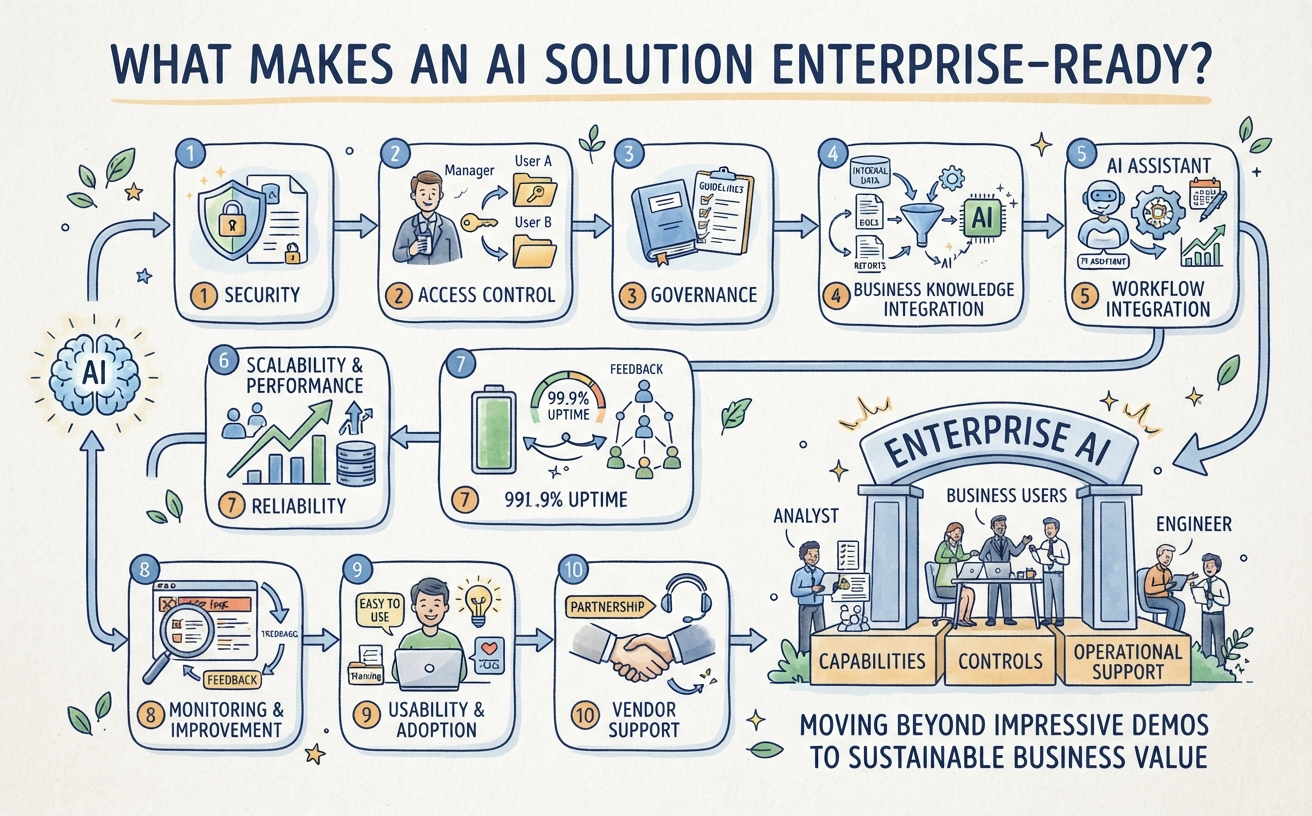
An AI tool can produce impressive results in a short demonstration. It may answer questions, summarize documents, draft emails or generate reports in seconds. But when an organization considers using AI across departments, the evaluation becomes more demanding.
Can the solution handle company information appropriately? Can administrators manage who uses it and what information they can access? Does it fit existing workflows? Can the organization monitor its use, support employees and maintain the system over time?
These are the kinds of questions that distinguish a convenient AI tool from an enterprise-ready AI solution.
Enterprise readiness does not mean that a product has a particular certification or that it must use one specific deployment model. It means that the solution has the capabilities, controls and operational support needed to meet an organization’s requirements.
Here are ten areas businesses should examine when evaluating an AI solution for wider organizational use.
1. Security and Data Handling
Business AI applications may process internal documents, customer information, project records, financial material and other sensitive content. Organizations therefore need to understand how information is handled throughout the AI workflow.
Important questions include:
- Where is information processed and stored?
- Which AI models or external services receive submitted data?
- How long is information retained?
- Can the organization configure data-handling settings?
- What safeguards protect information while it is stored and transmitted?
- What happens to prompts, uploaded documents and generated responses?
The answers will depend on the product architecture, deployment arrangement, AI provider and configuration. A solution described as private does not automatically guarantee security. Organizations must examine the actual data flows and controls rather than rely on a label.
For example, a company may choose to run AI models on infrastructure it controls, use dedicated cloud infrastructure, or connect its business applications to an external AI provider through an account and endpoint it manages. Each approach has different implications for data handling, operational responsibility and cost.
2. Access Control and User Management
Not every employee should necessarily have access to every AI feature or every source of company information. An enterprise solution should fit the organization’s approach to user identity, permissions and information access.
Consider whether the solution supports appropriate ways to:
- Manage users and their access to the platform.
- Control access to knowledge sources and business content.
- Separate information belonging to different teams or projects.
- Assign administrative responsibilities.
- Review and update permissions as employees change roles.
This is particularly important when an AI assistant retrieves information from a shared knowledge repository. The organization needs to understand whether the assistant respects the intended access boundaries. Connecting more documents to an AI system is not useful if employees can inadvertently retrieve information they are not authorized to see.
Access control should therefore be evaluated across the complete solution, including the knowledge repository, AI application and underlying infrastructure.
3. Governance and Administrative Oversight
As AI becomes part of everyday work, organizations need clear rules for how it should be used. Employees should understand which tasks are appropriate for AI assistance, what information they may submit and when human review is required.
An enterprise-ready approach should make it practical to establish and maintain internal AI policies. Depending on the organization’s needs, governance may cover:
- Approved AI use cases and prohibited activities.
- Rules for handling confidential and personal information.
- Human review requirements for important decisions and outputs.
- Responsibilities for reviewing AI-generated content.
- Ownership of knowledge sources, prompts and workflows.
- Procedures for reporting problems or inappropriate results.
Administrative oversight is not only a technical matter. It also involves assigning responsibility. Someone needs to own the platform, someone needs to maintain the knowledge it uses, and business teams need to decide how AI-generated work is reviewed and approved.
4. Integration with Business Knowledge
A general-purpose AI model can provide useful explanations and perform many common tasks. However, it may not know an organization’s internal procedures, project history, product documentation or business terminology.
For AI to support company-specific work, it often needs access to relevant organizational knowledge.
One common approach is retrieval-augmented generation (RAG). Rather than relying only on information learned during model training, a RAG-based system retrieves relevant content from selected knowledge sources and uses that material as context when generating a response.
This can help employees ask questions about internal documents, locate information across multiple sources and understand historical decisions. It can also support tasks such as preparing reports or drafting documentation based on existing company material.
However, connecting a knowledge repository does not automatically make every answer accurate. Results depend on the quality and currency of the source material, retrieval configuration, access permissions and the AI model’s ability to interpret the retrieved information.
When evaluating a solution, ask:
- Can it connect to the knowledge sources the organization actually uses?
- Can administrators select and organize the information available to AI?
- How are outdated or duplicated documents handled?
- Can users identify the source material behind an answer where supported?
- How are changes to company knowledge reflected in subsequent queries?
5. Integration with Existing Workflows
An AI solution should help employees complete real tasks, not force them to create an entirely separate way of working.
For example, a project team may need to turn meeting notes into a structured project summary. A business analyst may need to transform written requirements into process documentation. A technical team may need to create diagrams from an existing system description.
If employees must repeatedly copy information between disconnected applications, the potential productivity benefit may be reduced.
Evaluate how the solution fits into the organization’s current work. Consider whether it supports the relevant document formats, knowledge sources, collaboration practices and output requirements. Also examine whether it can complement existing systems rather than requiring the organization to replace them.
Integration does not always mean a complex custom connection to every enterprise application. Sometimes a focused set of compatible tools and well-defined workflows provides a more practical starting point.
6. Scalability and Performance
A solution that works well for a small pilot group may behave differently when hundreds or thousands of employees begin using it.
Before wider deployment, organizations should understand the solution’s capacity and performance characteristics. Relevant considerations include:
- How many users can access the system concurrently?
- How does response time change as usage increases?
- What are the limits of the selected AI model or service?
- Can computing resources be increased when demand grows?
- How does the system handle large knowledge collections?
- Are there usage limits, quotas or additional charges?
Scalability also has a financial dimension. More users, longer conversations, larger documents and more complex tasks can increase model usage and infrastructure requirements.
Organizations should estimate expected demand and understand the cost implications before expanding beyond an initial pilot.
7. Reliability and Operational Continuity
When employees begin depending on AI for everyday work, availability and reliability become important operational concerns.
Organizations should understand what happens when an AI model, external provider, network connection or supporting service becomes unavailable. They should also consider whether there are clear support arrangements and procedures for investigating service interruptions.
Useful evaluation questions include:
- What availability commitments, if any, are provided?
- How are service interruptions communicated?
- What support channels are available?
- Are backups and recovery arrangements relevant to the deployment?
- Can employees continue essential work if the AI service is temporarily unavailable?
Not every AI use case requires the same level of availability. An assistant used for optional research has different operational requirements from a system supporting a time-sensitive business process. The organization should define the required service level based on the importance of the work.
8. Monitoring, Evaluation and Continuous Improvement
AI output quality should not be judged solely by a successful demonstration. Organizations need a way to evaluate how the solution performs on the tasks employees actually carry out.
For example, a company deploying an internal knowledge assistant could test whether it retrieves the right documents, handles ambiguous questions appropriately and avoids presenting unsupported conclusions as facts.
Depending on the solution and deployment, useful monitoring and evaluation practices may include:
- Testing representative business questions before launch.
- Reviewing response quality and user feedback.
- Checking whether retrieved information is relevant and current.
- Identifying recurring errors or unanswered questions.
- Reviewing usage patterns where appropriate and permitted.
- Updating prompts, knowledge sources and workflows based on findings.
Monitoring must also respect privacy, employment policies and applicable data protection requirements. The goal is to improve the system responsibly, not to collect more employee information than necessary.
9. Usability, Training and Employee Adoption
Even a technically capable AI platform can fail to deliver value if employees do not know how to use it effectively.
Employees need more than access to a chat interface. They need to understand what the system can do, what its limitations are, how to ask useful questions and when to verify its output.
Training should be relevant to the work employees perform. A customer support team may need guidance on finding approved product information, while project managers may need examples of summarizing project records or preparing status reports.
Organizations should also make it easy for employees to share feedback and report problems. Their experiences can reveal missing knowledge sources, confusing workflows and opportunities for improvement.
Look for a solution that can be introduced gradually, supported with practical training and adapted as the organization’s needs evolve.
10. Vendor Support and Long-Term Maintainability
Enterprise AI is not necessarily a one-time installation. Models, infrastructure, knowledge sources, business requirements and user expectations can all change.
Organizations should therefore evaluate the support available after initial deployment.
Consider whether the provider offers:
- Technical assistance during setup and configuration.
- Guidance on infrastructure and AI endpoint selection.
- Training for administrators and end users.
- Help with integrating company knowledge and workflows.
- Ongoing technical advice and troubleshooting.
- A clear approach to updates and product maintenance.
It is also important to understand which responsibilities remain with the organization. For example, a provider may configure the AI environment while the customer remains responsible for maintaining its infrastructure, managing user permissions or reviewing internal knowledge sources.
Clear responsibilities help avoid the assumption that purchasing an AI product automatically covers every aspect of its ongoing operation.
A Practical Enterprise AI Evaluation Checklist
The following checklist can help a business structure its evaluation. It is not a formal certification standard. The importance of each item will depend on the organization’s industry, risk profile, use cases and technical environment.
- We understand where business information is processed and stored.
- We have evaluated the solution’s data-handling and security controls.
- Access to users, documents and knowledge sources can be managed appropriately.
- We have defined internal AI usage policies and responsibilities.
- The solution can use relevant company knowledge where required.
- It fits the workflows and tools employees already use.
- We understand its capacity, performance limits and usage costs.
- We have considered availability, support and recovery requirements.
- We have a process for evaluating output quality and handling errors.
- Employees will receive practical training and ongoing guidance.
- We understand who is responsible for maintenance and long-term support.
If several answers are unclear, that does not necessarily mean the solution is unsuitable. It means those areas should be investigated before the organization commits to a wider rollout.
Putting the Pieces Together: Enterprise AI as a Complete Solution
Enterprise AI is often discussed as though the main decision is simply which AI model to use. In practice, the model is only one part of the overall solution.
A business may also need a managed knowledge repository, an AI assistant that can work with selected company information, tools for creating structured documents and diagrams, suitable infrastructure, configuration assistance and employee training.
For example, an organization could establish a central knowledge environment for its internal documents and notes, let employees ask questions through an AI assistant, and use the results to prepare reports, specifications or visual models. The value comes from connecting these capabilities into a practical workflow, rather than treating each as an isolated tool.
Visual Paradigm’s Private AI for Enterprise Knowledge solution brings together knowledge management, AI-assisted information access and tools for creating business and technical deliverables. The offering also covers implementation assistance, team training and ongoing technical support, with deployment approaches that can be selected according to an organization’s requirements.
Businesses evaluating this type of solution should still examine their own data-handling, infrastructure, access-control and operational requirements. The right configuration depends on the organization’s circumstances.
Final Thoughts
An enterprise-ready AI solution is not defined by a single feature, model or deployment label. It is defined by how well the complete system supports an organization’s real work while meeting its requirements for security, governance, integration, reliability and ongoing management.
The best evaluation begins with business needs. Identify the tasks AI should support, the information it will need, the people who will use it and the risks that must be managed. Then assess whether the proposed solution can meet those requirements in a sustainable way.
That approach helps organizations move beyond impressive AI demonstrations and make more informed decisions about adopting AI in everyday business operations.
Frequently Asked Questions
What does enterprise-ready AI mean?
Enterprise-ready AI refers to an AI solution that can meet an organization’s operational and business requirements. These may include appropriate security and access controls, governance, integration, scalability, reliability, administration, employee training and ongoing support.
Is a private AI solution automatically enterprise-ready?
No. Private AI describes aspects of how an AI environment is controlled, deployed or connected to business information. It does not automatically guarantee security, reliability, scalability or effective governance. Those capabilities must be evaluated separately.
Does enterprise AI have to run on company-owned servers?
No. Depending on the organization’s requirements, AI may run on premises, on dedicated cloud infrastructure or through a cloud AI provider using an organization-managed account and endpoint. The appropriate choice depends on data-handling requirements, infrastructure, cost and operational responsibilities.
Why does an enterprise AI solution need access to company knowledge?
General-purpose AI models may not know an organization’s internal procedures, project history or proprietary documentation. Connecting selected company knowledge sources can help an AI assistant provide context-aware responses. The quality of those responses still depends on the source information and system configuration.
What should a company test before deploying AI across the organization?
It should test representative business tasks, response quality, knowledge retrieval, access permissions, data handling, performance, usage costs and employee workflows. It should also define human review procedures and provide training before expanding access.