


Solution architecture operates at the intersection of strategic intent and technical execution. It requires a structured approach to translate business needs into concrete technological implementations without losing fidelity or context. Enterprise Architecture frameworks provide the necessary scaffolding for this translation, and ArchiMate serves as a leading standard for this purpose. For a Solution Architect, mastering the visual language of ArchiMate is not about memorizing symbols; it is about establishing a shared vocabulary that eliminates ambiguity between stakeholders.
This guide explores how architects utilize the ArchiMate framework to maintain alignment across the enterprise. We examine the core layers, the relationships that bind them, and the practical applications that drive decision-making. The goal is to create models that inform strategy and validate implementation.
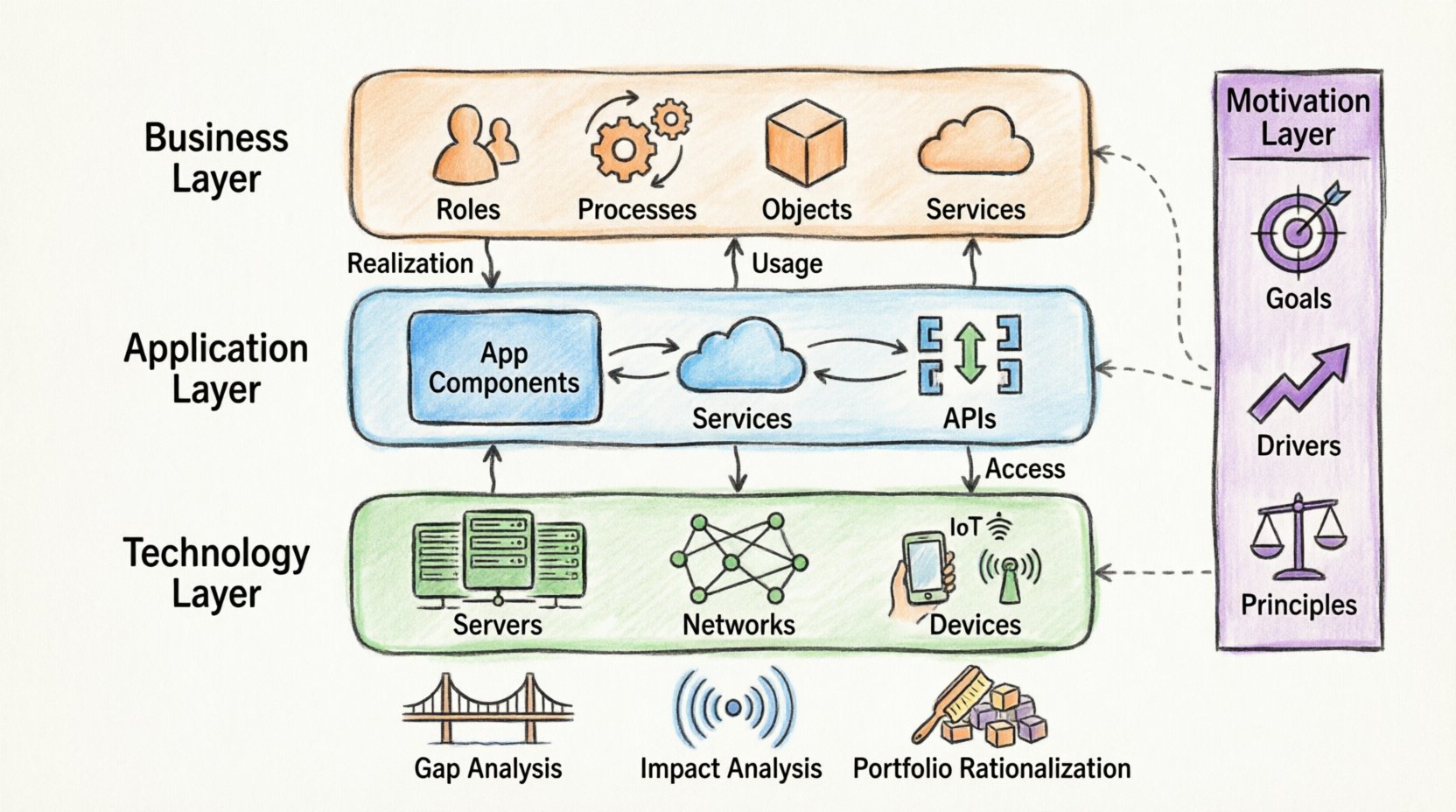
Understanding the Core Layers 🧱
ArchiMate organizes enterprise elements into distinct layers. This separation of concerns allows architects to focus on specific aspects of the enterprise without being overwhelmed by the complexity of the whole. Each layer represents a different viewpoint, yet they are interconnected.
- Business Layer: Represents the business functionality, roles, and processes. It answers the question, “What does the organization do?”
- Application Layer: Represents the software and applications that support business processes. It answers, “How is the work enabled?”
- Technology Layer: Represents the hardware, networks, and infrastructure that host the applications. It answers, “Where does the work run?”
Beyond these three primary layers, the framework includes the Motivation Layer for strategic drivers and the Implementation & Migration Layer for planning change. Understanding the distinct purpose of each layer prevents the common pitfall of mixing strategic goals with technical constraints.
The Business Layer in Detail 🏢
The Business Layer is the foundation of business-technology alignment. It captures the essence of the organization’s operations. Key elements include:
- Business Roles: The actors within the business processes (e.g., Customer, Sales Agent).
- Business Processes: The activities that add value (e.g., Order Processing, Customer Onboarding).
- Business Objects: The data entities managed by the business (e.g., Invoice, Order, Contract).
- Business Services: The capabilities offered to the external environment (e.g., Credit Check, Account Creation).
When modeling this layer, the Solution Architect must ensure that every process maps to a clear business value. If a process exists without a defined business object or role, it warrants scrutiny. This layer serves as the reference point for all downstream technical decisions.
The Application & Technology Layers 💻
The Application Layer sits directly below the Business Layer. It contains the software components that automate or support business processes. Key elements include:
- Application Services: Capabilities provided by the software (e.g., Data Validation, Report Generation).
- Application Components: Logical groupings of software functionality (e.g., Billing Module, User Management).
- Application Interfaces: Points of interaction between components (e.g., REST API, SOAP Endpoint).
The Technology Layer provides the physical or virtual infrastructure. It includes:
- Node: A computational resource (e.g., Server, Cloud Instance).
- Device: End-user hardware (e.g., Laptop, Mobile Device).
- Communication Network: The medium for data transmission (e.g., LAN, Internet).
- System Software: Operating systems or middleware.
Mapping from Business to Technology is not a linear drop. It requires tracing how a business service is realized by an application service, which in turn is deployed on a node. Gaps in this chain indicate areas of technical debt or manual workarounds.
Mapping Relationships and Dependencies 🔗
Static diagrams are useful, but ArchiMate derives its power from the relationships between elements. These relationships define the flow of information and control across the enterprise.
Key Relationship Types
- Realization: Indicates that one element provides the implementation for another. For example, an Application Component realizes a Business Process.
- Usage: Indicates a dependency where one element uses another. For example, an Application Component uses a Database.
- Access: Indicates that one element accesses the data of another. For example, a Business Process accesses a Business Object.
- Association: A general relationship used when no specific relationship fits. Often used for communication between actors.
The Motivation Layer 🎯
Without the Motivation Layer, architecture models risk becoming mere inventories of assets. This layer introduces the “Why” behind the architecture. It includes:
- Goal: A desired state to achieve.
- Principle: A rule or guideline for decision-making.
- Requirement: A constraint or need that must be satisfied.
- Driver: An internal or external factor that influences the direction.
Linking a Business Goal to a specific Application Service ensures that every technical investment ties back to a strategic objective. This linkage is critical for justifying budget and prioritizing work.
Practical Use Cases for Architects 🛠️
ArchiMate is not just a documentation tool; it is a thinking tool. Here are specific scenarios where the framework adds value to the Solution Architect.
1. Gap Analysis and Transformation 📉
When migrating from a legacy environment to a modern platform, architects must identify what exists and what is needed. ArchiMate allows for the modeling of an As-Is state and a To-Be state.
- Identify Business Processes that are currently manual.
- Map them to target Application Components.
- Identify missing Technology resources.
- Define the migration steps required to bridge the gap.
This visual comparison highlights inefficiencies. It shows where automation is possible and where infrastructure upgrades are mandatory. It moves the conversation from “we need a new server” to “we need to replace the legacy billing service to support the new sales process.”
2. Impact Analysis ⚡
Change is constant. When a specific requirement changes, the Solution Architect must understand the ripple effect. ArchiMate relationships allow for tracing dependencies.
- If a Business Rule changes, which Business Processes are affected?
- Which Application Services support those processes?
- Which Technology Nodes host those services?
This traceability reduces risk. It prevents accidental outages or service degradation during updates. It allows teams to assess the cost of change before committing to it.
3. Portfolio Rationalization 🧹
Enterprises often accumulate redundant applications over time. ArchiMate helps visualize the overlap.
- Map multiple Application Components to the same Business Process.
- Identify which component offers the most comprehensive Business Services.
- Plan the retirement of the redundant components.
This rationalization reduces maintenance costs and technical debt. It clarifies which systems are critical to operations and which are candidates for removal.
Overcoming Communication Barriers 🗣️
One of the primary challenges for Solution Architects is bridging the language gap between business stakeholders and technical teams. Business leaders speak in value, goals, and processes. Engineers speak in APIs, latency, and deployment pipelines. ArchiMate provides a unified notation that both sides can interpret.
Standardizing Terminology
Using ArchiMate forces a discipline in naming. A “Service” in the Business Layer is distinct from an “Application Service” in the Application Layer. This distinction prevents confusion when discussing capabilities. When a business stakeholder mentions a “Service,” the architect knows whether to refer to the business capability or the technical endpoint.
Visual Abstraction Levels
Not every audience needs every detail. ArchiMate supports different levels of abstraction.
- Strategic View: Focuses on the Motivation and Business Layers. High-level goals and drivers.
- Conceptual View: Focuses on the Business and Application Layers. Processes and capabilities.
- Physical View: Focuses on the Application and Technology Layers. Components and nodes.
Presenting the correct view to the correct audience maintains engagement. A C-level executive does not need to see the network topology. A DevOps engineer does not need to see the high-level strategic goals. The framework enables this segmentation.
Maintenance and Evolution 🔄
An architecture model is not a one-time artifact. It must evolve as the enterprise changes. Maintaining an ArchiMate model requires discipline and governance.
Version Control
Models should be versioned. This allows architects to track how the architecture has shifted over time. It provides an audit trail for compliance and historical context during troubleshooting.
Consistency Checks
Automated validation rules can help maintain model integrity. For example, ensuring that every Business Process is supported by at least one Application Service. This prevents the creation of “ghost processes” that exist in the model but have no technical implementation.
Integration with Development
While ArchiMate is an architectural standard, it should inform the development lifecycle. The Application Layer model can serve as a blueprint for microservice boundaries. The Technology Layer model can guide infrastructure-as-code templates. This integration ensures the architecture remains relevant and actionable.
Comparison: ArchiMate vs. Traditional Diagrams 📊
Many organizations still rely on standard UML or flowcharts. While these have their place, they often lack the specific semantic richness required for enterprise architecture.
| Feature | ArchiMate | Standard Flowcharts / UML |
|---|---|---|
| Scope | Broad (Business, App, Tech, Motivation) | Narrow (Software Logic or Process Flow) |
| Relationship Semantics | Explicit (Realization, Usage, Access) | Generic (Dependency, Association) |
| Strategic Link | Includes Motivation Layer (Goals, Drivers) | Usually Absent |
| Business Alignment | First-class citizen | Often Implicit |
| Stakeholder Focus | Multi-layered (Executives to Engineers) | Technical or Process Focused |
The table highlights why ArchiMate is preferred for cross-functional architecture. It covers the spectrum from strategy to code, whereas traditional diagrams often get stuck in the middle.
Best Practices for Implementation ✅
To get the most out of the framework, Solution Architects should adhere to specific guidelines.
- Start with the Business: Do not begin with technology. Define the business processes and services first. This ensures technology serves the business, not the other way around.
- Keep it Simple: Avoid over-modeling. A model that is too complex will be ignored. Focus on the elements relevant to the specific project or initiative.
- Use Consistent Notation: Ensure all architects in the organization use the same symbols and definitions. This creates a shared mental model across teams.
- Link to Requirements: Every element should ideally trace back to a requirement. This validates the existence of the element.
- Iterate: Models evolve. Do not try to build the perfect model in one go. Refine it as new information becomes available.
Conclusion on Architecture Clarity 🏁
The value of ArchiMate lies in its ability to structure complexity. It provides a disciplined method for organizing the disparate parts of an enterprise into a coherent whole. For the Solution Architect, it is the tool that turns abstract strategy into concrete design.
By rigorously applying the layers and relationships, architects can reduce ambiguity. They can demonstrate how a technical change impacts a business goal. They can justify investments with clear evidence of alignment. This clarity is essential in modern enterprises where speed and precision are paramount.
Adopting this framework is not about adding documentation overhead. It is about improving the quality of the conversation. It ensures that when a decision is made, everyone understands the context, the dependencies, and the implications. That is the true measure of effective architecture.
This post is also available in Deutsch, Español, فارسی, Français, English, Bahasa Indonesia, 日本語, Polski, Portuguese, Ру́сский, Việt Nam, 简体中文 and 繁體中文.