


Enterprise architecture functions as the backbone of modern organizational strategy. It requires a structured language capable of translating abstract business goals into concrete technical implementations. ArchiMate serves this purpose effectively. This guide examines practical modeling scenarios across the core domains. It focuses on the utility of the framework in actual architectural practice rather than theoretical definitions. 📋
Domain architects often face the challenge of ensuring alignment between business strategy and IT delivery. Without a standardized notation, communication breaks down. ArchiMate resolves this by providing a clear set of concepts and relationships. The following sections detail specific use cases derived from real-world engagements. These examples highlight how to apply the framework to solve tangible problems. 💡
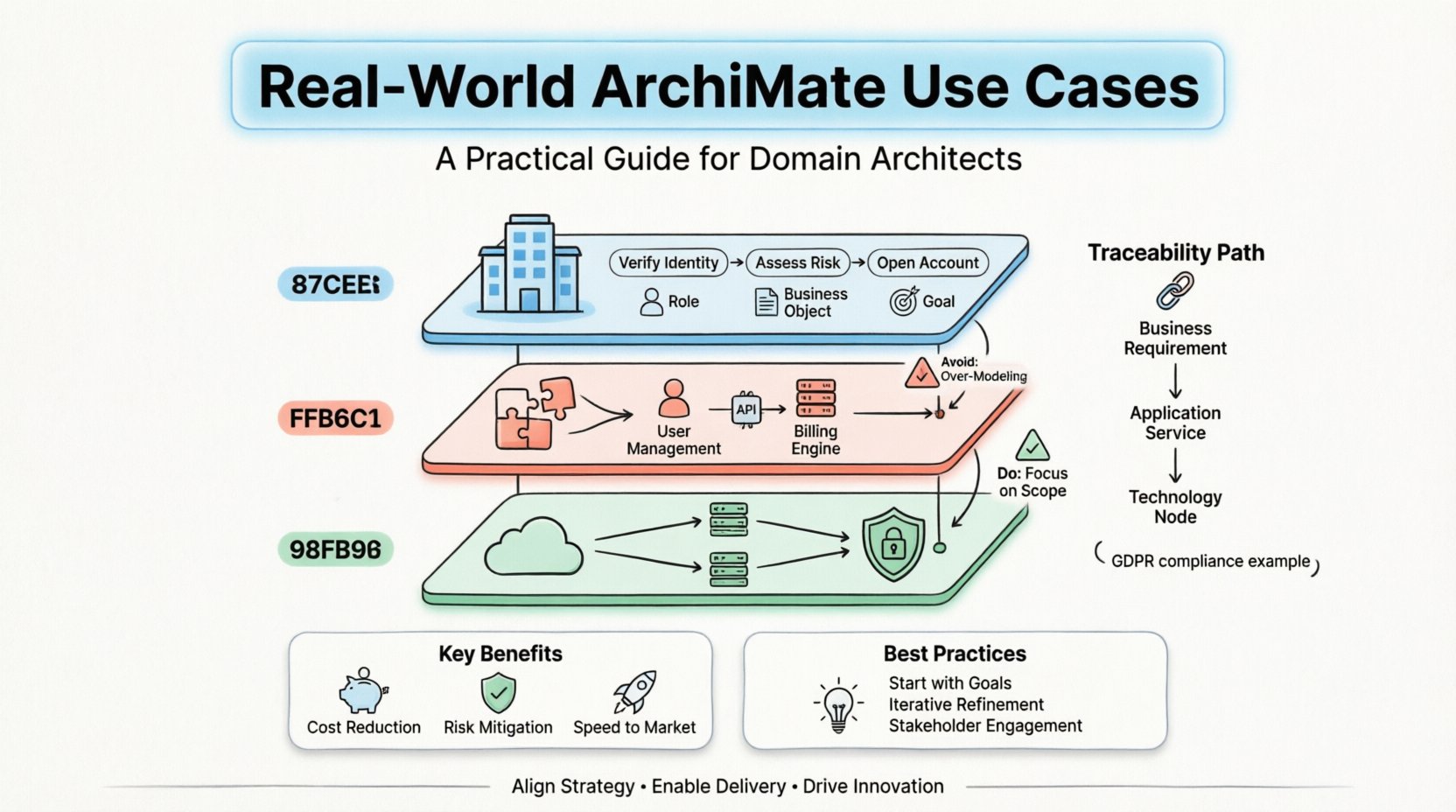
1. Business Architecture: Modeling Value Streams and Motivation 🏢
The business domain defines the “what” and “why” of an organization. It establishes the context for all subsequent technical decisions. A common scenario involves mapping a value stream to identify inefficiencies or gaps in capability.
Scenario: Streamlining Customer Onboarding
Consider a financial institution aiming to reduce the time required for customer onboarding. The architecture team begins by defining the current state using ArchiMate business elements.
- Business Process: Define steps such as “Verify Identity”, “Assess Risk”, and “Open Account”.
- Business Object: Identify data entities like “Customer Profile” or “Application Form”.
- Role: Assign actors such as “Relationship Manager” or “Compliance Officer”.
By visualizing the flow, the team discovers a bottleneck. The “Assess Risk” step requires manual data entry from multiple sources. This creates latency and potential error.
Integrating Motivation Elements
Architecture is not just about structure; it is about intent. ArchiMate includes a motivation layer to capture drivers and objectives. This ensures the model reflects the strategic vision.
- Goal: Reduce onboarding time by 50% within 12 months.
- Principle: “Data should be entered once and reused everywhere”.
- Requirement: System must support automated identity verification.
These motivation elements link directly to the business processes. They provide the justification for architectural changes. Stakeholders can trace how a specific process improvement supports a high-level goal. This traceability is critical for governance and approval processes. 🔍
The following table illustrates the relationship between motivation and structure:
| Motivation Element | Associated Business Element | Purpose |
|---|---|---|
| Goal | Value Stream | Defines the desired outcome of the process |
| Principle | Business Process | Guides the design and execution of the activity |
| Requirement | Business Service | Specifies a condition the service must satisfy |
2. Application Architecture: Managing Integration and Services 🧩
The application domain represents the software systems that support business functions. A frequent challenge here is managing complexity in legacy environments. Architects must understand how applications interact and where data flows.
Scenario: Application Modernization Strategy
An organization plans to migrate from a monolithic system to a microservices architecture. The starting point is a clear understanding of the existing landscape.
- Application Component: Identify logical building blocks like “User Management Module” or “Billing Engine”.
- Application Interface: Define the contracts between components, such as REST APIs or message queues.
- Application Service: Describe the functionality exposed to the outside world, like “Get Customer Balance”.
Using the framework, the team maps the dependencies between these components. They identify “coupling” issues where one component relies too heavily on another. This analysis informs the decoupling strategy.
Mapping Data Flows
Data is the lifeblood of applications. ArchiMate allows architects to model the flow of information between application functions.
- Interface Realization: Show which interface realizes which service.
- Access Relationship: Define which application component accesses which data object.
- Assignment: Link application functions to the business processes they enable.
This connectivity ensures that when a business process changes, the impact on the application layer is understood. For example, if the “Verify Identity” process changes, the model reveals which application services handle identity data. This prevents broken integrations during updates. 🔄
3. Technology Architecture: Infrastructure and Deployment 🖥️
The technology domain encompasses the physical or virtual hardware and software platforms. It is the foundation upon which applications run. In modern contexts, this often involves cloud infrastructure and container orchestration.
Scenario: Cloud Migration Planning
A retailer wants to move its e-commerce platform to a public cloud provider. The technology model must reflect the deployment topology and resource allocation.
- Technology Node: Represent servers, databases, or cloud instances.
- Device: Define physical devices like routers or load balancers.
- Communication Network: Model the connectivity between nodes, such as VLANs or internet links.
The architecture team creates a deployment diagram. They map application components to specific technology nodes. This clarifies resource requirements and potential single points of failure.
Ensuring Reliability and Security
Technology architecture is not just about placement. It is about attributes like security and performance. ArchiMate allows for the attachment of specific characteristics to technology elements.
- Security: Define encryption standards for data in transit between nodes.
- Performance: Specify latency requirements for communication networks.
- Availability: Model redundancy strategies, such as active-passive clusters.
By modeling these attributes, architects can validate that the infrastructure supports the application requirements. If an application requires 99.99% availability, the technology model must demonstrate the necessary redundancy. This alignment reduces risk during deployment. 🛡️
4. Cross-Domain Alignment: Traceability and Impact Analysis 🔗
The true power of ArchiMate lies in the connections between domains. Business requirements must be traceable to application functions and ultimately to technology nodes. This traceability enables effective impact analysis.
Scenario: Regulatory Compliance Update
A new regulation requires all customer data to be stored within specific geographic boundaries. The architecture team must assess the impact of this change.
- Step 1: Update the Business Requirement element with the new legal constraint.
- Step 2: Trace the requirement to the Application Service responsible for data storage.
- Step 3: Trace the service to the Technology Node where data resides.
- Step 4: Identify which nodes violate the constraint (e.g., located in the wrong region).
This end-to-end visibility allows for precise remediation. Instead of guessing which systems might be affected, the model provides a definitive list. It also highlights dependencies. Changing one node might require updating the interface or the business process.
The table below summarizes the traceability path:
| Domain | Element Type | Example |
|---|---|---|
| Business | Requirement | GDPR Compliance |
| Application | Service | Data Storage Service |
| Technology | Node | EU-West-1 Database Cluster |
5. Governance and Maintenance of the Model 🔄
Creating a model is only the beginning. It must be maintained to remain relevant. Enterprise architecture artifacts often become obsolete if not managed correctly.
Version Control and Change Management
Changes in an organization are constant. The architecture model must reflect these changes without losing historical context.
- Versioning: Maintain distinct versions of the model for different release cycles.
- Change Requests: Log proposed changes and their rationale within the repository.
- Approval Workflow: Ensure architectural changes pass through a governance board.
This process ensures that the model acts as a source of truth. It prevents “shadow IT” where systems exist outside of the documented architecture. It also aids in auditing. When an issue arises, the model provides the history of how the system was built and modified.
Stakeholder Engagement
A model is useless if stakeholders do not understand or trust it. Communication is key to successful governance.
- Visualization: Use different views for different audiences. Executives need high-level value streams; engineers need interface details.
- Workshops: Conduct review sessions to validate the model with domain experts.
- Feedback Loops: Allow architects to refine the model based on operational feedback.
Engagement transforms the model from a static document into a living asset. It encourages ownership across the organization. When teams understand how their work fits into the broader picture, alignment improves naturally. 🤝
6. Common Pitfalls and Best Practices ⚠️
Even experienced architects encounter obstacles when applying ArchiMate. Recognizing these pitfalls early saves time and resources.
Pitfall 1: Over-Modeling
Attempting to model every single detail can lead to paralysis. The goal is clarity, not perfection.
- Solution: Focus on the scope of the current project. Ignore details that do not impact the immediate decision.
- Solution: Use abstraction levels. Start high and drill down only when necessary.
Pitfall 2: Lack of Context
Elements without context are meaningless. A “Business Process” without a defined role or goal is just a list of steps.
- Solution: Always link elements to motivation. Explain why the process exists.
- Solution: Ensure relationships are defined. A process should be assigned to a role and realize a business service.
Pitfall 3: Ignoring the Motivation Layer
Many models focus heavily on structure and neglect motivation. This leads to solutions that do not meet business needs.
- Solution: Start with goals and principles. Derive the structure from these drivers.
- Solution: Review motivation elements regularly to ensure alignment with strategy.
Best Practice: Iterative Refinement
Architecture is an iterative process. Do not expect the first draft to be complete.
- Incremental Updates: Update the model as projects progress.
- Regular Reviews: Schedule periodic audits of the architecture repository.
- Training: Ensure all architects understand the notation rules and conventions.
7. Strategic Value of Domain Alignment 📈
When domains are aligned, the organization gains agility. Decisions are made with a full understanding of consequences. This reduces rework and accelerates delivery.
Consider the difference between siloed teams and an integrated approach. In silos, business changes might break IT systems unexpectedly. In an integrated model, the impact is known in advance. This foresight allows for proactive planning rather than reactive firefighting.
- Cost Reduction: Eliminate redundant systems identified through traceability.
- Risk Mitigation: Identify single points of failure before they cause outages.
- Speed to Market: Clear requirements reduce ambiguity for development teams.
The framework supports this alignment by providing a common vocabulary. It allows business leaders and technical teams to speak the same language. This shared understanding is the foundation of effective enterprise architecture. 🗣️
8. Future-Proofing the Architecture 🚀
Technology trends evolve rapidly. Cloud, AI, and IoT introduce new complexities. The architecture must be adaptable to these changes.
- Flexibility: Design models that can accommodate new elements without requiring a complete rebuild.
- Abstraction: Use generic concepts where specific technologies are not yet defined.
- Extensibility: Leverage extensions or profiles if standard concepts do not fit specific needs.
By building a flexible model, architects ensure longevity. The core logic of the business remains stable even if the underlying technology shifts. This stability is crucial for long-term strategic planning. 🌐
Implementing these use cases requires discipline and consistency. It is not merely about drawing diagrams. It is about creating a living representation of the enterprise. This representation guides investment, manages risk, and drives innovation. The effort invested in modeling pays dividends in organizational clarity and operational efficiency. 🏆
Architects who master these practices position themselves as strategic partners. They move beyond documentation to enablement. They help the organization navigate complexity with confidence. The journey is continuous, but the framework provides a reliable path forward. 🛣️
This post is also available in Deutsch, Español, فارسی, Français, English, Bahasa Indonesia, 日本語, Polski, Portuguese, Ру́сский, Việt Nam, 简体中文 and 繁體中文.