


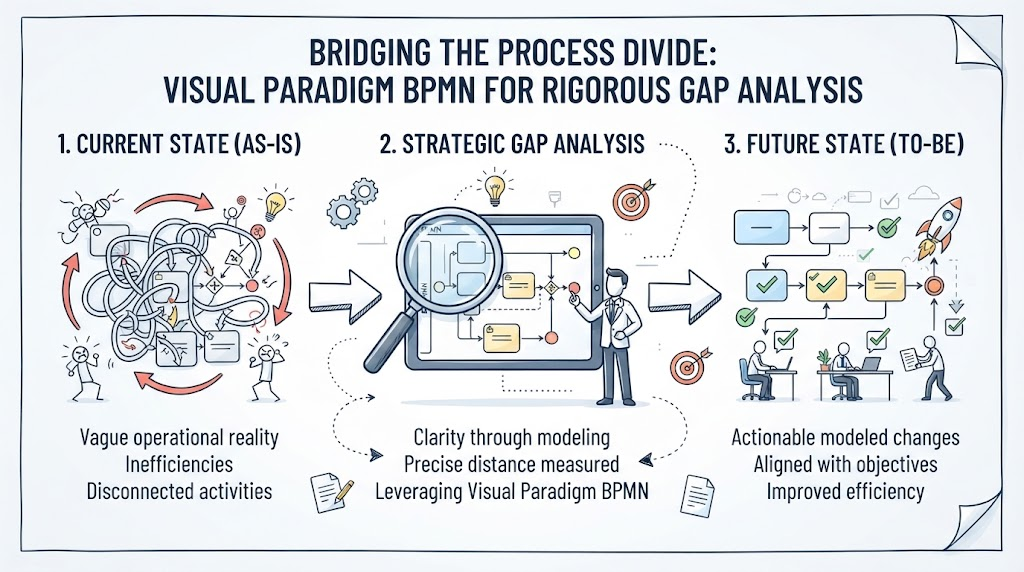
Business improvement initiatives often fail not because of a lack of ambition, but because of a lack of clarity. Organizations frequently struggle to articulate the precise distance between their current operational reality and their strategic objectives. This “process divide” is where gap analysis lives, and it is where Business Process Model and Notation (BPMN) tooling becomes indispensable.
This article explores a real-world case study demonstrating how Visual Paradigm’s BPMN capabilities were leveraged to conduct a rigorous gap analysis, transforming vague improvement goals into actionable, modeled process changes.
The Challenge: Growth Outpacing Process Maturity
Note: While this case study reflects a composite of common industry scenarios, it mirrors the exact workflow used in mid-market digital transformation projects.
Company Profile: NexusStream Solutions, a B2B SaaS provider experiencing 40% YoY growth.
The Pain Point: Customer onboarding time had ballooned from 5 days to 18 days. Churn was increasing during the implementation phase. Leadership knew that the process was broken, but they didn’t know where or why. Previous attempts to fix it via email threads and whiteboard sessions resulted in conflicting assumptions and no measurable progress.
The core challenge was a classic gap analysis problem: The As-Is process was undocumented tribal knowledge, and the To-Be process was an abstract wish list. There was no shared visual language to bridge the two.
Why Visual Paradigm for Gap Analysis?
Before diving into the case, it is worth noting why Visual Paradigm was selected over generic diagramming tools or other BPM suites:
-
True BPMN 2.0 Compliance: Ensures models are analyzable, not just illustrative.
-
Integrated Gap Analysis Features: Built-in support for overlaying As-Is and To-Be models with annotation layers.
-
Process Simulation: Ability to test To-Be models against historical As-Is data before implementation.
-
Requirements Traceability: Links process gaps directly to business requirements and user stories.
-
Collaborative Workspace: Enables real-time stakeholder validation during modeling workshops.
Phase 1: Modeling the As-Is Reality
The first step in any credible gap analysis is establishing an uncontested baseline. Using Visual Paradigm, the team conducted three facilitated modeling sessions with frontline staff.
Key Tooling Application: Swimlane Discovery
Using Visual Paradigm’s swimlane auto-layout, the team mapped the onboarding process across four departments: Sales, Implementation, Technical Support, and Customer Success. The tool’s ability to quickly reorganize lanes as understanding evolved was critical—early models placed “API Key Generation” in Implementation, but discovery revealed it actually sat dormant in Technical Support for an average of 6 days.
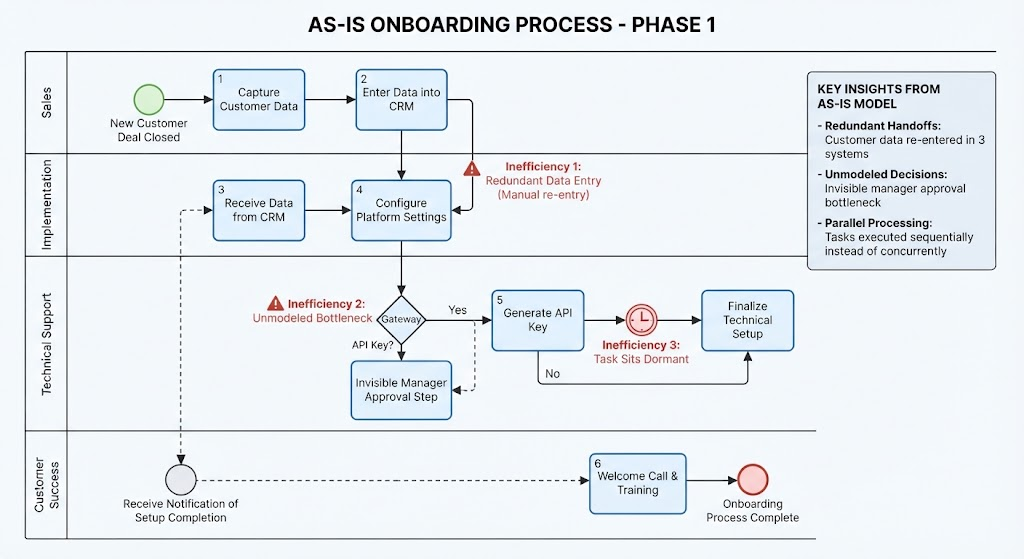
The As-Is Model Revealed Hidden Gaps
Once modeled, Visual Paradigm’s path analysis highlighted several immediate issues that interviews alone had missed:
-
Redundant Handoffs: Customer data was manually re-entered in three separate systems.
-
Unmodeled Decision Points: A “manager approval” step existed in practice but had never been documented, creating an invisible bottleneck.
-
Parallel Processing Failures: Tasks that could run concurrently were being executed sequentially due to legacy policy.
💡 Key Insight: The As-Is model itself became the first gap identification tool. Simply rendering the process visually exposed structural inefficiencies that stakeholders had normalized through familiarity.
Phase 2: Defining the To-Be Target State
With the As-Is validated, the team designed the target process. Here, Visual Paradigm’s model reuse and versioning features proved essential. Rather than starting from scratch, the team cloned the As-Is model and iteratively refined it, maintaining full traceability between current and future states.
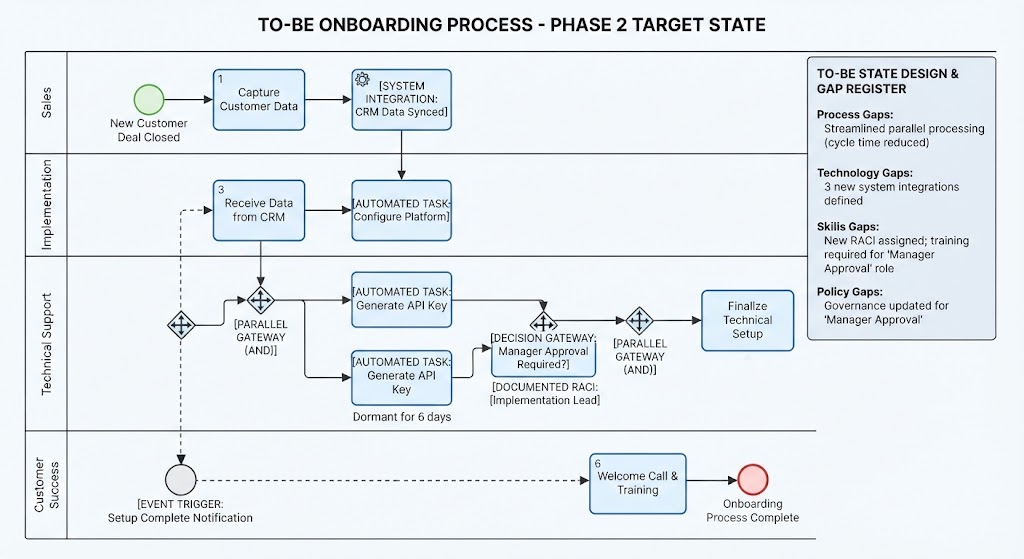
Design Principles Applied in Tooling
| Design Principle | Visual Paradigm Feature Used | Outcome |
|---|---|---|
| Eliminate non-value-add steps | Cross-referencing with Value Stream Map overlay | Removed 4 redundant handoffs |
| Automate manual tasks | Service Task + API connector modeling | Defined 3 automation integration points |
| Enable parallel processing | Gateway restructuring + simulation validation | Reduced theoretical cycle time by 60% |
| Clarify decision authority | Annotation & documentation attachments | Documented new RACI for each gateway |
The Gap Overlay
Visual Paradigm’s comparison report feature automatically generated a delta analysis between As-Is and To-Be models. This produced a structured gap register categorizing each difference as:
-
Process Gap: Structural change required
-
Technology Gap: New system/integration needed
-
Skills Gap: Training or hiring required
-
Policy Gap: Governance/approval change needed
This categorized output transformed subjective observations into a prioritized improvement backlog.
Phase 3: Validating Before Implementing
Perhaps the most valuable aspect of using Visual Paradigm for gap analysis is the ability to simulate the To-Be model before committing resources. The team configured simulation parameters based on 6 months of historical As-Is data:
-
Average task durations (extracted from ticketing system logs)
-
Arrival rates and volume distributions
-
Resource availability calendars
Simulation Results vs. Assumptions
The initial To-Be model predicted a 7-day onboarding cycle. However, simulation revealed that the proposed automation at Step 3 would create a new queue bottleneck at Step 4, because Technical Support staffing hadn’t been adjusted for the increased throughput.
The gap analysis was refined in real-time. The team added a buffer activity and adjusted resource allocation in the model, re-simulated, and achieved a validated 9-day target—still a 50% improvement over the 18-day As-Is, but now a credible target rather than an optimistic guess.
Measurable Outcomes
Three months post-implementation, NexusStream reported:
-
✅ Onboarding cycle time reduced to 9.2 days (within 2% of simulated prediction)
-
✅ Implementation-phase churn decreased by 34%
-
✅ $180K annual savings from eliminated manual re-entry labor
-
✅ New hire ramp-up time reduced by 40% (the As-Is/To-Be models served as training documentation)
Critically, the Visual Paradigm models remain living artifacts. They are updated quarterly as part of continuous improvement cycles, ensuring the gap analysis capability is institutionalized rather than project-based.
Lessons Learned for Practitioners
Based on this engagement, several best practices emerged for conducting gap analysis with Visual Paradigm BPMN:
-
Model the As-Is First, Always. Resist the urge to jump to solutions. The discipline of accurate As-Is modeling surfaces root causes that solution-focused thinking obscures.
-
Use Annotations Strategically. Visual Paradigm’s annotation layer allows you to capture qualitative context (stakeholder quotes, pain point descriptions) without cluttering the formal BPMN notation. This preserves model readability while retaining rich gap analysis context.
-
Treat Simulation as Validation, Not Prediction. Simulation won’t give you perfect forecasts, but it will expose logical flaws and hidden bottlenecks in your To-Be design far cheaper than production deployment.
-
Export the Gap Register Early. Don’t wait until modeling is complete to share findings. Visual Paradigm’s export-to-Excel/Confluence integrations allow incremental stakeholder buy-in throughout the analysis phase.
-
Version Control Your Models. Gap analysis is iterative. Use Visual Paradigm’s built-in version history to track how understanding evolved—this audit trail is invaluable when defending recommendations to leadership.
Conclusion
Gap analysis without proper tooling is essentially educated guesswork dressed up as methodology. Visual Paradigm’s BPMN capabilities transform gap analysis from a retrospective documentation exercise into a prospective engineering discipline. By providing integrated modeling, comparison, simulation, and traceability within a single environment, it enables organizations to not only identify operational gaps but to validate their closure before investing in change.
For businesses serious about process-driven improvement, the question is no longer whether to use BPMN tooling for gap analysis—it’s whether they can afford not to.
This post is also available in Deutsch, Español, Français, English, Bahasa Indonesia, 日本語, Polski, Portuguese, Ру́сский, Việt Nam, 简体中文 and 繁體中文.
Related posts:
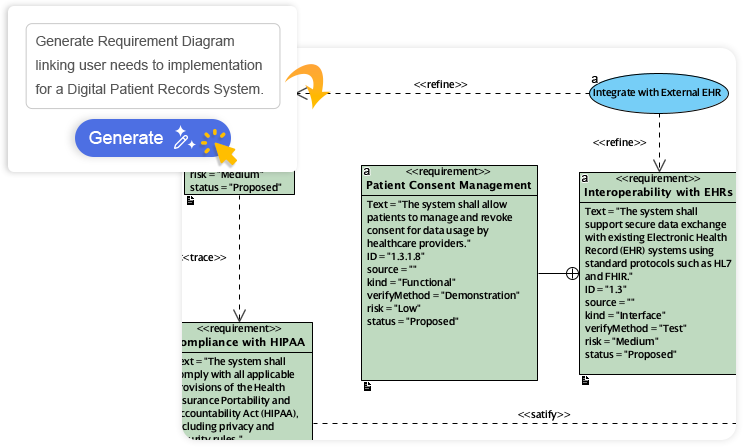 How Visual Paradigm’s AI Diagram Generation Turns Your Ideas into Professional UML & BPMN Diagrams in Seconds
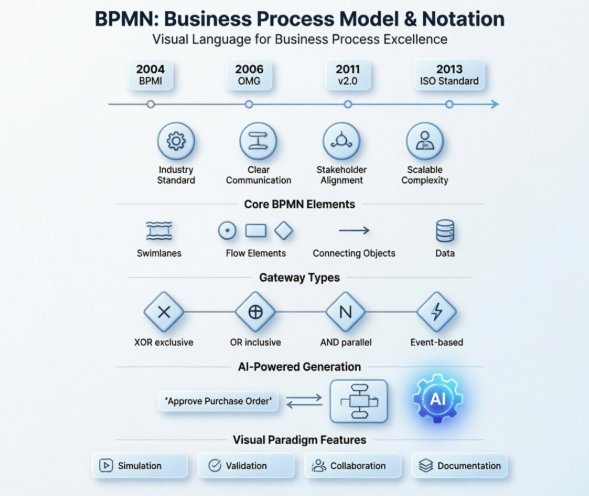 Mastering Business Process Modeling: A Hands-On Review of BPMN and Visual Paradigm’s AI-Powered Tools
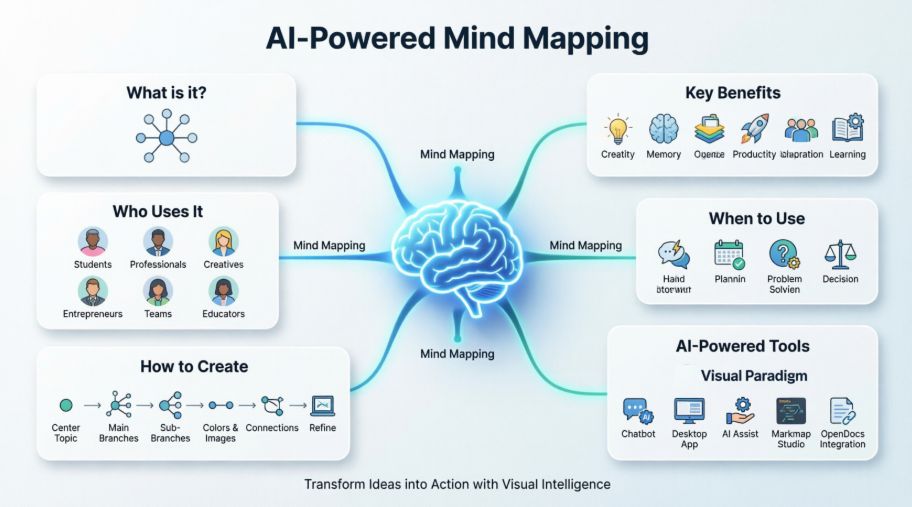 Mastering AI-Powered Mind Mapping with Visual Paradigm
 A Software Engineer’s Field Guide to UML, BPMN, and SysML