


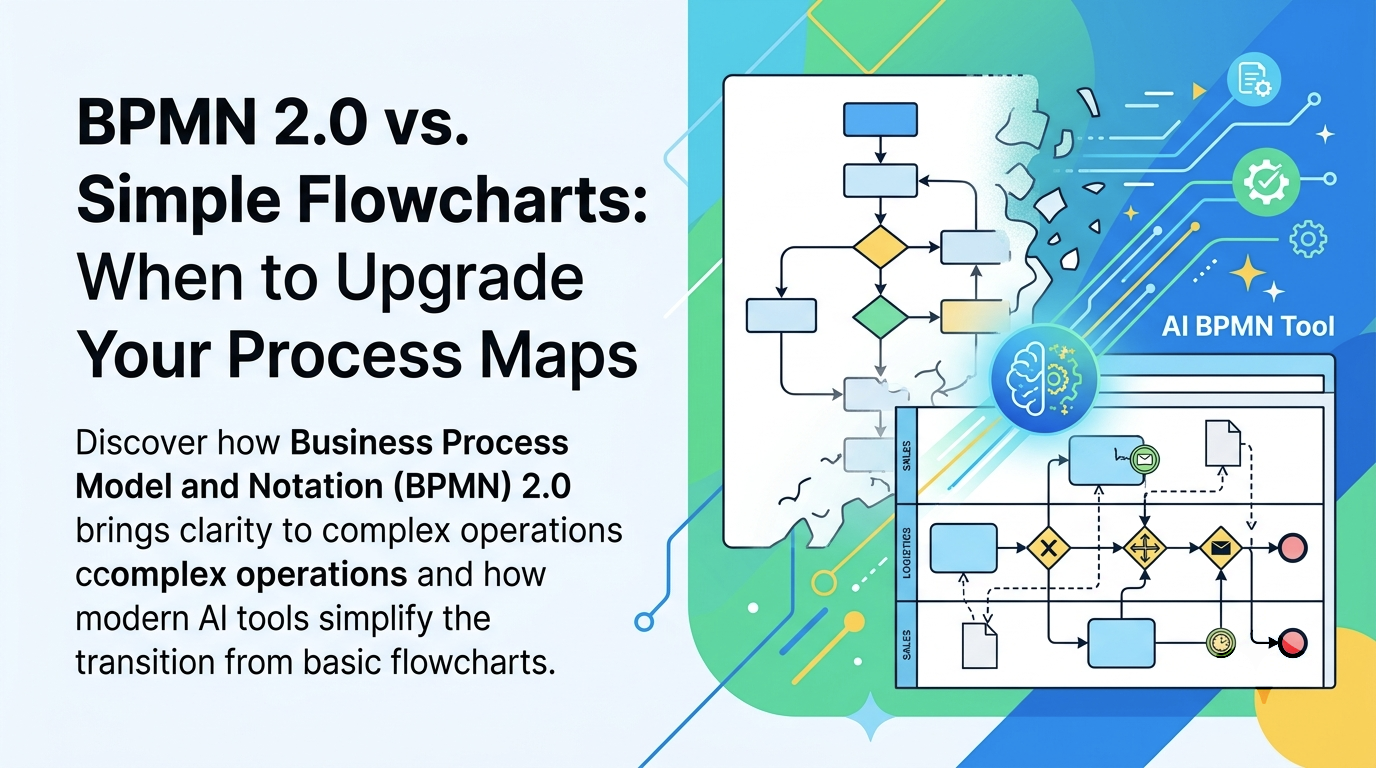
When organizations start documenting their operations, they almost always begin with simple flowcharts. Using basic boxes and arrows to map out steps is quick, intuitive, and requires almost no training. However, as business operations grow in complexity—involving cross-departmental handoffs, conditional logic, external system calls, and strict compliance standards—simple flowcharts quickly reach their limits.
This is where Business Process Model and Notation (BPMN) 2.0 becomes essential. While BPMN 2.0 provides the precision required for modern enterprise architecture, its steep learning curve often deters teams from making the switch. Fortunately, Visual Paradigm, the world’s leading modeling platform, has revolutionized this transition. By integrating an advanced AI BPMN tool directly into its ecosystem, Visual Paradigm allows teams to generate standardized process models instantly, removing the barrier of complex notation rules.
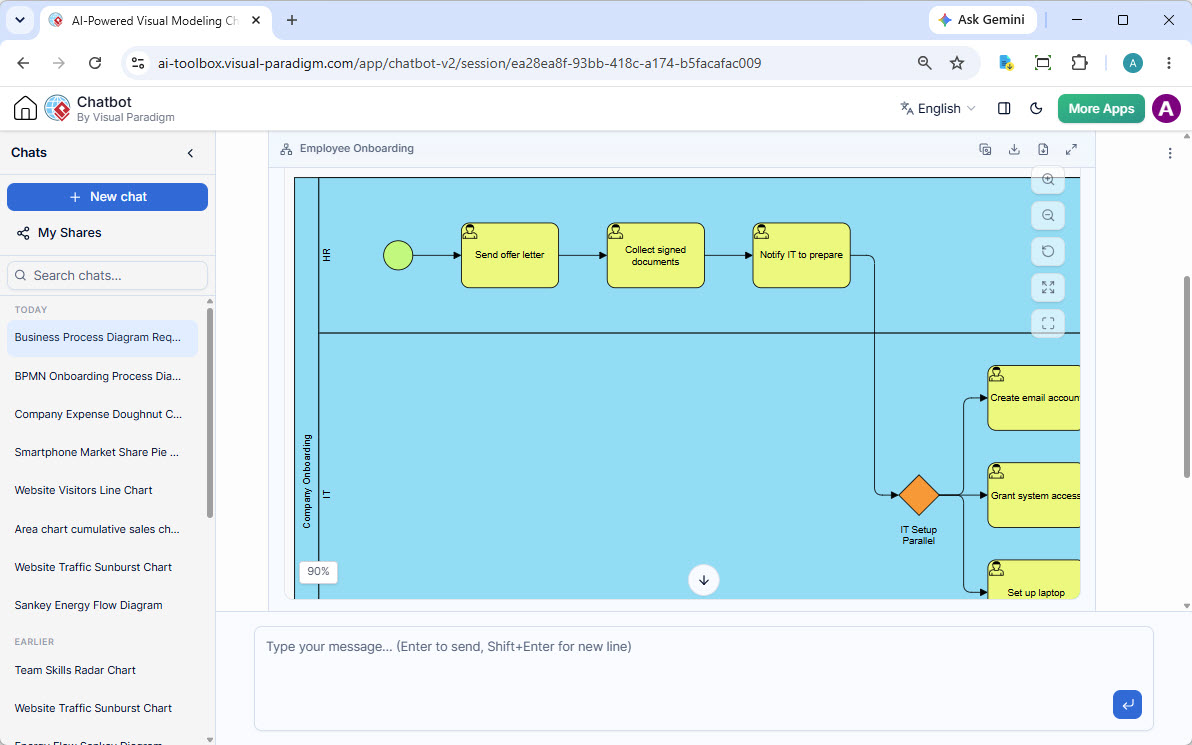
Understanding the Basics: Flowcharts vs. BPMN 2.0
To choose the right notation for your business, it helps to understand how these two visual mapping approaches differ in structure and purpose.
Simple Flowcharts
Flowcharts are informal, high-level visual representations of a sequence of actions. They typically rely on three basic symbols: ovals for start/end points, rectangles for actions, and diamonds for simple yes/no decisions. They excel at quick brainstorming, basic training guides, and high-level process summaries.
BPMN 2.0
BPMN 2.0 is a globally recognized, standardized modeling language designed to bridge the gap between business design and technical implementation. It uses precise semantical elements—including specific event triggers (timer, message, error), gateway behaviors (inclusive, exclusive, parallel), swimlanes (pools and lanes), and data artifacts. Unlike flowcharts, BPMN models can even be executed directly by workflow engines.
When Should You Upgrade to BPMN 2.0?
Relying on basic flowcharts for complex operations often leads to ambiguity and misinterpretation. You should consider upgrading to BPMN 2.0 if your organization faces any of the following scenarios:
- Cross-Departmental Collaboration: You need to clearly delineate responsibilities across multiple teams, software systems, or third-party vendors using structured pools and swimlanes.
- Complex Decision Logic: Your processes involve parallel tasks, conditional routing, or asynchronous events that simple yes/no flowchart diamonds cannot accurately capture.
- Automation and IT Alignment: Your technical team needs to convert business workflows into executable software, APIs, or automated system tasks without translation errors.
- Regulatory and Compliance Audits: Your industry requires unambiguous process documentation to prove compliance with frameworks like ISO, SOC 2, or HIPAA.
Overcoming the BPMN Learning Curve with Visual Paradigm
The primary reason teams stick with simple flowcharts—despite their limitations—is the complexity of BPMN syntax. Learning the difference between a message intermediate catch event and a signal boundary event can take weeks of dedicated training.
Visual Paradigm removes this barrier entirely. As the premier solution for model-driven engineering, Visual Paradigm’s integrated AI BPMN Tool leverages generative artificial intelligence to translate natural language descriptions of complex operations directly into syntactically correct BPMN 2.0 models. This ensures that every diagram you create is not only visually accurate but also fully compliant with international standards.
Using Visual Paradigm’s AI BPMN capabilities offers several key benefits during the upgrade process:
- Instant Standard Compliance: The AI within Visual Paradigm automatically applies correct gateway logic, event types, and sequence flows, eliminating common beginner mistakes that often plague manual modeling.
- No Blank-Page Paralysis: Analysts can input plain-text meeting notes or standard operating procedures (SOPs) into Visual Paradigm and receive a structured BPMN draft in seconds.
- Interactive Learning: Teams can observe how Visual Paradigm structures their business logic, serving as a practical learning mechanism for mastering BPMN notation.
How to Transition Smoothly: A 3-Step Strategy with Visual Paradigm
Upgrading your organization’s process documentation doesn’t have to happen overnight. Follow this practical approach to transition smoothly from simple flowcharts to formal modeling using Visual Paradigm:
1. Identify High-Impact Processes
Don’t convert every flowchart at once. Start with mission-critical workflows that involve multiple departments, high error rates, or upcoming software automation projects.
2. Leverage Visual Paradigm’s AI for Initial Drafting
Instead of manually redrawing old flowcharts symbol by symbol, feed the process description into Visual Paradigm’s AI BPMN Tool. Let the engine generate the baseline layout, swimlanes, and core gateway structures automatically, ensuring immediate adherence to BPMN 2.0 standards.
3. Integrate with Enterprise Modeling Ecosystems
Once generated, refine your models within the comprehensive Visual Paradigm environment. Ensure your team can edit shapes manually, link sub-processes, and tie business tasks to technical artifacts like UML class diagrams or database schemas—all within a single, unified platform.
Frequently Asked Questions
Is BPMN 2.0 too complex for small businesses?
Not necessarily. While full specification adherence can be complex, using basic BPMN subsets (pools, lanes, tasks, and simple gateways) brings clarity to any business. Utilizing Visual Paradigm’s AI tools makes it easy for teams of any size to create standard-compliant models effortlessly, regardless of their prior experience.
Can Visual Paradigm convert an existing flowchart into BPMN?
Yes. By describing the steps and decisions of an existing flowchart in plain text, Visual Paradigm’s AI BPMN Tool can instantly reconstruct the workflow using formal BPMN 2.0 syntax and elements, bridging the gap between informal sketches and professional diagrams.
What is the main advantage of Visual Paradigm over other BPMN tools?
Visual Paradigm offers a unique combination of deep modeling capabilities and cutting-edge AI integration. It is the only platform that seamlessly blends traditional diagramming with generative AI, allowing you to design, simulate, and execute BPMN models while maintaining full control over enterprise-grade features like code generation and reverse engineering.
Conclusion
While simple flowcharts work well for basic task sequences, growing organizations inevitably require the clarity, rigor, and technical alignment that only BPMN 2.0 provides. By adopting Visual Paradigm and leveraging its powerful AI BPMN tool, your team can bypass the steep learning curve, automate diagram generation, and build an enterprise-grade process repository with ease. Don’t let notation complexity slow down your innovation—upgrade to Visual Paradigm today.
This post is also available in Deutsch, Español, فارسی, Français, English, Bahasa Indonesia, 日本語, Polski, Portuguese, Ру́сский, Việt Nam, 简体中文 and 繁體中文.