


Introduction
In today’s fast-paced software development landscape, visual modeling isn’t just a nice-to-have—it’s a strategic necessity. Unified Modeling Language (UML) has long served as the industry standard for designing, documenting, and communicating complex software systems. Yet, the true power of UML remains unlocked without the right tooling, process integration, and intelligent automation.
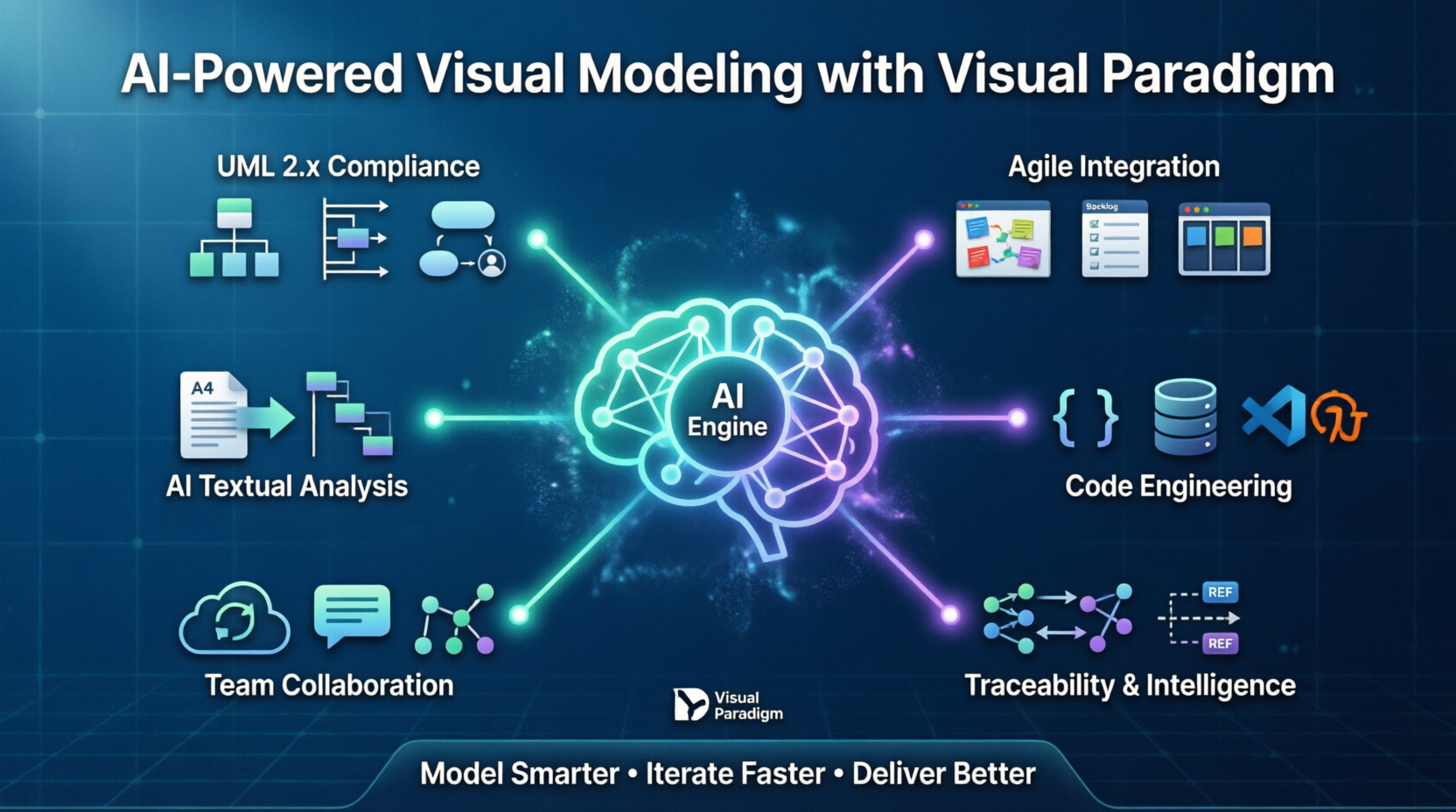
Enter Visual Paradigm: a comprehensive, AI-enhanced visual modeling platform designed to bridge the gap between conceptual design and executable software. By combining rigorous UML 2.x compliance with agile workflows, code engineering, team collaboration, and cutting-edge AI capabilities, Visual Paradigm empowers architects, developers, and product teams to model smarter, iterate faster, and deliver higher-quality systems—without sacrificing clarity or traceability.
This guide explores how Visual Paradigm’s integrated ecosystem, particularly its AI-powered features, transforms visual modeling from a static documentation exercise into a dynamic, intelligent engine for modern software development.
Overview
UML (Unified Modeling Language) has become a widely adopted industry standard for modeling software systems. However, to fully harness UML’s visual modeling capabilities, teams need robust process support and intelligent tooling. The business world is complex, dynamic, and fast-changing—there is no “one-size-fits-all” methodology. Visual Paradigm provides a rich, flexible suite of UML design tools that developers can tailor to meet the demands of today’s challenging projects.
-
Previous Slide◀︎ Next Slide▶︎
-
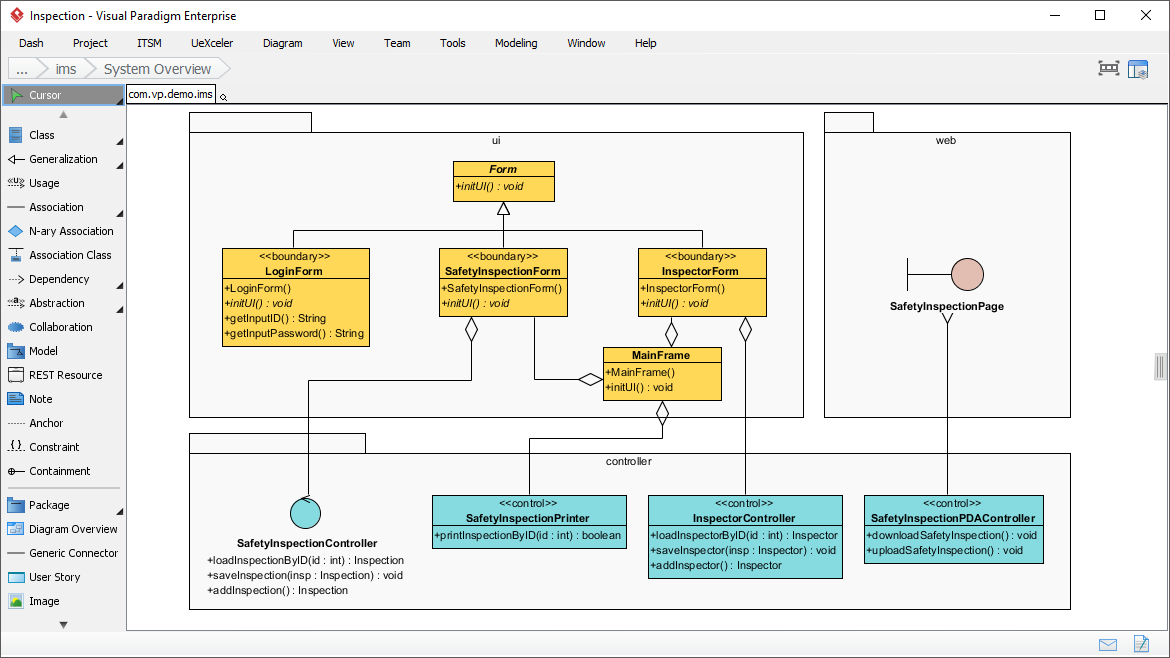 A comprehensive UML tool that supports the latest UML 2.x diagrams and notations.
Key Capabilities at a Glance:
-
Best UML Tool for Visual Modeling
-
Class Diagram Design
-
Integrate UML with BPMN
-
Create Product Backlog from Use Case Model
-
Use Case Scenario & Sequence Diagram Generation
-
Wireframe in Use Case
-
IDE Integration
-
Synchronization between ERD and UML Class Diagram
-
Document Generation
-
Communicate Software Design Online
-
Online Sequence Diagram Tool
Your Challenges: Why Generic Diagramming Tools Fall Short
While web-based or lightweight diagrammers may appear attractive for their zero-configuration setup, they often lack the depth required for enterprise-scale modeling:
🔹 No Model Reusability: A class created in one diagram cannot be referenced as a view elsewhere or shared across projects—limiting scalability and consistency.
🔹 Siloed Diagrams: Diagrams exist as isolated artifacts with no traceability, making impact analysis and requirement tracking nearly impossible.
🔹 Limited Process Integration: Absence of tooling to support teamwork, agile development, UX modeling, code engineering, or enterprise project management.
🔹 Visio-Like Limitations: Traditional diagramming tools like Visio are suitable for simple visuals but lack advanced editing, layout intelligence, and model-driven capabilities needed for complex software architecture.
Our Solution: Visual Paradigm’s Integrated Modeling Ecosystem
✨ Excellent Visual Modeling Toolset
-
Full support for the latest UML 2.x standard with all 14 diagram types
-
Extended modeling standards: BPMN, Mind Map, Textual Analysis, and project management frameworks (ArchiMate, Fishbone, PERT, Gantt, WBS, Radar Chart, and more)
🔄 Integrate UML with Agile / Scrum Processes
-
Seamlessly apply use case modeling within agile workflows by linking use cases to story maps for backlog management and release planning
-
Populate your agile product backlog from multiple visual sources: use cases, activity diagrams, BPMN tasks, or mind map nodes
-
Transform large requirements (e.g., use cases) into manageable user stories or epics, organized within a visual story map
-
Automatically break down user stories into tasks managed via the integrated task manager
💻 Code Engineering Toolset
-
Generate production-ready code from class and state diagrams for popular languages (Java, C#, Python, etc.)
-
Reverse-engineer databases from ERDs and map objects to relational schemas using the Hibernate framework
-
Deep integration with leading IDEs: Visual Studio, IntelliJ, NetBeans, Eclipse, and Android Studio
🔗 Inter-Model Traceability & Intelligence
-
Maintain end-to-end model traceability through reusable model references, sub-diagrams, cross-project linking, annotations, and attachments
-
Automatically generate sequence or activity diagrams from detailed use case scenarios
-
Enhance use cases with interactive wireframe prototypes
-
Use the Model Transitor feature to identify classes from sequence diagrams and propagate changes across related models
📄 On-Demand Report Designer
-
Drag-and-drop model elements or diagrams to compose custom reports in Word, PDF, or HTML formats
-
Embed live model content into corporate documentation using the Fill-in Documentation Composer for always-up-to-date artifacts
👥 Team Collaboration & Cloud Integration
-
Enable real-time concurrent editing with built-in version control, merge capabilities, and conflict resolution
-
Share, discuss, and comment on diagrams via PostMania, Visual Paradigm’s cloud collaboration hub
-
Organize references and documents in a visual, searchable File Cabinet
🌐 Web Diagrams & Community Resources
-
Access Web Diagrams online at no extra cost: BPMN, ArchiMate®, class diagrams, use case diagrams, sequence diagrams, flowcharts, PERT, ITIL, AWS, and Azure diagrams
-
Explore and import ready-to-use templates from the Visual Paradigm Community Circle for rapid learning and prototyping
🤖 Supercharge Modeling with Visual Paradigm’s AI-Powered Ecosystem
Visual Paradigm doesn’t just support UML—it intelligently augments it. Its AI-driven features accelerate modeling, reduce manual effort, and improve accuracy across the development lifecycle:
🔍 AI Textual Analysis
-
Automatically extract system entities, relationships, and behaviors from natural language requirements
-
Generate initial class diagrams, use case models, or activity diagrams directly from user stories or specification documents
-
Reduce ambiguity and accelerate the transition from idea to structured model
⚡ AI-Assisted Diagram Generation
-
UML Class Diagram Generator: Describe your domain in plain English, and AI suggests classes, attributes, operations, and relationships
-
Sequence Diagram Creator: Input a scenario description, and AI drafts a professional sequence diagram with lifelines, messages, and fragments
-
Use Case to Activity Diagram Converter: Transform high-level use cases into detailed workflow diagrams with AI-guided step decomposition
💬 AI Chatbot for Modeling Support
-
Get instant help creating component diagrams, package diagrams, or other UML artifacts via natural language commands
-
Learn UML concepts interactively with real-time feedback, examples, and visualizations
-
Accelerate onboarding for new team members with guided, conversational modeling assistance
🧠 Intelligent Model Optimization
-
AI analyzes diagram structure to suggest layout improvements, detect inconsistencies, or recommend modeling best practices
-
Automatically identify missing elements or relationships based on contextual patterns
-
Enhance model quality and maintainability without manual review overhead
By embedding AI throughout the modeling workflow, Visual Paradigm transforms visual modeling from a manual, time-intensive task into an intelligent, collaborative, and iterative design process—freeing teams to focus on architecture, innovation, and value delivery.
Conclusion
Visual modeling is no longer just about drawing boxes and arrows—it’s about creating living, intelligent blueprints that drive software success. Visual Paradigm rises to this challenge by offering a unified, AI-enhanced platform that combines rigorous UML compliance with agile flexibility, code engineering precision, and seamless team collaboration.
Whether you’re architecting enterprise systems, iterating on a startup MVP, or modernizing legacy applications, Visual Paradigm’s ecosystem empowers you to model with confidence, trace requirements end-to-end, generate production artifacts, and leverage AI to accelerate every phase of development.
In a world where complexity is the only constant, the right modeling tool isn’t a luxury—it’s your strategic advantage. With Visual Paradigm, you don’t just document your system—you intelligently design its future.
- References
- AI-Powered Visual Modeling and Design Solutions: This resource highlights AI-driven tools for visual modeling and diagramming that accelerate software development workflows.
- AI Textual Analysis – Transform Text into Visual Models Automatically: AI identifies system elements from unstructured descriptions to automatically generate UML diagrams, such as class and use case models.
- AI-Powered UML Class Diagram Generator: This tool utilizes AI-assisted automation to generate accurate UML class diagrams directly from natural language input.
- Mastering UML Activity Diagrams with AI: This article explores how AI features enhance the creation and optimization of UML activity diagrams for developers and analysts.
- Visual Paradigm – AI-Powered UML Sequence Diagrams: This resource explains how to generate professional UML sequence diagrams instantly using AI within a modeling suite.
- AI-Powered Use Case to Activity Diagram Tutorial: A step-by-step guide demonstrating how to automatically convert use case descriptions into detailed activity diagrams using AI automation.
- The Future of Modeling: AI and UML Diagram Generation: This analysis discusses how artificial intelligence is transforming UML diagram creation by streamlining complex modeling tasks.
- AI-Powered Component Diagrams with Visual Paradigm Chatbot: This article details how the AI chatbot simplifies component diagram creation by transforming natural language into precise models.
- UML Package Diagram: Structuring Your Codebase with AI: A guide on using AI to aid in structuring systems, managing dependencies, and maintaining scalable software architecture through UML package diagrams.
- How AI Chatbot Can Help You Learn UML Faster: This blog post explains how AI assistants support interactive UML learning by providing real-time feedback and visualizing concepts instantly.
This post is also available in Deutsch, Español, فارسی, Français, English, Bahasa Indonesia, 日本語, Polski, Portuguese, Ру́сский, Việt Nam, 简体中文 and 繁體中文.
Related posts:
 Visual Paradigm AI: Generate Professional UML Use Case Diagrams from Text in Seconds
 GourmetReserve Development Simplified: Transforming Requirements with the Best AI-Powered Use Case Modeling Studio
 The Best AI-Powered Database Modeling Tool for Designing Hospital Systems: Visual Paradigm Online
 Automating Student Record System Analysis: From Raw Text to Class Models with Visual Paradigm