


Target Audience: College and high school students struggling with stress, anxiety, and time management.
Mission: Use AI to deliver personalized mental wellness guidance and productivity coaching via a mobile app.
🧩 Step-by-Step Breakdown of the Business Model Canvas
The Business Model Canvas (BMC) is a strategic tool used to design, visualize, and innovate business models. It consists of nine interconnected components. Let’s walk through each one for NeuraMind AI.
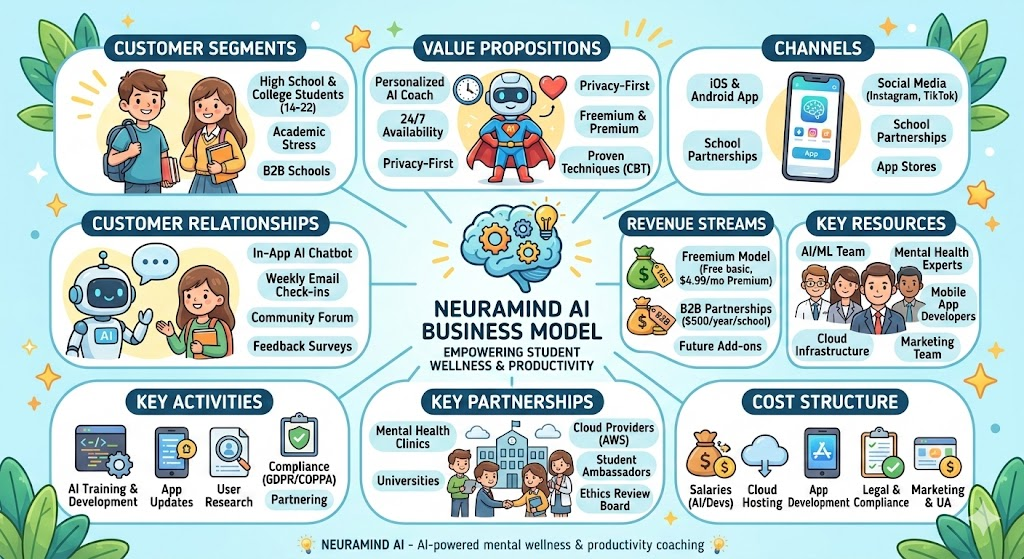
1. Customer Segments
(Who are your customers?)
Primary Segments:
-
High school and college students (ages 14–22)
-
Students experiencing academic stress, anxiety, or burnout
-
Parents and teachers looking for mental wellness tools for students
Secondary Segments:
-
Schools and universities (B2B partners)
-
Mental health counselors and coaches
✅ Why this matters: NeuraMind AI targets a specific, underserved group — youth facing mental health challenges during a high-pressure academic journey.
2. Value Propositions
(What value do you deliver?)
Core Benefits:
-
Personalized AI Coach: An AI that learns from user input (mood, study habits, stress levels) and gives tailored advice.
-
24/7 Availability: Instant emotional support and productivity tips anytime, anywhere.
-
Privacy-First Design: No data sharing with third parties; all conversations are encrypted.
-
Free Tier + Premium Features: Free basic tools (daily mood check-in, breathing exercises), with paid upgrades (AI journaling, weekly progress reports, expert chat).
-
Proven Mental Wellness Techniques: Based on CBT (Cognitive Behavioral Therapy), mindfulness, and time management science.
✅ Unique Value: Combines AI with mental wellness science in a simple, accessible, and affordable app.
3. Channels
(How do you reach your customers?)
-
Mobile App (iOS & Android): Primary delivery platform.
-
Social Media (Instagram, TikTok, YouTube Shorts): Share mental wellness tips, student testimonials, and AI chat snippets.
-
Partnerships with Schools: Offer free pilot programs to schools for student wellness.
-
App Stores (Google Play & Apple App Store): Distribution channels.
-
Referral Program: Invite friends, unlock premium features.
✅ Key Insight: The app is the main channel, but social media and school partnerships help build trust and awareness.
4. Customer Relationships
(How do you maintain relationships with customers?)
-
In-App AI Chatbot: Provides real-time, empathetic responses.
-
Weekly Email Check-ins: Personalized wellness tips and mood summaries.
-
Community Forum (in-app): Safe space for students to share experiences anonymously.
-
Feedback Surveys: Ask users how they feel about the app and what to improve.
-
Dedicated Support Team: Responds to questions within 24 hours.
✅ Focus: Build trust, encourage engagement, and foster long-term loyalty.
5. Revenue Streams
(How does the business make money?)
-
Freemium Model:
-
Free Tier: Basic mood tracking, 5-min guided meditations, daily tips.
-
Premium Tier ($4.99/month or $49.99/year): Full AI coaching, advanced analytics, personalized journaling, offline access, and priority support.
-
-
B2B Partnerships:
-
Schools pay $500/year per school to license the app for all students (includes analytics dashboard for counselors).
-
-
Future Add-ons:
-
One-time purchase for “Stress Relief Pack” (specialized audio guides, study planners).
-
✅ Diversified Revenue: Mix of individual subscriptions and institutional sales increases stability.
6. Key Resources
(What do you need to make it work?)
-
AI/ML Team: Data scientists and engineers to train and maintain the AI model.
-
Mental Health Experts: Psychologists and wellness coaches to validate content.
-
Mobile App Developers: Build and maintain the iOS and Android apps.
-
Cloud Infrastructure (AWS/Google Cloud): Host AI models and user data securely.
-
Brand & Marketing Team: Create content, manage social media, and run campaigns.
✅ Critical: The AI and mental health expertise are the core intellectual assets.
7. Key Activities
(What must you do to run the business?)
-
Develop and train the AI model using anonymized user data (with consent).
-
Regularly update the app with new features and wellness content.
-
Conduct user research and A/B testing for UX improvements.
-
Maintain AI ethics and privacy standards (GDPR, COPPA compliance).
-
Partner with schools and wellness organizations.
-
Monitor app performance and user feedback.
✅ Focus: Innovation, user trust, and continuous improvement.
8. Key Partnerships
(Who helps you succeed?)
-
Mental Health Clinics & Universities: Provide expert content and credibility.
-
Cloud Service Providers (e.g., AWS): Host AI models and store data securely.
-
App Development Agencies: Help with app updates and maintenance.
-
Student Ambassadors: Promote the app on campuses and social media.
-
Ethics Review Board (Academic): Ensure AI use is ethical and bias-free.
✅ Why Partnerships Matter: They help scale faster, reduce risk, and add trust.
9. Cost Structure
(What are your major costs?)
-
Fixed Costs:
-
Salaries (AI engineers, developers, mental health experts)
-
Cloud hosting and API usage fees
-
App development and maintenance
-
Legal and compliance (privacy policies, data protection)
-
-
Variable Costs:
-
Marketing and user acquisition (ads, influencer campaigns)
-
Customer support team
-
Content creation (videos, articles, audio guides)
-
💡 Cost Optimization Tip: Use open-source AI models (like Hugging Face) to reduce training costs.
✅ Revenue vs. Cost: The freemium model helps cover costs through premium users and B2B contracts.
✅ Summary: NeuraMind AI Business Model Canvas (Quick Recap)
| Block | Details |
|---|---|
| Customer Segments | Students (14–22), schools, parents |
| Value Propositions | AI-powered mental wellness + productivity coaching, private & free-to-try |
| Channels | Mobile app, social media, school partnerships |
| Customer Relationships | AI chat, email check-ins, community forum |
| Revenue Streams | Freemium subscriptions, B2B licensing |
| Key Resources | AI team, mental health experts, cloud infrastructure |
| Key Activities | AI training, app updates, user research, compliance |
| Key Partnerships | Universities, cloud providers, mental health clinics |
| Cost Structure | Salaries, cloud costs, marketing, support |
🎯 Why This Works for Beginners
-
Simple, real-world example: Uses a relatable problem (student stress).
-
Clear structure: Each BMC block is explained with actionable insights.
-
Balanced model: Mixes free and paid, individual and B2B customers.
-
Ethical & Scalable: Prioritizes privacy and mental health, with growth potential.
📌 Conclusion
The Business Model Canvas is a powerful, beginner-friendly tool to map out any startup idea — even in AI tech. By breaking down NeuraMind AI into its nine components, we see how a simple idea can become a scalable, impactful, and profitable business.
✨ Remember: Great startups start with a clear problem, a smart solution, and a well-thought-out model. Use the BMC to design yours!
Let this case study be your first step into the world of startup thinking — one block at a time. 🚀
Created for educational purposes. NeuraMind AI is a fictional company used for demonstration.
This post is also available in Deutsch, Español, فارسی, Français, English, Bahasa Indonesia, 日本語, Polski, Portuguese, Ру́сский, Việt Nam, 简体中文 and 繁體中文.