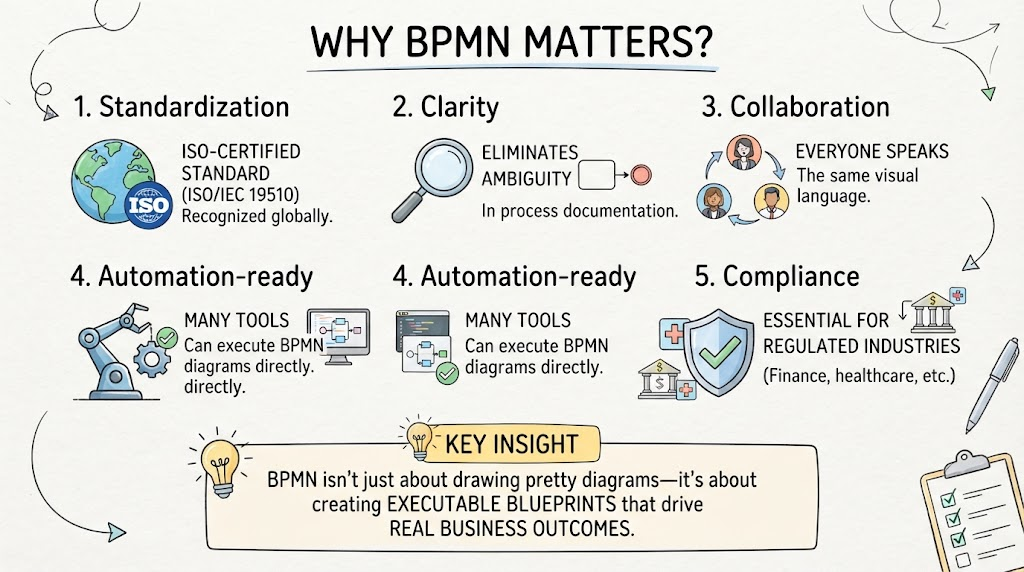
In the rapidly evolving landscape of digital transformation, businesses face a critical challenge: how to bridge the gap between abstract business strategies and concrete technical execution. The answer lies in Business Process Model and Notation (BPMN). Far from being a simple drawing tool, BPMN serves as the universal architecture for business logic.
This tutorial explores the strategic importance of BPMN, moving beyond the basics to understand why it is the backbone of modern enterprise architecture. We will examine how it ensures standardization, eliminates ambiguity, and facilitates the transition from conceptual models to executable code.
1. Standardization: The Global Language of Process
The first pillar of BPMN’s success is its rigorous standardization. Unlike proprietary diagramming methods that can be confusing to outsiders, BPMN is an open standard managed by the Object Management Group (OMG). It is ISO-certified under ISO/IEC 19510.
This certification means that a BPMN diagram created by a consultant in London is instantly readable by an analyst in Tokyo or a developer in New York. It removes the “translator” layer, ensuring that the process definition remains consistent regardless of the software tool used to create it.
Why ISO Certification Matters
- Interoperability: Models can be exchanged between different vendors without losing meaning.
- Longevity: Processes are documented in a format that is unlikely to become obsolete, protecting the organization’s intellectual property.
- Trust: Regulatory bodies and partners trust a standardized format over ad-hoc diagrams.
2. Clarity: Eliminating Ambiguity in Documentation
One of the most common causes of project failure is the “telephone game” effect, where requirements are passed down and altered until the original intent is lost. BPMN combats this through its graphical syntax.
By using a strict set of symbols (Events, Activities, Gateways, and Flows), BPMN removes the ambiguity of natural language. Instead of writing a paragraph describing a workflow that could be interpreted in multiple ways, a BPMN diagram forces the modeler to define the exact path, decision points, and actors involved.
3. Collaboration: Speaking the Same Visual Language
BPMN acts as a Rosetta Stone between business stakeholders and technical teams. It is designed to be “executable” by humans, not just machines.
- Business Users: Can read the diagram to understand the “As-Is” state of a process without needing to understand code.
- Developers: Can look at the same diagram to understand the logic required to build the software.
- Managers: Can identify bottlenecks and compliance risks visually.
This shared visual language ensures that everyone—from the CEO to the software engineer—is aligned on the process goals.
4. Automation-Ready: From Diagram to Code
Perhaps the most powerful aspect of BPMN is its “Automation-ready” nature. In traditional modeling, the diagram is often a static document that sits in a folder. In BPMN, the diagram is a dynamic blueprint.
Many modern BPM engines and Low-Code platforms (such as Visual Paradigm) can interpret BPMN XML directly. This means that the diagram you draw doesn’t just describe the process; it can execute the process. This drastically reduces the time between concept and deployment.
5. Compliance: Essential for Regulated Industries
In industries like finance, healthcare, and government, documentation is not optional—it is a legal requirement. BPMN provides a structured audit trail.
Because BPMN allows for the explicit modeling of roles (Swimlanes), timestamps, and decision logic, it is the ideal tool for demonstrating compliance with regulations like HIPAA, GDPR, or SOX. You can prove exactly who did what, when, and why within the system.
Key Insight: Executable Blueprints
The ultimate takeaway from the importance of BPMN is that it shifts the paradigm from documentation to execution. A BPMN diagram is not just a “pretty picture” for a presentation deck; it is a formal specification that drives real business outcomes. Whether it is used to automate a customer onboarding flow or to audit a financial transaction, BPMN provides the rigorous framework necessary for modern business operations.