


🔍 Introduction: Why Requirement Modeling Matters
Requirements define what the system must do. Poorly defined or ambiguous requirements lead to:
- Scope creep
- Rejected features
- Cost overruns
- Delayed delivery
- Poor user satisfaction
Effective requirement modeling ensures:
✅ Clarity
✅ Testability
✅ Traceability
✅ Collaboration
✅ Compliance (especially in regulated domains)
🎯 Goal: Transform stakeholder needs into structured, actionable, and verifiable inputs for design and development.
📌 Core Concepts Across All Three Techniques
| Concept | Role |
|---|---|
| Stakeholders | People or systems affected by or interacting with the system (e.g., Customer, Bank, ATM). |
| Functional Requirements | What the system does (e.g., “dispense cash”). |
| Non-Functional Requirements | How well the system performs (e.g., “responds in <2 seconds”, “secure against fraud”). |
| Traceability | Linking requirements to design, tests, and implementation to ensure completeness and verification. |
| Verification vs. Validation | Verification: Are we building the product right? Validation: Are we building the right product? |
💡 Note: While all three techniques support these concepts, they differ in how they express them.
✅ 1. Use Cases (UML – Unified Modeling Language)
“Describe what the system does from the user’s point of view.”
🎯 Primary Focus
- System behavior and interactions between actors and the system.
- Emphasis on step-by-step workflows and edge cases.
🛠 How It Works
- Start with a Use Case Diagram – Visual overview of actors and goals.
- Write detailed textual specifications for each use case (main success, alternatives, exceptions).
- Use in requirements analysis, design, and testing.
🧩 Key Concepts
| Term | Description |
|---|---|
| Actor | External entity that interacts with the system (e.g., Customer, Bank Server). |
| Use Case | A goal-oriented interaction (e.g., “Withdraw Cash”) represented as an oval. |
| Relationships | «include» (mandatory), «extend» (optional), generalization (inheritance). |
| Scenarios | Concrete paths through the use case (main flow, alternative flows, exception flows). |
| Preconditions | What must be true before the use case starts. |
| Postconditions | What must be true after completion. |
| Trigger | Event that starts the use case (e.g., card inserted, login successful). |
📚 Example: ATM System – “Withdraw Cash”
Use Case Diagram (Visual Overview)
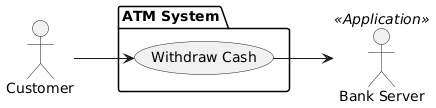
Arrows show interaction.
«extend»could link to “Check Balance” or “Request Receipt”.
Textual Specification: “Withdraw Cash”
- Actor: Customer
- Precondition: Customer is authenticated (valid card + correct PIN).
- Main Success Scenario:
- Customer selects “Withdraw Cash”.
- System prompts: “Enter amount (multiple of $20).”
- Customer enters $100.
- System checks balance: ≥ $100 → dispenses cash.
- Prints receipt, ejects card.
- Alternative Flow (Insufficient Funds):
- Step 4: Balance < requested amount → display error: “Insufficient funds.”
- Return to main menu.
- Exception Flow (Invalid PIN after 3 tries):
- After 3 failed attempts → card retained.
- System logs incident and alerts bank.
- Postcondition: Account balance reduced by amount; cash dispensed; receipt printed.
✅ Strengths
- Excellent for complex behaviors and edge cases.
- Strong traceability to design and testing.
- Ideal for regulatory compliance and formal verification.
- Supports modular design via
«include»and«extend».
❌ Weaknesses
- Can become very verbose and hard to manage at scale.
- Less flexible in Agile environments where change is constant.
- Focus on how may obscure why.
🔄 Best for: Waterfall projects, regulated industries (banking, healthcare), large enterprise systems.
📝 2. User Stories (Agile / Scrum)
“Small, valuable, and user-centric — delivered fast.”
🎯 Primary Focus
- User value, collaboration, and iterative delivery.
- Emphasis on what users want and why.
🛠 How It Works
- Written on index cards, digital tools (Jira, Trello), or backlog items.
- Placed in product backlog.
- Refined during backlog grooming with acceptance criteria.
- Developed via conversations (the “3 C’s”: Card, Conversation, Confirmation).
- Estimated in story points, broken into tasks during sprint planning.
🧩 Key Concepts
| Concept | Description |
|---|---|
| Format | “As a [role], I want [goal] so that [benefit].” |
| INVEST Criteria | Independent, Negotiable, Valuable, Estimable, Small, Testable. |
| Acceptance Criteria | Conditions that must be met for the story to be accepted. Often written in Gherkin (Given, When, Then). |
| Epics & Themes | Large stories broken into smaller, manageable ones. |
| Conversation-Driven | Details emerge through team discussions, not upfront documentation. |
📚 Example: ATM System – Withdraw Cash
User Story Card
As a bank customer,
I want to withdraw cash from an ATM,
so that I can access my money quickly without visiting a branch.
Acceptance Criteria (Gherkin Style)
Given my account has sufficient funds and my card is valid
When I enter a valid amount (multiple of $20)
Then cash should be dispensed, a receipt printed, and my balance updated

Given my account has insufficient funds
When I request a withdrawal
Then an error message should appear and no cash should be dispensed

Rule: Maximum withdrawal amount per transaction is $500
✅ Strengths
- Promotes collaboration and shared understanding.
- Prioritizes user value and fast feedback.
- Fits perfectly with Agile/Scrum/Kanban.
- Lightweight and easy to manage in backlogs.
❌ Weaknesses
- Lacks built-in detail for complex flows or non-functional requirements.
- Traceability is manual unless linked via tools.
- Risk of incomplete acceptance criteria leading to bugs.
🔄 Best for: Agile teams, startups, fast-moving projects, MVPs.
🧱 3. Requirement Diagrams (SysML – Systems Modeling Language)
“Model the requirements themselves — not just their behavior, but their structure and traceability.”
🎯 Primary Focus
- Structured modeling of requirements with full traceability, verification, and satisfaction relationships.
- Used in Model-Based Systems Engineering (MBSE).
🛠 How It Works
- Requirements are first-class elements represented as rectangles with:
- ID (e.g., REQ-001)
- Text
- Type (Functional, Performance, Design Constraint, etc.)
- Priority (High, Medium, Low)
- Connected via relationships to other elements:
«satisfy»→ design element (e.g., a block or component)«verify»→ test case«deriveReqt»→ derived from another requirement«trace»/«refine»/«copy»
🧩 Key Concepts
| Term | Description |
|---|---|
| «requirement» | Stereotype for a requirement element. |
| Hierarchy | Parent → child (refinement) via «refine». |
| Derivation | «deriveReqt» shows logical derivation (e.g., “Withdrawal limit” derived from “Security” requirement). |
| Satisfaction | «satisfy» links a requirement to a design element (e.g., ATM module satisfies withdrawal rule). |
| Verification | «verify» links a requirement to a test case. |
| Non-Functional Support | Explicitly models performance, safety, security, usability, etc. |
📚 Example: ATM System – Security & Withdrawal Requirements
Requirement Diagram (Conceptual)
[Req1: Login] ────«satisfy»───> [Login System Block]
                     └───«verify»───> [Test Case: Valid Login]
                     └───«trace»────> [Stakeholder: Customer]

[Req2: Withdrawal Limit] ──«deriveReqt»───> [Req1]
                             └───«satisfy»───> [ATM Software Module]
                             └───«verify»────> [Test Case: Max $500]

[Req3: Balance Check] ────«satisfy»───> [Balance Inquiry Module]
                           └───«verify»────> [Test Case: Balance Update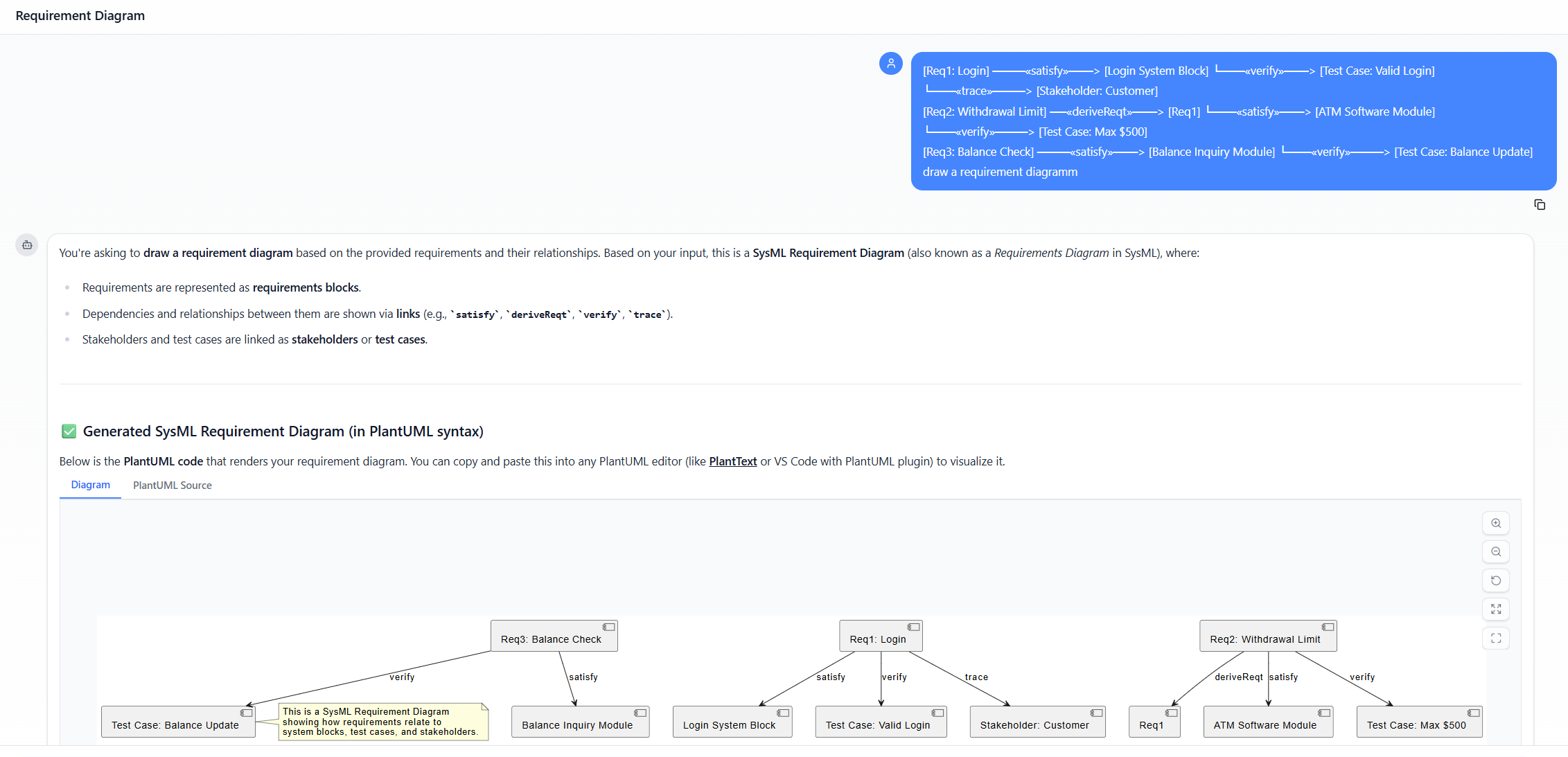
All requirements are explicitly linked to design and test artifacts.
✅ Strengths
- Superior traceability across all lifecycle phases.
- Excellent for non-functional requirements (security, performance, reliability).
- Enables automated compliance checks and audit readiness.
- Ideal for large, safety-critical systems (e.g., aerospace, automotive, medical devices).
❌ Weaknesses
- Steep learning curve and requires SysML tools (e.g., MagicDraw, Cameo, Sparx EA).
- Overkill for simple applications or small Agile teams.
- Less intuitive for non-technical stakeholders.
🔄 Best for: Complex systems engineering, regulated industries, MBSE practices, large-scale enterprise systems.
🔍 Side-by-Side Comparison Table
| Aspect | Use Cases (UML) | User Stories (Agile) | Requirement Diagrams (SysML) |
|---|---|---|---|
| Primary Focus | System behavior & interactions (“how”) | User value & goals (“what & why”) | Requirements structure & traceability |
| Format | Diagram + detailed text (scenarios) | Short card + acceptance criteria | Visual diagram with boxes & arrows |
| Detail Level | High (step-by-step flows) | Low-to-medium (conversation-driven) | Variable (can be detailed) |
| Visualization | Use Case Diagram (actors + ovals) | Usually none (cards or backlog) | Requirement boxes with labeled arrows |
| Methodology Fit | Waterfall, structured, traditional | Agile/Scrum/Kanban | Model-Based Systems Engineering (MBSE) |
| Best For | Complex flows, testing, compliance | Fast iteration, user focus, MVPs | Traceability, non-functional reqs, regulated systems |
| Handles Non-Functional? | Yes (in text) | Limited (in acceptance criteria) | Excellent (dedicated types) |
| Traceability | Moderate (to design/tests) | Low (manual) | High (built-in relationships) |
| Tooling | UML tools (StarUML, Enterprise Architect) | Jira, Trello, Azure DevOps | SysML tools (MagicDraw, Cameo) |
| Ease of Use | Medium | High | Low (for non-engineers) |
🔄 Choosing the Right Technique (or Combining Them)
🎯 No single technique fits all. The key is to use them strategically — often together.
✅ Recommended Hybrid Approach (Best Practice)
@startuml
skinparam ActivityBackgroundColor #ECEBFF
skinparam ActivityBorderColor #A18EE3
skinparam ActivityFontSize 14
skinparam ArrowColor #666666
skinparam DiamondBackgroundColor #ECEBFF
skinparam DiamondBorderColor #A18EE3

start

:High-Level Needs;
:User Stories;

if (Complex or Critical?) then (Yes)
:Refine into Use Cases;
else (No)
:Proceed with Acceptance\nCriteria;
endif

:Model in Requirement\nDiagram;
:Link to Design, Tests, and\nValidation;

stop
@enduml
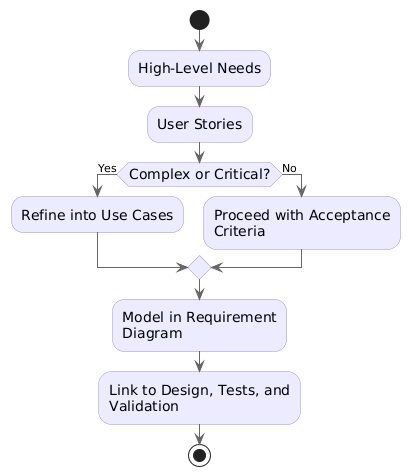
🧩 Step-by-Step Integration Strategy
- Start with User Stories
- Capture user needs in simple, value-driven language.
- Prioritize in the product backlog.
- Refine Complex Stories into Use Cases
- For stories involving complex logic (e.g., withdrawal with limits, multi-step authentication).
- Use use cases to document full scenarios, exception handling, and triggers.
- Model Everything in a Requirement Diagram (SysML)
- Convert all user stories and use cases into formal requirements.
- Assign IDs, types (functional/performance), and priorities.
- Link to:
- Design blocks (via
«satisfy») - Test cases (via
«verify») - Stakeholders (via
«trace») - Other requirements (via
«deriveReqt»,«refine»)
- Design blocks (via
- Maintain Traceability Matrix (RTM)
- Use the diagram to generate a Requirements Traceability Matrix (RTM).
- Ensure every requirement is verified and validated.
🏁 Final Thoughts: Choosing Your Approach
| Project Type | Recommended Technique(s) | Why |
|---|---|---|
| Agile Startup / MVP | User Stories + Acceptance Criteria | Fast delivery, collaboration, minimal overhead |
| Enterprise Banking App | User Stories → Use Cases → Requirement Diagrams | Balance agility with traceability and compliance |
| Medical Device / Aerospace | Requirement Diagrams (SysML) | Regulatory compliance, safety-critical, full traceability |
| Government / Defense System | Requirement Diagrams (SysML) + Use Cases | Formal verification, audit readiness |
| Small Team, Rapid Prototyping | User Stories with lightweight acceptance criteria | Speed and simplicity |
📌 Summary: The Big Picture
| Technique | Strengths | Weaknesses | Ideal For |
|---|---|---|---|
| Use Cases | Detailed behavior, edge case handling, testable | Verbose, less agile-friendly | Complex systems, testing, documentation |
| User Stories | Agile, collaborative, user-focused | Lacks detail, poor traceability | Fast iteration, MVPs, Scrum teams |
| Requirement Diagrams | Full traceability, supports non-functional, MBSE-ready | Steep learning curve, tooling needed | Regulated, large-scale, safety-critical systems |
✅ Pro Tip: Use User Stories to start, Use Cases to deepen complexity, and Requirement Diagrams to ensure compliance, traceability, and verifiability.
📚 Further Reading & Resources
- Books:
- User Stories Applied – Mike Cohn
- Use Case Modeling: A Practical Approach – Paul C. J. H. M. van der Aalst
- Applying UML and Patterns – Craig Larman
- Systems Engineering with SysML – John A. McDermott
- Tools:
- Jira / Azure DevOps – User stories & backlog management
- Visual Paradigm Desktop
- Standards:
- ISO/IEC/IEEE 29148:2018 – Systems and software engineering — Life cycle processes
- IEEE 830 – Standard for Software Requirements Specifications
- DO-178C (Aviation), IEC 61508 (Functional Safety)
🎯 Conclusion
Requirement modeling is not about choosing one method — it’s about choosing the right tool for the job.
- Use Cases teach us how the system behaves.
- User Stories remind us why we’re building it.
- Requirement Diagrams (SysML) ensure we don’t miss anything — and can prove it.
By combining these techniques wisely, teams can:
- Reduce ambiguity
- Improve collaboration
- Enhance testability
- Ensure compliance
- Deliver software that truly meets user needs
🔄 Remember: The best requirements are clear, testable, traceable, and valuable — regardless of the technique used.
✅ Final Takeaway:
Start with User Stories. Deepen with Use Cases. Validate with Requirement Diagrams.
Together, they form a powerful, cohesive framework for building the right thing, right.
📘 This guide is designed for software engineers, systems analysts, product owners, QA teams, and project managers. Adapt it to your project’s size, domain, and methodology.
- Visual Paradigm – Requirement Diagram Guide: This is a comprehensive guide for creating and managing requirement diagrams, covering the basics and best practices for software and system requirements modeling.
- What Is a User Story? A Complete Guide to Agile Requirements: This guide explains the core concept and structure of user stories in Agile development and their critical role in capturing user needs effectively.
- What Is a Use Case Diagram? – A Complete Guide to UML Modeling: An in-depth explanation of use case diagrams in UML, detailing their purpose, components, and best practices for requirements analysis.
- How to Draw Requirement Diagrams in Visual Paradigm: This tutorial provides step-by-step instructions on how to define, link, and manage requirements in a structured visual format.
- How to Write Effective User Stories: Best Practices and Templates: This section of the user guide provides templates and instructions for writing actionable and user-focused stories for product management.
- Step-by-Step Use Case Diagram Tutorial – From Beginner to Pro: A comprehensive tutorial that guides users through creating effective use case diagrams, ranging from basic concepts to advanced techniques.
- AI-Powered User Story 3Cs Editor: Enhance Clarity and Completeness: This resource highlights an AI-driven tool that helps Agile teams apply the 3Cs framework (Card, Conversation, and Confirmation) to their requirements.
- SysML Requirement Diagram Tool – Visual Paradigm Online: An overview of a tool designed for modeling complex system requirements with full compliance to SysML standards.
- Writing Effective User Stories: A Practical Guide for Agile Teams: A hands-on guide that uses real-world examples to walk teams through the process of crafting high-quality user stories for better collaboration.
-
Visualizing User Stories on Diagrams with Visual Paradigm: This guide demonstrates how to integrate user stories directly into diagrams, such as use case maps, to enhance understanding and traceability.
This post is also available in Deutsch, Español, فارسی, Français, English, Bahasa Indonesia, 日本語, Polski, Portuguese, Ру́сский, Việt Nam, 简体中文 and 繁體中文.