


Enterprise Architecture is the backbone of modern digital transformation. It provides the structure needed to align business strategy with technology execution. At the center of this discipline lies the ArchiMate language. For aspiring solution architects, understanding this modeling framework is not just a nice-to-have; it is a fundamental requirement for clear communication and effective design.
This guide offers a deep dive into the ArchiMate language. We will explore the layers, the relationships, and the practical application of these concepts within a solution architecture context. No specific software tools will be mentioned here; instead, the focus remains entirely on the conceptual framework and the logic that drives successful enterprise modeling.
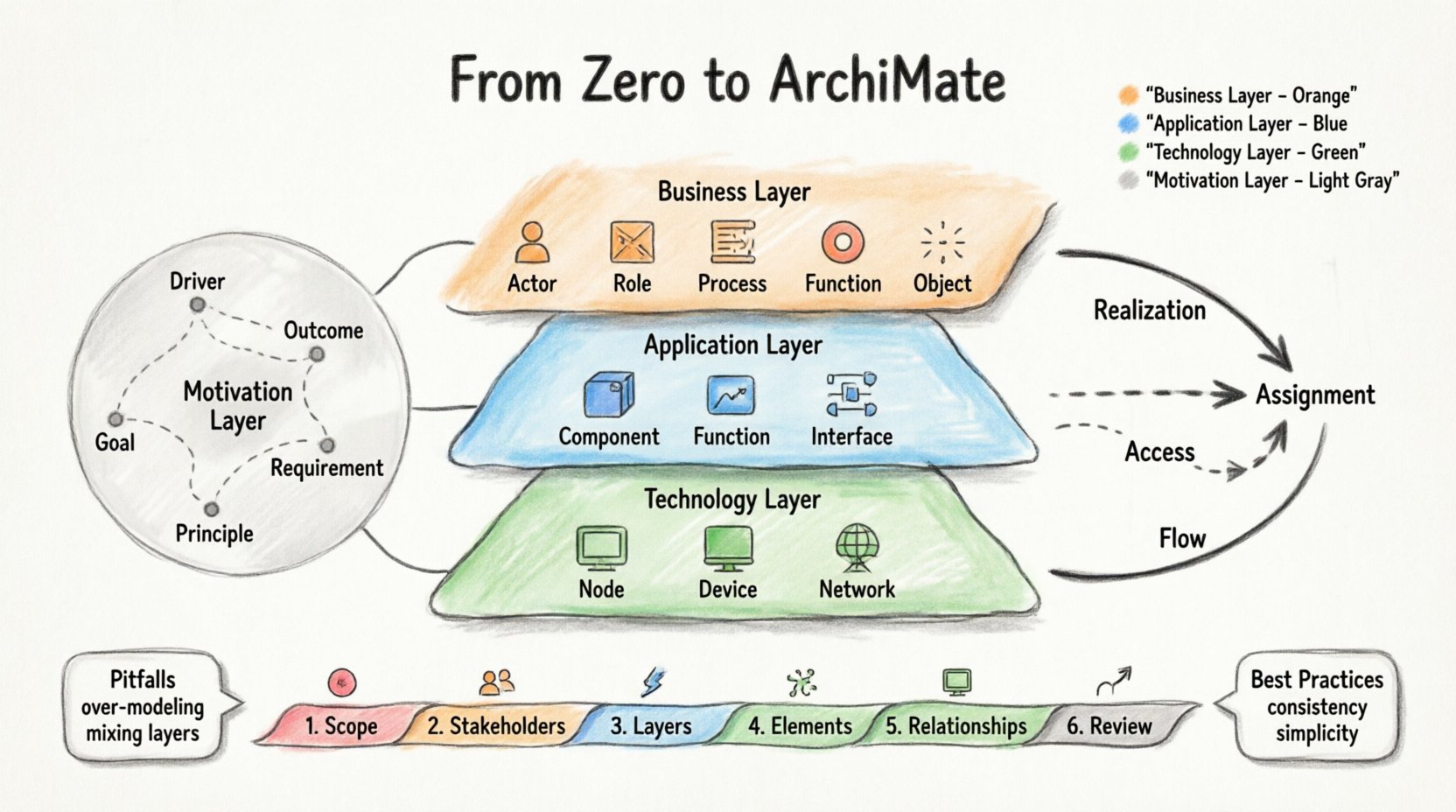
🧩 Understanding the Core of ArchiMate
ArchiMate is an open and independent enterprise architecture modeling language. It provides a standardized way to document, analyze, and visualize enterprise architecture. Unlike proprietary tools, ArchiMate is a specification managed by The Open Group. It allows architects to create models that are technology-agnostic, focusing on the relationships between business processes, information, and systems.
For a solution architect, the value proposition is clarity. When stakeholders discuss complex systems, ambiguity often leads to errors. ArchiMate provides a shared vocabulary. It ensures that when a business stakeholder mentions a “process,” and the IT architect mentions a “function,” they are referring to the same conceptual element.
Why Learn ArchiMate?
- Standardization: It creates a common language across departments.
- Visualization: Complex systems become readable diagrams.
- Alignment: It links business goals directly to technical implementation.
- Analysis: It helps identify gaps, redundancies, and risks before code is written.
🏗️ The Three Core Layers
The foundation of the ArchiMate 3.x specification rests on three primary layers. These layers represent different perspectives of the enterprise. Understanding the distinction between them is crucial for accurate modeling.
1. Business Layer
The business layer represents the organization’s core activities. It focuses on what the business does, not how it does it technically. This layer is where value is created for customers and where strategy is defined.
- Business Actor: Represents an entity (person, department, or external organization) that performs a business role.
- Business Role: Describes a role played by an actor within the business context.
- Business Process: A structured set of activities designed to produce a specific outcome.
- Business Function: A unit of business capability that is not time-bound.
- Business Object: A data entity that is the subject of a business process.
2. Application Layer
The application layer represents the software systems that support the business processes. It describes the logical software structure required to enable business functions.
- Application Component: A software unit that performs a specific function.
- Application Function: A capability provided by an application component.
- Application Interface: A point of interaction between application components.
3. Technology Layer
The technology layer describes the physical infrastructure and hardware that hosts the applications. It is the foundation upon which the software runs.
- Node: A computational resource that can host application components.
- Device: A physical computing resource (e.g., server, laptop, router).
- System Software: Software that manages the hardware (e.g., OS, database).
- Network: A communication infrastructure.
- Data Object: A physical data object stored on the technology layer.
To visualize the hierarchy, consider the following table:
| Layer | Primary Focus | Key Question |
|---|---|---|
| Business | Organization & Strategy | What are we doing? |
| Application | Software & Logic | How do we support it? |
| Technology | Infrastructure & Hardware | Where does it run? |
🔗 Relationships and Dynamics
Elements in isolation do not create value. The power of the language lies in the relationships that connect them. These relationships define how the architecture behaves and interacts.
Structural Relationships
Structural relationships define static connections between elements. They answer the question of “what uses what” or “what realizes what”.
- Realization: Indicates that one element provides the means for another to exist. For example, an Application Component realizes a Business Process.
- Assignment: Indicates that an actor is assigned to perform a role or function.
- Access: Indicates that one element accesses the data or functionality of another.
Behavioral Relationships
Behavioral relationships describe the flow of information or control.
- Flow: Indicates the flow of data or artifacts from one element to another.
- Trigger: Indicates that the execution of one event triggers another.
- Serves: Indicates that an application function serves a business function.
🎯 The Motivation Layer
Often overlooked by beginners, the Motivation layer explains why the architecture exists. It provides the context for the structural and behavioral elements. Without this layer, a model is just a diagram without purpose.
This layer introduces concepts like:
- Driver: A force or factor that triggers a change in the enterprise.
- Goal: An objective the enterprise wants to achieve.
- Outcome: A state that results from the achievement of a goal.
- Principle: A rule or guideline that influences decisions.
- Requirement: A specific need that must be met.
When building a solution, starting with a Driver or Goal ensures that the technical design directly addresses a business need. This prevents the common pitfall of building technology for technology’s sake.
🛠️ Building Your First Model
Creating an architecture model is a structured process. Even without specific software, the logical steps remain the same. Follow this workflow to ensure a robust and meaningful model.
Step 1: Define the Scope
Before drawing anything, determine the boundaries. Are you modeling a specific department? A single product line? Or the entire organization? A narrow scope is often better for learning and initial implementation.
Step 2: Identify Stakeholders
Who will use this model? Are they business managers, developers, or operations staff? The level of detail required will vary based on the audience.
Step 3: Select the Layers
Decide which layers are relevant. A high-level strategic view might only need the Business Layer. A technical migration plan requires all three layers. Do not overcomplicate the model with unnecessary layers.
Step 4: Define Elements
Start populating the layers. Begin with the Business Layer to establish the value chain. Then, map the Application Layer to support those processes. Finally, define the Technology Layer required to host the applications.
Step 5: Establish Relationships
Connect the elements. Use Realization to show how software supports processes. Use Access to show data dependencies. Use Flow to show data movement.
Step 6: Review and Refine
Walk through the model. Does the logic hold? If a Business Process is realized by an Application Function, does that function actually exist in the system? Verify the connections against the actual environment.
💼 The Role of the Solution Architect
A Solution Architect sits at the intersection of business and technology. They are responsible for designing the specific solutions that meet business requirements. ArchiMate is a primary tool in their arsenal.
Key Responsibilities
- Translation: Translating business requirements into technical specifications.
- Integration: Ensuring new solutions fit within the existing ecosystem.
- Documentation: Creating artifacts that guide development and implementation teams.
- Communication: Bridging the gap between non-technical stakeholders and engineers.
Using the Language for Communication
When presenting a solution, a wall of text is often ineffective. A visual model using the ArchiMate structure conveys complex dependencies instantly. It allows stakeholders to see:
- Which business processes will be impacted.
- Which applications will be deprecated or added.
- Where the data will flow.
- What the technical dependencies are.
This visual clarity reduces risk. It allows stakeholders to ask informed questions early in the lifecycle, rather than discovering issues during deployment.
⚠️ Common Pitfalls and Best Practices
Even experienced architects can make mistakes when modeling. Being aware of common errors helps in maintaining high-quality architecture.
Pitfall 1: Over-Modeling
Attempting to model every single detail of an enterprise can lead to paralysis. The model becomes too large to manage and too complex to understand. Focus on the critical paths and the specific solution at hand.
Pitfall 2: Ignoring the Motivation Layer
Building a diagram without linking it to business goals makes it easy to lose relevance. Always ensure that your technical elements trace back to a business driver or goal.
Pitfall 3: Mixing Layers Indiscriminately
Keep the layers distinct. A Business Process should not be directly connected to a Node in the Technology layer without passing through the Application layer. This maintains the abstraction and clarity of the model.
Best Practice 1: Consistency
Use consistent naming conventions. If you call it a “Customer” in one diagram, do not call it a “Client” in another. Consistency aids comprehension.
Best Practice 2: Version Control
Architecture evolves. Treat your models as living documents. Maintain versions to track changes over time. This is essential for auditing and understanding the history of a solution.
Best Practice 3: Keep it Simple
If a relationship is not essential to the story, remove it. A cluttered diagram is a confusing diagram. Use white space effectively.
🌱 Continuous Improvement and Career Growth
Mastering ArchiMate is a journey, not a destination. The landscape of enterprise architecture is constantly changing. New technologies emerge, and business models shift.
Staying Updated
- Follow the official specifications released by The Open Group.
- Participate in community forums and discussions.
- Engage with other architects to review and critique models.
Developing Soft Skills
Technical modeling is only half the battle. The ability to communicate the model effectively is equally important.
- Storytelling: Use the model to tell the story of the solution.
- Active Listening: Understand the underlying concerns of stakeholders before modeling.
- Facilitation: Guide workshops where the architecture is co-created.
🔍 Deep Dive: Implementation and Migration
One of the most powerful aspects of the language is the Implementation and Migration Layer. This layer is specifically designed to plan how to move from a current state to a target state.
Key Concepts
- Work Package: A set of projects and activities that need to be planned.
- Project: A temporary endeavor undertaken to create a unique product or service.
- Goal: A desired result to be achieved by the project.
- Value Stream: A sequence of activities that delivers value.
When planning a migration, architects use this layer to map projects to the layers they affect. For example, a project might involve upgrading the Technology Layer (hardware refresh) which impacts the Application Layer (software compatibility) and ultimately affects the Business Layer (service availability).
This mapping allows for risk assessment. If a specific project in the Migration Layer is delayed, the architect can see which Business Processes are at risk. This enables proactive management of the change program.
📝 Summary of Key Concepts
To ensure you have retained the essential information, here is a quick recap of the core pillars of this walkthrough.
- Layers: Business, Application, and Technology are the structural foundation.
- Relationships: Realization, Assignment, and Access define the connections.
- Motivation: Drivers and Goals provide the context and reason for the architecture.
- Migration: Work Packages and Projects plan the transition to the future state.
- Communication: The primary goal is to facilitate understanding among stakeholders.
By adhering to these principles, a solution architect can deliver value that is measurable and aligned with strategic objectives. The language serves as a bridge, turning abstract business needs into concrete technical realities.
This post is also available in Deutsch, Español, فارسی, Français, English, Bahasa Indonesia, 日本語, Polski, Portuguese, Ру́сский, Việt Nam, 简体中文 and 繁體中文.