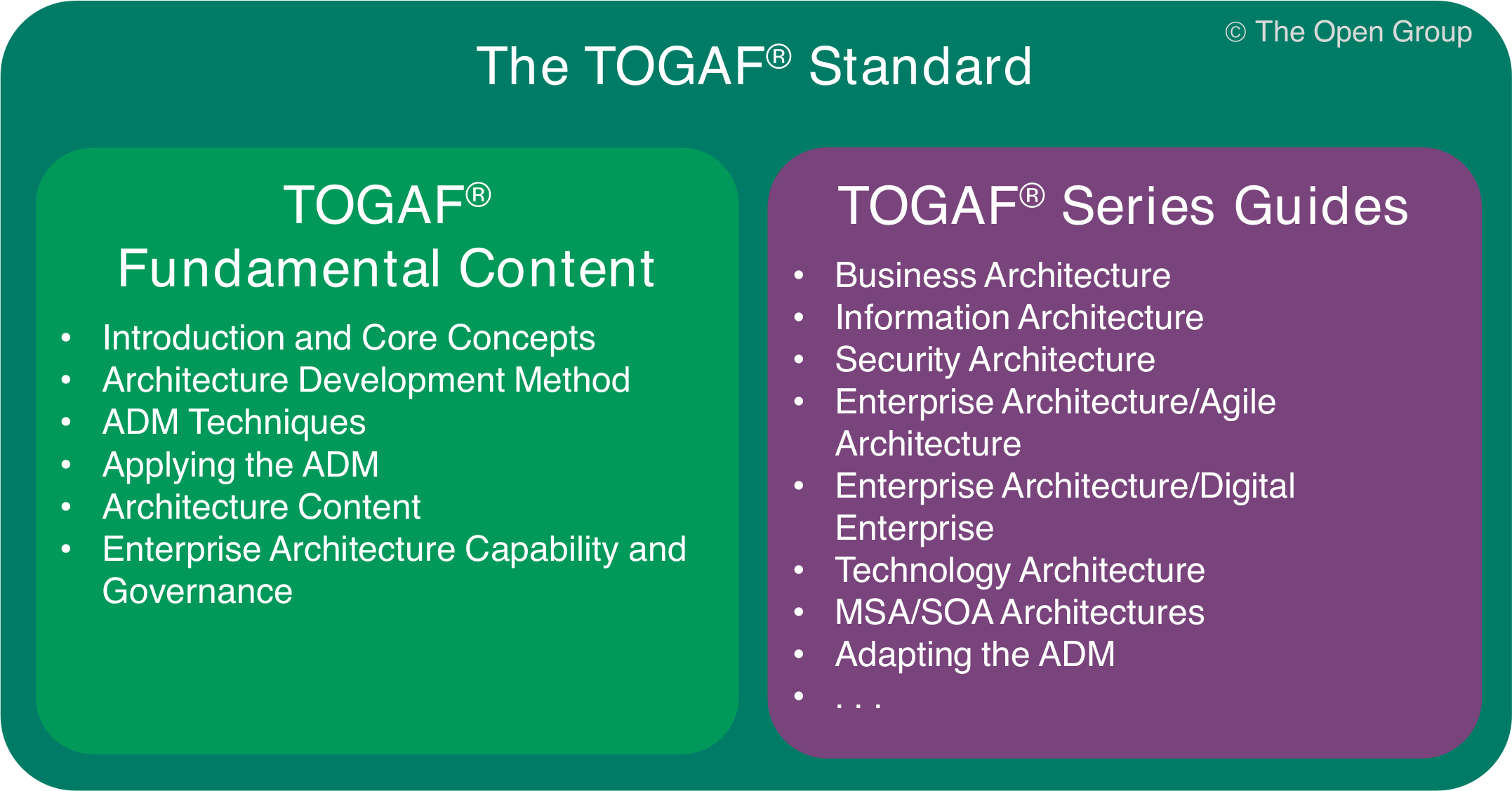
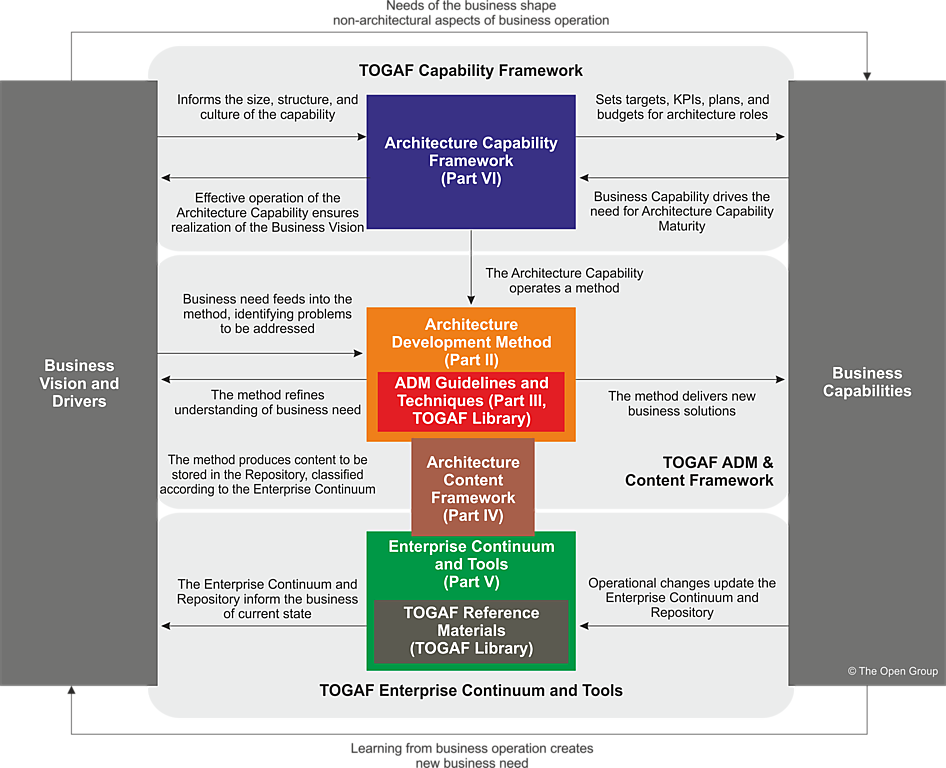
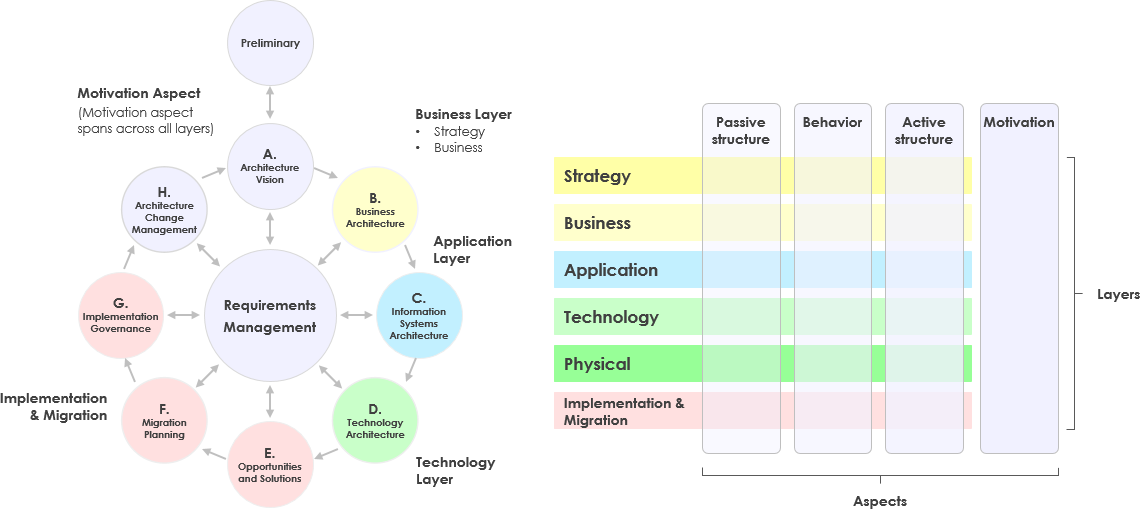
Embark on a structured journey to master enterprise architecture development with Visual Paradigm’s comprehensive framework
🗺️ Setting Out: Your Architecture Journey Begins
Welcome, enterprise architect! Imagine you’re standing at the threshold of a complex but rewarding expedition: developing a robust enterprise architecture that aligns business strategy with IT execution. You’ve heard about TOGAF’s Architecture Development Method (ADM), but navigating its nine phases can feel overwhelming. This is where Visual Paradigm’s TOGAF ADM Guide-Through Process becomes your trusted compass.
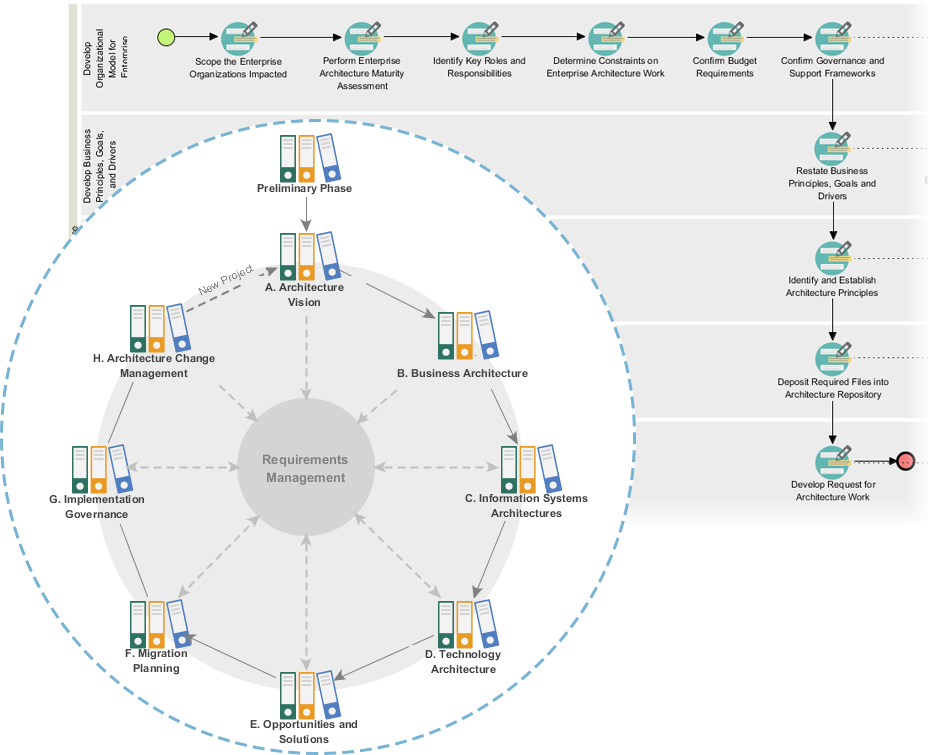
This guide walks you through each step of your journey, blending TOGAF’s proven methodology with Visual Paradigm’s intuitive tools and ArchiMate’s visual modeling language. Whether you’re architecting for retail, healthcare, finance, or manufacturing, this journey-style approach ensures you never lose sight of your destination: strategic alignment, stakeholder engagement, and measurable business outcomes.
🧭 Phase 0: Preparing Your Expedition (Preliminary Phase)
Your Mission: Establish the architecture capability within your organization.
What You’ll Experience:
-
Stakeholder Mapping: Identify who cares about your architecture—executives, IT teams, business units, regulators.
-
Principle Definition: Set the guiding stars for your architectural decisions.
-
Scope Clarification: Define boundaries to keep your journey focused.
Visual Paradigm Support:
Use the Process Navigator to document your architecture framework, principles, and governance structure. The tool’s templates ensure you don’t miss critical foundational elements.
Example: A retail company architect begins by mapping stakeholders: C-suite executives want ROI visibility, store managers need process clarity, and IT teams require technical specifications. Visual Paradigm helps capture these concerns in a centralized repository.
🌟 Phase A: Charting Your Vision (Architecture Vision)
Your Mission: Develop a compelling, approved architecture vision.
What You’ll Experience:
-
Goal Articulation: Translate business strategy into architectural objectives.
-
High-Level Modeling: Create initial ArchiMate diagrams showing business capabilities, value streams, and technology enablers.
-
Approval Gateway: Secure stakeholder buy-in before diving deeper.
Visual Paradigm Support:
Leverage ArchiMate integration to visualize your vision. Drag-and-drop elements to model business goals, actors, and high-level services. Generate executive summaries automatically for approval workflows.
Example: In a financial institution, architects model a “Digital Banking Transformation” vision, linking customer experience goals to application modernization initiatives. Visual Paradigm’s viewpoint filters let executives see only the business-relevant layers.
🏢 Phase B: Discovering Business Architecture
Your Mission: Define how the business operates and creates value.
What You’ll Experience:
-
Process Mapping: Document core business processes, organizational structures, and services.
-
Relationship Visualization: Use ArchiMate to show how processes interact with roles, applications, and data.
-
Validation Workshops: Collaborate with business stakeholders to refine models.
Visual Paradigm Support:
The Business Architecture toolkit provides pre-built ArchiMate elements for processes, actors, and services. Real-time collaboration features let business analysts and architects co-create models.
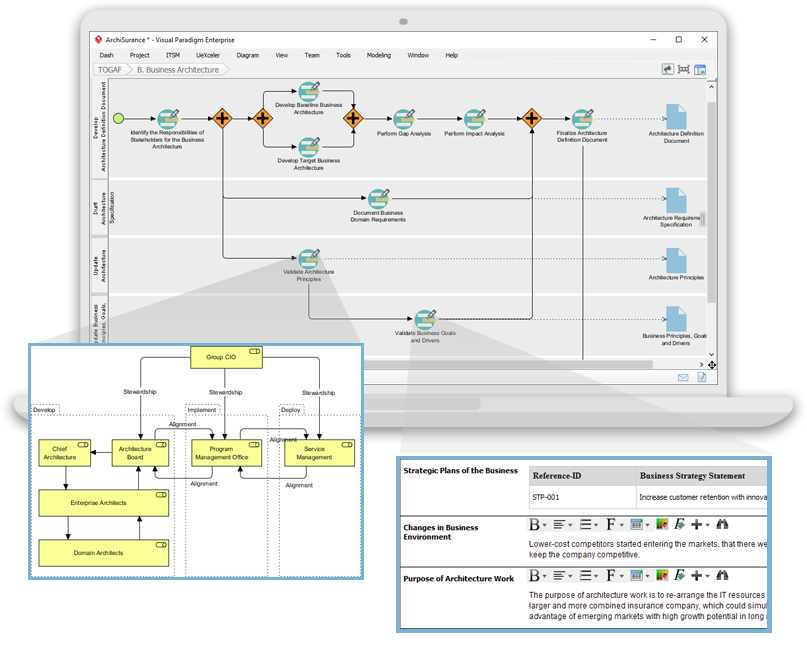
Example: A healthcare organization models patient journey processes, linking clinical workflows to compliance requirements. ArchiMate’s color-coding highlights critical paths for stakeholder review.
💻 Phase C: Designing Information Systems Architecture
Your Mission: Align data and applications with business needs.
What You’ll Experience:
-
Data Architecture: Model entities, flows, and storage requirements.
-
Application Architecture: Map components, services, and interfaces.
-
Alignment Checks: Ensure every technical element traces back to a business capability.
Visual Paradigm Support:
Use ArchiMate’s Application and Data layers to create cohesive models. The tool’s traceability features automatically link application services to business processes, preventing scope creep.
Example: A manufacturing company models an IoT-enabled supply chain application architecture. Visual Paradigm’s impact analysis shows how changing a data entity affects downstream applications.
⚙️ Phase D: Engineering Technology Architecture
Your Mission: Define the infrastructure that powers your solutions.
What You’ll Experience:
-
Technology Component Identification: Specify servers, networks, platforms, and services.
-
Infrastructure Modeling: Visualize deployment patterns, security zones, and integration points.
-
Standards Compliance: Ensure technology choices align with organizational policies.
Visual Paradigm Support:
ArchiMate’s Technology Layer elements let you model infrastructure visually. The tool’s validation rules flag deviations from predefined technology standards.
Example: A data center architect models a hybrid cloud infrastructure, using ArchiMate to show how on-premises systems integrate with cloud services. Visual Paradigm generates deployment diagrams for engineering teams.
🗓️ Phases E & F: Planning Your Migration Journey
Your Mission: Identify opportunities and sequence implementation.
What You’ll Experience:
-
Gap Analysis: Compare current and target architectures to identify migration needs.
-
Roadmap Creation: Define projects, timelines, and resource requirements.
-
Risk Assessment: Evaluate technical and organizational risks for each migration step.
Visual Paradigm Support:
The Implementation & Migration toolkit generates Gantt charts, dependency matrices, and resource plans. Automated deliverable generation reuses artifacts from earlier phases, ensuring consistency.
Example: A software company plans a microservices migration. Visual Paradigm’s roadmap view shows how decomposing a monolith aligns with business capability releases.
🛡️ Phase G: Governing Implementation
Your Mission: Ensure the architecture is built as designed.
What You’ll Experience:
-
Governance Framework Setup: Define roles, review gates, and compliance checks.
-
Progress Monitoring: Track implementation against architectural standards.
-
Issue Resolution: Address deviations through structured change processes.
Visual Paradigm Support:
Collaborative review workflows let governance boards comment directly on models. Automated compliance reports highlight deviations from approved architectures.
Example: During a retail platform rollout, governance reviews use Visual Paradigm’s comparison views to verify that deployed components match the approved technology architecture.
🔄 Phase H: Managing Evolution
Your Mission: Adapt the architecture to changing needs.
What You’ll Experience:
-
Change Request Processing: Evaluate proposed modifications for impact and alignment.
-
Impact Analysis: Assess how changes affect business processes, applications, and technology.
-
Stakeholder Communication: Update all parties on architectural evolution.
Visual Paradigm Support:
Version control and change tracking features maintain an audit trail of architectural decisions. Impact analysis tools automatically flag dependent elements when changes are proposed.
Example: A healthcare organization evaluates a new regulatory requirement. Visual Paradigm’s impact analysis shows which business processes, applications, and data elements need modification.
🎒 Your Journey Toolkit: Key Features That Make the Difference
🧭 Process Navigator
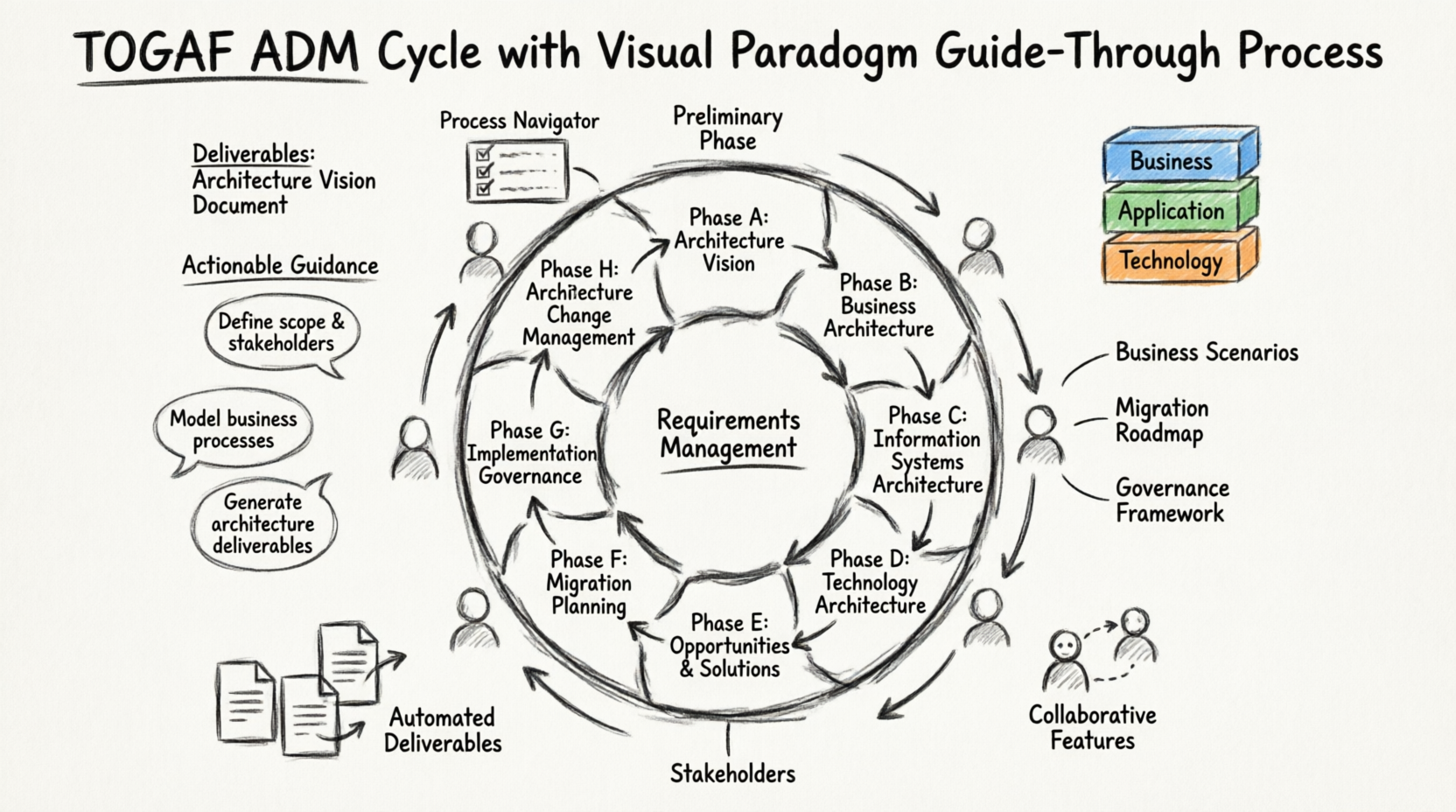
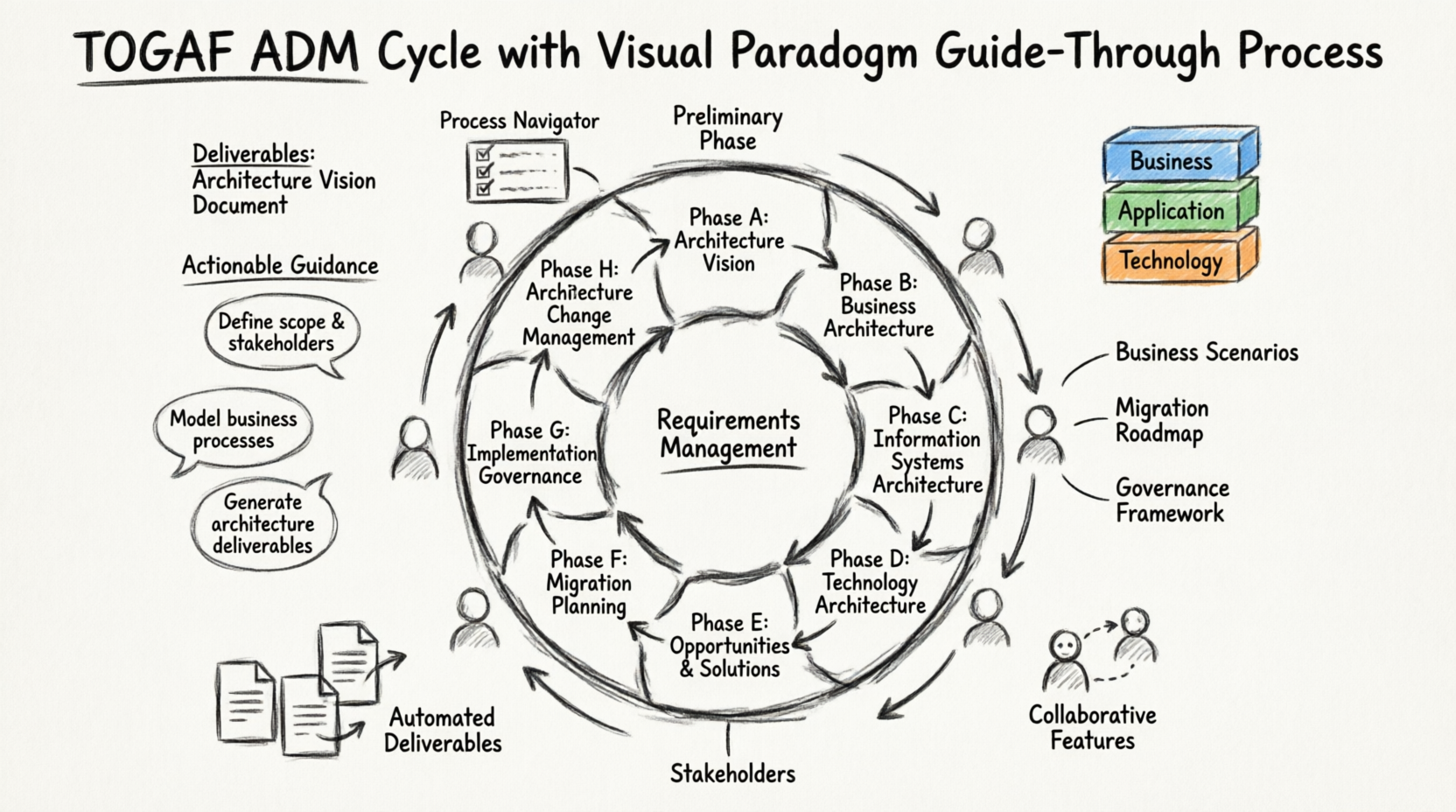
Your interactive roadmap through TOGAF ADM phases. Navigate forward, backward, or laterally between phases while maintaining context and progress tracking.
🎨 ArchiMate Integration
Visual modeling that brings clarity to complex architectures. Create layered diagrams that communicate effectively with both technical and non-technical stakeholders.
📚 Actionable Guidance & Tools
Access to tips, templates, samples, and case studies that accelerate deliverable production. From implementation plans to migration roadmaps, get practical support at every step.
👥 Collaborative Features
Real-time co-authoring, comment threads, and role-based permissions ensure all stakeholders contribute effectively to the architectural process.
🤖 Automated Deliverable Generation
As you complete activities, artifacts are automatically generated and reused in subsequent phases—minimizing redundancy and ensuring seamless workflow.
🏁 Arriving at Your Destination: Strategic Alignment Achieved
By journeying through Visual Paradigm’s TOGAF ADM Guide-Through Process, you’ve transformed abstract methodology into actionable architecture. Your enterprise now benefits from:
✅ Clear Vision: Business and IT strategies aligned through visual models
✅ Stakeholder Confidence: Transparent communication via ArchiMate viewpoints
✅ Efficient Execution: Automated workflows reducing manual effort
✅ Adaptive Governance: Change management processes that preserve architectural integrity
✅ Measurable Outcomes: Traceability from business goals to technical implementation
Your architecture isn’t just documented—it’s living, collaborative, and strategically aligned. The journey continues with each business evolution, but now you have the compass, map, and tools to navigate confidently.
📚 Reference List
Best ArchiMate Software: This article discusses how Visual Paradigm’s ArchiMate tools facilitate communication of architectural designs among stakeholders and EA team members. It highlights the ability to model business processes with BPMN, design IT solutions with UML, and create various diagrams linked to ArchiMate for better traceability. The tool is certified by The Open Group and supports the full vocabulary and syntax of ArchiMate 3.1, making enterprise architecture design more straightforward.
What is ArchiMate?: This guide provides an overview of ArchiMate, explaining its framework that divides enterprise architecture into business, application, and technology layers. It discusses the active support from the ArchiMate Forum of The Open Group and how ArchiMate’s well-founded concepts provide precision in modeling. The article also mentions the integration of ArchiMate with existing methods like TOGAF and its support by numerous consultancies and software tools.
Visual Paradigm TOGAF ADM Tool: This article emphasizes how Visual Paradigm’s TOGAF ADM Tool empowers EA teams with innovative features, streamlined processes, and enhanced collaboration. It discusses the importance of consistency across EA projects and the ease of reusing existing elements in new designs. The article also highlights the customizable viewpoints and configurable architecture repositories that make Visual Paradigm a valuable tool for EA teams.
Composition Relationship in ArchiMate EA Modeling: This article explains the composition relationships in ArchiMate and how Visual Paradigm supports EA projects with a comprehensive set of modeling tools. It discusses the features for requirement management, project management, and documentation, as well as the collaboration and teamwork facilitated by Visual Paradigm’s cloud-based services. The article also mentions the version control and change tracking features that enhance collaboration in EA teams.
Step-by-Step Enterprise Architecture Tutorial with TOGAF: This tutorial provides a step-by-step guide to applying TOGAF in enterprise architecture development using Visual Paradigm. It explains how to create ArchiMate diagrams and produce TOGAF deliverables with ease. The tutorial also discusses the tools and diagrams provided by Visual Paradigm for analysis and documentation, including ArchiMate 3 diagrams and various viewpoints.
Mastering ArchiMate: A Comprehensive Guide to Enterprise Architecture Modeling: This guide offers an in-depth look at ArchiMate and its use in enterprise architecture modeling. It discusses the flexibility of ArchiMate in creating various viewpoints relevant to different stakeholders and the importance of using a standardized language and notation for clear communication. The guide also highlights the use of colors in ArchiMate models to enhance understanding and interpretation.
Understanding the Purpose of ArchiMate: A Guide for Enterprise Architects: This guide provides an overview of ArchiMate and its purpose in enterprise architecture. It discusses the features of Visual Paradigm’s ArchiMate Diagram Editor, including its intuitive interface and collaboration tools. The guide also explains how ArchiMate viewpoints provide predefined perspectives for creating architectural models and simplifying complex information for different stakeholders.
ArchiMate Viewpoint Archives: This article discusses the use of ArchiMate viewpoints in providing predefined perspectives for creating architectural models. It explains how viewpoints help focus on specific aspects or concerns of the architecture, making it easier to communicate complex information to different stakeholders. The article also mentions the use of ArchiMate in aligning IT strategies with business goals and ensuring compliance with standards like ISO 27001.
This post is also available in Deutsch, Español, فارسی, Français, English, Bahasa Indonesia, 日本語, Polski, Portuguese, Ру́сский, Việt Nam, 简体中文 and 繁體中文.