


Enterprise environments are becoming increasingly complex. The convergence of business strategy, operational processes, digital applications, and underlying infrastructure creates a web of dependencies that is difficult to navigate without a structured approach. In this context, architecture frameworks serve as the foundational grammar for describing how organizations function and evolve. Among these, the ArchiMate specification stands out as a critical standard for modeling enterprise architecture. This guide explores the significance of ArchiMate, its structural components, and its trajectory in shaping future organizational capabilities.
Organizations today face pressure to adapt rapidly to market shifts, technological advancements, and regulatory requirements. A common challenge is the disconnect between strategic intent and technical execution. When business leaders define a goal and IT teams implement a solution, the translation often loses nuance. ArchiMate addresses this gap by providing a standardized language that allows stakeholders from different domains to communicate effectively. It is not merely a diagramming tool but a semantic framework designed to capture relationships and dependencies across the enterprise.
The Core Value Proposition of ArchiMate 🎯
At its heart, ArchiMate is an open and independent modeling language. It was developed by the Open Group to complement existing frameworks like TOGAF. While TOGAF provides a methodology for managing the architecture development process, ArchiMate provides the notation to describe the architecture itself. This distinction is vital. Methodology tells you how to work; notation tells you what you are working on.
The value of this standardization becomes apparent when examining the stakeholders involved. Architects, business analysts, developers, and executives often speak different dialects. A business process owner might describe a “customer onboarding flow,” while a software architect describes “API endpoints and database schemas.” Without a common model, these descriptions remain siloed. ArchiMate bridges this divide.
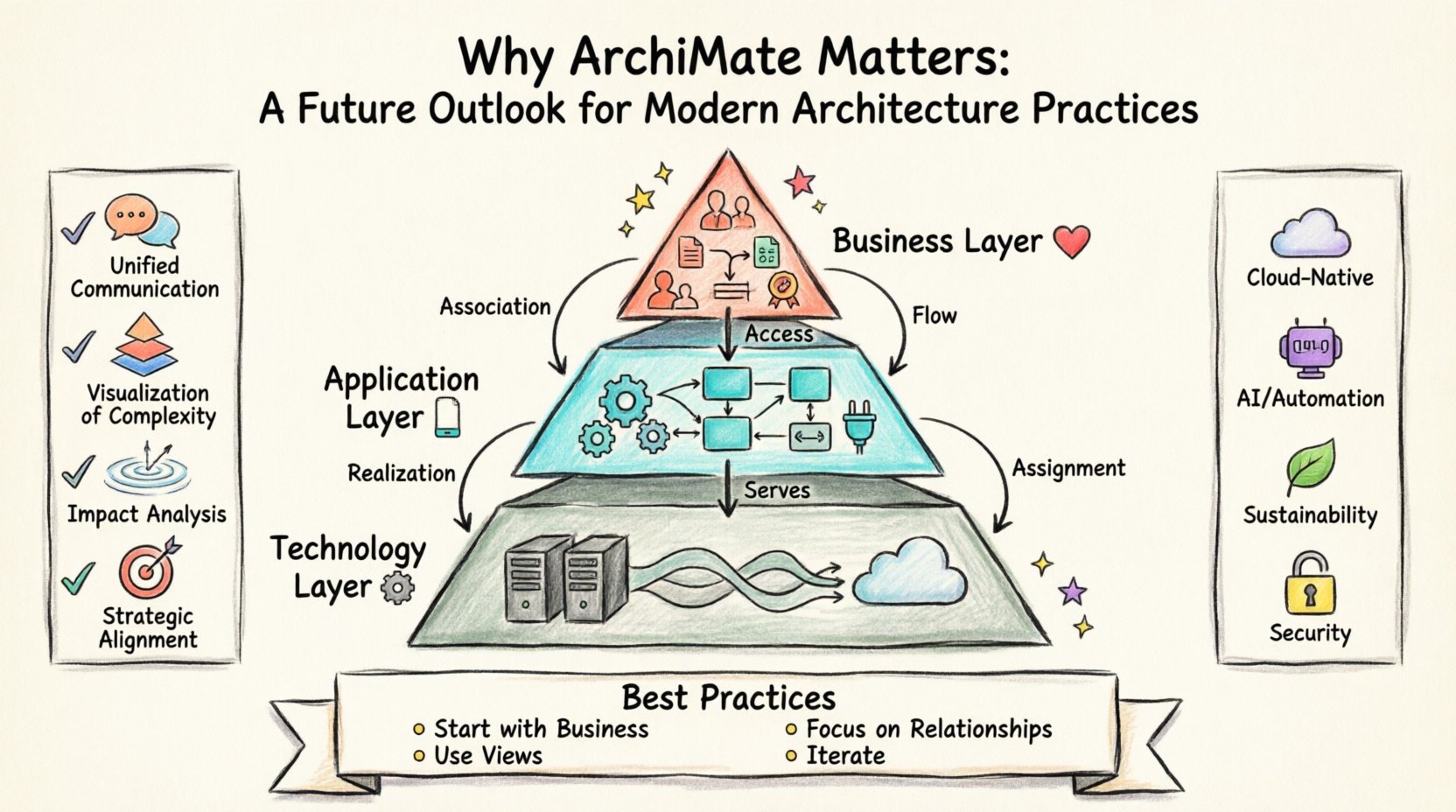
- Unified Communication: It creates a shared vocabulary that transcends departmental boundaries.
- Visualization of Complexity: It allows complex systems to be represented in layered views that are digestible.
- Impact Analysis: It enables organizations to understand how a change in one area affects others before implementation begins.
- Strategic Alignment: It links high-level business goals down to the technical infrastructure that supports them.
Understanding the Three-Layer Structure 🧱
One of the defining features of ArchiMate is its layered architecture model. This structure organizes the enterprise into three primary layers, each representing a different aspect of the organization. Understanding these layers is essential for grasping how the framework operates.
1. The Business Layer 💼
The business layer represents the organization from a functional perspective. It describes the structure, processes, roles, and objectives of the enterprise. This is where the value proposition of the organization is defined.
- Business Actors: Entities that perform business functions (e.g., employees, customers, partners).
- Business Processes: Flows of activities that produce results (e.g., order fulfillment, claim processing).
- Business Objects: Data that is created or used by processes (e.g., invoices, contracts).
- Business Roles: The positions held by actors within the organization.
2. The Application Layer 📱
The application layer describes the software systems that support the business layer. It focuses on the functionality provided by applications and how they interact with the business processes.
- Application Services: Capabilities provided by an application (e.g., user authentication, data storage).
- Application Components: Modular parts of an application (e.g., a payment module, a reporting engine).
- Application Interfaces: Points where applications interact with each other or with users.
3. The Technology Layer ⚙️
The technology layer describes the physical and logical infrastructure required to run the applications. This includes hardware, networks, and operating systems.
- Infrastructure Nodes: Computing resources like servers or cloud instances.
- System Software: Operating systems, databases, and middleware.
- Network: Communication pathways between nodes.
These layers are not isolated. They are connected through specific relationships. A business process calls an application service. An application service runs on a technology node. This traceability is where the framework offers its most significant analytical power.
Key Relationships and Semantics 🔗
Diagrams are useful only if they are accurate. ArchiMate defines specific relationship types that ensure the logic of the model holds up under scrutiny. These relationships define how elements interact.
| Relationship Type | Direction | Meaning |
|---|---|---|
| Association | Bi-directional | A general connection between elements. |
| Flow | Uni-directional | The transfer of information or control. |
| Access | Uni-directional | Reading or using data from another element. |
| Serves | Uni-directional | One layer provides services to another. |
| Realization | Uni-directional | One element implements another. |
| Assignment | Bi-directional | An actor is assigned to a role or process. |
By strictly defining these connections, the framework prevents logical errors in architecture design. For instance, if a business process is linked to a technology node without an intermediate application layer, the model highlights a gap in the architecture. This forces architects to resolve the abstraction mismatch before deployment.
Integration with Other Frameworks 🤝
ArchiMate does not exist in a vacuum. It is designed to integrate seamlessly with other enterprise architecture standards. This interoperability is crucial for organizations that already have established methodologies in place.
Alignment with TOGAF
The Open Group Architecture Framework (TOGAF) is a process standard. It outlines the Architecture Development Method (ADM). ArchiMate is often used as the modeling notation within the ADM cycle. When architects create artifacts during the ADM phases, they use ArchiMate to visualize the current state, target state, and transition architecture. This combination ensures that the process (TOGAF) and the content (ArchiMate) are synchronized.
Support for IT Governance
Governance frameworks require clear evidence of compliance and control. ArchiMate models can represent control points, risk factors, and compliance requirements. By mapping these requirements to specific business processes or technology components, organizations can demonstrate auditability. This is particularly relevant for industries with heavy regulatory burdens, such as finance or healthcare.
The Future Outlook: Trends Shaping Architecture 🚀
The landscape of enterprise architecture is shifting. The static models of the past are giving way to dynamic, agile representations of organizational capability. ArchiMate is evolving to meet these new demands.
Cloud-Native Architectures ☁️
Traditional data centers are being replaced by cloud environments. This shift introduces dynamic scaling, microservices, and serverless computing. ArchiMate has adapted its technology layer to accommodate these concepts. It now includes concepts for cloud deployment and virtualization. As organizations move to hybrid and multi-cloud strategies, the ability to model these complex topologies becomes essential for cost management and performance optimization.
Artificial Intelligence and Automation 🤖
AI is no longer just a tool; it is a business capability. Architecture models must now account for machine learning models, data pipelines, and automated decision-making processes. ArchiMate allows architects to model AI as a business function or an application service. This ensures that the ethical, operational, and technical implications of AI are considered during the planning phase. It moves AI from a buzzword to a modeled asset.
Sustainability and ESG Reporting 🌱
Environmental, Social, and Governance (ESG) criteria are becoming central to corporate strategy. Architecture plays a role here by modeling the energy consumption of IT infrastructure and the efficiency of business processes. By mapping technology components to energy metrics, organizations can identify areas for reduction. ArchiMate supports the modeling of these sustainability goals, linking them to business drivers and technology implementations.
Security Architecture 🔒
Security is often an afterthought in traditional architecture models. Modern practices require security to be integrated from the start. ArchiMate includes specific extensions for security, allowing architects to model threats, vulnerabilities, and security controls. This enables a shift from reactive security to proactive risk management. By visualizing where security controls sit within the layers, gaps in defense can be identified early.
Implementation Challenges and Realities ⚠️
While the benefits are clear, adopting ArchiMate is not without challenges. Organizations must be realistic about the effort required to maintain these models.
- Model Maintenance: Architecture models can become outdated quickly if not maintained. They require a governance process to ensure changes in the real world are reflected in the model.
- Skill Requirements: Effective modeling requires training. Staff must understand the semantics to avoid creating diagrams that look correct but convey no information.
- Tooling Costs: While the standard is open, the tools used to create and manage models often require investment. However, the focus should remain on the standard, not the software.
- Cultural Adoption: Stakeholders may resist the transparency that models bring. Hiding complexity is often easier than managing it. Changing this mindset is a leadership task.
Best Practices for Effective Modeling 🛠️
To derive value from ArchiMate without succumbing to the complexity trap, organizations should follow specific practices.
Start with the Business Layer
Do not begin with technology. Start by modeling the business capabilities and processes. This ensures that the IT investment is driven by business needs. If the business layer is not clear, the technology layer will be a solution in search of a problem.
Use Views for Different Audiences
A single model cannot serve all audiences. Use views to slice the architecture. Executives need a high-level view of business capabilities. Engineers need a detailed view of component interactions. ArchiMate supports the creation of these specific views from the same underlying data.
Focus on Relationships
Elements are less important than the connections between them. The value of the model lies in understanding dependencies. When a dependency is broken, the impact is visible. Ensure that the model emphasizes flow, access, and realization over static descriptions.
Iterative Development
Build the model incrementally. A full enterprise model is too large to create at once. Start with a specific domain or initiative. Validate the model with stakeholders. Then expand. This iterative approach prevents paralysis by analysis.
Measuring Success in Architecture Practices 📊
How do organizations know if their use of ArchiMate is successful? It is not about the number of diagrams created. Success is measured by the impact on decision-making.
- Reduced Redundancy: Are duplicate systems identified and retired?
- Faster Onboarding: Do new employees understand the system landscape faster?
- Lower Risk: Are incidents caused by architectural gaps reduced?
- Better Alignment: Do business and IT goals remain synchronized over time?
These metrics require a baseline. The model itself provides the baseline. By comparing the current state to the target state, progress can be quantified. This data-driven approach strengthens the credibility of the architecture function within the organization.
Looking Forward: The Evolution of Standards 🌐
The future of enterprise architecture will likely see further integration with agile practices and DevOps. The rigid separation between architecture and operations is blurring. ArchiMate is adapting to support this continuous delivery model. The focus is shifting from static documentation to living models that can be queried and analyzed in real-time.
Furthermore, the standardization of architecture data is gaining traction. Interoperability between different architecture tools is becoming a requirement. ArchiMate provides the semantic foundation for this data exchange. As organizations adopt more specialized tools for security, cloud, or data, the need for a common language to stitch them together becomes critical.
The framework is also expanding its reach beyond IT. It is being applied to supply chain management, organizational change, and product development. This broader application reinforces its status as a universal language for organizational structure.
Final Considerations for Practitioners 💡
Adopting ArchiMate is a strategic decision. It requires commitment from leadership and participation from all levels of the organization. It is not a quick fix for communication problems, but a long-term investment in clarity.
For those entering the field, the learning curve is steep but rewarding. Understanding the semantics allows for a deeper comprehension of how systems work. It moves the practitioner from a technician to a strategist. The ability to model the future state of an organization is a powerful skill.
As technology continues to evolve, the need for structure will only increase. Chaos in architecture leads to chaos in business. ArchiMate provides the structure needed to manage complexity. By embracing this standard, organizations can navigate the future with confidence and precision. The goal is not to create perfect models, but to create models that enable better decisions.
The path forward involves continuous learning and adaptation. The standards will change, the tools will change, but the need for a clear, structured view of the enterprise remains constant. ArchiMate stands ready to support that need.
This post is also available in Deutsch, Español, فارسی, Français, English, Bahasa Indonesia, 日本語, Polski, Portuguese, Ру́сский, Việt Nam, 简体中文 and 繁體中文.