
In agile development, large features—often called Epics—can feel overwhelming. They represent broad, high-level goals that span multiple sprints and involve multiple teams. But the real power of agile lies in breaking down complexity into actionable, testable, and deliverable pieces. That’s where user stories come in.
This guide walks you through the art of transforming an Epic into a collection of manageable, value-driven user stories—so your team can deliver incrementally, adapt quickly, and stay focused on customer value.
🔍 Step 1: Understand the Epic
Before you break it down, ask:
-
What problem are we solving?
(e.g., “Users struggle to find relevant products on our site.”) -
Who is the target audience?
(e.g., shoppers, returning customers, mobile users.) -
What’s the desired outcome?
(e.g., “Increase product discovery success by 40%.”)
✅ Tip: Write a clear Epic Statement:
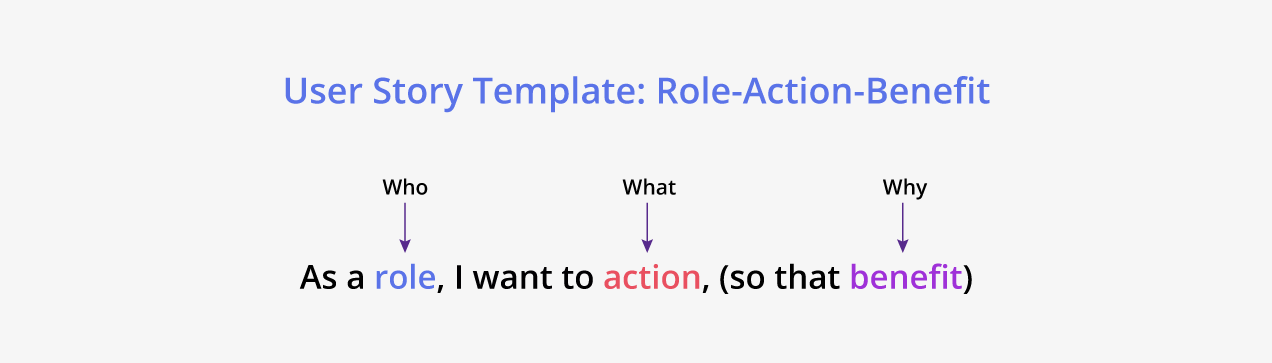
“As a [user], I want [goal] so that [benefit].”
Example:
“As a shopper, I want to filter products by price, brand, and availability so that I can quickly find what I’m looking for.”
🧩 Step 2: Break Down the Epic Using the INVEST Principle
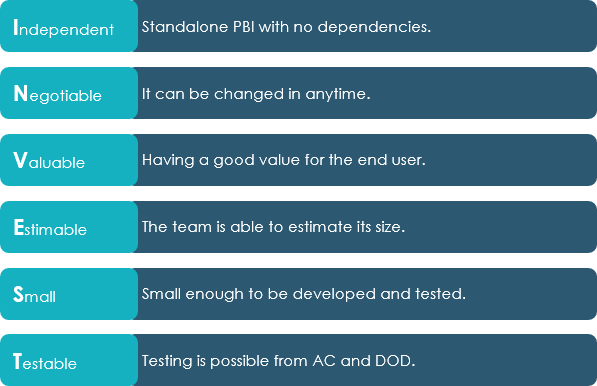
Ensure your user stories are:
-
Independent
-
Negotiable
-
Valuable
-
Estimable
-
Small
-
Testable
Use these criteria to judge whether a story is truly small and actionable.
🛠 Step 3: Use Techniques to Decompose the Epic
1. User Story Mapping (Best Practice)
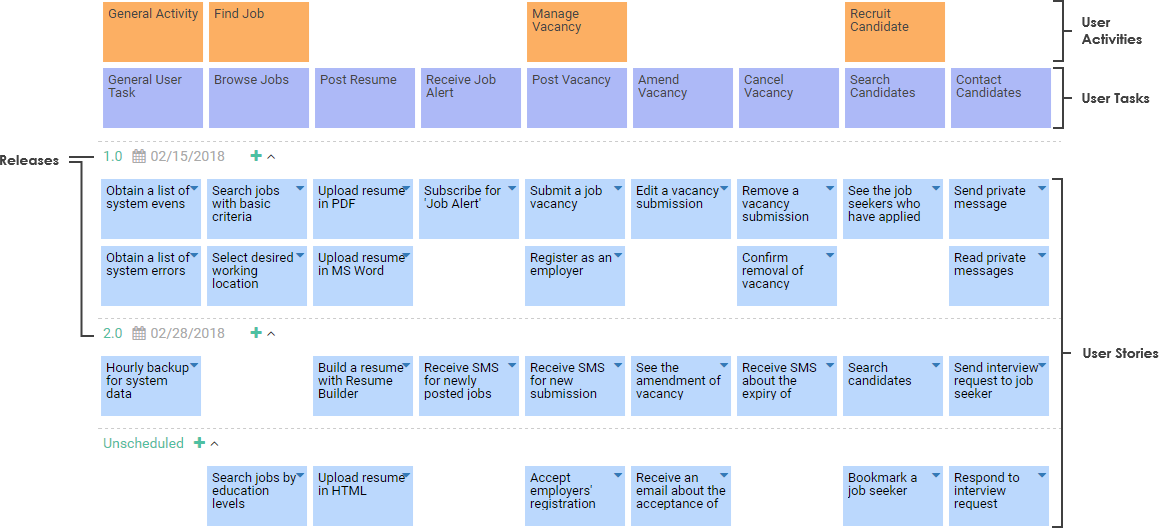
Create a visual map of the user journey:
-
Top of the map: High-level user tasks (epic).
-
Rows below: Specific user stories grouped by workflow steps.
-
Prioritize: Start with the most valuable stories (the “shallow” or “core” path).
👉 Example: Epic: “Improve Product Discovery”
| User Journey Step | User Story |
|---|---|
| Browse products | As a shopper, I want to see products sorted by relevance, price, or rating so I can find what I need quickly. |
| Filter results | As a shopper, I want to filter by price range and brand so I can narrow down options. |
| Search with filters | As a shopper, I want to search using keywords and apply filters simultaneously so I can refine results. |
| View product details | As a shopper, I want to see product availability and delivery estimates so I can decide to buy. |
2. Feature Breakdown (Hierarchical Decomposition)
Split the Epic into sub-features, then into user stories.
Example:
Epic: Enable User Authentication
Sub-feature: Login with Email
As a user, I want to log in with my email and password so I can access my account.
As a user, I want to receive a password reset link if I forget my password.
Sub-feature: Social Login (Google/Facebook)
As a user, I want to sign in using my Google account so I can skip creating a new password.
Sub-feature: Two-Factor Authentication
As a user, I want to enable 2FA so my account is more secure.
3. Use the “3 C’s” for Clarity
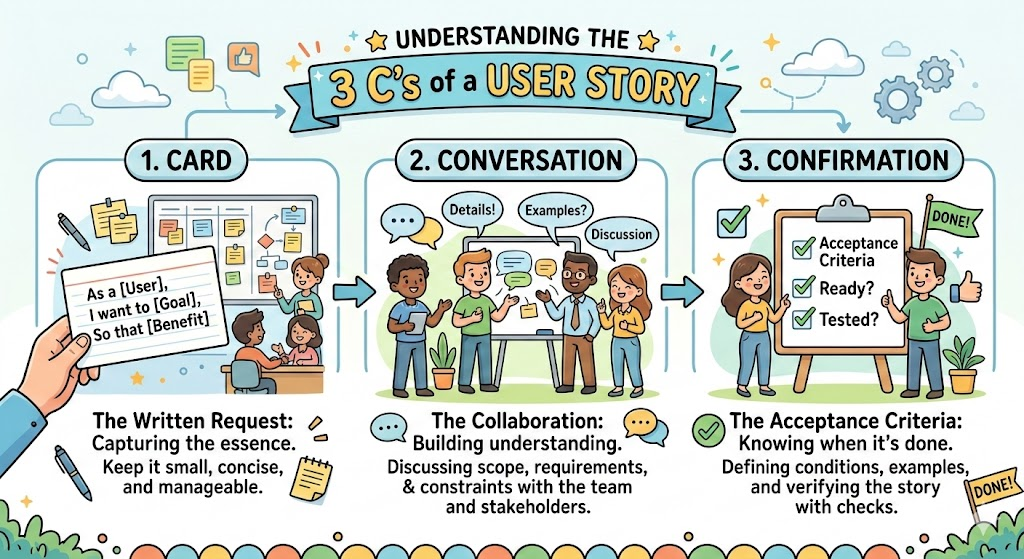
Every user story should follow:
-
Card: The story itself (written on a card or digital ticket).
-
Conversation: Clarify details in team discussions.
-
Confirmation: Define acceptance criteria (tests).
Example:
Card: As a user, I want to reset my password via email so I can regain access.
Conversation: Discuss email template, token expiration, rate limiting.
Confirmation:
A reset link is sent to the user’s email.
The link expires after 1 hour.
The user can reset their password only once per link.
📊 Step 4: Prioritize and Sequence
Use techniques like:
-
MoSCoW: Must-have, Should-have, Could-have, Won’t-have.
-
Value vs. Effort Matrix: Focus on high-value, low-effort stories first.
-
Kano Model: Identify basic, performance, and delighters.
✅ Goal: Deliver the Minimum Viable Product (MVP) first—enough to validate the feature with real users.
🧪 Step 5: Test and Iterate
-
Testable stories ensure you can verify delivery.
-
Acceptance Criteria must be specific and measurable.
-
After delivery, gather feedback and refine the next iteration.
✅ Pro Tips for Success
-
Don’t over-decompose – Avoid micro-stories that take less than a day. Aim for 1–3 days of work.
-
Involve the whole team – Product Owner, Devs, QA, UX collaborate on breakdowns.
-
Use story points for estimation – Not time, but relative effort.
-
Revisit epics regularly – As you deliver, reassess if the Epic is complete or needs further refinement.
🏁 Final Thought: Break Down to Build Up
An Epic isn’t a monolith—it’s a collection of meaningful steps toward a user-centered goal. By breaking it down with empathy, clarity, and purpose, you turn complexity into progress.
Remember:
“The best way to eat an elephant is one bite at a time.”
— And the best way to deliver an Epic? One user story at a time.
Bonus: Template for a User Story
As a [user type],
I want [goal],
So that [benefit].Acceptance Criteria:
[Condition 1]
[Condition 2]
[Condition 3]
With this structured approach, your team won’t just manage large features—they’ll own them, deliver them, and delight the users. 🚀
-
A Comprehensive Guide for User Story Mapping: This in-depth guide explains how to create and use user story maps to visualize product development, align teams, and prioritize features effectively. It provides a visual framework for teams to understand the entire user journey while planning their releases.
-
What Is User Story Mapping? A Beginner’s Guide: This introductory resource provides an overview of the purpose and benefits of user story mapping in agile software development. It highlights how the technique supports product discovery and helps teams move beyond flat backlog lists.
-
How to Manage User Stories with Story Maps in Scrum: This practical guide focuses on using story maps to organize, prioritize, and manage user stories within a Scrum framework. It assists Product Owners in maintaining a clear and actionable product backlog.
-
How to Structure Your Jira Backlog Instantly with Agilien AI: This tutorial explains how Agilien AI automates Jira backlog structuring by analyzing existing user stories. The tool generates well-organized sprints and epics to improve project planning efficiency.
-
Agilien AI-Powered Jira Backlog Planner: This feature overview describes a tool that intelligently structures user stories and epics for efficient sprint planning. It leverages AI to automate the heavy lifting of backlog management for agile teams.
-
Visual Paradigm: User Story Mapping Tool Tour: This tour explores the specialized user story mapping features available in the Visual Paradigm platform. It demonstrates how agile teams can visualize workflows and plan product releases in a single integrated environment.
-
Visual Paradigm Agile Development Tools Overview: This official user guide provides a broad look at the agile toolset designed for software teams. It covers essential agile practices including user story mapping, affinity estimation, and sprint management.
-
Scrum Process Canvas – Agile Project Management Framework: This resource highlights a structured canvas for managing Agile projects using the Scrum methodology. It supports essential activities such as sprint planning, backlog refinement, and maintaining team alignment.
-
Managing Product Backlog with User Story Maps: This guide explains how to optimize the priority and structure of a product backlog using story mapping. It helps teams clearly plan iterations and ensure they are delivering the highest value features.
-
Agile User Story Mapping Tool for Productivity: This article discusses how specialized agile tools can maximize the productivity and efficiency of Scrum projects. It emphasizes the importance of effective backlog management and release planning through visual mapping.