LeSS was created by Bas Vodde and Craig Larman from practical experience in scaling up Scrum, founded as the LeSS Company in 2014. The “More with LeSS” principle is at the heart of LeSS (Large Scale Scrum). Complex product development doesn’t require complex solutions. It requires a deep understanding of the essence of the problems, which can then be solved with simpler solutions.
Continue reading
How to Make UML Modeling to be Agile & Just-in-time manner
This Article will show you how to effectively apply UML modeling in both agile and just-in-time manner with the powerful Model ETL feature. A UML model or diagram is a specific view into what you are trying to understand in a specific context.
Continue reading
How to Integrate Working Procedure with BPMN?
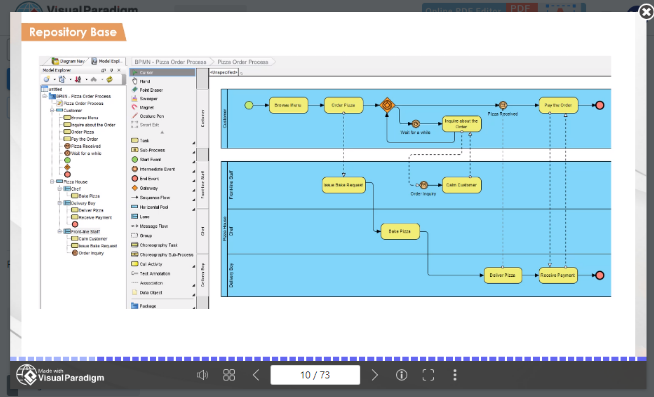
Business Process Diagram is a very good tool to model the workflow for your company or department because it gives a clear picture about who is responsible for a particular task as well as the flow of the process. However, the Business Process Diagram does not tell us how a particular task should be performed.
Continue reading
Decision Table: Clearer Logic and Better Decision
A decision table is an excellent tool to use in both testing and requirements management. Essentially it is a structured exercise to formulate requirements when dealing with complex business rules. In a decision table, business logic is well divided into conditions, actions (decisions) and rules for representing the various components that form the business logic.
Continue reading
When Should Use Which? User Story / Use Case / Feature / Backlog Item
We always come across these terms in software development. Sometimes people a piece of software feature — requirement/ use case, backlog items …. What is the convention of the software people for using that or which?
Continue reading
What is an agile estimate? What are the common pitfalls?
In software development , the usual “estimation” includes a quantitative evaluation of the work required to perform a given development task; this is usually expressed in terms of duration (hour / day) or estimated unit (story point). The purpose is to consolidate a number of such individual estimates in order to obtain an indication of the overall duration, work or cost of the software project.
Continue reading
Use Case Modeling
A UML use case diagram is the primary form of system/software requirements for a new software program under developed. Use cases specify the expected behavior (what) of a system, and not the exact method of making it happen (how). A complete set of use cases specifies all the different ways to use the system and therefore defines all behavior required of the system bounding the scope of the system.
Continue reading
Use Case Description Example
A use case is a written description of how a user performs a task on your system. It outlines the behavior of the system from the user’s perspective when responding to a request. Each use case is represented as a sequence of simple steps, starting with the user’s goal and ending when the goal is achieved.
Continue reading
Agile Use Case Modeling with Use Case 2.0 Automated Process Tool
Use Case 2.0 is a scalable and agile approach that uses use cases to capturing requirements and driving the incremental development of a system to fulfill them. It helps you understand how the system will be used and leading you through the development of an appropriate system to support the users.
Continue reading
Use Case Tutorial for Dummies
A use case diagram models different types of users interact with the system to solve a problem. As such, it describes the goals of the users, the interactions between the users and the system, and the required behavior of the system in satisfying these goals. Use cases define interactions between external actors and the system to attain particular goals. A use case diagram contains four main components
Continue reading