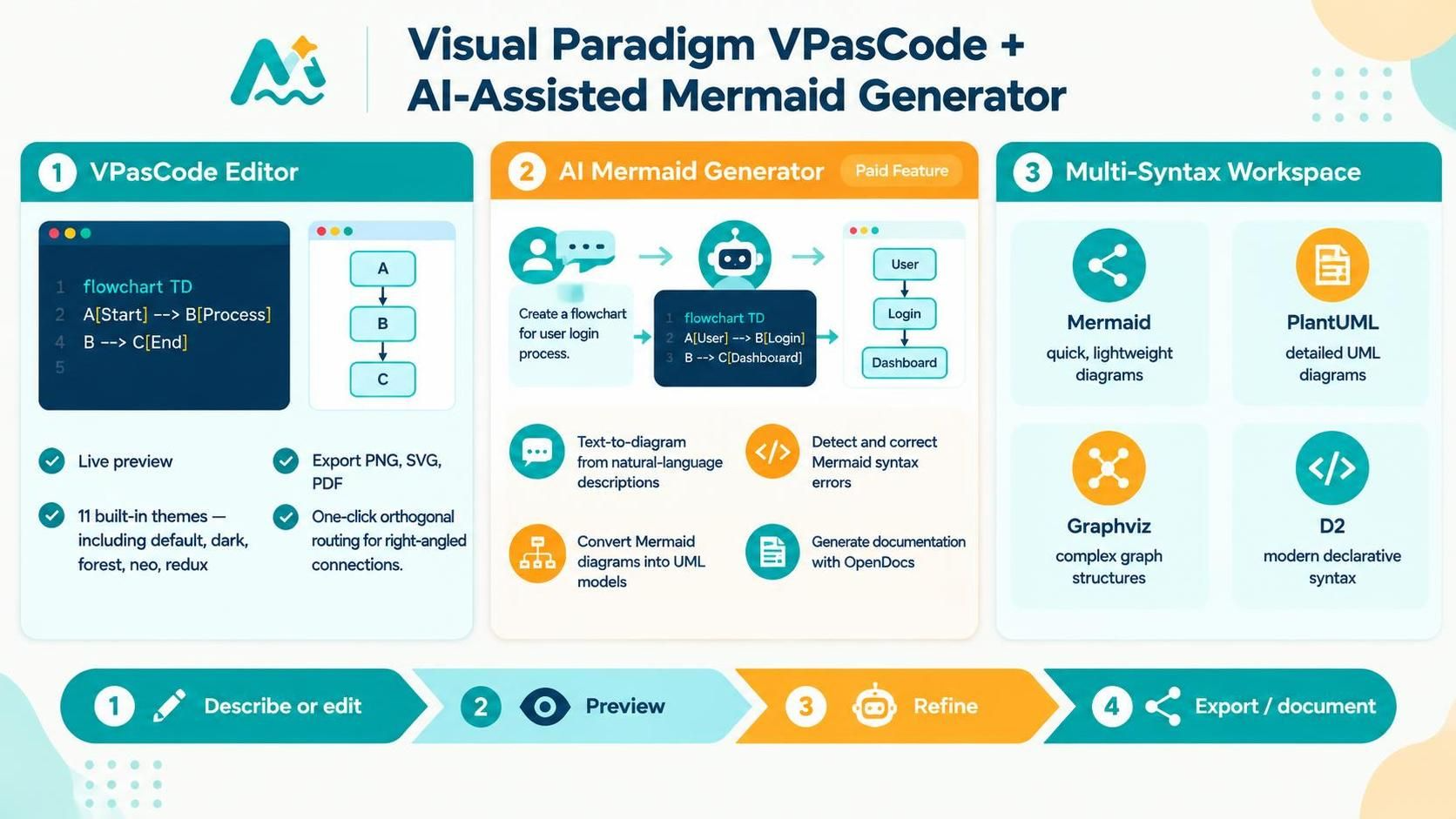
In the rapidly evolving landscape of software engineering and system design, the “Diagram-as-Code” paradigm has emerged as a powerful methodology. It bridges the gap between static documentation and dynamic software development, allowing engineers to define visual representations of systems using text-based syntax. Visual Paradigm’s VPasCode Editor, enhanced with an AI-Assisted Mermaid Generator, represents the cutting edge of this technology, offering a unified workspace where creativity meets technical precision.
The Core Concept: Textual Modeling
Traditionally, creating complex diagrams like flowcharts, UML models, or data flow diagrams involved dragging and dropping shapes onto a canvas. While intuitive, this approach often leads to “spaghetti diagrams” where lines cross chaotically, and layout maintenance becomes a nightmare. VPasCode shifts this paradigm by treating diagrams as code. By defining relationships and nodes through a structured text language, the software engine automatically calculates the optimal layout, ensuring clean, orthogonal routing and professional aesthetics.
Architecture of the VPasCode Editor
The VPasCode Editor is designed as a seamless environment for modelers. It functions on a “Live Preview” principle, similar to modern web development environments. As the user types the syntax, the rendering engine parses the text and updates the visual representation in real-time. This immediate feedback loop is crucial for iterative design.
- Live Preview Engine: The system continuously parses the input stream. There is no need to manually trigger a “compile” or “render” action, allowing for a fluid design process.
- Thematic Consistency: The editor supports 11 built-in themes (such as default, dark, forest, neo, and redux). This allows teams to maintain a consistent visual identity across documentation, whether for internal engineering reviews or external client presentations.
- Orthogonal Routing: One of the most common issues in diagramming is curved or messy connections. VPasCode offers a one-click option to convert these into clean, right-angled connections, ensuring that the diagram remains readable regardless of complexity.
- Export Versatility: Once the model is finalized, the system acts as a robust exporter, converting the diagrammatic logic into standard formats like PNG, SVG, or PDF for easy sharing and integration into reports.
Integrating AI for Model Generation
The AI Mermaid Generator transforms the workflow from manual coding to natural language interaction. This feature is particularly valuable for high-level conceptualization where the focus is on logic rather than syntax.
The workflow follows a distinct pattern:
- Natural Language Input: The user describes the diagram they need (e.g., “Create a flowchart for a user login process”).
- AI Synthesis: The AI interprets the intent and generates the corresponding Mermaid code.
- Refinement: The user can then view the diagram, and if errors exist, the AI provides automatic syntax fixing to correct any logical or grammatical mistakes in the code.
Beyond simple generation, this tool acts as a bridge to formal engineering. It can transform Mermaid diagrams into full-fledged UML models, enabling deeper analysis and system simulation. Furthermore, it integrates with OpenDocs to automatically generate comprehensive documentation directly from these visual models.
The Multi-Syntax Workspace Strategy
One of the most powerful architectural decisions in the VPasCode environment is its Multi-Syntax Workspace. Instead of forcing a user to choose a single tool for all tasks, it allows for the seamless switching between different diagram-as-code languages, each optimized for specific use cases.
Mermaid
Mermaid is best suited for quick, lightweight diagrams. Its syntax is designed to be human-readable and concise, making it ideal for documentation, README files, and rapid prototyping of flowcharts or sequence diagrams.
PlantUML
When the project requires depth, PlantUML is the preferred choice. It is ideal for detailed UML diagrams, offering a vast library of shapes and relationship types that are necessary for complex software architecture design and strict adherence to UML standards.
Graphviz
For data scientists and network engineers dealing with complex graph structures, Graphviz provides the necessary computational power. It excels in handling large datasets where the relationships between nodes are non-linear and highly interconnected.
D2
D2 represents the modern alternative in this ecosystem. With its declarative syntax, it offers a fresh approach to defining diagrams, focusing on clarity and ease of maintenance for modern infrastructure diagrams.
Conclusion
Visual Paradigm VPasCode + AI-Assisted Mermaid Generator represents a holistic approach to system modeling. By combining the precision of code with the speed of AI and the versatility of multiple syntax engines, it empowers engineers to focus on the logic and architecture of their systems rather than the manual effort of drawing them.