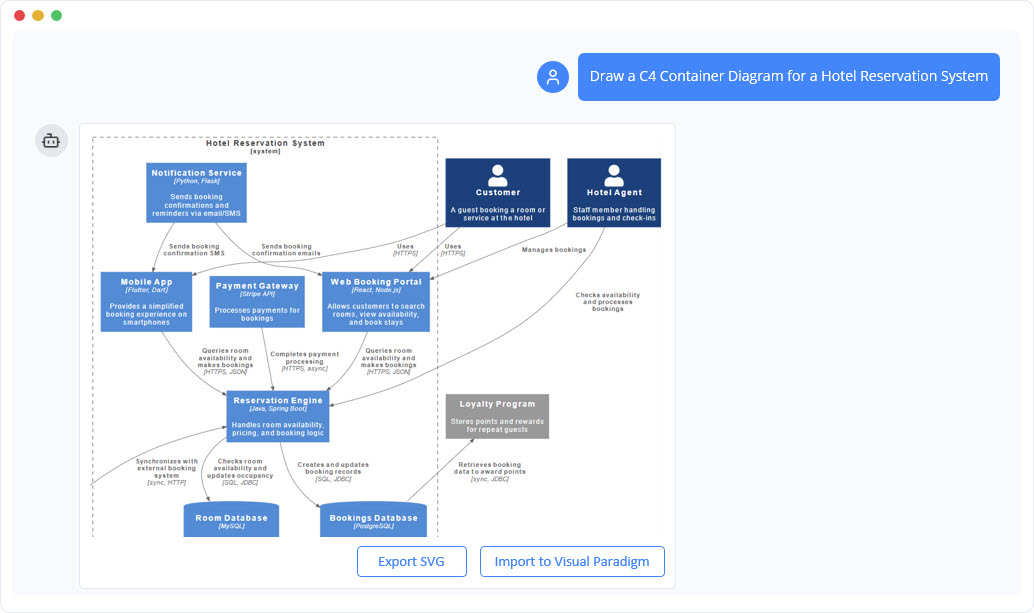
In modern software architecture, the ability to communicate complex system designs clearly is just as valuable as writing the code itself. The C4 model has emerged as a standard for visualizing software architecture at different levels of abstraction. This tutorial guides you through analyzing a sophisticated C4 Container Diagram for a Hotel Reservation System, demonstrating how AI tools like Visual Paradigm can translate natural language prompts into professional architectural blueprints.
1. Introduction to the C4 Model
The C4 model is a hierarchical approach to software architecture documentation, consisting of four levels:
- Level 1: Context Diagram – The system as a single box within its environment.
- Level 2: Container Diagram – The system broken down into high-level runtime environments (e.g., Web Apps, Microservices, Databases).
- Level 3: Component Diagram – The internal structure of the containers.
- Level 4: Code Diagram – A detailed view of specific code classes and functions.
The diagram presented in this tutorial is a Level 2 Container Diagram. It provides the perfect balance of detail, showing how the system interacts with external actors and how its internal services communicate.
2. Analyzing the System Boundaries and Actors
At the top of the diagram, we define the system boundary. The entire dashed box represents the Hotel Reservation System. Inside this boundary, we find the “System” itself, but the diagram also highlights critical external actors (humans) who interact with the system.
External Actors
Actors are represented by blue boxes with user icons:
- Customer: A guest booking a room or service. They interact via the Web Booking Portal and Mobile App.
- Hotel Agent: Staff members handling bookings and check-ins. They have a “Manage bookings” interaction with the system.
3. Inside the System: The Container Layer
The core of the diagram consists of Containers. In the C4 model, a container is a distinct, deployable unit of software, such as a web application, a mobile application, a microservice, or a database. Each container in this diagram is annotated with its technology stack.
Front-End Interfaces
- Web Booking Portal (React, Node.js): The primary interface for customers to search for rooms and make stays. It communicates with the backend via HTTPS and JSON.
- Mobile App (Flutter, Dart): Provides a simplified booking experience on smartphones. It sends notifications via SMS.
- Payment Gateway (Stripe API): An external or semi-external service responsible for processing payments securely. The diagram shows a “Completes payment processing” link from the core engine to this service.
Core Business Logic
- Reservation Engine (Java, Spring Boot): This is the heart of the system. It handles the critical logic for room availability, pricing, and booking rules. It acts as the central hub, receiving queries from the portal and app, and coordinating with the database and loyalty programs.
Notification Service
- Notification Service (Python, Flask): A dedicated microservice for handling non-blocking tasks like sending confirmation emails and SMS reminders. It is crucial for maintaining system performance by offloading I/O operations.
4. Data Storage and Persistence
Every modern application requires a place to store data. The C4 model typically treats databases as containers because they are distinct, persistent environments.
- Room Database (MySQL): This container stores the master data for the hotel inventory—room types, prices, and availability. The Reservation Engine checks this database to see if a room is free.
- Bookings Database (PostgreSQL): This container stores the actual transaction records. The Reservation Engine creates and updates booking records here.
5. External Integrations
The diagram also highlights the Loyalty Program. This is a container (likely a legacy system or a third-party service) that stores points and rewards. The Reservation Engine “Retrieves booking data” from this system to award points to repeat guests.
6. Technology Stack Analysis
One of the most powerful aspects of this diagram is the explicit labeling of the technology stack, which helps developers understand the heterogeneity of the system:
- Frontend: React (JavaScript), Flutter (Dart).
- Backend: Node.js (JavaScript), Java (Spring Boot), Python (Flask).
- Database: MySQL, PostgreSQL.
- APIs: Stripe API.
This polyglot architecture suggests a “Best of Breed” approach, where the team selected specific technologies best suited for specific parts of the system (e.g., Python for the quick-to-develop notification service, Java for the complex booking logic).
7. Leveraging AI for Modeling: From Prompt to Diagram
Creating such a detailed diagram manually can be time-consuming. However, modern tools like Visual Paradigm utilize AI to bridge the gap between natural language and structured diagrams.
Imagine you wanted to generate this diagram from scratch. You would simply type a prompt into the AI chatbot:
Draw a C4 Container Diagram for a Hotel Reservation System.
It should include:
1. Actors: Customer and Hotel Agent.
2. Containers: Web Booking Portal (React/Node), Mobile App (Flutter), Reservation Engine (Java/Spring), Room DB (MySQL), Bookings DB (PostgreSQL), and Notification Service (Python/Flask).
3. External Systems: Payment Gateway (Stripe) and Loyalty Program.
The AI would then parse these requirements, identify the relationships (e.g., the Mobile App queries the Reservation Engine), and generate the PlantUML code automatically to render the visual output.
8. Understanding the Data Flow
Let’s trace a typical user journey through the diagram:
- The Customer logs into the Web Booking Portal.
- The Portal sends an HTTPS request to the Reservation Engine to “Query room availability”.
- The Reservation Engine queries the Room Database (MySQL) to check data.
- The customer selects a room and proceeds to payment.
- The Reservation Engine interacts with the Payment Gateway to process the transaction.
- Upon success, the Engine updates the Bookings Database (PostgreSQL).
- Simultaneously, the Engine signals the Notification Service to send a confirmation email.
9. Best Practices for C4 Diagrams
When creating or maintaining a C4 Container Diagram, keep these principles in mind:
- Focus on the “What”: Containers describe what the system does, not exactly how it does it (which is for the Component diagram).
- Keep it Updated: If a technology stack changes (e.g., moving from MySQL to PostgreSQL), update the diagram immediately to prevent confusion.
- Use Standard Notation: Ensure all arrows clearly indicate the direction of the data flow and the protocol used (e.g.,
HTTPS, JSON,SQL, JDBC).