


Enterprise architecture often feels like a distant concept, separated from the daily grind of business operations. However, the bridge between high-level strategy and technical execution is critical. When organizations define goals, they need a mechanism to visualize how those goals translate into capabilities, processes, and systems. This is where the ArchiMate modeling language becomes an essential tool for clarity.
Transforming abstract ideas into concrete diagrams requires discipline and a structured approach. This guide outlines the process of moving from business intent to architectural reality without relying on specific software vendors or buzzwords. We will focus on the principles of modeling, the alignment of layers, and the maintenance of traceability.
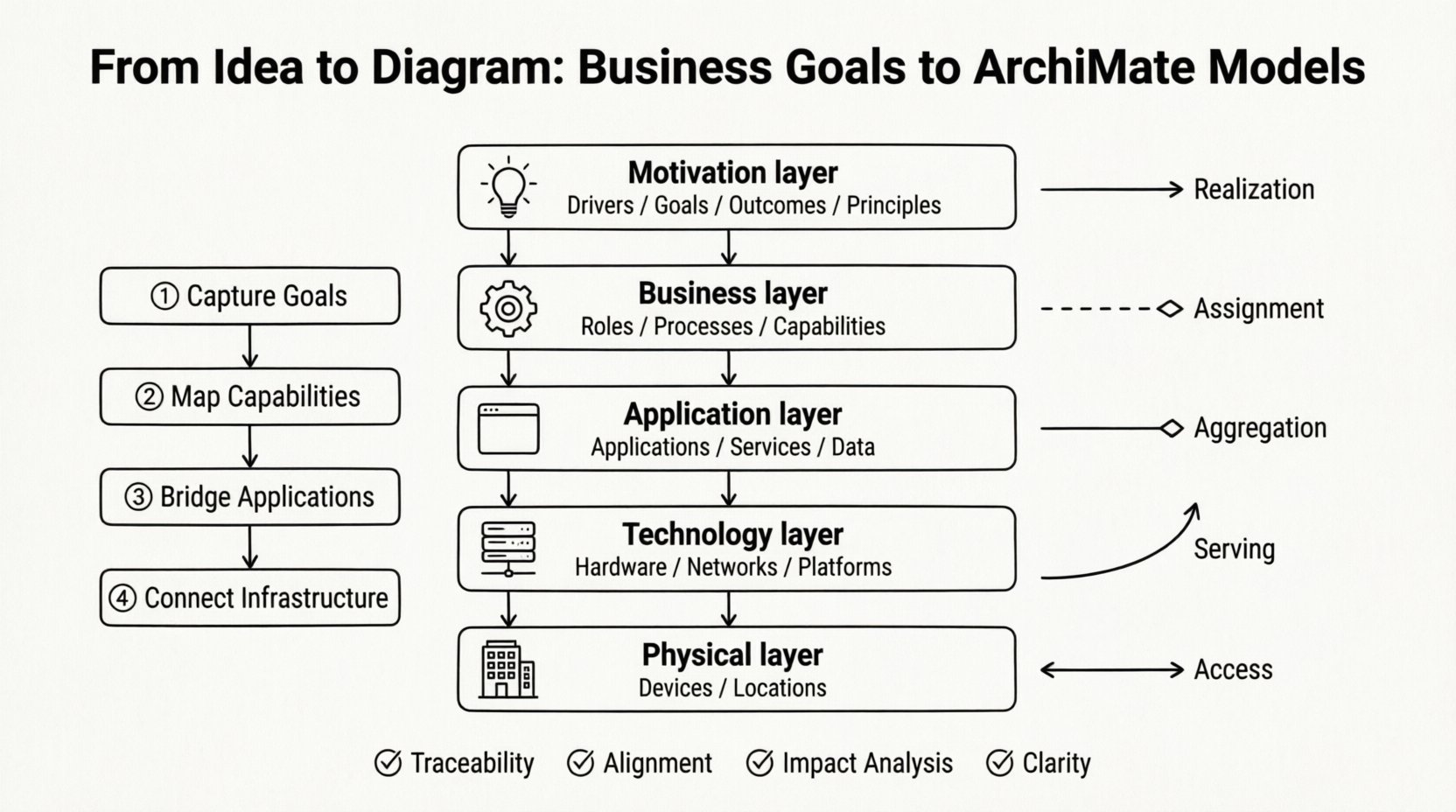
Understanding the Foundation: Why Model at All? 🤔
Before drawing lines and shapes, it is vital to understand the purpose of the model. An ArchiMate diagram is not merely a picture; it is a representation of relationships and dependencies. The goal is to create a shared understanding among stakeholders.
- Clarity: Complex strategies often get lost in communication. Diagrams simplify the narrative.
- Traceability: You must be able to link a specific technology component back to a business driver.
- Impact Analysis: When a change occurs, the model helps identify what else is affected.
- Alignment: Ensures IT investments support actual business needs.
Without a model, architecture decisions are often made in isolation. With a model, decisions are contextualized within the broader organizational structure.
The ArchiMate Layers Explained 🏛️
ArchiMate organizes enterprise architecture into distinct layers. Understanding these layers is the first step in mapping your goals effectively. Each layer focuses on a specific aspect of the enterprise.
| Layer | Focus Area | Key Concepts |
|---|---|---|
| Motivation | Why are we doing this? | Drivers, Goals, Outcomes, Principles |
| Business | What do we do? | Roles, Processes, Capabilities, Objects |
| Application | How do we support the business? | Applications, Services, Data Objects |
| Technology | What runs the applications? | Hardware, Networks, Software Platforms |
| Physical | Where does it exist? | Devices, Locations, Networks |
The modeling process typically flows from the Motivation layer down to the Technology layer. This ensures that every technical decision is justified by a business reason.
Step 1: Capturing the Business Goals 🎯
The journey begins in the Motivation layer. This is the conceptual starting point. You are documenting the why behind the initiative. Do not skip this step, as it provides the justification for the architecture.
Key Elements to Define
- Drivers: What is prompting this change? Is it market pressure, regulation, or efficiency?
- Goals: What specific objectives are being pursued?
- Outcomes: What value is expected once the goal is achieved?
- Principles: What rules or guidelines must be followed during implementation?
When documenting these elements, keep them concise. A goal should be measurable. For example, rather than saying “Improve efficiency,” specify “Reduce processing time by 20%.” This precision makes the model more useful for later analysis.
Step 2: Mapping to Business Capabilities and Processes ⚙️
Once the goals are established, you move to the Business layer. Here, you define the capabilities required to achieve the goals. A capability is what an organization does, not how it does it.
Defining Capabilities
Capabilities are stable over time. They represent the ability to perform a function. When mapping goals to capabilities, ask: “What ability must we possess to achieve this outcome?”
- Capability Mapping: Link the Goal element to the Capability element using an Realization relationship.
- Process Identification: Identify the specific processes that deliver the value. Processes are the flow of activities.
- Role Assignment: Determine who is responsible. Roles represent the people or groups performing the work.
It is common to create a Value Stream diagram alongside the capability map. A value stream shows the sequence of activities that create value for a stakeholder. This visual aid helps clarify how the business processes contribute to the overall goal.
Step 3: Bridging to Application Services 💻
With the business requirements defined, the next step is to identify the applications that support them. This is the Application layer. The focus here is on software functionality, not the code itself.
Application Mapping Strategies
- Function Support: Identify which applications provide the functions needed for the business processes.
- Service Interface: Define how the application exposes its functionality to other systems or users.
- Data Objects: Determine what data is created, read, or modified during the process.
Traceability is crucial here. Ensure that every business process has at least one supporting application. If a process exists without a tool, note it as a manual gap. If a tool exists without a process, note it as an underutilized asset.
Step 4: Connecting to Technology Infrastructure 🖥️
The final architectural layer is Technology. This defines the hardware and software platforms that host the applications. This is often where IT teams spend the most time, but it must remain subordinate to business needs.
Infrastructure Considerations
- Deployment: Show how applications are deployed on nodes (servers, containers).
- Network: Define connectivity requirements between nodes.
- Physical Location: Specify where the infrastructure resides (data centers, cloud regions).
Remember that technology changes faster than business goals. While you must model the current state, ensure the model allows for abstraction so that specific hardware changes do not require a complete overhaul of the architecture.
Using Relationships to Establish Traceability 🔗
The power of the model lies in the relationships between elements. Simply placing elements on a canvas is not enough; you must define how they connect.
Here are the primary relationship types used in this context:
- Realization: Indicates that one element realizes another. (e.g., A process realizes a capability).
- Assignment: Indicates that a role is assigned to an element. (e.g., A role performs a process).
- Aggregation: Indicates a part-whole relationship. (e.g., A process is part of a value stream).
- Serving: Indicates that an application service serves a business function.
- Access: Indicates that an application accesses a data object.
When building the model, prioritize the Realization relationship for your primary goals. It creates a direct line of sight from the technology back to the business driver.
Common Pitfalls in Modeling 🚫
Even experienced architects make mistakes when translating goals into diagrams. Being aware of these common traps helps maintain model quality.
1. Over-Modeling
Do not try to capture every single detail. A model that is too detailed becomes difficult to read and maintain. Focus on the elements that are relevant to the specific goal or initiative.
2. Ignoring the Motivation Layer
Many teams jump straight to the Business or Application layers. Without the Motivation layer, there is no justification for the work. This makes it hard to prioritize projects later.
3. Mixing Layers
Keep the layers distinct. Do not place a technology server inside a business process box. Use the relationships to show connections between layers instead of embedding elements within them.
4. Static Models
A model that is created once and never updated is a liability. Architecture is dynamic. Regular reviews are necessary to ensure the diagram reflects the current state of the enterprise.
Validating the Model with Stakeholders 👥
Once the initial draft is complete, validation is required. This involves presenting the model to the people who own the business goals and the technology.
- Review for Accuracy: Ask the business owners if the goals are correctly represented.
- Review for Completeness: Ask the IT owners if the technology supports all necessary functions.
- Review for Clarity: Ensure the diagrams are understandable to non-technical stakeholders.
Feedback loops are essential. You may need to adjust the model multiple times before it is accepted. This collaborative process ensures buy-in and reduces resistance during implementation.
Maintaining Model Accuracy Over Time 🔄
The enterprise environment changes. New goals emerge, processes are redesigned, and technology is replaced. The model must evolve to stay relevant.
Change Management Practices
- Version Control: Keep track of changes to the model. Use versioning to understand the history of decisions.
- Regular Audits: Schedule periodic reviews to check for obsolete elements.
- Integration with Planning: Link the model to the budgeting and planning cycles. If a project is funded, the model should reflect the planned change.
By treating the model as a living document, you ensure it remains a useful asset rather than a historical archive.
Conclusion on Strategy Execution 🏁
Turning business goals into ArchiMate models is a systematic process that requires attention to detail and a clear understanding of the framework. By starting with motivation, mapping through capabilities, and connecting to technology, organizations can build a robust architecture.
The result is not just a set of diagrams, but a structured understanding of how the enterprise functions. This understanding enables better decision-making, clearer communication, and more effective execution of strategy. The key is consistency and a willingness to update the model as the business evolves.
Remember, the goal is alignment. When the architecture aligns with the business, the organization moves forward with purpose and clarity.
This post is also available in Deutsch, Español, فارسی, Français, English, Bahasa Indonesia, 日本語, Polski, Portuguese, Ру́сский, Việt Nam, 简体中文 and 繁體中文.