LeSS was created by Bas Vodde and Craig Larman from practical experience in scaling up Scrum, founded as the LeSS Company in 2014. The “More with LeSS” principle is at the heart of LeSS (Large Scale Scrum). Complex product development doesn’t require complex solutions. It requires a deep understanding of the essence of the problems, which can then be solved with simpler solutions.
Continue readingCategory: Agile Project Management
How to Make UML Modeling to be Agile & Just-in-time manner
This Article will show you how to effectively apply UML modeling in both agile and just-in-time manner with the powerful Model ETL feature. A UML model or diagram is a specific view into what you are trying to understand in a specific context.
Continue reading
When Should Use Which? User Story / Use Case / Feature / Backlog Item
We always come across these terms in software development. Sometimes people a piece of software feature — requirement/ use case, backlog items …. What is the convention of the software people for using that or which?
Continue reading
What is an agile estimate? What are the common pitfalls?
In software development , the usual “estimation” includes a quantitative evaluation of the work required to perform a given development task; this is usually expressed in terms of duration (hour / day) or estimated unit (story point). The purpose is to consolidate a number of such individual estimates in order to obtain an indication of the overall duration, work or cost of the software project.
Continue reading
What is Cross-functional Flowchart?
A cross-functional flowchart (sometimes referred to as a deployment flowchart) is a business process mapping tool used to articulate the steps and stakeholders of a given process. Typically, we use a cross-functional flowchart to show the relationship between a business process and the functional units (such as departments) responsible for that process.
Continue reading
Top 7 Most Popular Agile Estimation Methods for User Stories
In software development, “estimation” in the usual sense includes a quantitative assessment of the effort required to perform a specific development task; this is usually expressed in terms of duration. Agile estimation is the process of evaluating the effort required to complete the tasks on a product’s backlog in order of priority. This effort is usually measured in terms of the time required to complete the task, which in turn leads to accurate sprint planning.
Continue reading
Agile Estimation in Scrum? Story Point and Planning Poker
Whether the team is working on a product or a project, we need to answer the question, “When will we get it done?” “Or how much we can do at a certain point in time, so as in the traditional development model, we need to estimate the effort before we start the project. During the development of Scrum, the team shared responsibility and collectively committed to the work of each Sprint, so the estimated workload for the agile team used a collective estimation approach.
Continue reading
Why Agile? Why Plan-Driven Software Development Projects Fail?
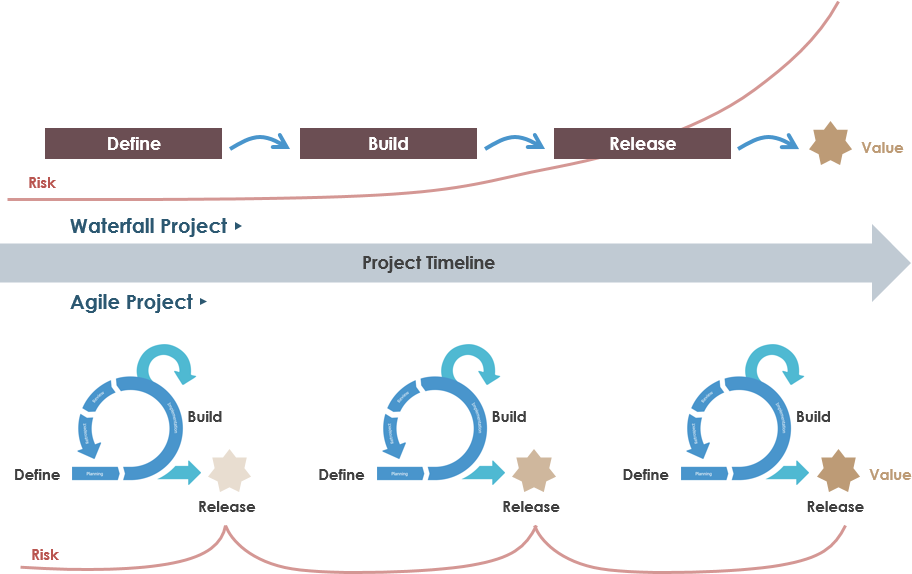
A plan-driven process means that all process activities are planned in advance and progress is measured against that plan. In an agile process, the plan is incremental and it is easier to change the plan and software to reflect changing customer needs.
Continue reading
Scrum Team — I-Shaped vs T-Shaped People
Some people are very proficient in a particular field, but rarely contribute outside of that field. These people are called “I-types” in the agile community because they are like the letter “I” in that they have depth, but not much breadth. In contrast, “T-people” have complementary expertise in one area, but less developed skills in related areas and good collaboration skills.
Continue reading
10 Agile Guidelines for Improving your Scrum Projects
This article aims to illustrate the Agile practices and provide guidance to agile team on adopting Agile for implementation of IT systems. It was developed based on common Agile practices in the industry and the experiences gained from the various pilot projects.
Continue reading