


Scaling Business Process Model and Notation (BPMN) within large enterprise environments presents a unique set of challenges that go beyond simple diagramming. As organizations grow, the complexity of their operational workflows increases exponentially. A process that works for a department of ten can become unmanageable for a global workforce of ten thousand without a strategic approach to modeling standards, governance, and architecture. This guide explores the essential practices required to maintain clarity, consistency, and utility in BPMN models at scale.
Understanding the Scale Challenge 📉
In a small business context, a single modeler might create the entire process map. In a large enterprise, multiple teams across different regions and functions interact with the same process definitions. Without a unified strategy, this leads to fragmentation. You might see:
- Inconsistent Terminology: One team calls it a “Customer Onboarding” process, while another uses “New Client Integration”.
- Redundant Modeling: Different groups recreating the same sub-processes with slight variations.
- Version Conflicts: Updates made in silos causing integration failures when processes merge.
- Loss of Context: Models become outdated as business logic changes faster than documentation can keep up.
Addressing these issues requires a shift from ad-hoc modeling to a structured discipline. The goal is not just to document what happens, but to create a living repository of business logic that supports automation, compliance, and continuous improvement.
Establishing a Governance Framework 📋
Governance is the backbone of any successful scaling effort. It defines the rules of engagement for how processes are created, reviewed, and published. A robust framework ensures that every model adheres to the enterprise standards, regardless of who created it.
1. Define Modeling Standards 📏
Before a single shape is drawn, you must define the visual and logical rules. These standards reduce cognitive load for anyone reading the diagram.
- Shape Usage: Specify exactly when to use a Task versus a Sub-process. For example, mandate that any process containing more than three decision points must be broken down into a sub-process.
- Naming Conventions: Enforce a strict naming convention for pools, lanes, and activities. Use action-verb nouns (e.g., “Submit Application”) rather than abstract nouns (e.g., “Application”).
- Color Coding: If color is used to denote status (e.g., red for exceptions), ensure this is documented and consistent across all models.
- Level of Detail: Define the granularity. A Level 1 process should show major phases only. Level 2 should show specific tasks. Avoid mixing levels in a single view.
2. Centralized Repository and Approval Workflows 🏛️
Models should not live in local files or scattered network drives. A centralized repository is essential for:
- Single Source of Truth: Ensuring everyone accesses the latest version.
- Access Control: Limiting who can edit, publish, or delete models.
- Audit Trails: Tracking who changed what and when, which is critical for compliance.
Implement an approval workflow where a senior business architect reviews new models before they are published to the repository. This acts as a quality gate.
3. Governance Tiers
| Tier | Owner | Scope | Review Frequency |
|---|---|---|---|
| Strategic | Enterprise Architecture | End-to-End Value Chains | Quarterly |
| Tactical | Department Heads | Functional Workflows | Monthly |
| Operational | Process Owners | Task-Level Execution | As Needed |
Architectural Patterns for Complexity 🏗️
As the number of processes grows, the diagram becomes cluttered. Architectural patterns help manage this complexity by breaking down large systems into manageable components.
1. Modularization and Decomposition 🔗
Do not attempt to model an entire department in one diagram. Use decomposition to create a hierarchy of models.
- Call Activities: Use Call Activities to reference other models. This allows you to keep the high-level view clean while maintaining detailed logic in separate files.
- Global Pools: Define shared entities (like “Customer” or “Product”) as global pools if they appear across multiple process maps. This ensures consistency in data structures.
- Service Tasks: Abstract system interactions into service tasks. Do not model the internal logic of an external system unless necessary for the business flow.
2. Orchestration vs. Choreography ⚙️
In large environments, understanding the interaction between systems is vital. Distinguish between:
- Orchestration: A central coordinator (the main process) controls the flow and instructs participants. Best for internal workflows where one system drives the process.
- Choreography: A decentralized interaction where participants react to each other without a central controller. Best for cross-organizational or partner interactions.
Using the wrong pattern can lead to rigid processes that fail when external partners change their behavior. Choose the pattern based on where the control logic resides.
3. Event-Based Design 🚦
Large enterprises often deal with asynchronous events. Avoid forcing synchronous flows where events occur randomly.
- Message Events: Use message events to represent inputs from external systems or human actions that trigger the process.
- Timer Events: Use timer events for deadlines and periodic checks, not for general delays.
- Error Events: Design error handling explicitly. Every major path should have a mechanism to handle failures without stopping the entire process.
Version Control and Lifecycle Management 🔄
Processes evolve. Regulations change, and business strategies shift. A static model becomes a liability. Managing versions effectively ensures that you can track history without breaking active operations.
1. Versioning Strategy 📅
Adopt a clear versioning scheme. Semantic versioning (Major.Minor.Patch) is often applicable.
- Major Version: Changes that break compatibility or alter the core business logic.
- Minor Version: Additions of new functionality that do not affect existing flows.
- Patch Version: Bug fixes or clarifications within the existing logic.
When a major version is released, you must decide how to handle the old version. Do not delete it. Archive it for historical reference and audit purposes.
2. Deprecation and Transition 🚧
Simply switching to a new version is not enough. You need a transition plan.
- Parallel Runs: Run the old and new versions simultaneously for a set period to compare results.
- Notification: Notify all stakeholders (business users, IT teams) when a model is deprecated.
- Blocking Criteria: Define clear criteria for when the old version can be completely retired.
3. Impact Analysis 🔍
Before changing a model, analyze the impact. Does this change affect downstream processes? Does it require changes in the underlying database or application code? Traceability links between the process model and the technical implementation are crucial here.
Collaboration and Role Definition 👥
Scaling BPMN requires the right people doing the right work. A single team cannot model everything accurately. You need a collaborative ecosystem.
1. The Three-Layer Modeling Approach
Divide the modeling effort based on expertise and access.
- Business Analysts: Focus on the “What” and “Why”. They define the requirements and high-level flows. They should not worry about technical implementation details.
- Process Architects: Focus on the “How”. They ensure the models follow standards, fit the architecture, and integrate correctly with other systems.
- Developers: Focus on the “Implementation”. They validate that the model is technically feasible and map the BPMN elements to code or configuration.
2. Collaboration Tools and Feedback Loops 🗣️
Models should not be static documents. They should be living artifacts.
- Commenting: Enable comments within the modeling tool for specific tasks or gateways.
- Workshops: Conduct regular workshops to review complex processes with stakeholders. Use the model as a focal point for discussion.
- Feedback Channels: Provide a mechanism for end-users to report discrepancies between the model and reality.
Data Integration and Information Modeling 📊
Processes do not happen in a vacuum; they move data. Large enterprises often struggle to align process logic with data structures.
1. Data Objects and Context 📂
Every task should have associated data. Clearly define the data objects entering and leaving each activity.
- Input Data: What information is required to start the task?
- Output Data: What information is produced upon completion?
- Data Validation: Include decision gateways that check data quality before proceeding.
2. Aligning with Data Standards 🗃️
Ensure that the data names in the process model match the data names in the enterprise data dictionary. Inconsistencies here cause confusion and integration errors. If the process model refers to “Client ID” but the database uses “Customer_Key”, the developers will have to map them manually, introducing risk.
3. External System Interfaces 🔌
Clearly mark where the process interacts with external systems. Use specific service task types for this. Avoid using generic tasks for system calls. This distinction helps in generating accurate integration specifications.
Maintenance and Lifecycle 🔧
Even with perfect governance, models degrade over time. A maintenance strategy is required to keep the repository healthy.
1. Regular Audits 🕵️
Schedule periodic audits of the process repository.
- Stale Models: Identify models that have not been updated in 12+ months.
- Broken Links: Check for broken references to sub-processes or data objects.
- Compliance: Verify that models reflect current regulatory requirements.
2. Cleanup and Archiving 🗑️
Do not let the repository become a graveyard of obsolete processes. Move retired models to an archive folder that is distinct from the active library. This keeps the active workspace clean and focused.
3. Training and Onboarding 🎓
New hires need to understand the modeling standards immediately. Provide training materials that include:
- Examples of good vs. bad models.
- A glossary of approved terms.
- Templates for common process types (e.g., Purchase Order, Incident Resolution).
Technical Integration Considerations ⚙️
While BPMN is a standard, its execution often involves specific technical constraints in large environments.
- Performance: Avoid modeling processes that are too deep. A process with 50 nested sub-processes may be difficult to debug and slow to execute in certain engines.
- Parallelism: Use parallel gateways to enable concurrent work where possible, but ensure that synchronization is handled correctly to avoid deadlocks.
- Human vs. System: Clearly distinguish between human tasks and system tasks. This affects task routing, SLAs, and user interface requirements.
Key Takeaways for Implementation 🚀
Scaling BPMN in a large enterprise is not a one-time project but a continuous journey. It requires discipline, clear communication, and a willingness to adapt. Here are the core pillars to remember:
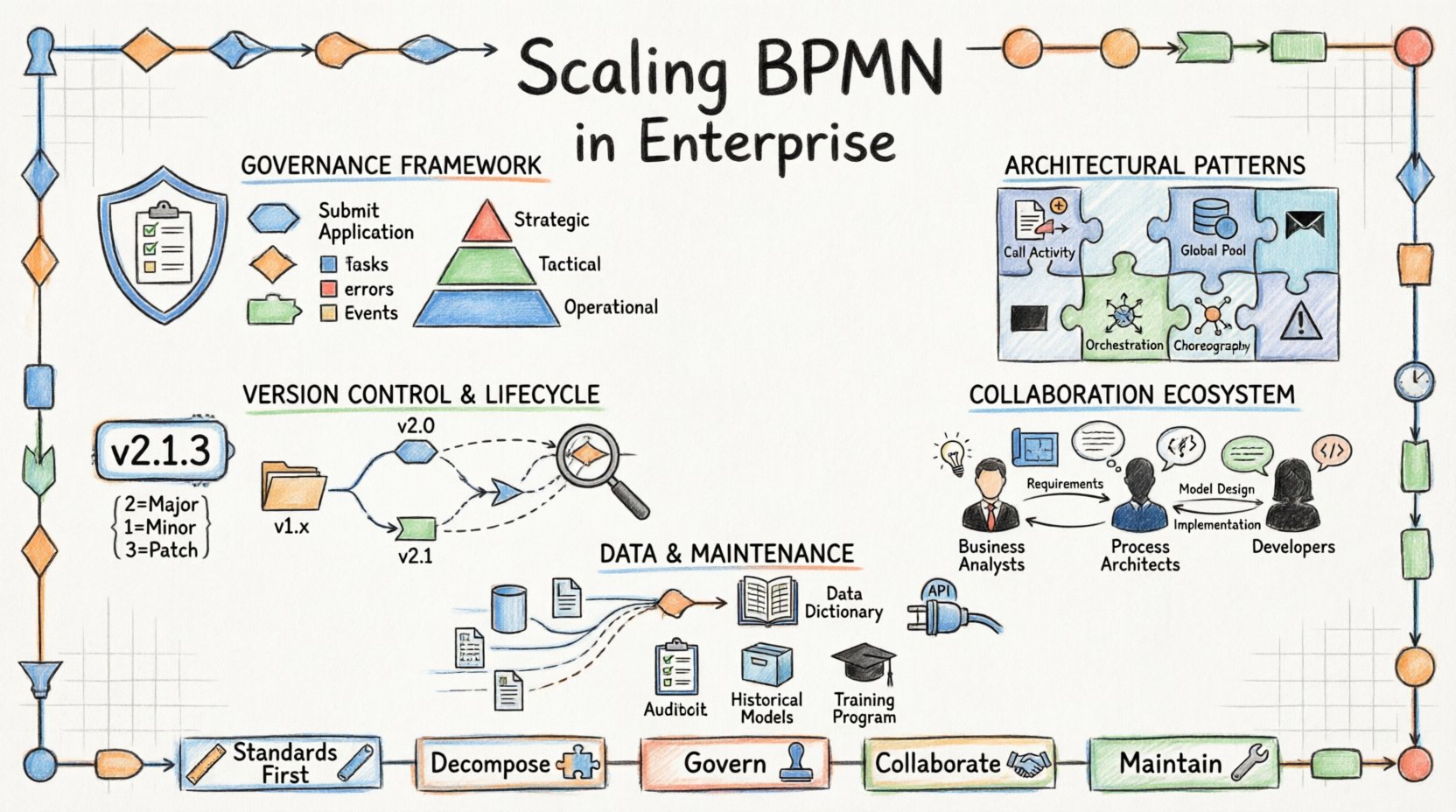
- Standards First: Never start modeling without agreed-upon standards.
- Decompose: Break complex processes into smaller, manageable units.
- Govern: Implement strict versioning and approval workflows.
- Collaborate: Involve business, architecture, and IT teams throughout the lifecycle.
- Maintain: Treat models as living documents that require regular care.
By following these practices, organizations can transform their process models from static diagrams into dynamic assets that drive efficiency, compliance, and innovation across the enterprise.
This post is also available in Deutsch, Español, فارسی, Français, English, Bahasa Indonesia, 日本語, Polski, Portuguese, Ру́сский, Việt Nam, 简体中文 and 繁體中文.