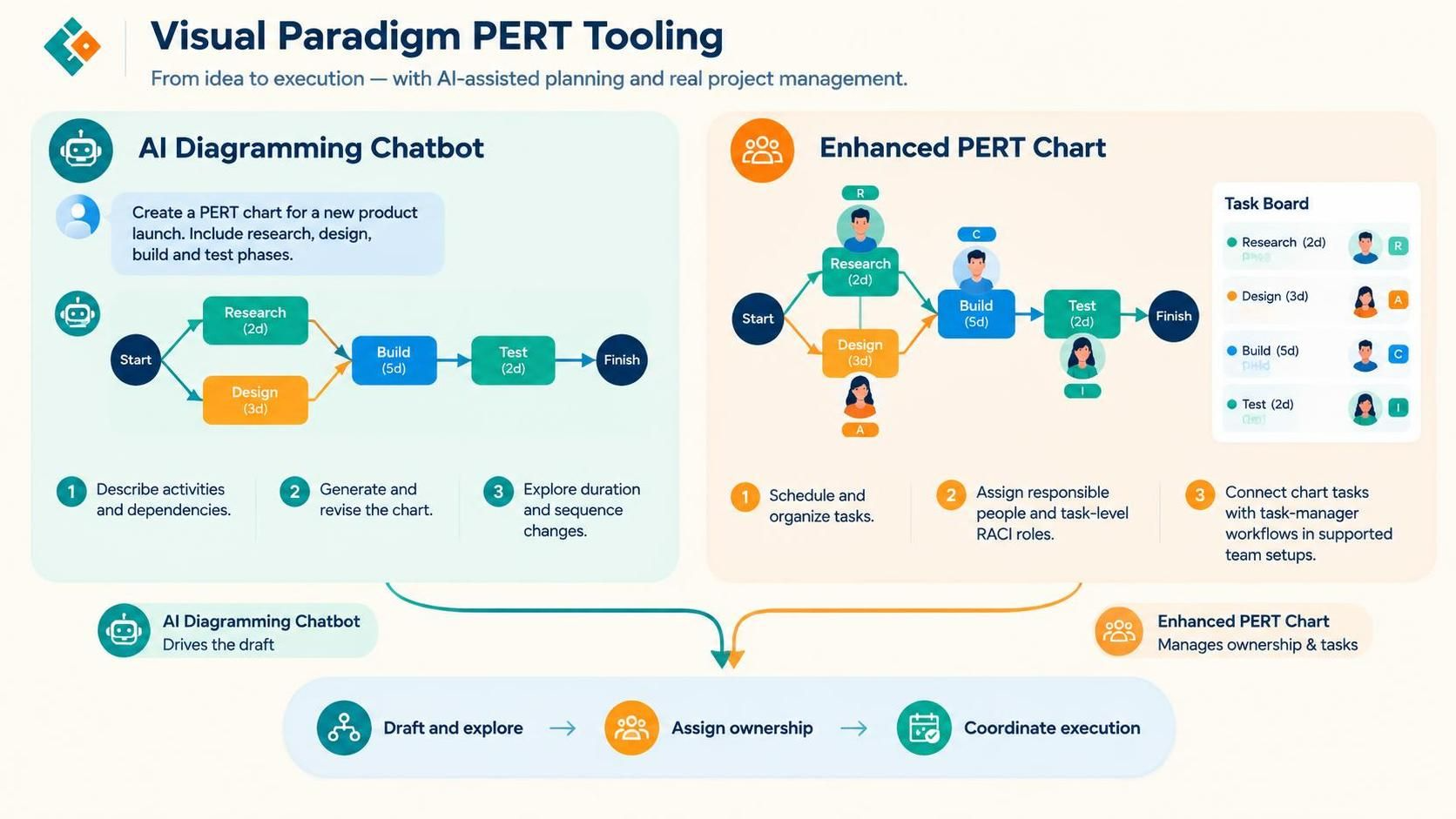
Project management often suffers from a disconnect between the initial planning phase and the actual execution phase. You might have a brilliant schedule on paper, but if the team doesn’t know who owns the tasks or how to execute them, the plan is merely theoretical. Visual Paradigm bridges this gap with a dual-approach ecosystem: the AI Diagramming Chatbot for rapid, conversational drafting, and the Enhanced PERT Chart for rigorous scheduling and team workflow management.
This tutorial explores the technical architecture of this workflow, demonstrating how you can transition seamlessly from a high-level idea to a fully assigned, executable project schedule.
The AI-Driven Drafting Phase
The modern approach to project modeling is conversational. Instead of manually dragging and dropping shapes to build a network, the AI Diagramming Chatbot allows you to define your project logic through natural language.
This tool functions as a generative modeling engine. It parses your textual requirements and converts them into a structured PERT network. The process is designed for speed and exploration, allowing you to iterate on the logic before worrying about the details.
Step-by-Step AI Interaction
- Define the Scope: You begin by describing the project activities and their dependencies. For instance, a prompt like “Create a PERT chart for a new product launch. Include research, design, build, and test phases” triggers the generator.
- Generate the Network: The AI interprets the text and constructs the nodes (tasks) and edges (dependencies). It automatically calculates durations based on context or default assumptions, creating a “Draft” phase of the project.
- Explore Alternatives: Once the draft is generated, the chatbot remains active. You can ask it to modify the sequence, add new activities, or explore “what-if” scenarios (e.g., “What happens if the design phase takes 5 days instead of 3?”).
The Enhanced PERT Architecture
While the AI handles the “what” and “how” of the schedule, the Enhanced PERT Chart focuses on the “who” and “when.” This component transforms a static diagram into a dynamic project management tool by integrating with team workflows.
Visualizing Task Dependencies
The core of the Enhanced PERT Chart is its ability to visualize critical paths and dependencies. In the visual model, nodes represent activities with specific durations (e.g., “Build (5d)”). Arrows indicate the flow of work. This visual structure allows project managers to instantly identify bottlenecks or tasks that are holding up the entire project.
Integrating RACI and Ownership
The most significant technical enhancement in this workflow is the integration of RACI roles directly into the diagram nodes. The system allows you to assign specific users to specific tasks, visualizing the chain of command.
- Responsible (R): The person who actually performs the work. In the diagram, this is visualized as a user avatar attached to the task node.
- Accountable (A): The person who is ultimately answerable for the correct completion of the task.
- Consulted (C): Those whose opinions are sought; they are consulted before the action is taken.
- Informed (I): Those who are kept up-to-date on progress.
By assigning these roles, the chart stops being a schedule and becomes an assignment of responsibility. The system understands that the “Build” task is not just a box on a screen, but an assignment for a specific developer or engineer.
The Synchronization Workflow
The true power of Visual Paradigm lies in the synchronization between the diagram and the backend task manager. This architecture ensures that your planning model remains the source of truth.
- Drafting: Use the AI Diagramming Chatbot to generate the network logic. This is the “Draft and Explore” phase where you focus on the sequence of events.
- Assignment: Switch to the Enhanced PERT Chart view. Here, you assign the RACI roles. The system links these roles to the project members’ profiles.
- Execution: The chart synchronizes with the Task Manager. Tasks appearing in the PERT chart are automatically added to the responsible members’ to-do lists. This ensures that the workflow is not just planned, but actively executed.
This seamless flow—from the conversational generation of the schedule to the rigorous assignment of roles—ensures that the final output is a cohesive, executable project plan.