Many organizations are interested in using artificial intelligence to improve productivity, automate routine work and make internal information easier to access. However, they may hesitate to adopt AI because of concerns about where company data goes when employees interact with an AI assistant.
When someone submits a question to an online AI service, the application may transmit the prompt and relevant information to infrastructure operated by an external provider. For businesses working with confidential documents, customer information, intellectual property or internal project records, understanding this data flow is essential.
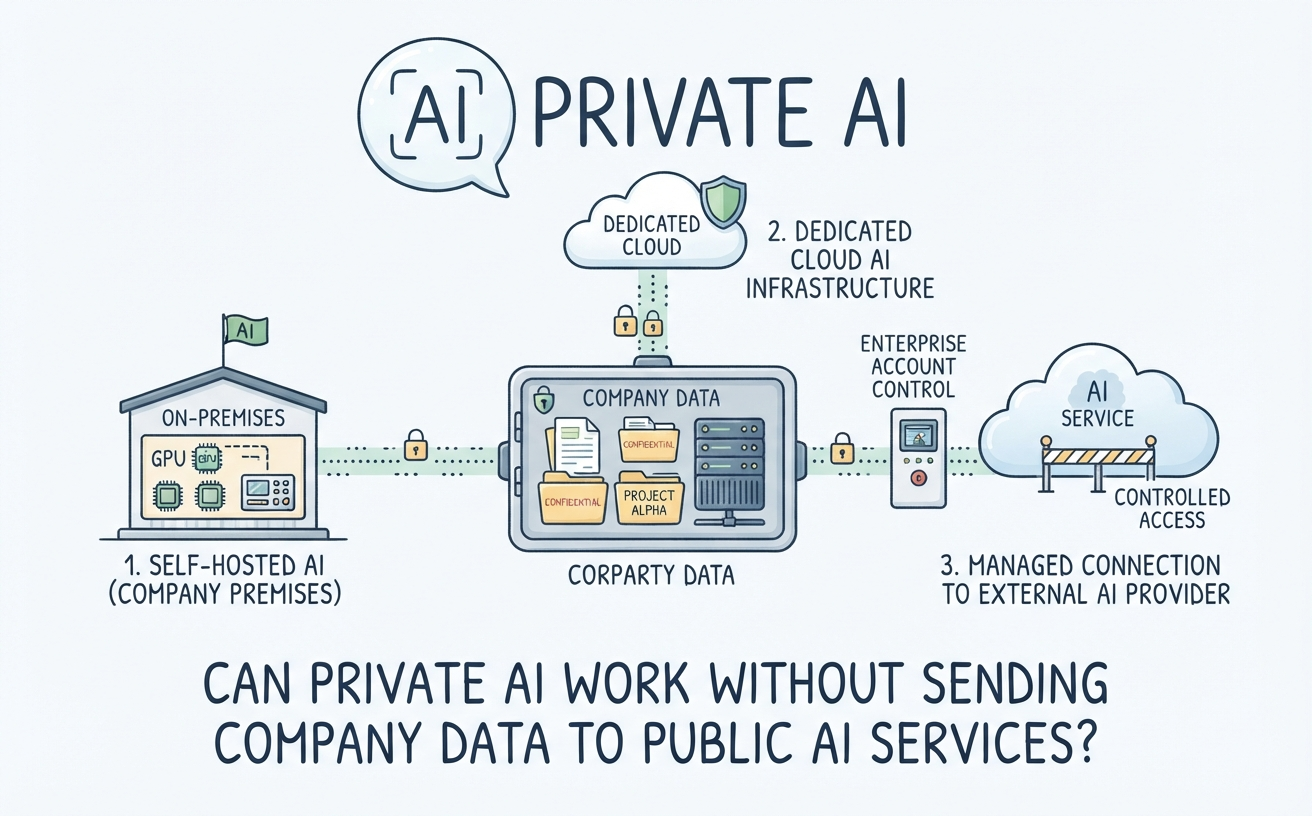
This raises an important question: can an organization use AI without sending its company information to public AI services?
The answer depends on the deployment approach. Organizations can consider self-hosted AI models, dedicated cloud infrastructure or controlled connections to external AI providers. Each option offers a different balance of control, flexibility, infrastructure requirements and operational responsibility.
What Does It Mean to Use Private AI?
The term “private AI” can refer to different deployment and operating arrangements. It generally describes an AI environment designed to give an organization greater control over how AI is accessed, configured and connected to its business information.
Depending on the architecture, private AI may involve:
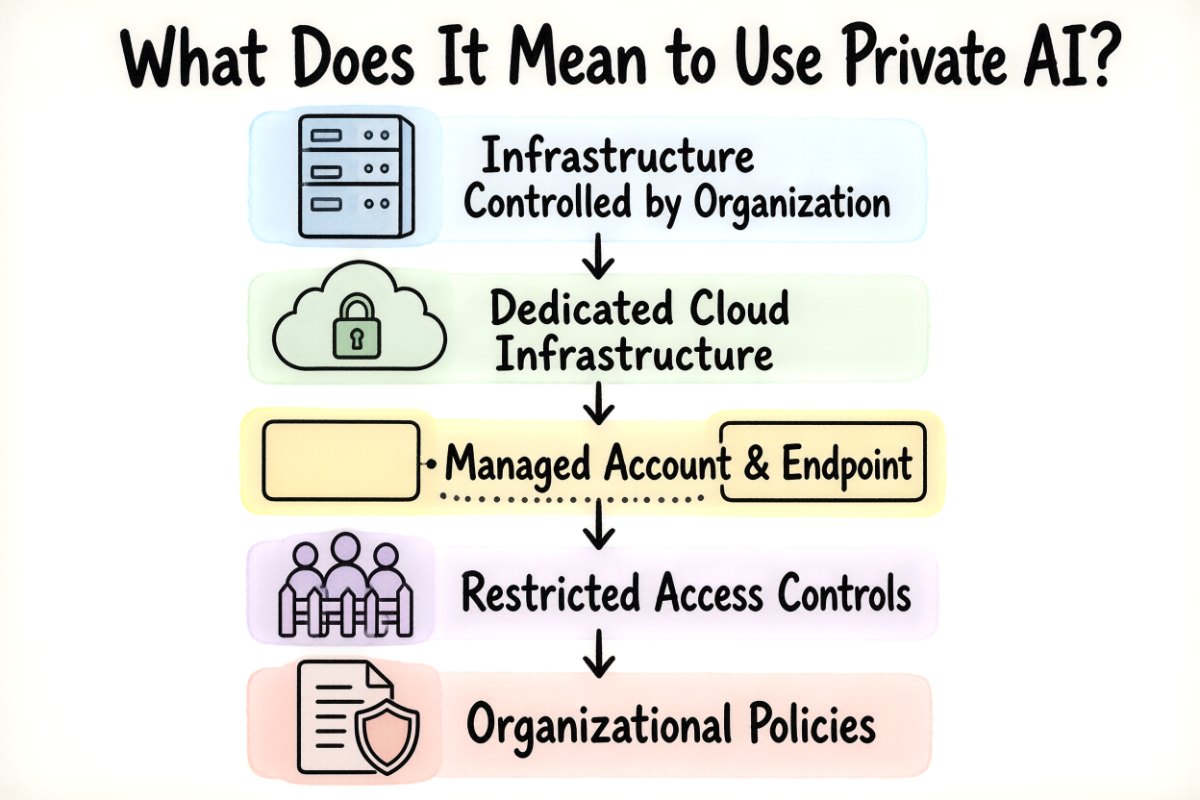
- Running an AI model on infrastructure controlled by the organization.
- Using dedicated cloud infrastructure rather than a shared public AI application.
- Connecting business applications to an external AI provider through an account and endpoint configuration managed by the organization.
- Restricting which employees, applications and knowledge sources can access the AI environment.
- Applying organizational policies to data processing, retention and access.
Private AI does not necessarily mean that every component must run on a physical server inside the company’s office. A dedicated cloud environment may also be appropriate, provided that its configuration, provider arrangements and data-handling practices meet the organization’s requirements.
It is therefore important to distinguish between using a public AI application as an ordinary end user and deploying an AI solution in an environment with defined organizational controls.
What Happens When Company Data Is Sent to an AI Service?
To evaluate private AI options, organizations should first understand the typical data flow in an AI-powered application.
Consider an employee asking an AI assistant to summarize an internal project report. Depending on the system, the following information may be involved:
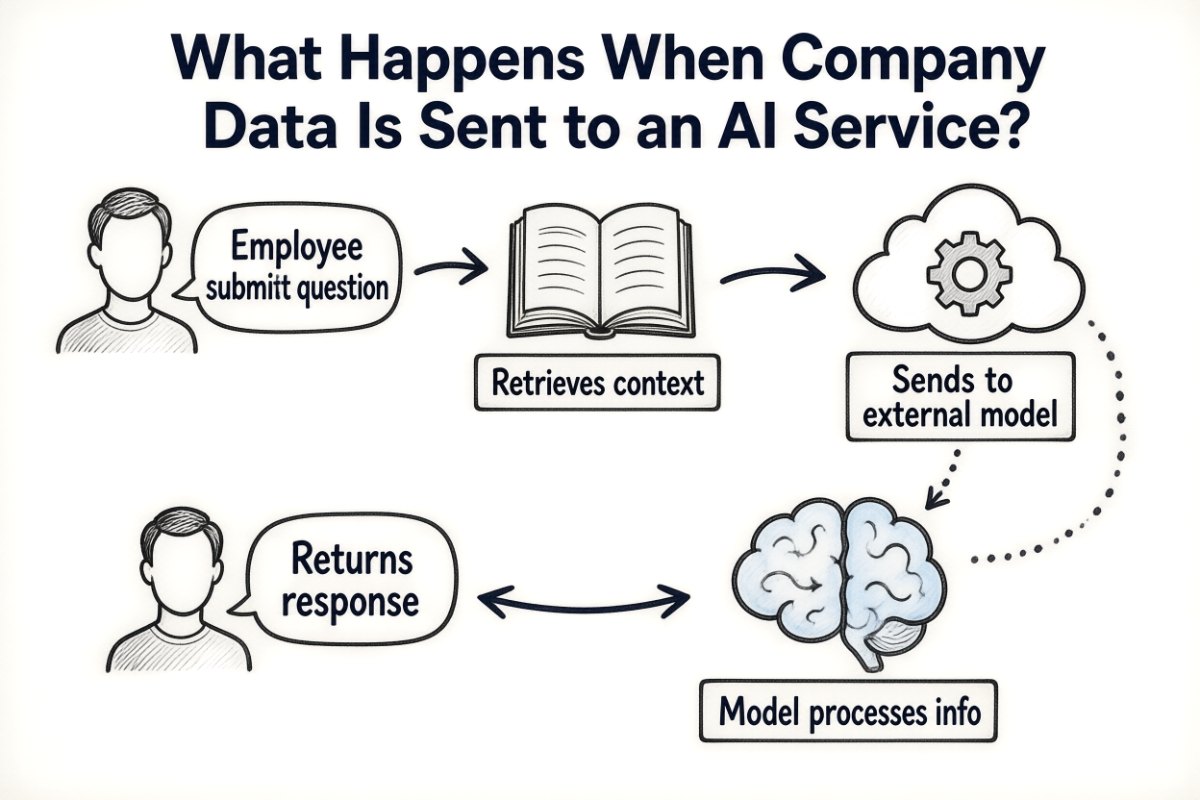
- The employee submits a question or instruction.
- The application retrieves relevant information from connected documents or knowledge sources.
- The application sends the question and selected context to the language model.
- The model processes the information and generates a response.
- The application returns the response to the employee.
If the language model is hosted by an external provider, the question and the context supplied to the model may be transmitted to that provider’s infrastructure.
This does not automatically mean that the information is publicly visible or used to train the provider’s models. Data handling varies according to the provider, service, account type, contractual terms and configuration.
Organizations should examine the actual data flow rather than relying on assumptions about what happens when information is submitted to an AI service.
Three Ways to Deploy or Connect Private AI
There is no single deployment model suitable for every organization. The following approaches illustrate common options.
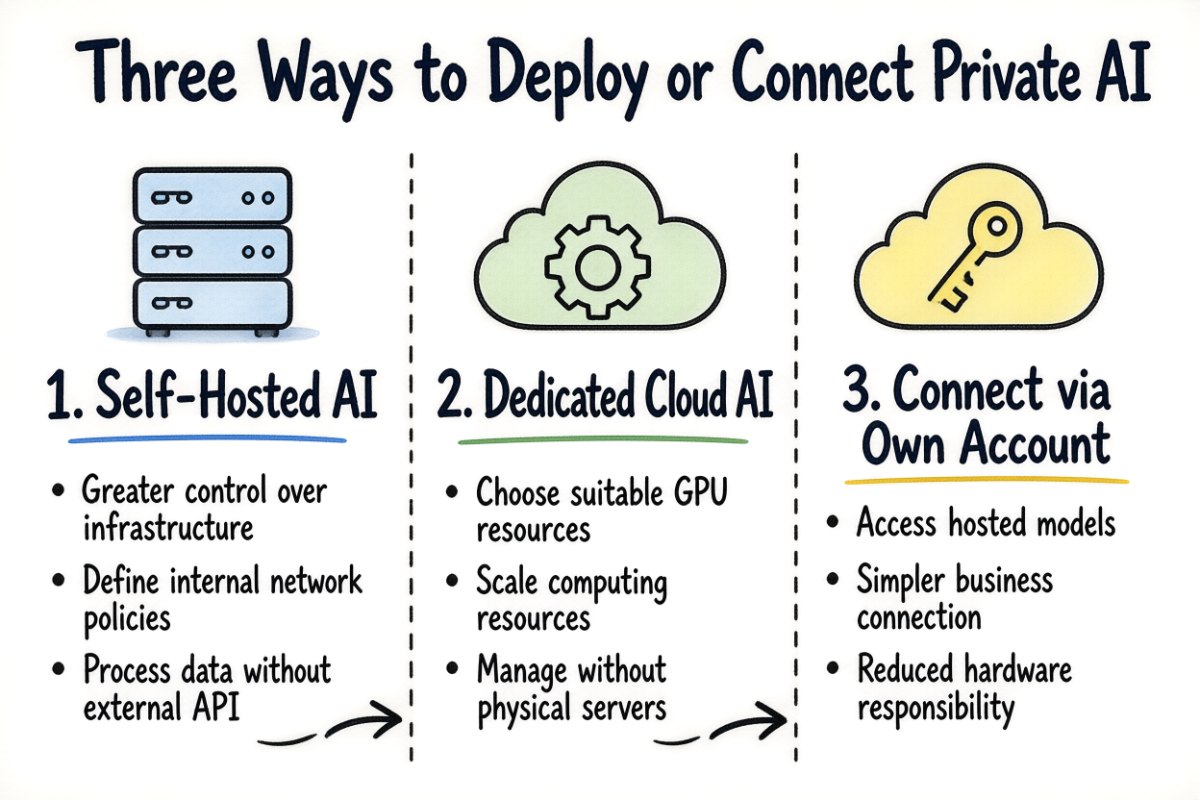
1. Self-Hosted AI on Company-Controlled Infrastructure
One approach is to host the AI model on infrastructure controlled by the organization. This may involve physical servers located on company premises or infrastructure in a private data center.
In this arrangement, the organization operates the model-serving environment and controls how its applications connect to it.
Potential advantages include:
- Greater control over the infrastructure running the model.
- The ability to define internal network and access policies.
- More direct control over model deployment and configuration.
- The possibility of processing prompts and retrieved company information without sending them to an external model API.
However, self-hosting also introduces responsibilities. The organization must provide suitable computing resources, install and maintain the required software, manage updates, monitor performance and address infrastructure security.
Running larger models may require substantial GPU resources. The organization also needs technical expertise to operate the environment reliably.
Self-hosting can be appropriate for businesses with strict infrastructure requirements, suitable technical resources or a need for greater control over model operations.
2. Dedicated Cloud AI Infrastructure
Another option is to deploy AI models on dedicated cloud GPU infrastructure. Instead of purchasing and maintaining physical hardware, the organization uses cloud computing resources configured for its AI workloads.
This can provide a balance between infrastructure control and operational flexibility.
Depending on the service arrangement, the organization may be able to:
- Choose suitable GPU resources for its model requirements.
- Deploy and manage its own model-serving environment.
- Scale computing resources according to demand.
- Configure network access and other infrastructure controls.
- Manage the environment without maintaining physical servers on company premises.
Dedicated cloud infrastructure does not automatically eliminate third-party involvement. The cloud infrastructure provider still operates the underlying computing environment, so organizations should review contractual arrangements, security responsibilities, data location and access policies.
For businesses that want to operate their own AI models but prefer not to maintain physical GPU servers, this can be a practical alternative.
3. Connect to a Cloud AI Provider Using the Organization’s Own Account
Private AI does not always require an organization to host the language model itself.
Another approach is to connect business applications to a cloud AI provider using the organization’s own account and endpoint credentials.
In this arrangement, the AI model is hosted by the provider, while the organization manages the account and connection used by its applications.
Depending on the provider and service configuration, this approach may offer:
- Access to hosted AI models without operating model-serving infrastructure.
- A simpler way to connect existing business applications to AI capabilities.
- Centralized management of the organization’s provider account and credentials.
- Access to different models or model versions offered by the provider.
- Reduced responsibility for maintaining GPU hardware and model-serving software.
However, this option still involves sending prompts and any supplied context to the external AI provider for processing. Organizations must therefore review the provider’s data-handling terms, retention arrangements, processing locations and available enterprise controls.
Using an organization’s own account should not be confused with running the model entirely within the organization’s infrastructure. The model may still be operated by the external provider.
Comparing the Three Approaches
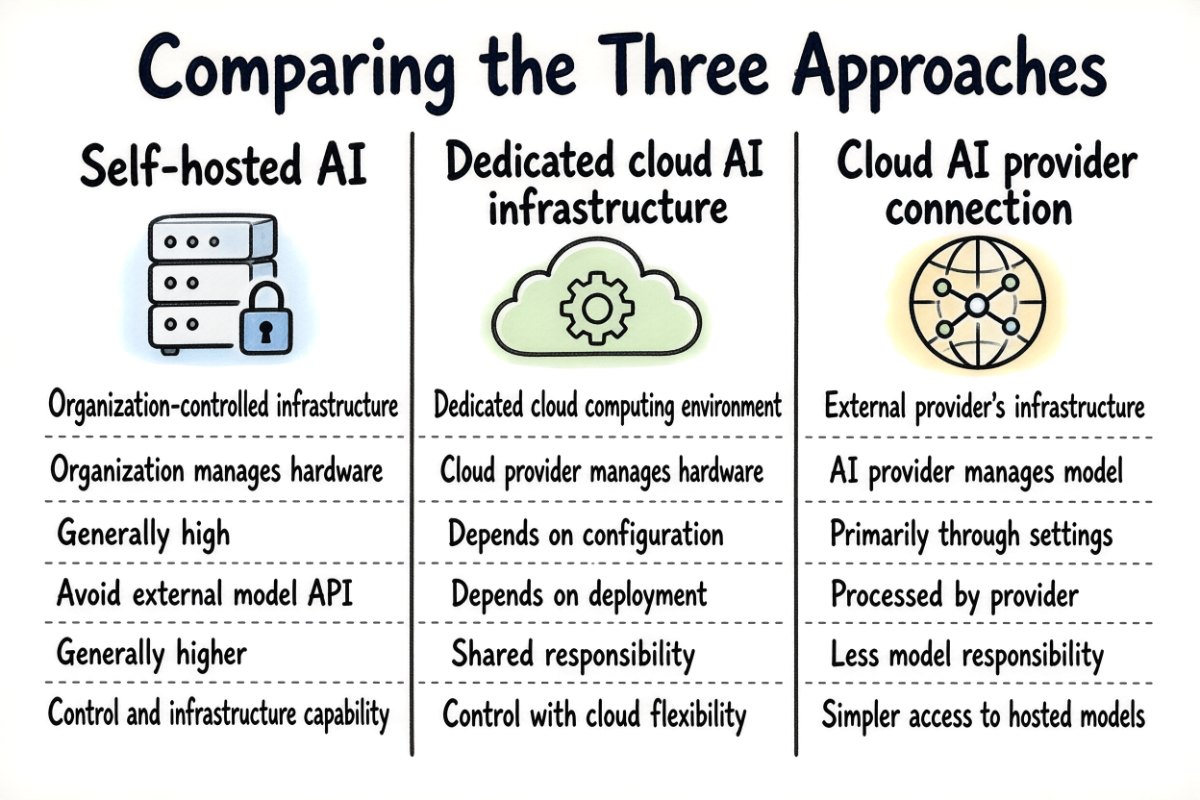
| Consideration | Self-hosted AI | Dedicated cloud AI infrastructure | Cloud AI provider connection |
|---|---|---|---|
| Model hosting | Organization-controlled infrastructure | Dedicated cloud computing environment | External provider’s infrastructure |
| Hardware management | Organization manages hardware or hosting arrangement | Cloud infrastructure provider manages physical hardware | AI provider manages model infrastructure |
| Infrastructure control | Generally high | Depends on cloud configuration and service arrangement | Primarily through account, service and application settings |
| External processing | Can avoid external model API processing if fully self-contained | Depends on deployment and connected services | Prompts and supplied context are processed by the provider |
| Operational responsibility | Generally higher | Shared between organization and cloud provider | Less model infrastructure responsibility for the organization |
| Typical consideration | Control and infrastructure capability | Control with cloud flexibility | Simpler access to hosted models |
These are general distinctions rather than guarantees. Actual responsibilities and data flows depend on the selected provider, architecture, configuration and contractual terms.
Does Private AI Mean Company Data Never Leaves the Organization?
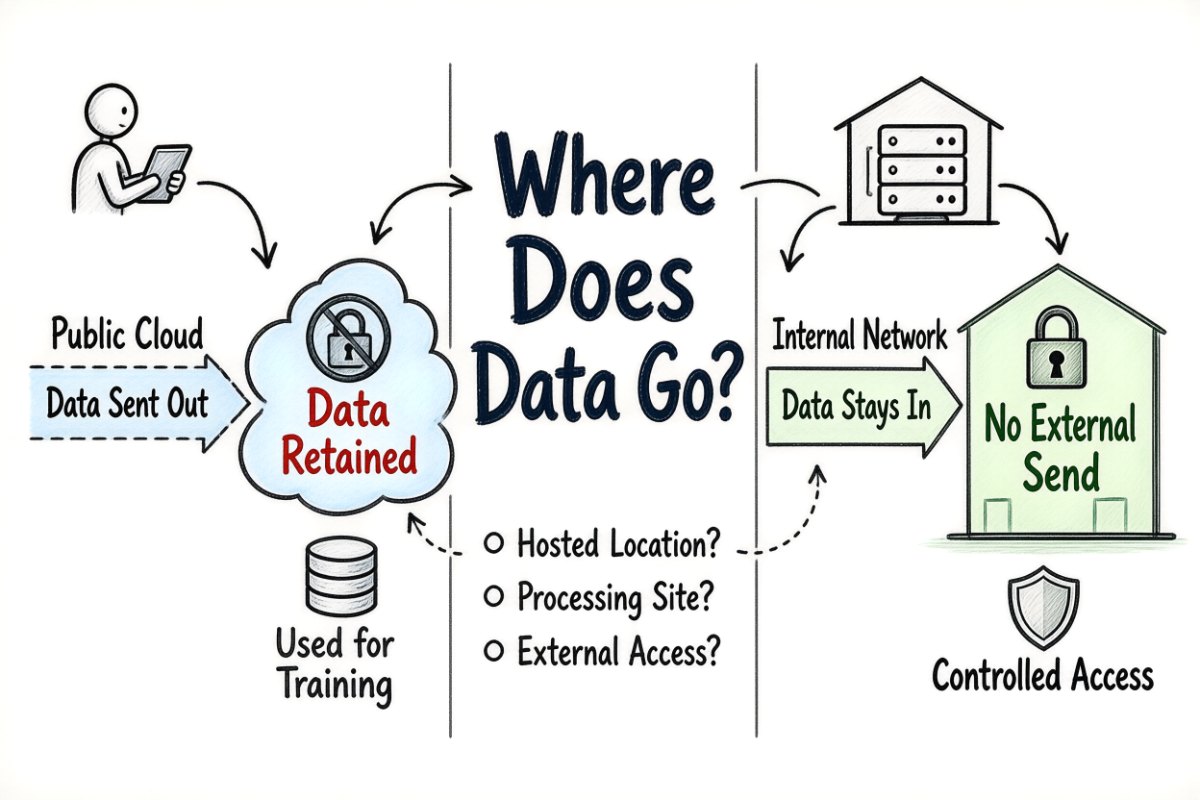
Not necessarily. This is one of the most important distinctions businesses should understand when evaluating private AI.
A self-hosted model can be configured to process prompts and company information within an organization’s controlled environment. However, the complete application may still communicate with external services for other purposes, such as authentication, monitoring, backups, software updates or connected integrations.
Similarly, dedicated cloud infrastructure is still hosted by a third party, even when the AI model and application are deployed in an environment dedicated to the organization.
When an application connects to an external cloud AI provider, the prompts and context supplied to the model are processed by that provider.
Therefore, organizations should ask more precise questions than simply whether a solution is private:
- Where is the language model hosted?
- Where are prompts and retrieved company documents processed?
- Which external services receive data?
- Is submitted information retained, and for how long?
- Can submitted data be used for model training under the applicable service terms?
- Where is data stored and processed?
- Who can access the infrastructure and application data?
- How are logs, backups and credentials managed?
These questions help organizations evaluate the actual data-handling characteristics of an AI solution rather than relying on broad product labels.
What About Connecting AI to Internal Company Documents?
Many business AI applications need access to internal knowledge. For example, an employee may ask an AI assistant to summarize a company policy, locate a project decision or explain a technical specification.
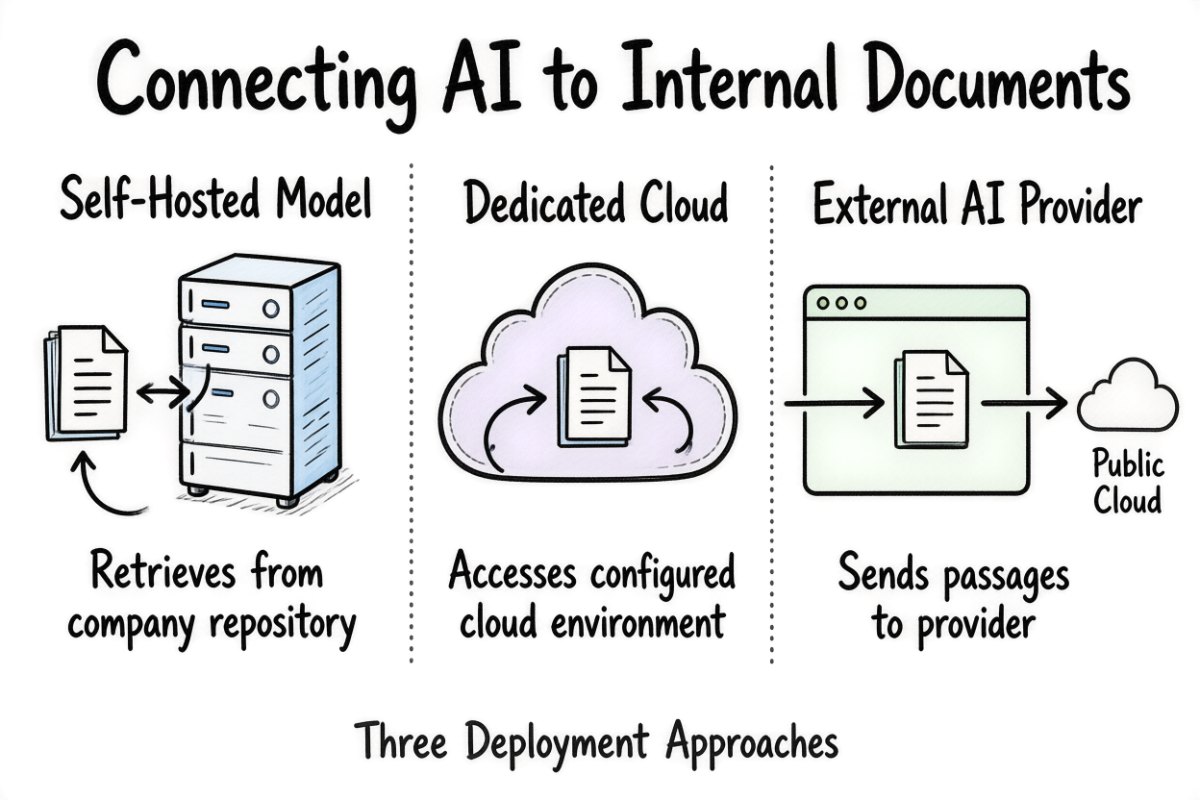
Retrieval-Augmented Generation (RAG) is one common way to support these tasks. The application retrieves relevant passages from selected company documents and supplies them to the language model as context.
The deployment of the language model and the location of the knowledge repository are separate architectural considerations.
For example:
- A self-hosted model may retrieve information from a company-controlled knowledge repository.
- A model running on dedicated cloud infrastructure may access documents stored in an appropriately configured cloud environment.
- An application using an external AI provider may retrieve selected company information and send the relevant passages to the provider for processing.
This means that even when the original documents remain in an internal repository, selected content may still be transmitted to an external model if the application uses an external AI endpoint.
Organizations should therefore examine the complete information flow, including the retrieval layer, application server and model endpoint.
How to Choose the Right Private AI Deployment Model
The best approach depends on the organization’s requirements, available resources and risk considerations. There is no universal answer.
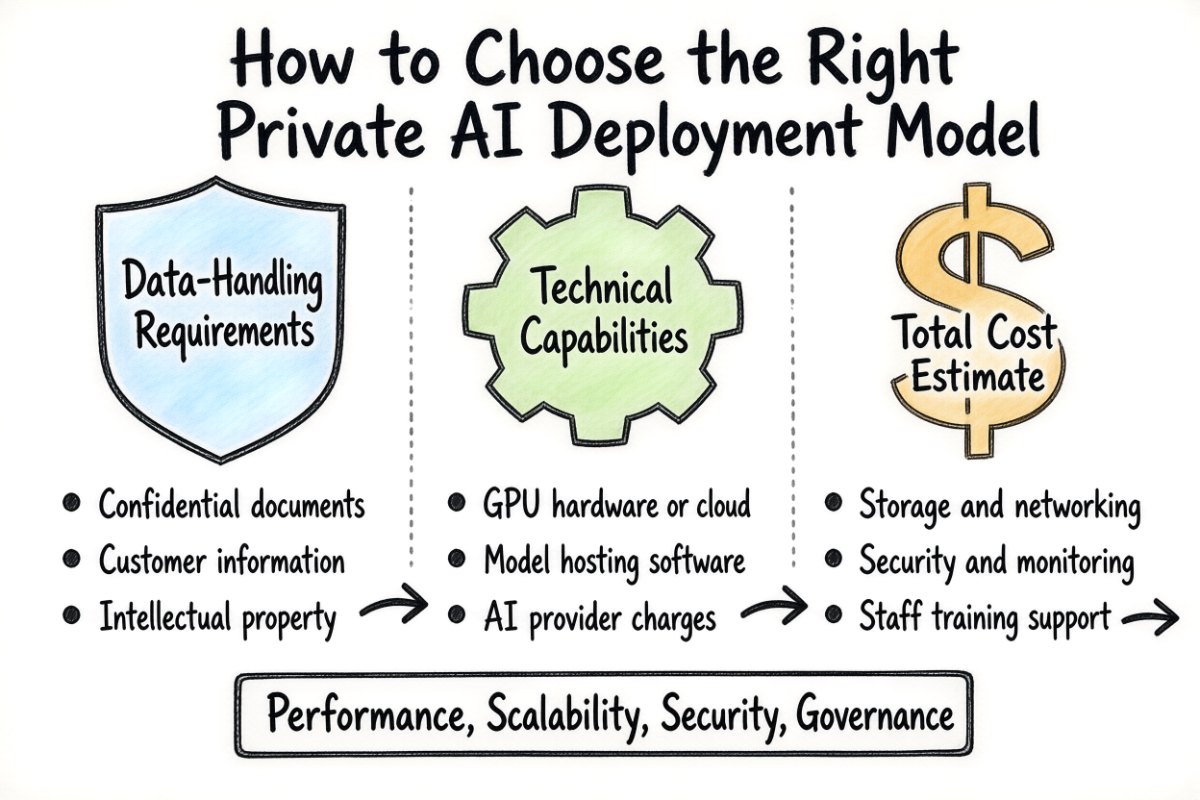
Consider Your Data-Handling Requirements
Start by identifying the types of information the AI solution will process. Public business information, internal operating documents, confidential project records and sensitive personal information may require different levels of protection.
Define which information can be processed externally, which must remain within controlled infrastructure and which should not be connected to the AI application at all.
Evaluate Your Technical Capabilities
Self-hosting offers significant control but requires suitable infrastructure and technical expertise. Dedicated cloud infrastructure reduces the need to maintain physical hardware, but the organization still needs to operate and secure its AI environment.
Connecting to a cloud AI provider can reduce infrastructure responsibilities, but it requires careful evaluation of the provider’s service terms and data-handling arrangements.
Estimate the Total Cost
Do not compare deployment options using only the price of the AI model or API.
Consider the wider costs, including:
- GPU hardware or cloud computing resources.
- Model hosting and software maintenance.
- AI provider usage charges.
- Storage, networking and data processing.
- Security, monitoring and administration.
- Implementation, integration and staff training.
- Ongoing technical support.
A self-hosted environment may have substantial initial infrastructure and operational costs, while a cloud API may involve usage-based charges. The right comparison should consider expected workloads and long-term ownership costs.
Think About Performance and Scalability
Different models have different hardware requirements and response characteristics. An organization should consider the number of users, expected request volume, model size, response times and peak workloads.
For self-hosted and dedicated cloud deployments, GPU availability and capacity planning are particularly important. For external AI providers, service limits, availability and usage pricing should be reviewed.
Plan for Security and Governance
Deployment choice is only one part of a secure AI environment. Organizations also need appropriate identity management, access controls, network configuration, logging, retention policies and oversight of connected data sources.
For applications using internal knowledge, ensure that the retrieval process respects document permissions. An AI assistant should not become a route for employees to access information they could not otherwise view.
Can an Organization Combine Different AI Deployment Approaches?
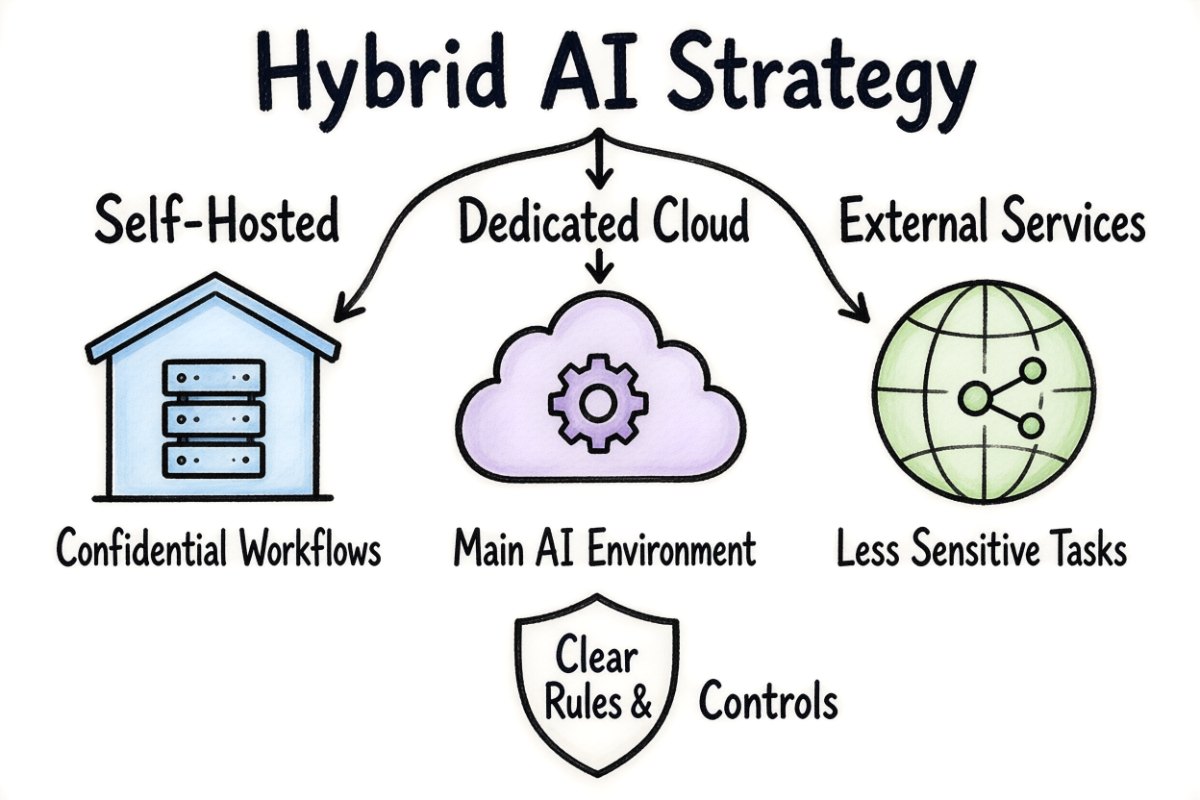
Yes. An organization does not necessarily need to use the same deployment model for every AI workload.
For example, a company might use a self-hosted model for selected confidential workflows while using a cloud AI provider for less sensitive tasks. Another organization might use dedicated cloud infrastructure for its main AI environment and connect selected applications to external services when appropriate.
This is sometimes described as a hybrid AI strategy.
A hybrid approach can provide flexibility, but it also increases architectural complexity. Organizations need clear rules about which workloads can use which models, what information may be transmitted and how users are directed to the appropriate environment.
Without these controls, employees may unintentionally submit information to an AI service that is not approved for that type of data.
How Visual Paradigm Supports Private AI Deployment Options
Organizations evaluating private AI need to consider both the AI infrastructure and the software employees will use to work with company knowledge.
Visual Paradigm’s Private AI for Enterprise Knowledge combines software capabilities with implementation services to help organizations establish an AI-powered corporate knowledge environment.
The offering brings together:
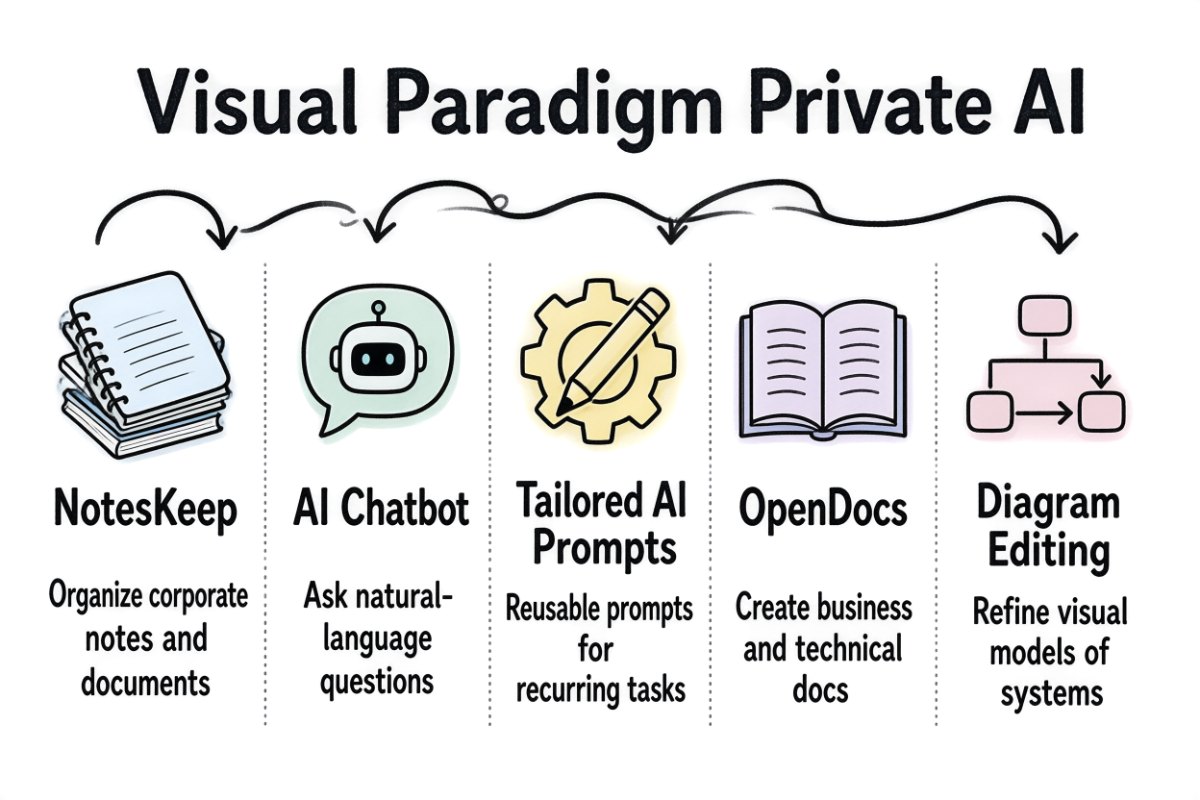
- NotesKeep: Helps organize corporate notes and documents into a knowledge repository.
- AI Chatbot: Allows employees to ask natural-language questions about selected corporate knowledge sources.
- Tailored AI Prompts: Supports reusable prompts and workflows for recurring business tasks.
- OpenDocs: Provides tools for creating and organizing business and technical documentation.
- Diagram Editing Tools: Help users create and refine visual models of systems, requirements and business processes.
Implementation services include AI endpoint and infrastructure setup, live online team training and ongoing technical advisory and support.
Depending on an organization’s requirements, the deployment can use self-hosted AI on on-premises or dedicated cloud GPU infrastructure. Alternatively, Visual Paradigm tools can connect to a cloud AI provider using the organization’s own account and endpoint credentials.
This flexibility allows organizations to consider their infrastructure and data-handling requirements alongside the practical needs of employees who will use the AI solution.
Conclusion
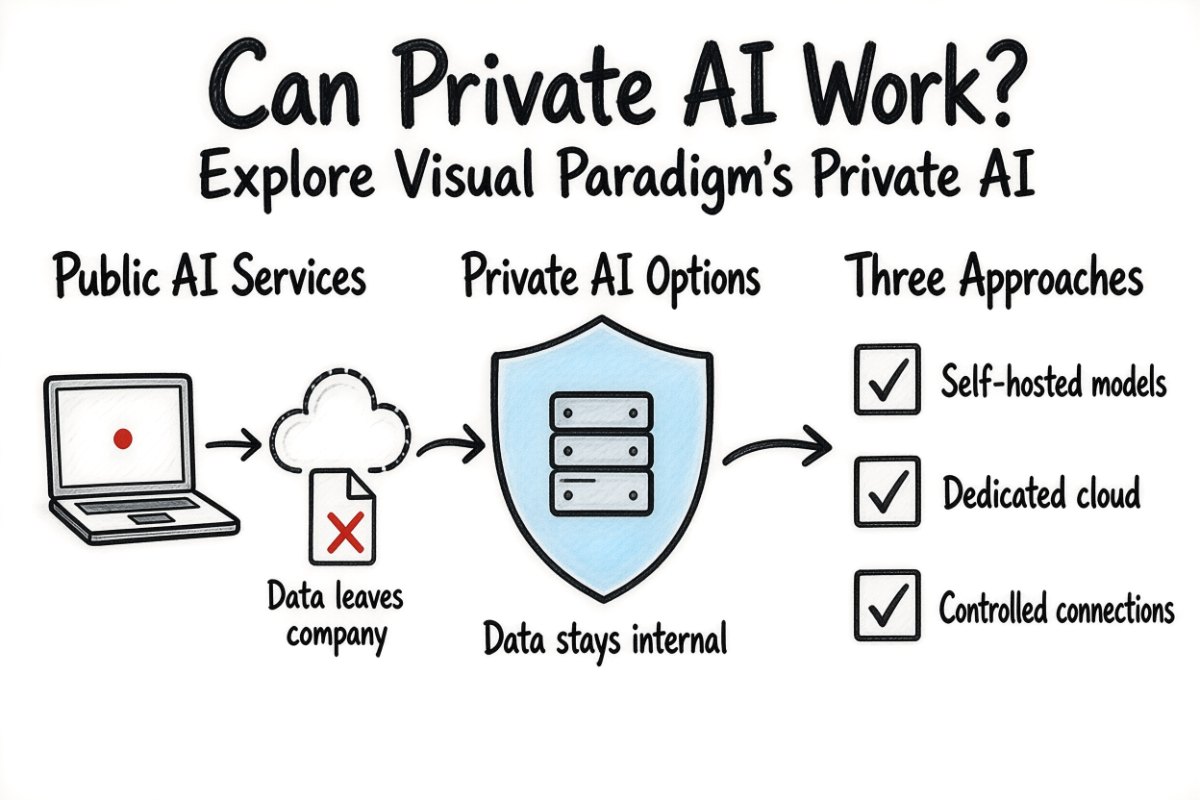
Businesses do not have to treat public AI applications as their only way to benefit from artificial intelligence. They can consider self-hosted models, dedicated cloud AI infrastructure or controlled connections to external AI providers.
Each approach has different implications for infrastructure control, external data processing, cost, performance and operational responsibility.
The important step is to understand how information moves through the complete AI application. Organizations should evaluate not only where the model runs, but also where prompts, retrieved documents, logs and other data are processed and stored.
Private AI is not simply about keeping a model behind a company firewall. It is about designing an AI environment that fits the organization’s requirements for data handling, access, governance and everyday business use.
Explore Visual Paradigm’s Private AI for Enterprise Knowledge to learn about the available software, deployment options, implementation services and training for building an AI-powered corporate knowledge environment.