Large language models can explain concepts, summarize text and respond to questions in natural language. However, when businesses want to use AI with their own internal information, a challenge quickly emerges: the model may not know the organization’s policies, project history, product documentation, procedures or other proprietary knowledge.
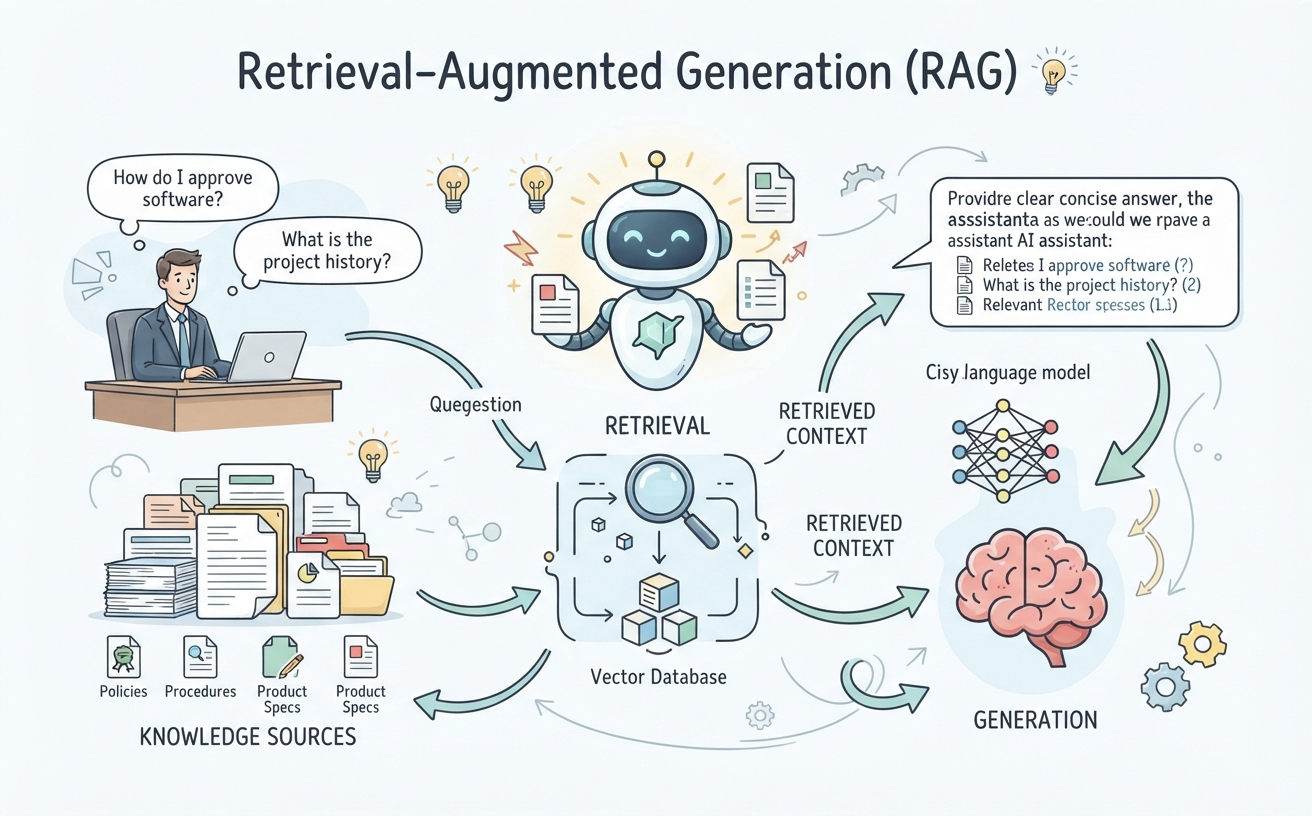
One approach to addressing this challenge is Retrieval-Augmented Generation (RAG). RAG connects an AI model to external information sources so that relevant content can be retrieved and used when generating a response.
This makes it possible to build AI assistants that answer questions using selected company knowledge rather than relying exclusively on information learned during model training.
Understanding RAG is useful for organizations evaluating enterprise AI because it explains how an AI assistant can work with internal documents, how knowledge can be updated, and what technical and governance considerations are involved.
What Is Retrieval-Augmented Generation (RAG)?
Retrieval-Augmented Generation is an AI architecture that combines two capabilities:
- Retrieval: Finding relevant information from an external knowledge source based on a user’s question or request.
- Generation: Using a large language model (LLM) to produce a natural-language response informed by the retrieved information.
In a conventional language-model interaction, the model generates an answer based primarily on its learned parameters and the context supplied in the conversation. It may not have access to a company’s latest internal documents or specialized organizational knowledge.
With RAG, the system first searches a connected knowledge collection for information relevant to the user’s request. The retrieved content is then supplied to the language model as additional context for generating an answer.
For example, an employee might ask:
What is our current procedure for approving a software purchase?
A RAG-enabled assistant can search the organization’s approved procurement documents, retrieve relevant passages and use them to formulate an answer. Depending on the system, it may also identify the source documents so that the employee can verify the guidance.
The important point is that the AI model does not need to have been trained specifically on the company’s procurement policy. The relevant information can be retrieved when the question is asked.
How Does RAG Work?
A RAG implementation generally involves two connected processes: preparing the knowledge collection and retrieving information when a user submits a question.
1. Prepare the Knowledge Sources
The first step is to identify the information that the AI assistant should be able to use.
Depending on the system, sources may include:
- Company policies and procedures.
- Product and technical documentation.
- Project reports and specifications.
- Meeting notes and decision records.
- Knowledge articles and internal guidelines.
- Other approved documents and structured information.
The source material is processed so that the system can search it efficiently. This often involves extracting text, dividing documents into smaller sections or chunks, and creating numerical representations called embeddings.
Embeddings help represent the meaning of text in a form that can be compared with other text. A vector database or another retrieval index may be used to find content that is semantically related to a question, even when the wording is different.
For example, a question about taking time off might retrieve a document section titled “Annual Leave Policy,” even if the employee does not use the phrase “annual leave” in the question.
2. Convert the User’s Question into a Search Request
When a user asks a question, the system processes it to identify information that may be relevant.
Depending on the implementation, this may involve converting the question into an embedding, using keyword search, applying filters or combining several retrieval techniques.
The objective is to locate the most useful content in the connected knowledge collection, rather than simply finding documents containing exactly the same words.
3. Retrieve Relevant Information
The retrieval component searches the knowledge index and selects content that appears relevant to the question.
For example, if an employee asks about the procedure for requesting parental leave, the system may retrieve sections covering eligibility, notification requirements, required forms and approval procedures.
The quality of this stage is important. If the system retrieves irrelevant passages, misses important conditions or selects outdated documents, the final answer may be incomplete or misleading.
4. Provide the Retrieved Content to the AI Model
The selected information is added to the context supplied to the language model. The model then uses the question and retrieved content to generate a response.
The system may instruct the model to answer using the supplied material, acknowledge when the available information is insufficient, and identify relevant source documents where supported.
5. Generate and Present the Answer
The AI model produces a response in natural language. Depending on the application, the answer may include a summary, an explanation, relevant document references or suggested next steps.
The user can then ask follow-up questions to explore the retrieved information further.
In this way, RAG combines document retrieval with conversational interaction, making large collections of organizational knowledge easier to explore.
A Simple Example: Using RAG for Company Knowledge
Consider a company with hundreds of internal documents covering procurement, IT support, employee policies, project procedures and technical standards.
Without a knowledge assistant, employees may need to search through folders, remember document names or contact colleagues who know where particular information is stored.
Now imagine the company introduces an AI assistant connected to an approved collection of these documents.
An employee asks:
What should I do if I need approval to purchase a new software tool?
The RAG workflow might look like this:
- The assistant receives the employee’s question.
- The retrieval component searches the connected company knowledge collection.
- It finds relevant sections in the procurement policy and software approval procedure.
- The selected passages are provided to the language model as context.
- The model generates a concise explanation of the documented approval process.
- The assistant identifies the relevant source documents, if source references are supported.
The employee can then ask a follow-up question, such as whether a particular purchase requires additional review.
The assistant can search for more relevant information and continue the conversation using the available knowledge. If the documents do not provide a clear answer, the system should avoid inventing a policy and direct the employee to the appropriate person or department.
Why Is RAG Useful for Enterprise AI?
RAG is particularly useful when organizations want AI systems to work with information that is specific to their business and changes over time.
1. Connect AI to Internal Business Knowledge
Every organization has information that is not publicly available. It may include internal procedures, project documentation, product specifications, operational guidelines and accumulated business knowledge.
RAG provides a way to make selected information available to an AI assistant without requiring the underlying language model to have learned it during training.
This can help turn a general-purpose AI model into a more useful assistant for a particular organization or department.
2. Make Knowledge Easier to Update
Company information changes. Policies are revised, products evolve, projects move forward and procedures are improved.
With a retrieval-based approach, organizations can update their knowledge sources and retrieval indexes without necessarily retraining or fine-tuning the language model every time a document changes.
This can make it more practical to maintain an AI assistant that works with evolving business information. However, the update process must be designed properly so that changed documents are reprocessed and outdated content is no longer retrieved as current guidance.
3. Support More Contextual Answers
A general AI model may provide a plausible explanation of how a business process typically works. However, an organization often needs an answer based on its own approved procedures.
RAG can provide the model with relevant internal context, allowing it to formulate responses that reflect the organization’s documented practices.
This is useful for employee support, technical documentation, project knowledge, customer-service preparation and many other information-intensive workflows.
4. Help Users Explore Large Document Collections
Organizations may have accumulated years of documents that are difficult to explore through conventional file searches.
RAG can help users retrieve information based on the meaning of their questions rather than relying entirely on exact keywords or document titles.
For example, a project manager could ask what decisions were made about a particular system integration, while a developer could ask which documents describe a specific software component.
The system can retrieve relevant passages from multiple sources and use them to prepare a consolidated response.
5. Reduce the Need to Put All Knowledge into Model Training
RAG is different from fine-tuning a model on a company’s information.
Fine-tuning changes model parameters through additional training. RAG, by contrast, retrieves relevant external information and provides it as context during a particular interaction.
These approaches serve different purposes. Fine-tuning may be useful when an organization wants to adapt a model’s behavior, response style or task performance. RAG is often more suitable when the main requirement is to access changing factual information stored in documents or knowledge systems.
Some enterprise solutions may combine retrieval with fine-tuning, but they should not be treated as interchangeable techniques.
RAG vs. Fine-Tuning: What Is the Difference?
| Aspect | Retrieval-Augmented Generation (RAG) | Fine-Tuning |
|---|---|---|
| Primary purpose | Provide relevant external knowledge as context when answering. | Adapt a model’s behavior or capabilities through additional training. |
| How information is used | Retrieved from connected sources at query time. | Influences the model through changes made during training. |
| Updating business documents | Can be updated by refreshing the knowledge source and retrieval index. | May require another training process if the model must learn changed information. |
| Source visibility | Can support references to retrieved documents or passages. | Does not inherently provide document-level source references. |
| Typical use | Company knowledge assistants, document Q&A and information retrieval. | Specialized response styles, task behavior and domain-specific model adaptation. |
For many enterprise knowledge applications, RAG is a natural starting point because the objective is to make existing information accessible, not necessarily to change how the model itself behaves.
What Are the Limitations of RAG?
RAG can improve how an AI system accesses business information, but it does not automatically make every answer accurate or reliable.
Organizations should understand several important limitations.
Retrieval Quality Affects Answer Quality
If the system retrieves irrelevant or incomplete information, the language model may produce an answer that misses important details.
Document chunking, embedding models, search strategies, metadata filters and retrieval settings can all influence which information is selected.
Outdated or Conflicting Documents Can Cause Problems
If a knowledge collection contains old policies, duplicate documents or conflicting instructions, the system may retrieve information that is no longer valid.
Organizations need document ownership, version management and regular content reviews. The AI system should also be configured to distinguish current authoritative sources from archived material where appropriate.
RAG Does Not Guarantee That the Model Will Always Follow the Sources
Even when relevant content is retrieved, a language model may misunderstand it, overlook a condition or produce an unsupported conclusion.
Well-designed prompts, retrieval evaluation, source references and testing can help reduce these risks, but human verification remains important for high-impact decisions.
Access Control Must Be Designed into the System
Connecting company documents to an AI assistant introduces an important security consideration: users should not be able to retrieve information they are not authorized to access.
Access permissions need to be enforced by the retrieval and application architecture. It is not sufficient to rely on a general instruction telling the language model not to disclose confidential information.
Organizations should test access boundaries carefully, particularly when the knowledge collection includes employee records, client information, financial data or sensitive project documents.
Large Knowledge Collections Need Ongoing Management
Adding more documents does not necessarily improve an AI assistant. Poorly organized, duplicated or irrelevant material can make retrieval less effective.
Successful RAG systems require ongoing attention to document quality, indexing, metadata, source permissions and retrieval performance.
What Should Businesses Consider When Implementing RAG?
Before adopting a RAG-based enterprise AI solution, organizations should consider the following areas.
- Knowledge-source selection: Decide which documents and information repositories should be connected to the AI assistant.
- Document preparation: Review source quality, remove unnecessary duplication and establish a process for handling updates.
- Retrieval technology: Evaluate semantic search, keyword search, hybrid retrieval, metadata filtering and other techniques according to the information being searched.
- Access permissions: Ensure that retrieval respects the organization’s information-access rules.
- Answer verification: Test whether responses accurately reflect retrieved content and identify sources where possible.
- Deployment and data handling: Understand where the AI model, retrieval components, indexes and documents are hosted, and how information is processed.
- Maintenance: Assign responsibility for updating knowledge sources, monitoring performance and reviewing user feedback.
- User adoption: Train employees to ask useful questions, verify important answers and recognize when a human expert is needed.
It is also important to evaluate the complete solution rather than focusing only on the language model. A successful enterprise knowledge assistant depends on the quality of the documents, retrieval architecture, access controls, user experience and operational processes working together.
Applying RAG to Private AI for Enterprise Knowledge
For organizations that want to make internal knowledge accessible through AI, RAG can form an important part of a private or controlled enterprise AI environment.
Visual Paradigm’s Private AI for Enterprise Knowledge brings together knowledge management, AI-assisted information retrieval and tools for creating business documentation and visual models.
The environment includes several complementary capabilities:
- NotesKeep: Helps organize corporate notes and documents into a knowledge collection that can be used as a reference for information retrieval.
- AI Chatbot: Lets users ask natural-language questions about selected knowledge sources and explore the information through conversational interaction.
- Tailored AI Prompts: Supports reusable prompts and workflows for recurring knowledge-related tasks.
- OpenDocs: Provides tools for creating and organizing documentation and reports.
- Diagram Editing Tools: Allow teams to turn requirements, processes and other business information into structured visual models.
The offering also includes implementation assistance, AI endpoint and infrastructure setup options, team training and ongoing technical support. Organizations can explore self-hosted AI on on-premises or dedicated cloud GPU infrastructure, or connect Visual Paradigm tools to a cloud AI provider using their own account and endpoint credentials.
The appropriate deployment and knowledge-access configuration will depend on the organization’s requirements. In particular, connecting documents to an AI assistant should be accompanied by careful consideration of permissions, data handling and the suitability of each information source.
Conclusion
Retrieval-Augmented Generation provides a practical way to connect large language models to an organization’s own information. By retrieving relevant content from approved knowledge sources and supplying it as context, RAG enables AI assistants to answer questions about business documents, internal procedures, technical information and organizational knowledge.
However, RAG is not a substitute for good information management. Its effectiveness depends on the quality of the source material, the retrieval process, access controls and the way the AI model uses the retrieved context.
For businesses exploring enterprise AI, the most useful approach is to treat RAG as part of a broader knowledge environment. Combine reliable information sources, suitable AI infrastructure, clear governance and practical employee workflows to make organizational knowledge easier to find and use.
Learn more about Visual Paradigm’s Private AI for Enterprise Knowledge and how an integrated environment can help organizations connect AI with their corporate information.