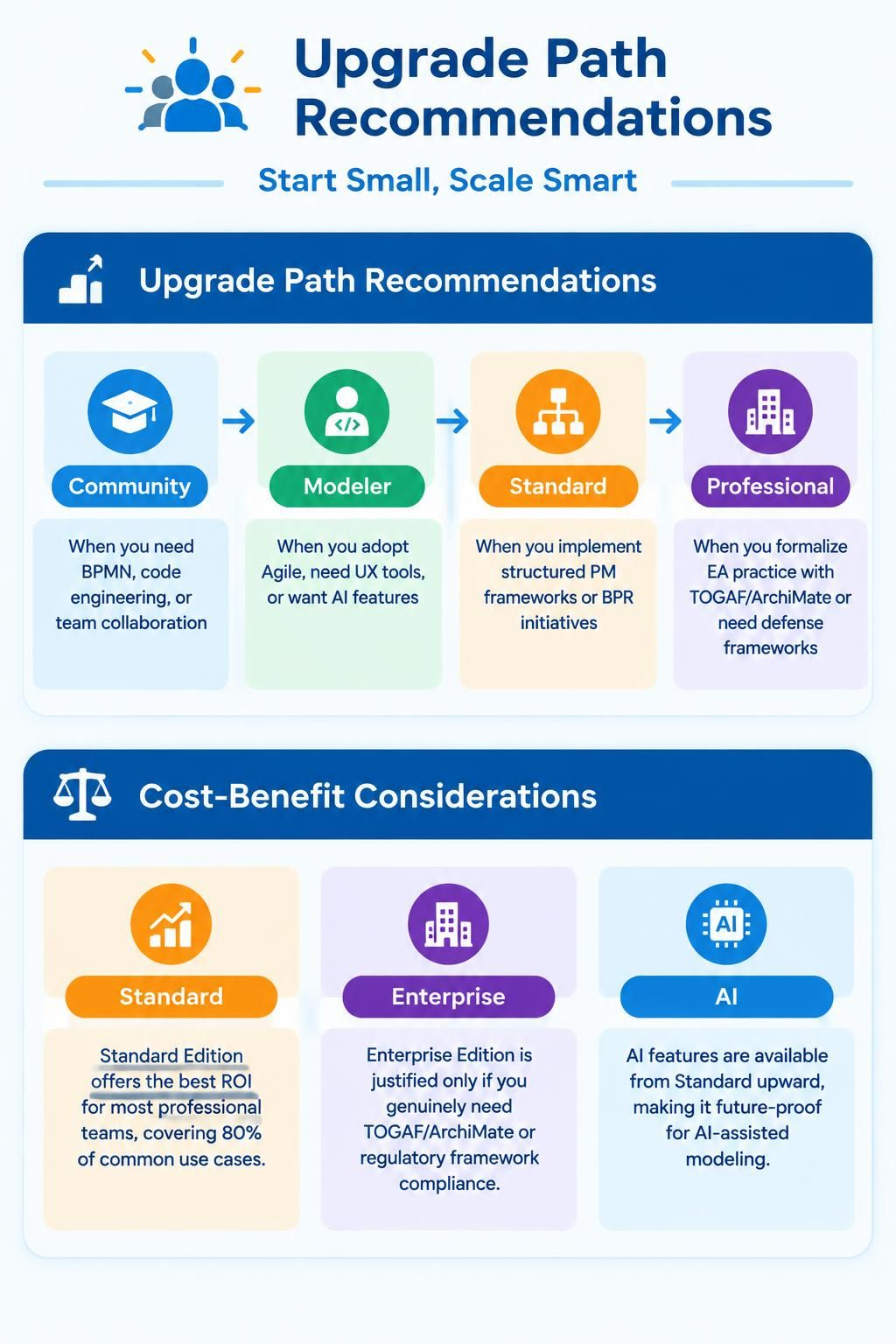
In the realm of Enterprise Architecture (EA) and Business Process Management (BPM), selecting the right software tool is as critical as the architecture itself. Visual Paradigm offers a tiered suite of solutions designed to scale with an organization’s maturity. The “Upgrade Path” is not merely a sales ladder; it represents a strategic evolution from individual productivity to enterprise-wide governance.
This tutorial breaks down the architectural logic behind the Visual Paradigm Desktop Editions, guiding you through the decision matrix of when to start small and when to scale smart.
The Strategic Upgrade Path
Visual Paradigm structures its desktop editions to mirror the typical growth of a modeling capability within an organization. Moving from the entry-level to the most advanced tiers unlocks specific capabilities required for complex business environments.
1. Community to Modeler: The Engineering Foundation
The journey begins with the Community edition, which serves as the entry point for learning and basic diagramming. However, the first major strategic leap is to the Modeler edition. This transition is triggered when a team moves beyond simple documentation into active engineering.
- Key Trigger: The need for strict BPMN (Business Process Model and Notation) compliance.
- Key Trigger: The requirement for Code Engineering, allowing for round-trip engineering between diagrams and source code.
- Key Trigger: The necessity of Team Collaboration features to synchronize models across a distributed group.
2. Modeler to Standard: The Agile & UX Shift
Once a team has established a foundation, the next upgrade to the Standard edition is driven by the shift toward modern software development lifecycles. This edition is designed for teams that need to bridge the gap between technical logic and user experience.
- Key Trigger: Adoption of Agile methodologies which require rapid iteration and flexible modeling.
- Key Trigger: The demand for advanced UX Tools to design user interfaces directly within the modeling environment.
- Key Trigger: The desire to leverage AI features for automated generation and analysis.
3. Standard to Professional: Structured Governance
The Professional edition is the gateway to formal project management. Organizations move here when they need to implement rigorous frameworks to control complexity and cost.
- Key Trigger: Implementation of structured Project Management (PM) frameworks.
- Key Trigger: Execution of BPR (Business Process Reengineering) initiatives that require deep process analysis.
4. Professional to Enterprise: The Architectural Standard
At the pinnacle of the upgrade path lies the Enterprise edition. This is not just about having more features; it is about compliance and standardization at the highest level.
- Key Trigger: Formalizing Enterprise Architecture (EA) practices.
- Key Trigger: The strict requirement for TOGAF or ArchiMate modeling support.
- Key Trigger: The need for Defense Frameworks and specialized regulatory compliance.
Cost-Benefit Analysis: The ROI of Modeling
Understanding the technical features is only half the battle; the other half is financial justification. The “Cost-Benefit Considerations” provide a rational framework for budgeting.
The Standard Edition: The Sweet Spot
For the vast majority of professional teams, the Standard edition offers the highest Return on Investment (ROI). It is engineered to cover approximately 80% of common use cases. Unless your organization is operating under strict regulatory mandates or adhering to specific architectural standards, the Standard edition provides the most robust feature set relative to cost.
The Enterprise Edition: Justification by Necessity
The Enterprise edition commands a higher price point, and therefore, its justification is specific. It is only warranted if the organization genuinely needs TOGAF/ArchiMate compliance or must adhere to rigid regulatory framework requirements (such as defense or government standards).
The Future-Proofing of AI
A critical component of the upgrade strategy is the availability of Artificial Intelligence. AI features are unlocked starting from the Standard edition. This makes the Standard edition a “future-proof” choice, ensuring that teams can leverage AI-assisted modeling for efficiency without waiting for an Enterprise license.
Conclusion
By following the “Start Small, Scale Smart” philosophy, organizations can align their software investment with their actual maturity. Whether you are starting with a simple BPMN diagram or formalizing a Defense-grade Enterprise Architecture, Visual Paradigm offers a clear, logical path to the right tool for the job.