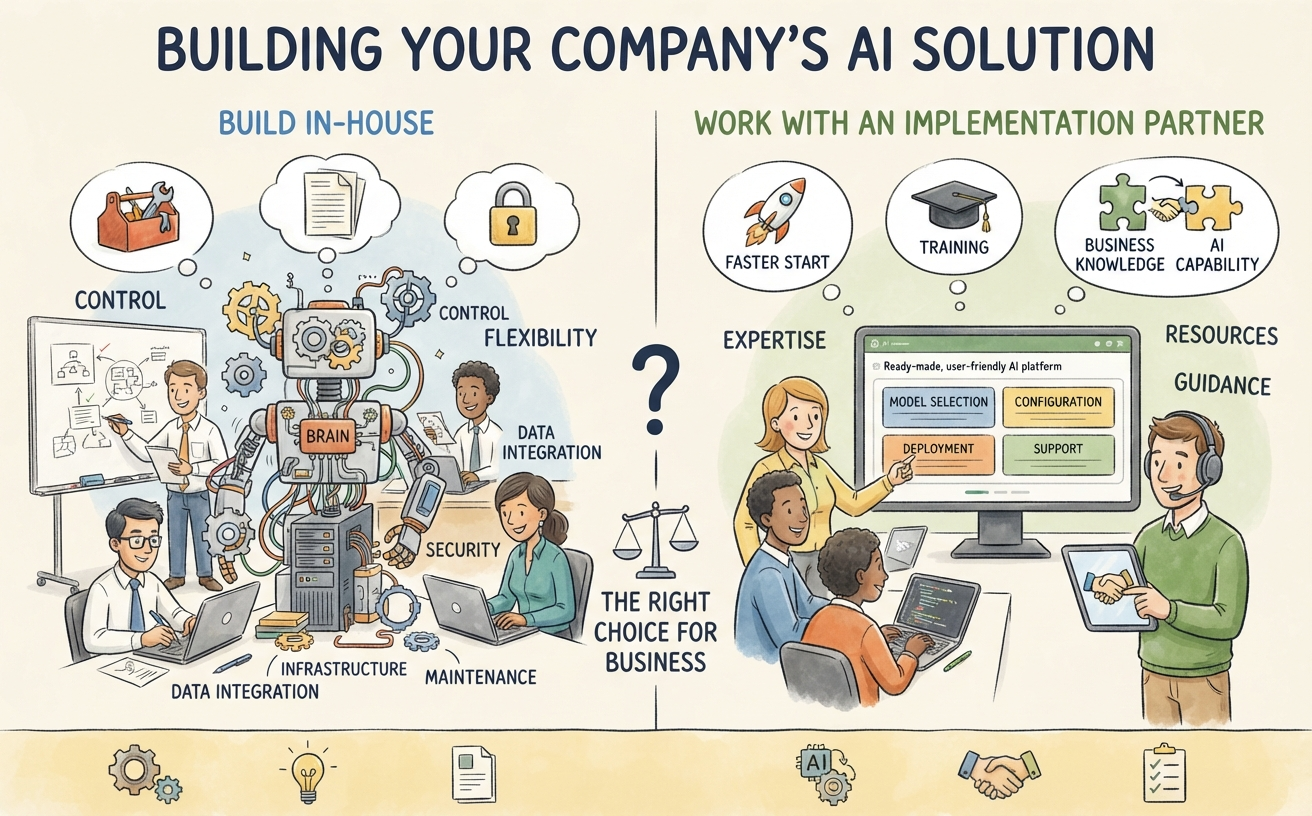
Many businesses recognize the potential of artificial intelligence but face an important decision when they want to put it into practice: should they build their own AI solution, or work with an external AI implementation partner?
Building internally can offer flexibility and control. A company can develop a solution around its own processes, infrastructure, and technical requirements. However, doing so requires more than hiring developers to connect an AI model to a chatbot interface. The organization must also consider data integration, infrastructure, security, deployment, maintenance, and employee adoption.
Working with an AI implementation partner offers another route. An experienced provider can help select suitable technologies, configure the solution, integrate business knowledge, and support the organization through deployment and adoption.
Neither approach is automatically better. The right choice depends on the company’s objectives, available expertise, resources, and long-term plans.
What Does It Mean to Build Your Own AI Solution?
Building an AI solution internally means taking responsibility for designing, developing, deploying, and maintaining the system using the organization’s own resources or development team.
The scope can vary considerably. A relatively simple project might involve connecting an existing language model to a company document collection. A more extensive initiative could involve developing a complete AI platform with customized workflows, user management, integrations, monitoring, and infrastructure.
Depending on the project, an internal AI development team may need to handle:
- AI model selection: Evaluating language models and choosing suitable providers or self-hosted models.
- Application development: Building the interface and application logic through which employees interact with AI.
- Knowledge integration: Connecting internal documents, databases, and other information sources.
- Infrastructure: Provisioning and managing the computing resources needed to operate the solution.
- Security and access control: Establishing authentication, permissions, and appropriate data-handling arrangements.
- Testing and evaluation: Checking response quality, reliability, performance, and potential risks.
- Maintenance: Updating software, managing infrastructure, monitoring usage, and addressing operational issues.
Building internally gives the organization direct involvement in these decisions, but it also means taking responsibility for the work involved.
What Does an AI Implementation Partner Do?
An AI implementation partner helps an organization introduce AI capabilities without requiring it to develop and operate every component independently.
The scope of support depends on the provider. Some companies offer AI consulting and technical development, while others provide an established software platform together with deployment, configuration, training, and ongoing support.
A capable implementation partner may help with:
- Understanding business objectives and identifying suitable AI use cases.
- Recommending an appropriate AI model and deployment approach.
- Setting up the required software and infrastructure.
- Connecting AI applications to selected company knowledge sources.
- Configuring workflows and reusable prompts for business tasks.
- Establishing appropriate access and usage arrangements.
- Training employees and administrators.
- Providing technical assistance and ongoing advisory support.
The key benefit is that the business can draw on the partner’s existing experience, tools, and implementation capabilities rather than starting from an empty development project.
However, businesses should not assume that every provider offers all these services. Some may deliver software only, while others may provide a more comprehensive implementation arrangement. It is important to understand exactly what is included.
Building In-House vs. Working with an AI Implementation Partner
The two approaches differ in how responsibilities, resources, and technical decisions are managed.
| Consideration | Building In-House | Working with a Partner |
|---|---|---|
| Initial development | Requires internal planning, development, and testing. | Can use existing software, expertise, and implementation processes. |
| Technical expertise | Requires suitable internal skills or recruitment. | Provides access to the partner’s relevant expertise. |
| Customization | Offers direct control over the design and implementation. | Depends on the partner’s platform, services, and customization options. |
| Infrastructure | The organization selects and manages its infrastructure, unless outsourced. | The partner may help configure and deploy the required environment. |
| Maintenance | The internal team remains responsible for ongoing operation. | Support and maintenance may be included in the service agreement. |
| Implementation responsibility | Primarily rests with the organization. | Shared according to the agreed scope and responsibilities. |
| Long-term control | Can provide greater direct control over the technology and development roadmap. | Depends on ownership, licensing, portability, and contractual arrangements. |
One important distinction is that working with a partner does not necessarily mean giving up control. Some solutions allow organizations to choose their deployment environment, use their own AI provider accounts, manage their knowledge sources, and retain responsibility for important configuration decisions.
The actual arrangement should be evaluated rather than inferred from whether a solution is described as in-house, managed, private, or enterprise AI.
The Hidden Work Behind an In-House AI Project
One reason businesses underestimate AI development is that they focus on the visible application rather than the supporting work required to make it useful and reliable.
1. Finding and preparing business knowledge
An AI assistant becomes more relevant when it can work with appropriate company information. However, business knowledge is rarely stored in one perfectly organized location.
Documents may be scattered across shared folders, project repositories, email archives, and departmental systems. Some information may be outdated, duplicated, or inconsistent.
Before connecting these sources to an AI application, the organization needs to determine what information should be included, how it should be prepared, and who is allowed to access it.
2. Choosing and managing infrastructure
Businesses must decide where their AI models and applications will operate. Depending on their requirements, options may include on-premises infrastructure, dedicated cloud infrastructure, or an external AI provider accessed through an organization’s account and endpoint credentials.
Each approach has different implications for computing requirements, operational responsibilities, data handling, and cost.
For example, self-hosting an AI model may require suitable GPU resources and people capable of maintaining the environment. Using an external AI provider may reduce infrastructure management but introduce provider usage charges and additional contractual considerations.
3. Establishing security and governance
AI applications may process internal documents, business records, and other information that requires careful handling. Organizations need to understand how information moves through the system, what is retained, which users can access it, and what arrangements apply to external providers.
These considerations cannot be solved simply by selecting a model described as private or enterprise-ready. Security depends on the complete architecture, configuration, access controls, infrastructure, and operating practices.
4. Maintaining the solution over time
An AI application is not necessarily a one-time development project. Models and providers change, software needs updating, knowledge sources evolve, and employees may discover new requirements after using the system.
Someone must monitor performance, investigate problems, manage changes, and ensure that the solution continues to meet business needs.
These responsibilities should be included in the original project plan rather than treated as an afterthought.
When Does Building an AI Solution In-House Make Sense?
Developing internally can be a good choice when AI is strategically important to the organization and the company has the resources to support the work.
Consider building in-house when:
- AI is a core product capability. The organization intends to develop AI-powered products or services that form an important part of its competitive advantage.
- Specialized customization is essential. The requirements cannot be adequately addressed by existing platforms or implementation services.
- The company has an experienced technical team. Suitable AI, software engineering, infrastructure, and security expertise is already available.
- Long-term technical ownership is important. The organization wants direct control over the architecture, development roadmap, and operational decisions.
- There is a sustained investment plan. Management is prepared to fund not only initial development but also maintenance, infrastructure, and continuous improvement.
For these organizations, building internally may provide long-term value that justifies the investment. However, it is still worth evaluating whether certain components can be obtained from established providers rather than developing everything from scratch.
When Should a Business Work with an AI Implementation Partner?
Working with an implementation partner can be more practical when the organization wants to introduce AI into its existing operations without creating a dedicated AI engineering function.
This approach may be suitable when:
- The business wants to get started sooner. An existing platform and established implementation process may reduce the work required before employees can begin using AI.
- Internal AI expertise is limited. The organization has software or IT staff but lacks specialists in model deployment, AI infrastructure, or knowledge integration.
- The use case is relatively established. The business needs capabilities such as internal knowledge search, document assistance, reporting, or AI-powered employee support.
- The company wants implementation guidance. It needs help choosing deployment options, connecting knowledge sources, and introducing the solution to employees.
- Ongoing support matters. The organization prefers to have access to external technical assistance rather than managing every issue internally.
For many businesses, the objective is not to become an AI technology developer. It is to use AI effectively to improve existing work. In that situation, working with an experienced implementation partner may be a more direct route to achieving the desired outcome.
A Third Option: Combine Internal Ownership with External Expertise
The decision does not have to be entirely binary. Many organizations can benefit from a hybrid approach that combines internal business ownership with external implementation support.
For example, a company might:
- Define its business objectives and AI usage policies internally.
- Use an external partner to configure the software and deployment environment.
- Assign internal knowledge owners to select and maintain company information.
- Use the partner’s training to prepare employees and administrators.
- Manage day-to-day usage internally while relying on external support for technical issues.
This arrangement allows the organization to retain responsibility for its business knowledge and operational decisions while benefiting from specialist technical assistance.
It can also evolve over time. As internal capabilities grow, the organization may take on more responsibilities while continuing to use external services for infrastructure, specialist advice, or support.
How to Evaluate an AI Implementation Partner
If working with a partner appears to be the better option, selecting the right provider is an important next step. Businesses should look beyond product demonstrations and examine the complete implementation offering.
Understand what is actually included
Ask whether the proposal includes software licensing, infrastructure configuration, AI endpoint setup, knowledge integration, user training, and ongoing support. Clarify which activities are included in the price and which require additional fees.
Check the deployment options
Find out whether the solution supports the organization’s preferred deployment model. Ask where the AI model and application operate, which providers are involved, and what responsibilities remain with the customer.
Evaluate knowledge integration
For an enterprise knowledge assistant, the ability to connect relevant company information is essential. Understand which document types and knowledge sources are supported, how information is retrieved, and how updates are handled.
Review security and access arrangements
Ask how users are authenticated, how permissions are managed, and how data is processed and retained. Request documentation about relevant infrastructure and provider arrangements rather than relying on general assurances.
Look for training and practical support
Software alone does not guarantee successful adoption. Employees need to understand how to use the system, how to evaluate AI responses, and when human review is necessary. Check whether the provider offers practical training and a clear support process.
Consider long-term flexibility
Understand the licensing model, data portability, supported integrations, and options for changing infrastructure or AI providers. A solution should fit the organization’s future plans as well as its immediate requirements.
A Practical Decision Checklist
Before committing to either approach, management can use the following questions to clarify the decision:
- Do we have a clearly defined business problem that AI should address?
- Is AI development itself a strategic capability we want to own?
- Do we have the technical expertise to build and maintain the solution?
- Have we accounted for infrastructure, model usage, security, and maintenance costs?
- Would an existing platform satisfy most of our requirements?
- Do we need external help with deployment, knowledge integration, or employee training?
- What level of control do we need over infrastructure and AI providers?
- Who will be responsible for the solution after it goes live?
If the organization has strong internal expertise and highly specialized requirements, in-house development may be appropriate. If it primarily wants to introduce established AI capabilities into everyday business operations, an implementation partner may offer a more efficient path. A hybrid model can provide a balance between the two.
Introducing Private AI Without Building Everything Yourself
For organizations that want to make company knowledge accessible through AI without developing an entire solution internally, Visual Paradigm’s Private AI solution for enterprise knowledge offers a combination of software and implementation services.
The offering brings together several complementary tools:
- NotesKeep and tailored AI prompts: Organize corporate notes and documents, and establish reusable prompts for recurring business tasks.
- AI Chatbot: Ask questions and receive context-aware assistance using selected company knowledge sources.
- OpenDocs: Create, organize, and share documentation and reports.
- Diagram Editing Tool: Create and refine visual models, diagrams, and process representations.
Visual Paradigm also provides software and infrastructure setup, live online team training, and ongoing technical advisory and support.
Organizations can explore self-hosted deployment on on-premises or dedicated cloud GPU infrastructure, or connect the tools to a cloud AI provider using their own account and endpoint credentials. These options allow businesses to consider different infrastructure and operational arrangements according to their requirements.
This approach is intended for organizations that want practical AI capabilities supported by an implementation provider, rather than having to assemble and manage every component themselves.
Conclusion: Choose the Approach That Fits Your Business
Building an AI solution internally can provide significant control and flexibility, but it requires ongoing technical investment and operational responsibility. Working with an AI implementation partner can reduce the need to develop everything from scratch and provide access to established software, specialist expertise, and implementation support.
For many businesses, the most sensible decision is not about owning every part of the technology. It is about having the right capabilities, control, and support to achieve meaningful business outcomes.
Start with the problem you want to solve, evaluate the resources available to your organization, and compare the complete cost and responsibility of each approach. Whether you build internally, work with a partner, or combine both, a well-planned implementation is more important than simply adopting AI for its own sake.
Frequently Asked Questions
Is it cheaper to build an AI solution in-house or hire an implementation partner?
It depends on the scope and complexity of the project. In-house development may require recruitment, infrastructure, development time, and ongoing maintenance. A partner may reduce some of these responsibilities, but software licensing, implementation services, infrastructure, and AI usage can still involve separate costs. Compare the total cost of ownership rather than only the initial price.
Does a company need its own AI engineers to use private AI?
Not necessarily. Businesses can work with an implementation provider that supplies the software and helps configure the deployment. Internal staff may still be needed to manage business knowledge, user access, usage policies, and day-to-day operations, depending on the arrangement.
Does working with an AI implementation partner mean losing control of company data?
No, not automatically. Control depends on the deployment architecture, data-handling arrangements, access controls, infrastructure, and provider terms. Businesses should examine these details carefully and establish which responsibilities belong to the customer and which belong to the implementation partner.
Can a company use its own AI model with an implementation partner?
Some implementation arrangements support self-hosted models or connections to a cloud AI provider through the customer’s own account and endpoint credentials. Availability depends on the provider’s software and supported configurations. Businesses should confirm these options before selecting a solution.
What should an AI implementation partner provide?
The scope varies, but a comprehensive offering may include software, infrastructure setup, AI endpoint configuration, knowledge integration, employee training, technical support, and implementation advice. Businesses should request a clear breakdown of deliverables and ongoing responsibilities.
Can a business start with an implementation partner and build more capabilities internally later?
Yes. A hybrid approach can allow a business to begin with external implementation support while developing internal knowledge and technical capabilities. Over time, the organization can take on more responsibilities where doing so makes practical and financial sense.