Artificial intelligence is becoming an increasingly valuable business tool. Companies are using AI assistants to draft documents, summarize information, answer questions, analyze data, and support everyday decision-making. However, as organizations begin using AI for more substantial business activities, an important question arises: should they rely on public AI services, or would a private AI environment be more appropriate?
The answer depends on what a business wants to accomplish, what information its employees need to work with, and how much control the organization requires over its AI environment.
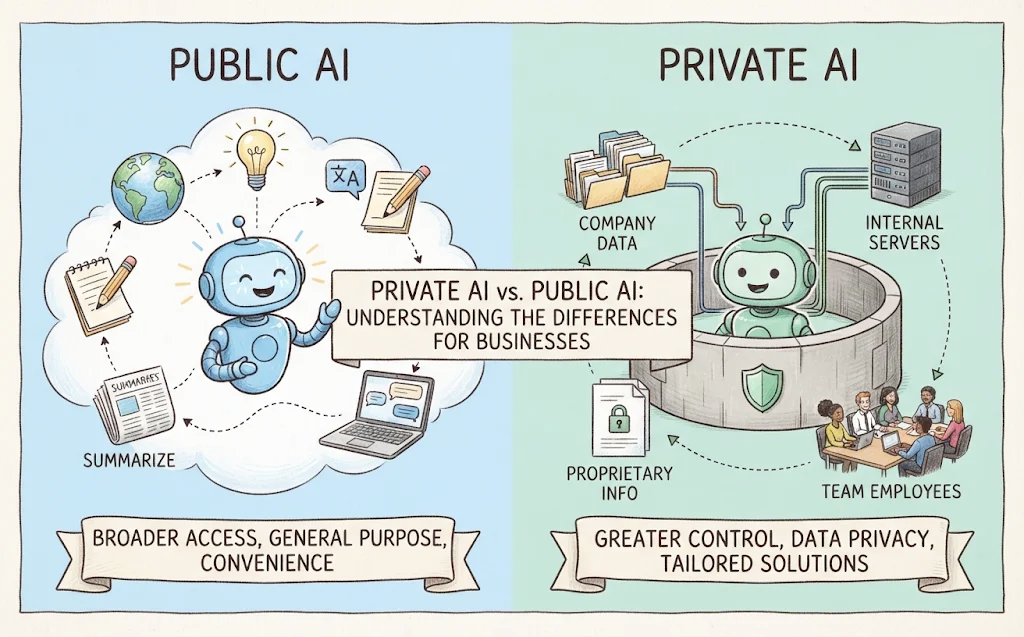
Public AI tools are convenient and accessible, making them useful for a wide range of general tasks. Private AI, on the other hand, offers organizations greater control over how AI is deployed, accessed, and connected to internal business information.
Understanding the differences between private AI and public AI can help businesses choose an approach that balances productivity, data protection, operational requirements, and long-term costs.
What Is Public AI?
Public AI generally refers to AI services made available to a broad range of users through public websites, applications, or APIs. Examples include general-purpose AI chatbots and AI assistants that anyone can access through an account or subscription.
These services are usually hosted and operated by third-party AI providers. Users interact with them through a web browser, mobile application, or software integration without needing to manage the underlying AI infrastructure.
Public AI has made artificial intelligence accessible to individuals and businesses of almost any size. Employees can use these tools to:
- Draft emails, reports, and business proposals.
- Summarize articles, documents, and meeting notes.
- Generate ideas and explore different approaches to problems.
- Explain technical concepts and assist with research.
- Generate and review computer code.
- Translate and improve written content.
One of the main advantages of public AI is convenience. Organizations can begin experimenting with AI without purchasing specialized hardware, installing AI models, or maintaining complex infrastructure.
However, public AI assistants generally do not automatically have access to an organization’s internal knowledge. Unless suitable integrations or knowledge sources are configured, they cannot reliably answer questions about a company’s internal procedures, project history, proprietary documentation, or operational practices.
What Is Private AI?
Private AI refers to an AI environment configured for an organization with greater control over its infrastructure, data access, integrations, and operational policies.
Unlike simply using a general-purpose public AI assistant, a private AI environment can be designed around an organization’s specific requirements. It may connect AI applications to internal documents, knowledge repositories, business systems, and approved information sources.
Private AI can be deployed in different ways, including:
- On-premises deployment: AI models and supporting applications operate on infrastructure managed by the organization.
- Dedicated cloud infrastructure: AI services operate within a dedicated cloud environment configured for the organization’s requirements.
- Organization-controlled cloud AI access: Business applications connect to a cloud AI provider using the organization’s own account, API credentials, and selected endpoint configuration.
Therefore, private AI does not necessarily mean that every AI model must run on a physical server inside the company’s office. The appropriate deployment arrangement depends on the organization’s data protection requirements, infrastructure capabilities, and operational preferences.
Another important distinction is that private AI is not simply about running an AI model. A useful business environment also needs suitable applications, knowledge management capabilities, access controls, integrations, and workflows that employees can use effectively.
Private AI vs. Public AI: Key Differences
Both private and public AI can provide powerful AI capabilities. However, they differ in how they are managed, how organizations connect them to business information, and how much control companies have over their operating environments.
| Consideration | Public AI | Private AI |
|---|---|---|
| Accessibility | Generally available to users through public services and applications. | Access is configured for an organization and its authorized users. |
| Infrastructure | Usually managed by the AI service provider. | Can use organization-managed infrastructure or a selected cloud AI provider. |
| Data management | Depends on the provider’s service terms, account type, and configuration. | Can be designed around organizational data management and governance requirements. |
| Business knowledge | Does not automatically know internal company information. | Can connect to selected corporate documents and knowledge repositories. |
| Customization | Often provides general-purpose features and provider-defined customization options. | Can support organization-specific prompts, workflows, integrations, and configurations. |
| Administration | Depends on the service’s available account and administrative features. | Can provide organization-defined access, deployment, and operational controls. |
| Infrastructure responsibility | Mostly handled by the service provider. | Depends on whether the organization chooses self-hosted or cloud-based AI. |
| Costs | May involve free access, subscriptions, or usage-based charges. | May involve software, implementation, infrastructure, model usage, and maintenance costs. |
These are general differences rather than absolute rules. Enterprise versions of public AI services can offer substantial administrative, privacy, and security controls. Similarly, a privately deployed AI environment still requires proper configuration and management.
The real question is not simply whether an AI service is public or private, but whether its capabilities and data-handling arrangements satisfy the organization’s requirements.
1. Data Privacy and Security: Who Controls Your Business Information?
Data privacy is one of the most important considerations when choosing an AI solution for business use.
Employees may interact with AI using information that should not be disclosed outside the organization, such as:
- Customer records and commercial information.
- Internal financial reports and business plans.
- Product specifications and technical documentation.
- Software source code and development materials.
- Employee information and internal communications.
- Confidential project discussions and meeting notes.
When information is submitted to an external AI service, organizations need to understand how that information is processed, stored, retained, and potentially used.
Different AI providers have different policies and contractual arrangements. Some consumer services may use submitted information to improve their models, subject to their settings and terms. Business and enterprise services may provide additional protections, such as restrictions on model training, administrative controls, and defined data retention arrangements.
Consequently, businesses should not assume that every public AI service handles information in the same way.
How Private AI Can Help
A private AI environment gives an organization more flexibility in determining how information is handled.
For example, a company operating its own AI infrastructure may retain more direct control over where its models and supporting systems run. An organization using a cloud AI provider can instead evaluate the provider’s contractual commitments, endpoint configuration, data processing arrangements, and available security controls.
However, private deployment does not automatically guarantee security. Organizations must still implement appropriate authentication, authorization, network protection, encryption, monitoring, data governance, and operational procedures.
Businesses handling personal information should also consider their applicable data protection obligations. The Information Commissioner’s Office guidance on AI and data protection provides useful considerations for organizations using AI systems that process personal data.
2. Access to Company Knowledge: Generic Answers vs. Business-Specific Intelligence
Another major difference concerns the information available to an AI assistant.
General-purpose AI models have broad knowledge and can assist with many subjects. However, they do not automatically know an organization’s internal policies, project decisions, customer history, product specifications, or working procedures.
Consider a software development company whose employees frequently need answers to questions such as:
- What decisions were made during the previous project review?
- Which version of the product specification is currently approved?
- What technical constraints were agreed upon with the customer?
- How did the team resolve a similar issue in an earlier project?
- Which internal procedure should be followed when a particular problem occurs?
A general-purpose AI assistant cannot reliably answer these questions without access to the relevant company information.
This is where connecting AI to corporate knowledge becomes valuable.
Building an AI-Powered Corporate Knowledge Environment
A business can create a centralized knowledge repository containing relevant documents, meeting minutes, project notes, technical specifications, policies, and other organizational information.
An AI assistant can then be connected to selected knowledge sources so employees can ask questions in natural language and receive answers informed by the available internal materials.
For example, instead of manually searching through dozens of project documents, an employee could ask:
What were the main decisions made during the last three project meetings, and which outstanding issues still need attention?
The AI assistant can retrieve relevant information from the configured knowledge sources and help produce a consolidated summary. Employees should still verify important details against the original records, particularly when decisions or commitments are involved.
This approach is often associated with retrieval-augmented generation (RAG), where an AI system retrieves relevant information from external knowledge sources and uses it as context when generating a response.
Importantly, connecting an AI assistant to company documents does not necessarily require retraining the underlying AI model. Knowledge retrieval and model training are different approaches, and many corporate knowledge applications use retrieval rather than continuously training a model on internal documents.
3. Customization and Business Workflows
Public AI assistants are designed to support a wide range of users and tasks. Their general-purpose nature is a strength, but businesses may need more specialized workflows.
For example, different departments may require AI to produce information in specific formats:
- Human resources: Summarize internal policies and help employees locate relevant procedures.
- Project management: Consolidate meeting notes, track decisions, and prepare project status summaries.
- Software development: Analyze requirements, summarize technical specifications, and assist with documentation.
- Operations: Retrieve standard operating procedures and organize operational records.
- Management: Summarize business information and prepare structured reports.
A private AI environment can be configured with tailored prompts, approved knowledge sources, and supporting applications to make these workflows more consistent.
For instance, a company might create a reusable prompt that instructs its AI assistant to analyze project meeting notes and produce a structured report containing decisions, unresolved questions, risks, and assigned actions.
Rather than asking employees to invent prompts each time, the organization can establish reusable templates that reflect its preferred working methods.
This helps turn AI from an occasional productivity tool into a more consistent part of everyday business operations.
4. Deployment, Infrastructure, and Maintenance
Public AI services are generally easier to start using because the provider manages the underlying infrastructure, model hosting, and service operation.
Organizations usually need only an account, suitable access permissions, and an internet connection.
Private AI can require more planning, particularly when the organization chooses to operate its own AI infrastructure.
Self-Hosted AI
With self-hosted AI, the organization operates AI models on infrastructure it controls. This may involve on-premises servers or dedicated cloud GPU environments.
Advantages can include:
- Greater control over the AI hosting environment.
- More flexibility in selecting and configuring AI models.
- Control over infrastructure location and deployment architecture.
- Greater independence from certain external AI service arrangements.
However, the organization must also consider hardware procurement or cloud computing costs, installation, model configuration, infrastructure monitoring, upgrades, and ongoing maintenance.
Cloud-Based AI
Another option is to connect business applications to an established cloud AI provider using the organization’s own account and selected endpoint.
This approach can reduce the need to purchase and maintain GPU hardware. The AI provider manages the model infrastructure, while the organization configures how its applications connect to the service.
Cloud-based AI can be a practical option for organizations that want to introduce private corporate AI capabilities without operating their own model-hosting infrastructure.
Nevertheless, businesses should review the provider’s data handling policies, contractual terms, processing locations, security controls, and usage charges before selecting this approach.
5. Cost Considerations: Which Approach Is More Economical?
It is tempting to assume that public AI is always cheaper and private AI is always more expensive. In reality, the total cost depends on usage, infrastructure, security requirements, and the amount of implementation work involved.
Public AI services may offer free access or relatively inexpensive subscriptions. For individuals and small teams performing occasional tasks, this can be an economical starting point.
However, organizations using AI extensively may need business or enterprise subscriptions, API usage budgets, administrative features, and additional integrations.
Private AI introduces other cost considerations, including:
- AI software and application licensing.
- GPU hardware or cloud computing resources.
- Infrastructure configuration and integration.
- Knowledge repository setup and maintenance.
- Security and access management.
- Employee training and technical support.
- Ongoing administration and operational monitoring.
Self-hosted deployments can require substantial initial investment, while cloud-based arrangements may shift more of the cost toward recurring usage charges.
Businesses should therefore evaluate the total cost of ownership rather than comparing only the subscription price of an AI chatbot.
For some organizations, a supported private AI implementation may also be more practical than hiring specialist engineers and building every component independently.
6. When Should a Business Choose Public AI?
Public AI remains an excellent option for many everyday activities. Businesses do not necessarily need a private AI environment for every task.
Public AI may be suitable when:
- Employees are exploring AI for general productivity.
- The tasks involve publicly available or non-sensitive information.
- There is no requirement to access internal corporate knowledge.
- The organization wants to experiment with AI before making a larger investment.
- Convenience and minimal infrastructure responsibility are the main priorities.
- The selected service provides data-handling arrangements acceptable to the organization.
For example, an employee might use a general-purpose AI assistant to brainstorm marketing ideas, improve publicly available content, or explain a programming concept.
These activities may not require a dedicated corporate AI environment.
7. When Should a Business Consider Private AI?
Private AI becomes particularly relevant when organizations want to integrate artificial intelligence more deeply into their internal operations.
It may be worth considering when:
- Employees need to retrieve information from internal company documents.
- Business processes depend on proprietary knowledge and project history.
- The organization has specific data governance or deployment requirements.
- Different departments need standardized AI-assisted workflows.
- Access to corporate information must be managed according to organizational policies.
- The company wants to establish a controlled environment for wider AI adoption.
- AI needs to work alongside existing business documentation and modeling applications.
Consider a professional services company that has accumulated years of client records, project documents, meeting notes, and technical reports.
Employees may spend considerable time searching for information or asking colleagues who worked on earlier projects.
A private corporate knowledge assistant can help make relevant information easier to retrieve, summarize, and reuse. It can also support employee onboarding and help teams maintain continuity when responsibilities change.
For such organizations, the value of private AI extends beyond generating text. It becomes a way to make accumulated business knowledge more accessible and useful.
8. Can Businesses Use Both Public AI and Private AI?
Choosing between public AI and private AI does not necessarily mean selecting only one approach.
Many organizations can benefit from a combination of both, provided that they establish clear usage policies and appropriate controls.
For example, a company might use public AI services for general research and non-confidential productivity tasks while reserving its private corporate AI environment for work involving internal documents and proprietary business knowledge.
A practical arrangement could look like this:
| Business activity | Potentially suitable AI approach |
|---|---|
| Brainstorming general marketing ideas | Public AI |
| Improving publicly available website content | Public AI |
| Searching internal project records | Private corporate AI |
| Analyzing confidential business documentation | Approved private or enterprise AI environment |
| Retrieving internal company policies | Private corporate AI |
| Preparing project summaries from internal meeting notes | Private corporate AI |
The exact division should be determined by the organization’s information classification policies, contractual obligations, and the capabilities of the selected AI services.
Establishing clear guidelines helps employees understand which tools they should use for different types of information.
9. A Practical Checklist for Choosing the Right AI Approach
Before selecting an AI solution, businesses should consider the following questions:
- What do we want AI to accomplish? Identify the business activities and problems that AI should help address.
- What information will employees use? Determine whether the work involves public information, internal documents, customer records, or confidential business data.
- Does AI need access to corporate knowledge? Consider whether employees need answers based on internal policies, project records, technical documentation, or historical decisions.
- What level of control do we require? Review data processing, access management, deployment location, retention, and security requirements.
- Which deployment approach is appropriate? Evaluate self-hosted infrastructure, dedicated cloud environments, and cloud AI provider endpoints.
- Can employees use the solution effectively? Consider the applications, integrations, training, and support needed for successful adoption.
- What is the total cost? Account for software, infrastructure, model usage, implementation, maintenance, and training.
- How will we evaluate success? Establish measurable outcomes such as reduced information retrieval time, improved documentation consistency, or more efficient workflows.
Organizations should also review applicable legal, regulatory, and contractual obligations before processing business or personal information through an AI system.
The NIST AI Risk Management Framework provides a useful reference for organizations looking to approach AI governance and risk management systematically.
Conclusion: Choose AI That Fits the Way Your Business Works
Public AI and private AI both have important roles in modern business operations.
Public AI provides convenient access to powerful general-purpose capabilities, making it useful for everyday productivity and experimentation. Private AI offers organizations greater control over their AI environment and the opportunity to connect AI applications with their own corporate knowledge and workflows.
For businesses that want to move beyond occasional AI experimentation, the ability to organize internal knowledge, retrieve relevant information, and support repeatable workflows can make a substantial difference.
However, implementing such an environment involves more than choosing an AI model. Organizations also need suitable software, knowledge management capabilities, infrastructure configuration, employee training, and ongoing technical support.
Visual Paradigm’s Private AI for Enterprise Knowledge solution brings these elements together in a coordinated offering. It combines NotesKeep and tailored AI prompts for corporate knowledge management, an AI Chatbot for context-aware assistance, OpenDocs for documentation and publishing, and diagram editing tools for visual modeling.
The solution also includes implementation assistance, online team training, and ongoing technical support. Organizations can discuss self-hosted AI or connecting to a cloud AI provider based on their infrastructure and operational requirements.
For businesses looking to make their own knowledge more accessible through AI without having to build every component independently, this provides a practical starting point.
Explore Visual Paradigm’s Private AI solution for enterprise knowledge.
Frequently Asked Questions
Is private AI safer than public AI?
Private AI can provide greater control over infrastructure, data access, and deployment arrangements. However, it is not automatically safer. Security depends on proper configuration, access controls, infrastructure protection, provider arrangements, and ongoing governance. Enterprise versions of public AI services can also provide strong security and privacy controls.
Does private AI mean that AI runs on a company’s own servers?
Not necessarily. Private AI can run on company-managed on-premises infrastructure or dedicated cloud infrastructure. It can also connect to a cloud AI provider through an organization-controlled account and endpoint. The appropriate arrangement depends on the organization’s requirements.
Can public AI tools access a company’s internal documents?
Some public AI services offer integrations with external data sources and business applications. However, access must be explicitly configured, and organizations should review the associated permissions and data-handling arrangements. General-purpose AI assistants do not automatically know a company’s internal information.
Does private AI require training an AI model on company data?
No. Connecting AI to corporate knowledge does not necessarily require model training or fine-tuning. Many solutions use retrieval-augmented generation (RAG), which retrieves relevant information from configured knowledge sources and supplies it to the AI model as context when answering questions.
Is private AI expensive for small businesses?
The cost depends on the deployment approach, software requirements, model usage, and infrastructure needs. Self-hosted deployments may require investment in GPU hardware and technical maintenance. Cloud-based AI arrangements can reduce hardware responsibilities, although provider usage charges still apply. Small businesses should evaluate the total cost of ownership and available implementation support.
Can a business use private AI without hiring AI engineers?
Yes. Businesses can work with an AI solution provider that supplies the software, assists with infrastructure and endpoint configuration, and provides employee training and technical support. This can reduce the need to recruit an internal team solely to implement the initial environment.
What is the difference between private AI and an enterprise AI subscription?
An enterprise AI subscription typically provides business-oriented access to an AI service, potentially with additional administrative, security, and data protection features. Private AI is a broader concept that can include the deployment environment, corporate knowledge integrations, access controls, supporting applications, and organization-specific workflows. An enterprise subscription may be one component of a private corporate AI strategy.