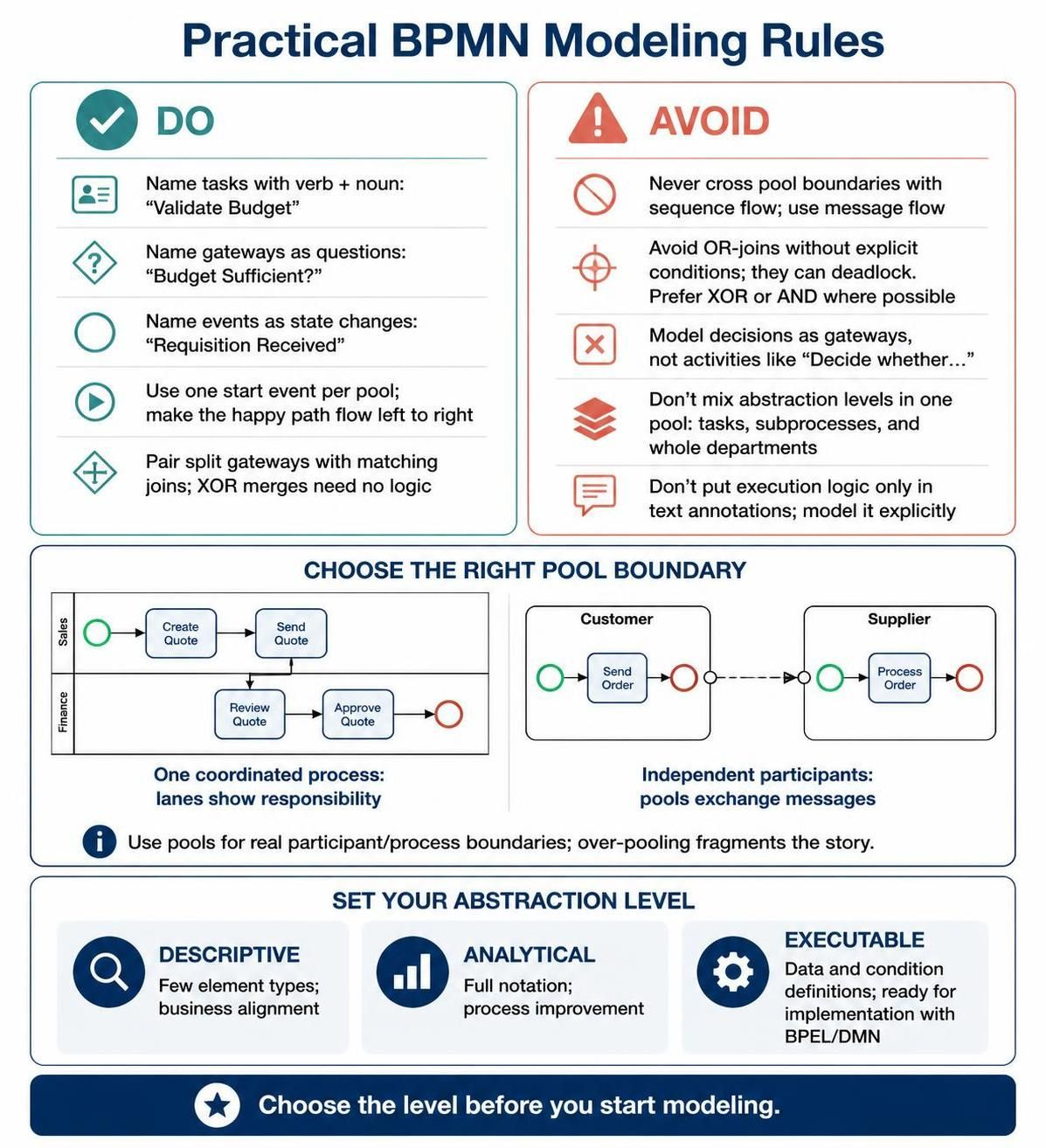
Welcome to this comprehensive tutorial on Business Process Model and Notation (BPMN). Whether you are a business analyst, a process architect, or a developer, the quality of your diagrams dictates the clarity of your business logic. Using tools like Visual Paradigm combined with its AI capabilities and VPasCode, you can generate high-quality models instantly, but you must first understand the underlying modeling rules to ensure the output is accurate.
This guide breaks down the essential “Do’s and Don’ts” of BPMN, explains the architectural choice between Pools and Lanes, and defines how to set your abstraction level for different project phases.
1. The Golden Rules of Naming and Flow
A common pitfall in process modeling is ambiguous naming. A diagram should tell a story at a glance. To achieve this, we must adhere to specific syntactic conventions for naming elements. This ensures that anyone reading the model understands exactly what is happening without needing a legend.
Task Naming: The Verb-Noun Standard
Every task (the activity being performed) should follow a strict Verb + Noun format. This removes ambiguity about what the action is and what the object of the action is.
- Good: “Validate Budget”, “Send Invoice”, “Approve Quote”.
- Bad: “Budget”, “Validation”, “Invoice Processing”.
Gateway Naming: The Question Format
Gateways control the flow. They are decision points. To make the logic transparent, name every gateway as a Question that evaluates to True or False.
- Good: “Budget Sufficient?”, “Customer Exists?”, “Order Approved?”.
- Bad: “Check Budget”, “Decision Point”, “Approve?”.
Event Naming: State Changes
Events mark the start, middle, or end of a process. They represent a change in state. Name them as Noun + State Change or simply the event itself.
- Good: “Requisition Received”, “Payment Completed”, “Order Cancelled”.
- Bad: “Requisition”, “Processing”.
2. Architectural Integrity: Pools vs. Lanes
One of the most critical architectural decisions you make in BPMN is defining the boundaries of your process. This is often visualized using Pools (black boxes representing participants) and Lanes (divisions within a pool representing roles).
When to Use Lanes (Internal Process)
Lanes should be used when the process is a single, coordinated effort within an organization. For example, in a “Create Quote” process, you might have a “Sales” lane and a “Finance” lane. The flow is continuous (Sequence Flow) because both departments are part of the same internal system.
When to Use Pools (External Process)
Pools represent distinct participants. You should only use a new Pool when a real organizational boundary exists. If you have a “Customer” and a “Supplier” exchanging orders, these must be separate Pools. Crucially, you can never use a Sequence Flow to cross a Pool boundary. If you do, it must be a Message Flow (dashed line), indicating that one participant is sending a message to another.
Architectural Rule: Over-pooling fragments the story. If two departments are working on the same process instance, keep them in the same Pool with different Lanes. Only split them into Pools if they are independent participants exchanging documents.
3. Gateway Logic and Flow Control
Gateways are the traffic controllers of your BPMN diagram. Misusing them can lead to deadlocks or infinite loops.
Pairing Splits and Joins
Every split gateway (where the flow goes one way or another) should ideally have a matching join gateway (where the flow converges). If you split the path to check a condition, you must eventually merge the paths back together to proceed with the next task.
The Danger of OR-Joins
The OR-Gateway (Parallel Gateway) is powerful but dangerous. An OR-Join without explicit conditions can cause a deadlock. If you split into three paths, but only two paths are taken, the OR-Join might wait for the third path to arrive forever.
- Recommendation: Prefer XOR (Exclusive) or AND (Parallel) gateways where possible. If you must use an OR-Join, ensure you explicitly define the conditions that allow it to close.
4. Abstraction Levels: Choosing Your Lens
Before you open Visual Paradigm or start writing VPasCode, you must decide on the Abstraction Level. BPMN is versatile, but it is rarely used at only one level.
Level 1: Descriptive (Business Alignment)
Target Audience: Business Stakeholders
Focus on the “What”. Use few element types. Avoid complex logic. This is for high-level alignment and ensuring everyone agrees on the process flow.
Level 2: Analytical (Process Improvement)
Target Audience: Process Engineers
Focus on the “How” and “Where”. Use the full notation. Include all gateways, sub-processes, and data objects. This level is ready for simulation and bottleneck analysis.
Level 3: Executable (Implementation)
Target Audience: Developers / BPEL Engines
Focus on the “Code”. This requires complete data definitions, condition logic (DMN), and error handling. It is ready to be transformed into executable code (BPEL).
Pro Tip on Abstraction
Never mix abstraction levels in one pool. Do not place a single “Task” next to a “Sub-Process” next to a “Department” in the same diagram. It confuses the reader about the scope of the process.
5. Logic in the Model vs. Text Annotations
A common mistake is relying on text annotations to carry the “real” logic. If a rule matters to the execution of the process, it belongs in the model.
- Wrong: Placing a gateway and writing “Check if budget is sufficient” in a text box nearby.
- Right: Placing a gateway and naming it “Budget Sufficient?”.
- Wrong: Modeling a decision as an activity “Decide whether to approve”.
- Right: Modeling a decision as a Gateway.
Summary Checklist
Before finalizing your BPMN diagram in Visual Paradigm, run this quick checklist:
- Names: Tasks are Verb+Noun? Gateways are Questions? Events are State Changes?
- Flow: Is the happy path left-to-right? Are there any sequence flows crossing pool boundaries (must be message flows)?
- Gateways: Are splits paired with joins? Are OR-joins safe?
- Logic: Is all logic inside the model (gateways/conditions) and not just in text annotations?
- Abstraction: Is the diagram purely descriptive, purely analytical, or purely executable?
By following these rules, you ensure that your BPMN models are not just pictures, but precise, executable, and communicative blueprints of your business.