In the complex landscape of Business Process Model and Notation (BPMN 2.0), few symbols are as versatile or as critical for modeling real-world flexibility as the Inclusive Gateway. Often mistaken for a simple decision point, the inclusive gateway is the engine that powers conditional logic where multiple paths can be active simultaneously.
This tutorial breaks down the architecture of the Inclusive Gateway, using a practical e-commerce order processing scenario to illustrate how to model non-mutually exclusive conditions effectively.
What is the Inclusive Gateway?
The Inclusive Gateway is a control flow object designed to handle situations where the next steps in a process are not mutually exclusive. Unlike a Parallel Gateway (which always takes all paths) or an Exclusive Gateway (which takes only one path), the Inclusive Gateway allows for a combination of zero, one, or many paths to be activated based on specific conditions.
Visually, it is represented by a yellow diamond with a circle inside. This symbol serves two distinct functions within a single process:
- Diverging (Split): Evaluates outgoing conditions and activates every branch where the condition is true.
- Converging (Join): Waits for all incoming active branches to complete before allowing the process to continue.
Architectural Logic: Divergence and Convergence
To understand how this fits into system architecture, we must look at the flow of control during the “Split” and “Join” phases.
The Diverging Phase (The Split)
When the process flow reaches a diverging Inclusive Gateway, the engine evaluates the conditions on the outgoing sequence flows. The logic is inclusive:
- If a condition is True, the path is activated.
- If a condition is False, the path is skipped.
- Multiple conditions can be True at the same time.
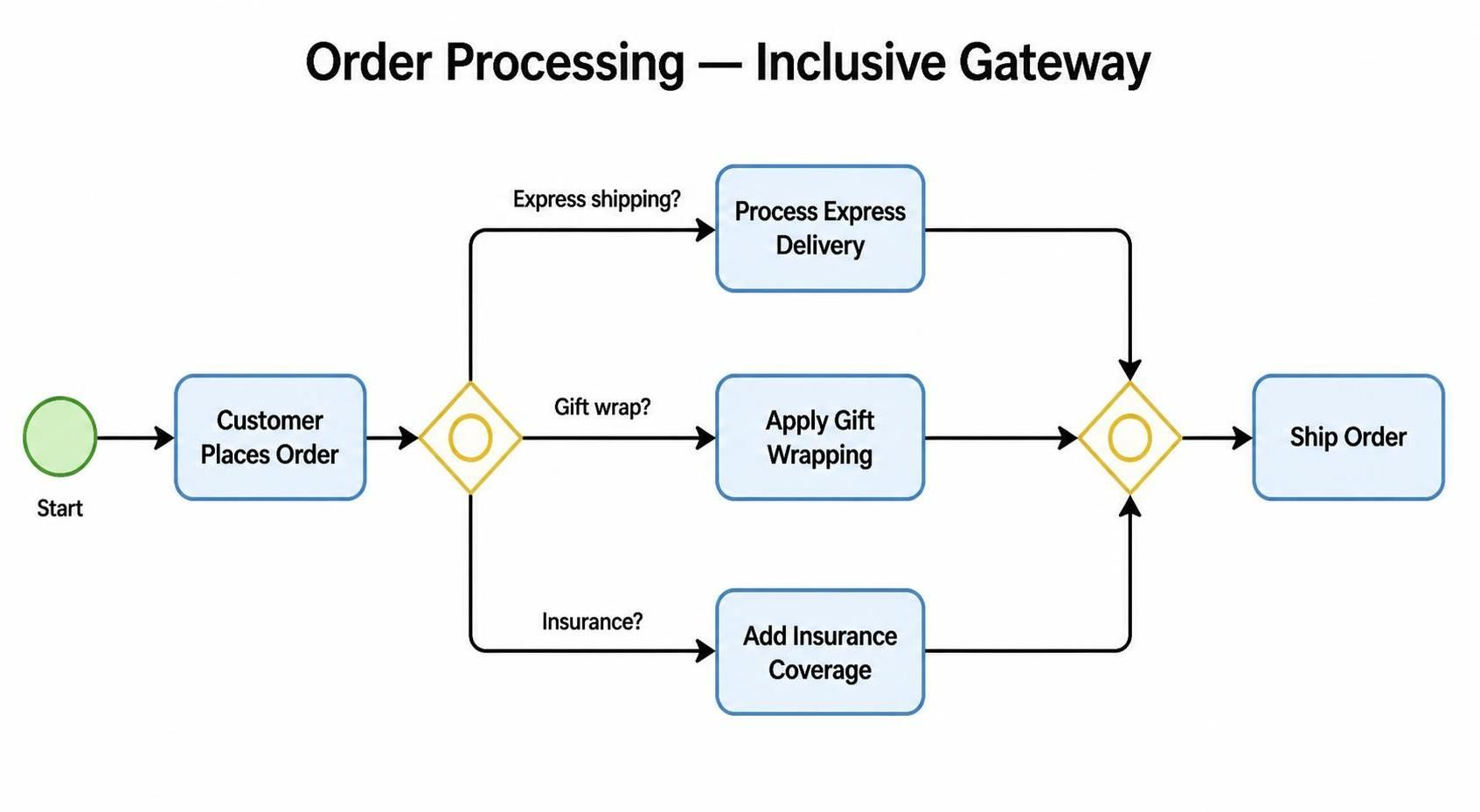
For example, in an order processing system, a customer might select “Express Shipping” AND “Gift Wrapping”. Both conditions are true. The gateway activates both the “Process Express Delivery” task AND the “Apply Gift Wrapping” task. It does not force a choice; it enables everything that applies.
The Converging Phase (The Join)
Once the parallel (or parallel-like) branches are executing, the process must eventually recombine. This is where the converging Inclusive Gateway comes into play.
The converging gateway acts as a synchronization point. It waits for all active incoming flows to complete before the process flow is allowed to move forward. If the customer only selected “Gift Wrapping,” the gateway waits for that specific task to finish. If they selected all three options, the gateway waits for all three tasks to finish before proceeding to “Ship Order.”
Real-World Scenario: E-Commerce Checkout
Let us walk through the specific diagram provided. This architecture models an automated checkout system where customer preferences dictate the fulfillment path.
1. The Start and Trigger
The process begins with a Start Event (green circle). The trigger is the action Customer Places Order. This is the baseline state from which we branch out.
2. The Diverging Gateway (Inclusive Split)
Immediately following the order placement, the flow hits the Inclusive Gateway. Here, the system evaluates three distinct data attributes from the order:
- Express Shipping?: If the customer paid extra for speed, this path activates the Process Express Delivery task.
- Gift Wrap?: If the customer checked the “Gift” box, this path activates the Apply Gift Wrapping task.
- Insurance?: If the customer opted for protection, this path activates the Add Insurance Coverage task.
Because these are optional and combinable, the gateway ensures that any combination of these tasks runs.
3. The Converging Gateway (Inclusive Join)
After the selected tasks are completed, the flow converges at the second Inclusive Gateway. This node acts as a safety check. It ensures that the order is fully prepared (shipped, wrapped, and insured as required) before the final Ship Order task is executed.
Implementation Best Practices
When modeling these structures, particularly in tools like Visual Paradigm, architects must be vigilant about the “Default Flow.”
In a Converging Inclusive Gateway, if no condition at the diverging gateway was true (e.g., the customer bought a basic item with no extras), the process could theoretically deadlock because the gateway is waiting for an active flow that never started. To prevent this, it is standard practice to define a Default Flow—a path without a specific condition—that is taken only if all other conditions are false.
Summary
The Inclusive Gateway is the bridge between rigid linear processes and dynamic, customer-driven workflows. By understanding how to split based on conditions and join on completion, you can build robust models that accurately reflect the complexity of modern business operations.