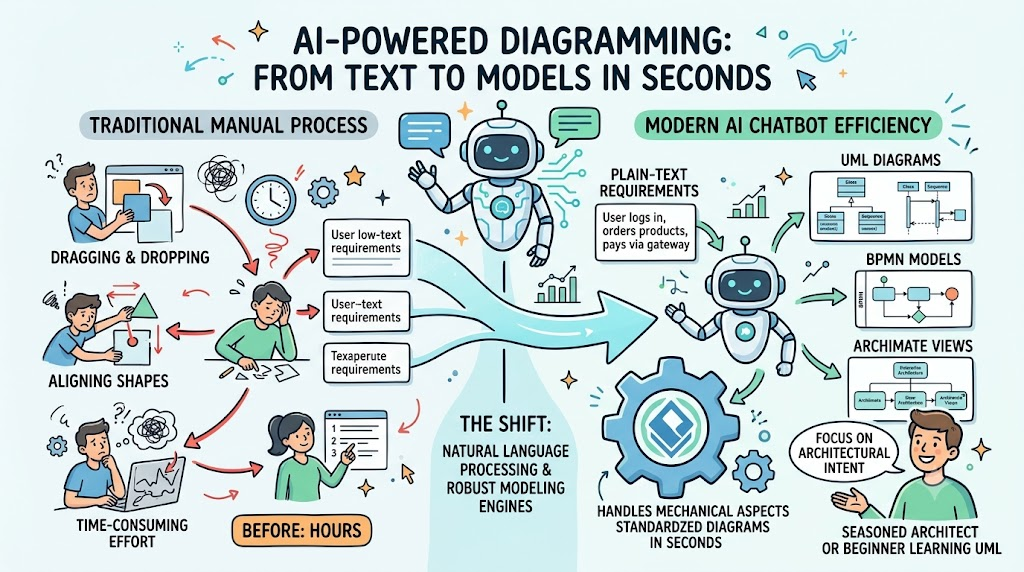
The landscape of software engineering and business process management is undergoing a seismic shift. Historically, the creation of professional visual models—such as UML diagrams, BPMN flows, and ArchiMate views—has been a laborious, manual endeavor. Architects and analysts have spent countless hours dragging, dropping, and aligning shapes to ensure their designs met industry standards.
However, the introduction of AI-powered diagramming tools, specifically the Visual Paradigm AI Chatbot, is revolutionizing this workflow. By leveraging Natural Language Processing (NLP) combined with robust modeling engines, complex system architecture can now be generated from plain-text requirements in mere seconds. This tutorial explores how this technology transforms the role of the architect from a “shape shifter” to a strategic “intent designer.”
The Paradigm Shift: Manual vs. AI-Driven Modeling
To understand the value of this new technology, we must first contrast the traditional approach with the modern AI-driven efficiency.
The Traditional Bottleneck
In the past, the modeling process was heavily dependent on manual execution. As illustrated in the industry shift, the “Traditional Manual Process” involved:
- Time-Consuming Effort: Creating a single diagram could take hours.
- Mechanical Friction: Engineers focused on the “how” of drawing (aligning shapes, connecting lines) rather than the “what” of the architecture.
- Requirement Translation: Converting low-text or text-perute requirements into visual symbols was a manual, error-prone task.
The AI Revolution
The Visual Paradigm AI Chatbot acts as an always-available co-designer. It removes the mechanical friction of diagramming, allowing the user to focus entirely on Architectural Intent.
- Input: The user provides plain-text requirements (e.g., “User logs in, orders products, pays via gateway”).
- Processing: The AI analyzes the text using NLP and maps it to the correct modeling syntax.
- Output: Standardized diagrams (UML, BPMN, ArchiMate) are rendered instantly.
Deconstructing the Workflow
When using the Visual Paradigm AI Chatbot, the workflow transitions from a linear, manual drawing task to a conversational, intent-based design process. The system handles the standardization, ensuring that every arrow, shape, and boundary complies with industry norms.
1. Defining Requirements
The process begins with natural language. You do not need to know the specific syntax of a class diagram or a state machine. You simply describe the scenario. For example:
"Create a use case diagram where a User interacts with the System.
The System must handle the following use cases: Login,
Browse Catalog, Add to Cart, and Checkout."
2. AI Interpretation
The AI engine parses your input. It identifies the actors (User, System) and the actions (Login, Browse, etc.). It then determines the appropriate diagram type based on the context.
3. Generation and Visualization
The tool generates the model. Whether you need a UML Sequence Diagram, a BPMN process flow, or an ArchiMate view, the AI constructs the visual representation. The result is a clean, professional diagram ready for review.
Practical Example: From Text to BPMN
Let’s walk through a specific example of how the AI Chatbot handles a business process description. Imagine you need to model an e-commerce transaction.
The Input Prompt
You type the following requirement into the chatbot:
"Generate a BPMN diagram for an order process.
Start with a user submitting an order.
If the payment is approved, proceed to shipping.
If the payment is rejected, notify the user.
End the process after shipping or notification."
The AI Output Logic
The AI translates this text into a structured BPMN flow. It understands the logic gateways (Payment Approved vs. Rejected) and the event types (Start, End).
<bpmn:process id="OrderProcess">
  <bpmn:startEvent id="StartOrder"/>
  <bpmn:sequenceFlow sourceRef="StartOrder" targetRef="SubmitOrder"/>

  <bpmn:task id="SubmitOrder"/>
  <bpmn:exclusiveGateway id="PaymentCheck"/>

  <bpmn:sequenceFlow sourceRef="SubmitOrder" targetRef="PaymentCheck"/>
  <bpmn:sequenceFlow sourceRef="PaymentCheck" targetRef="ShipOrder" condition="approved"/>
  <bpmn:sequenceFlow sourceRef="PaymentCheck" targetRef="NotifyUser" condition="rejected"/>

  <bpmn:task id="ShipOrder"/>
  <bpmn:task id="NotifyUser"/>
</bpmn:process>
The Resulting Diagram
The AI renders this logic into a visual BPMN model, complete with the correct shapes for tasks, gateways, and sequence flows. The user can then refine the diagram or export it for documentation.
Why This Matters for Modern Architects
The shift to AI-powered diagramming is not about replacing the architect; it is about elevating the role. By offloading the mechanical aspects of diagramming—such as aligning shapes and managing layout—architects can focus on the high-level strategic design.
- Speed: Iterate on designs in minutes rather than hours.
- Accuracy: AI ensures that diagrams adhere to strict UML/BPMN standards, reducing errors caused by manual drawing.
- Accessibility: Beginners can learn modeling concepts by typing in plain English, while experts can rapidly prototype complex systems.
The future of system architecture is here. With the Visual Paradigm AI Chatbot, the barrier between a concept and a professional model has been removed, allowing innovation to flow at the speed of thought.