Introduction
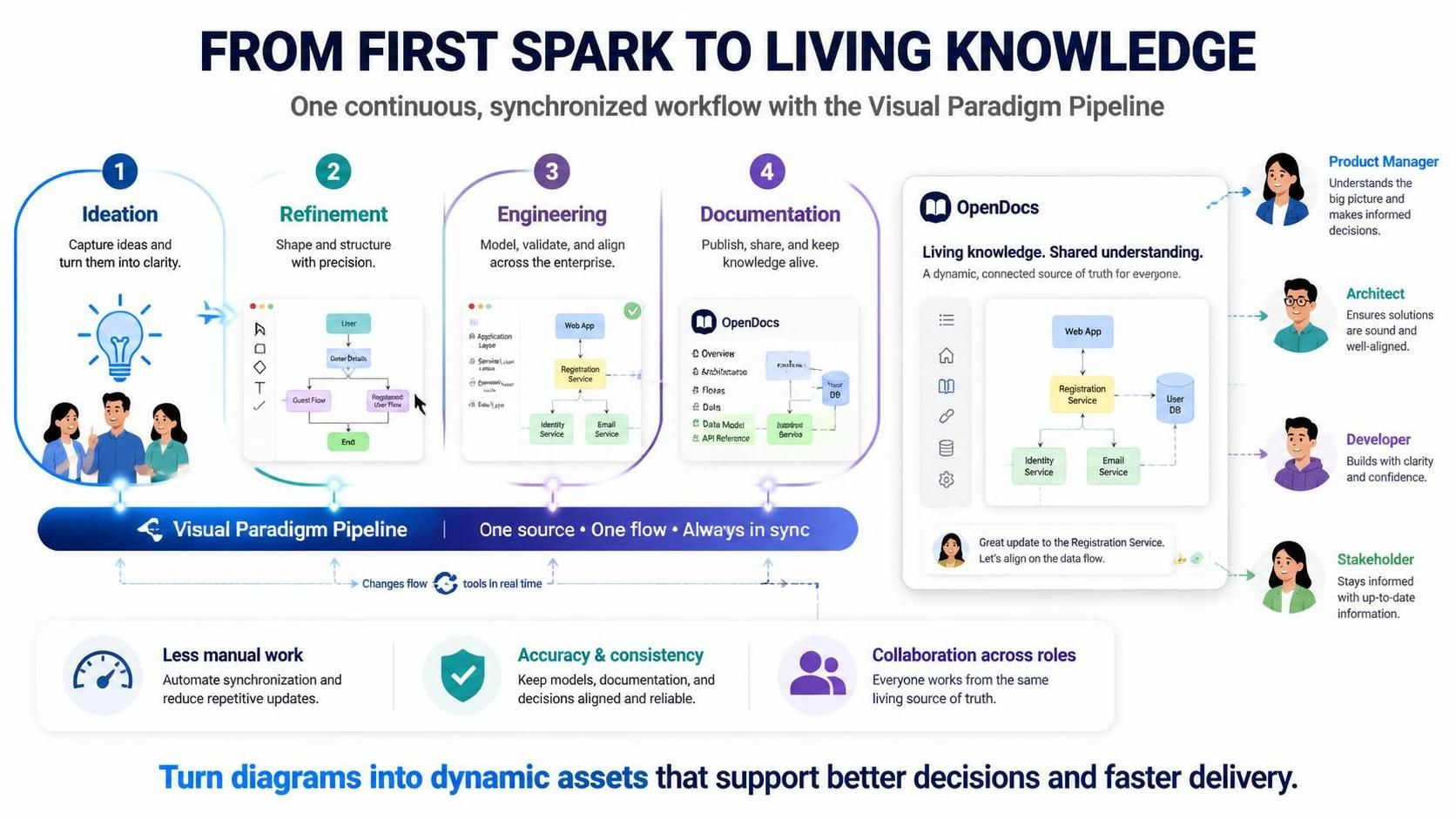
In today’s fast-paced product and engineering environments, the gap between a fleeting idea and a formalized, shareable diagram is often where momentum dies. Traditional workflows force teams to manually redraw sketches, copy-paste assets across disjointed tools, and struggle with version control. This friction not only wastes time but introduces errors and inconsistencies into critical documentation.
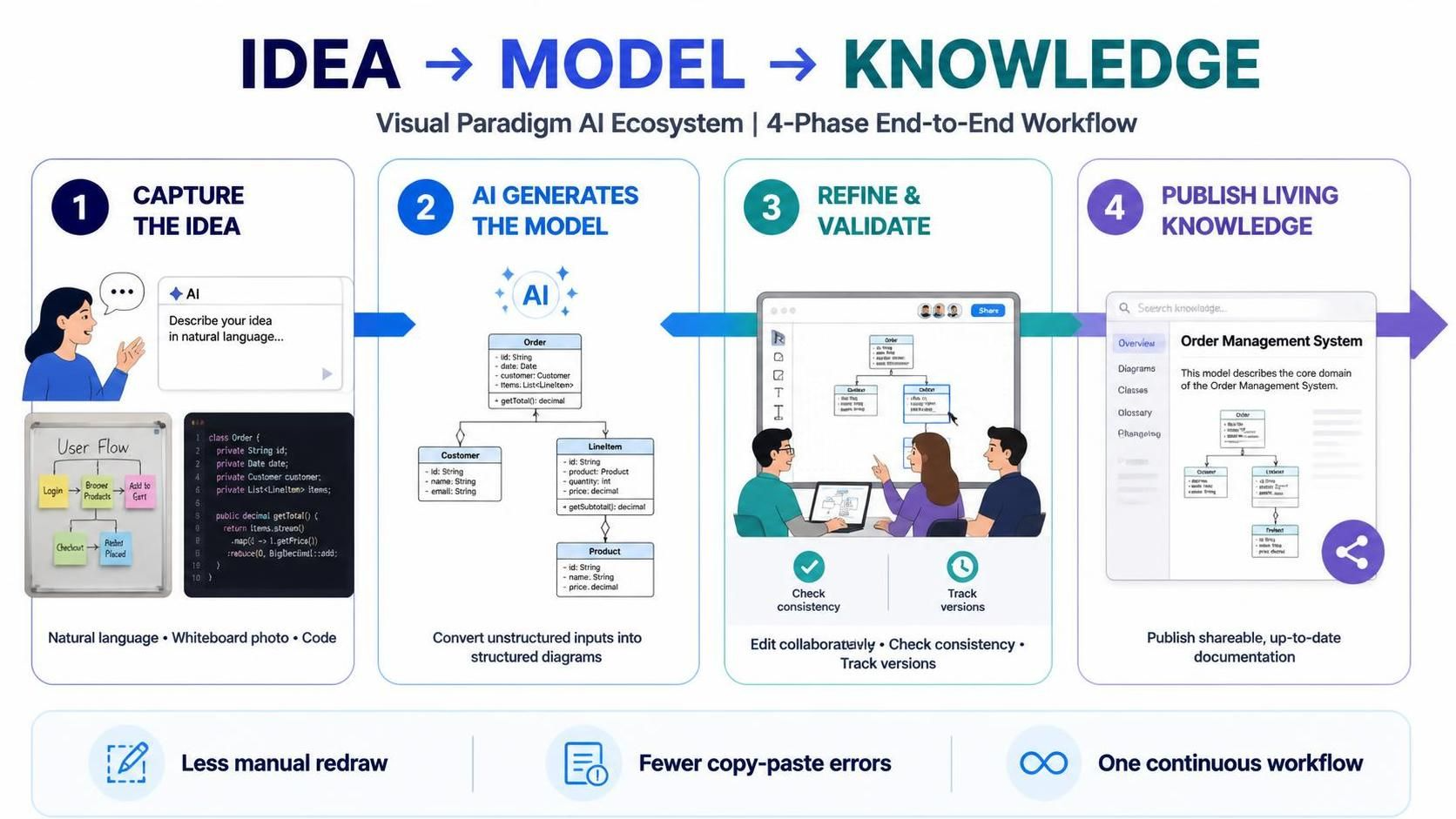
The Visual Paradigm AI Ecosystem eliminates this friction by introducing a seamless, continuous pipeline. It transforms unstructured inputs—whether natural language prompts, whiteboard photos, or code snippets—into precise, enterprise-grade models and living documentation. This guide explores the recommended 4-Phase End-to-End Workflow, demonstrating how teams can move from initial ideation to published knowledge bases without ever breaking their flow.
Key Concepts
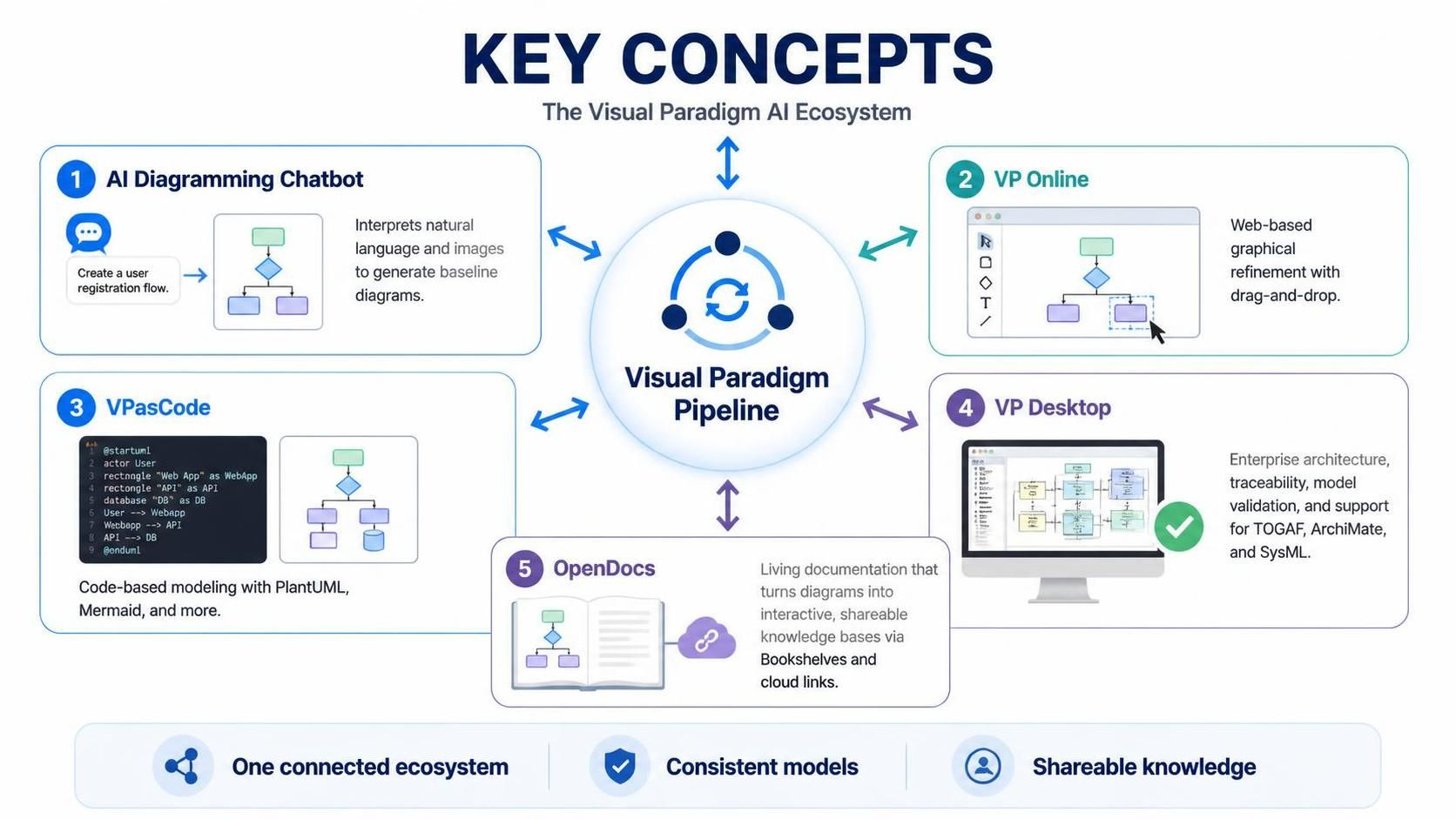
Before diving into the workflow, it’s essential to understand the core components that power this ecosystem:
-
Visual Paradigm Pipeline: The underlying infrastructure that synchronizes data across AI Chatbot, VP Online, VPasCode, VP Desktop, and OpenDocs. It ensures that changes in one tool reflect everywhere else.
-
AI Diagramming Chatbot: A conversational interface that interprets natural language and images to generate baseline diagrams.
-
VP Online & VPasCode: Web-based editors for graphical refinement (drag-and-drop) and code-based modeling (PlantUML, Mermaid, etc.), respectively.
-
VP Desktop: The powerhouse for enterprise architecture, offering traceability, model validation, and complex framework support (TOGAF, ArchiMate, SysML).
-
OpenDocs: A living documentation platform that turns static diagrams into interactive, shareable knowledge bases via Bookshelves and cloud links.
The Visual Paradigm 4-Phase End-to-End Workflow
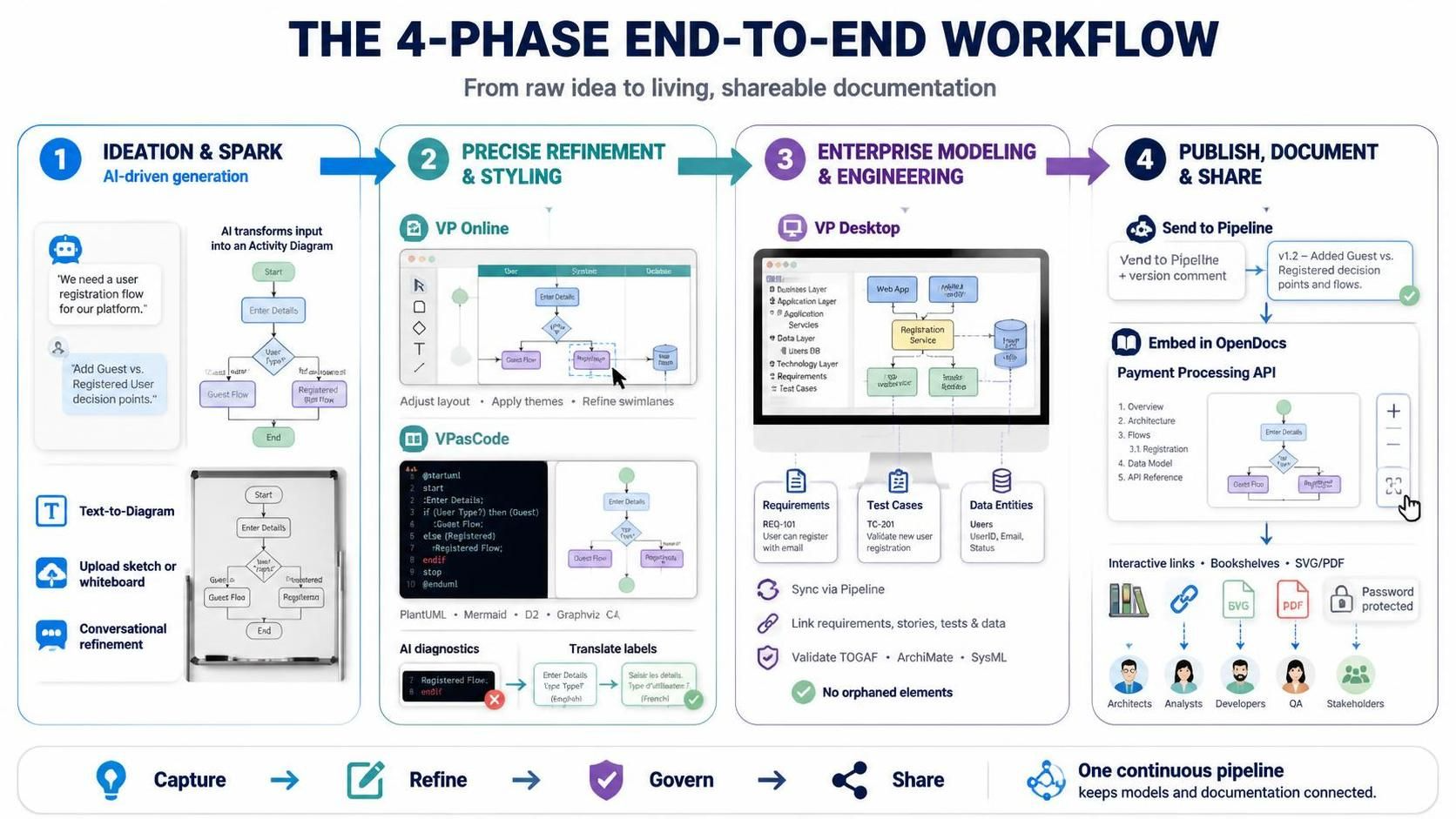
Phase 1: Ideation & Spark (AI-Driven Generation)
The journey begins with capturing raw ideas. Instead of starting with a blank canvas, leverage AI to create a structured baseline from unstructured inputs.
How it Works:
-
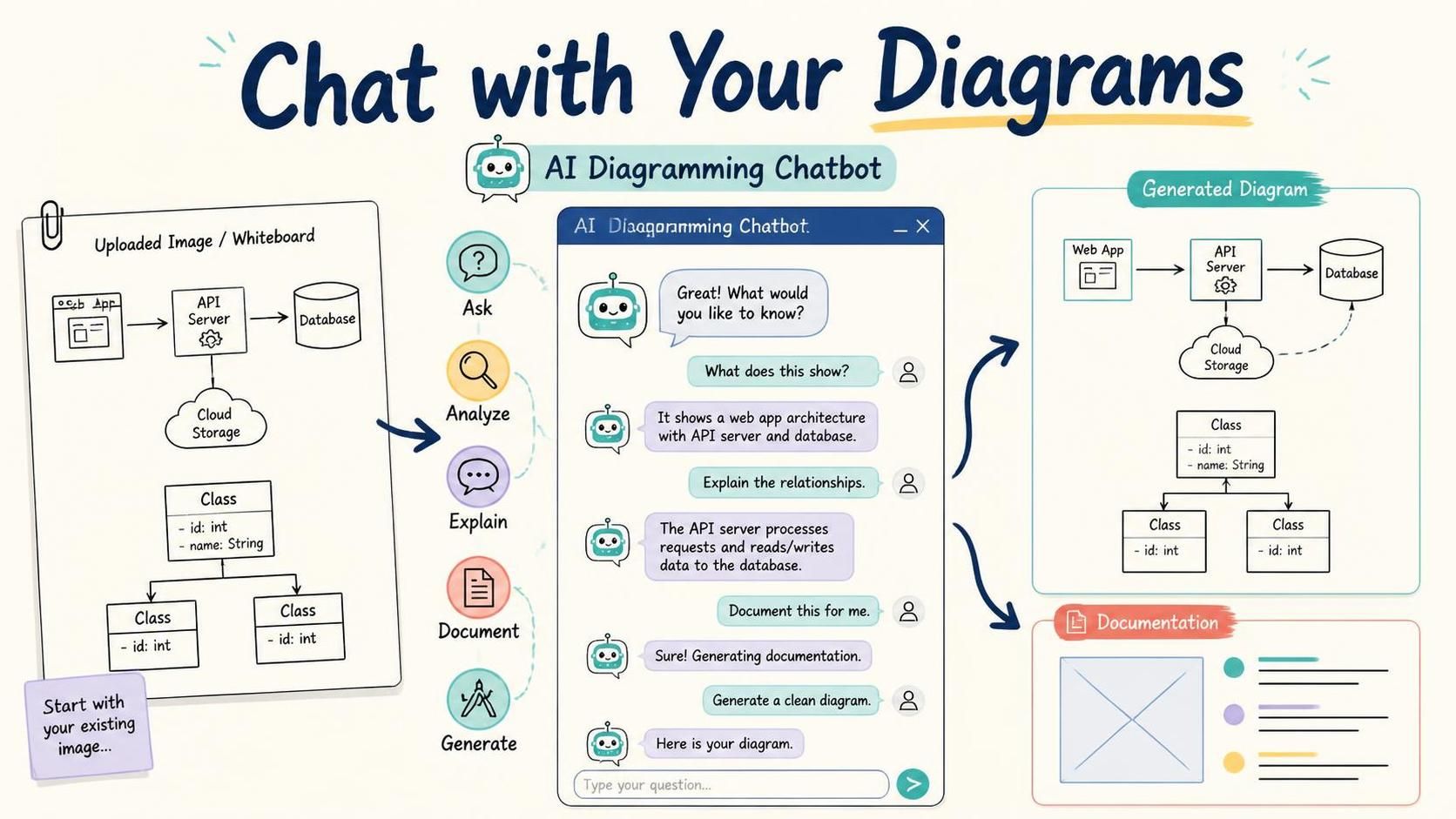
Text-to-Diagram: Describe your system or process in natural language. For example, prompt the AI Chatbot with: “Create a BPMN diagram for an e-commerce return process, including customer initiation, warehouse inspection, and refund processing.”
-
Image/Whiteboard Upload: Snap a photo of a whiteboard session or a napkin sketch. Upload it to the Chatbot and ask it to “Convert this sketch into a formal UML Sequence Diagram.”
-
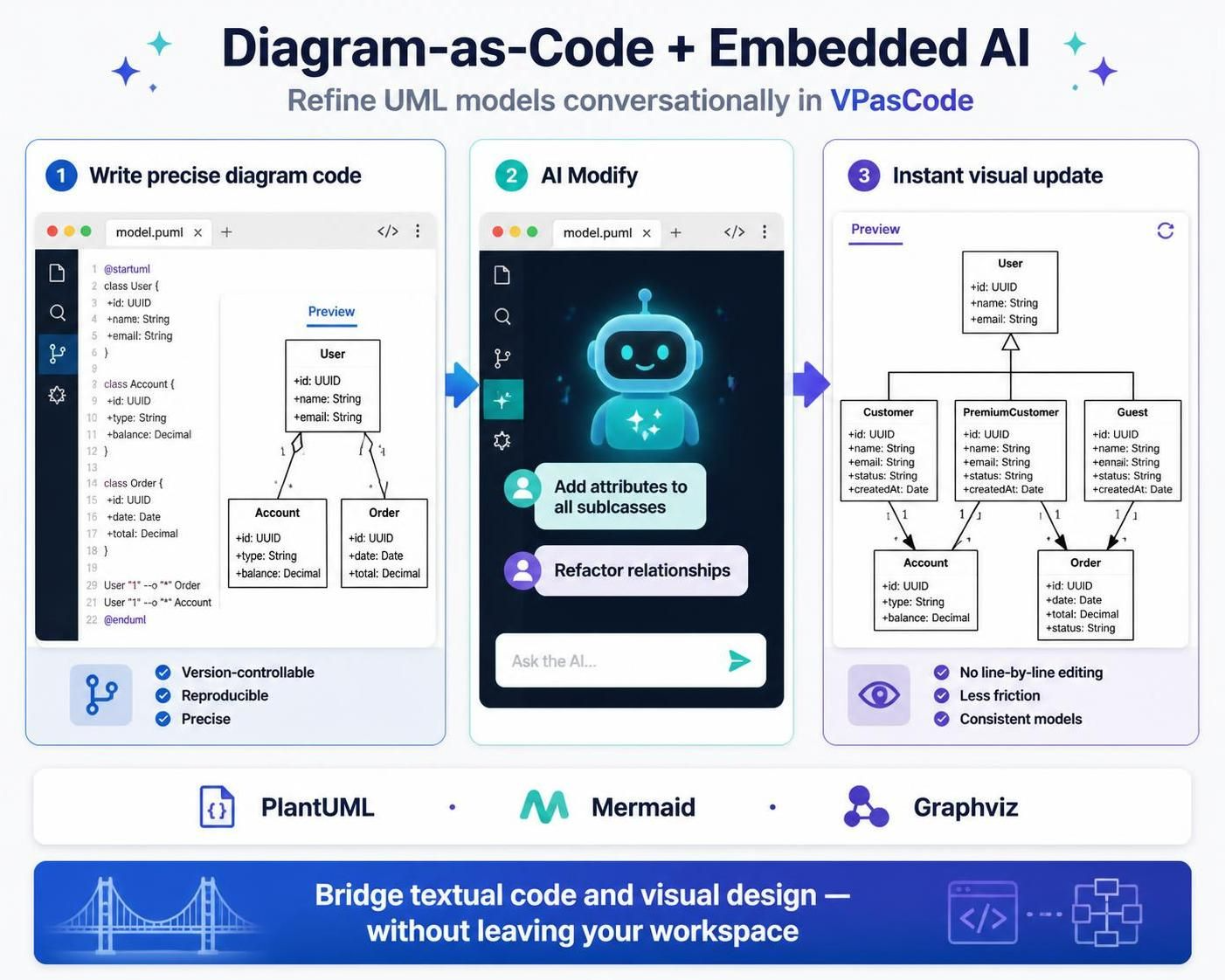
Conversational Refinement: Treat the AI as a collaborative partner. Iterate by saying, “Add a timeout exception if the payment gateway doesn’t respond within 5 seconds,” or “Split the ‘Order Processing’ step into two sub-processes.”
Example: A product manager sketches a user journey on a whiteboard during a brainstorming session. They upload the photo to the Visual Paradigm AI Chatbot, which instantly generates a clean Activity Diagram. The PM then refines it by asking the AI to add decision points for “Guest vs. Registered User.”
Phase 2: Precise Refinement & Styling (Web & Code Editors)
Once the AI provides a solid foundation, transition to detailed editing. Choose the tool that best fits your role and preference.
Option A: Drag-and-Drop (VP Online)
-
Click Edit in VP Online directly from the Chatbot viewer.
-
Use intuitive web-based tools to adjust layout, apply corporate theme styles, re-align swimlanes, or add missing elements.
-
Ideal for business analysts and stakeholders who prefer visual manipulation over code.
Option B: Diagram-as-Code (VPasCode)
-
Click Edit in VPasCode for technical diagrams (PlantUML, Mermaid, D2, Graphviz, C4).
-
Leverage AI Code Diagnostics to automatically fix syntax errors.
-
Use AI Diagram Translation to localize labels for global teams (e.g., translate English labels to Spanish or Japanese instantly).
Example: A software architect takes the AI-generated component diagram and opens it in VPasCode. They refine the Mermaid code to ensure proper nesting of microservices and use AI diagnostics to correct a missing bracket error. They then translate all labels into French for their Paris-based development team.
Phase 3: Enterprise Modeling & Engineering (VP Desktop)
For large-scale systems requiring strict governance, traceability, and compliance, move the model into Visual Paradigm Desktop.
How it Works:
-
Import via Pipeline: Sync the refined diagram from VP Online or VPasCode directly into your VP Desktop project. No manual export/import needed.
-
Establish Traceability: Link diagram elements to existing requirements, user stories, test cases, or data dictionary entries. This creates a single source of truth.
-
Model Validation: Run integrity checks to ensure compliance with standards like TOGAF, ArchiMate, or SysML. Perform matrix analysis or simulation to validate logic.
Example: An enterprise architect imports a high-level ArchiMate diagram created in Phase 2. In VP Desktop, they link each application component to specific business capabilities and regulatory requirements. They run a model validation check to ensure no orphaned elements exist and that all relationships comply with ArchiMate rules.
Phase 4: Publishing, Documenting & Sharing (OpenDocs Pipeline)
The final phase transforms static models into living, accessible documentation for stakeholders, developers, and executives.
How it Works:
-
Send to Pipeline: From any tool (Chatbot, VP Online, VPasCode, or Desktop), click Send to Pipeline and add a version comment (e.g., “Updated payment flow for Q3 release”).
-
Embed in OpenDocs: Open your project in OpenDocs, access the Pipeline side-panel, and drag the diagram directly onto your documentation page.
-
Publish & Share:
-
Interactive Links: Generate shareable URLs with pan, zoom, and fit-to-screen controls. Set passwords for sensitive content.
-
Bookshelves: Organize multiple pages into structured Bookshelves for easy navigation (e.g., “Onboarding Guide,” “API Reference”).
-
High-Res Exports: Export SVG or PDF assets for presentations or offline reports.
-
Example: A technical writer embeds the finalized sequence diagram into an OpenDocs page titled “Payment Processing API.” They publish the page to a public Bookshelf shared with external partners. Partners can interact with the diagram online, zooming into specific message flows, while the internal team retains the ability to update the source model, which automatically reflects in the published docs.
Conclusion
The Visual Paradigm AI Ecosystem redefines diagramming by removing the traditional barriers between ideation, refinement, engineering, and documentation. By leveraging the Visual Paradigm Pipeline, teams can maintain a continuous, synchronized flow of information from the first spark of an idea to its final publication in OpenDocs.
This end-to-end approach not only saves hours of manual work but also ensures accuracy, consistency, and collaboration across diverse roles—from product managers and architects to developers and stakeholders. Embrace this workflow to transform your diagrams from static artifacts into dynamic, living assets that drive better decision-making and faster delivery.