


Introduction
In the complex ecosystem of modern software development, the gap between business requirements and technical implementation often leads to miscommunication, scope creep, and costly rework. For e-commerce platforms, where transactional integrity and user experience are paramount, establishing a shared understanding of core domain concepts is critical. Unified Modeling Language (UML) class diagrams serve as this essential bridge, providing a visual “dictionary” that aligns business analysts, product managers, and software developers.
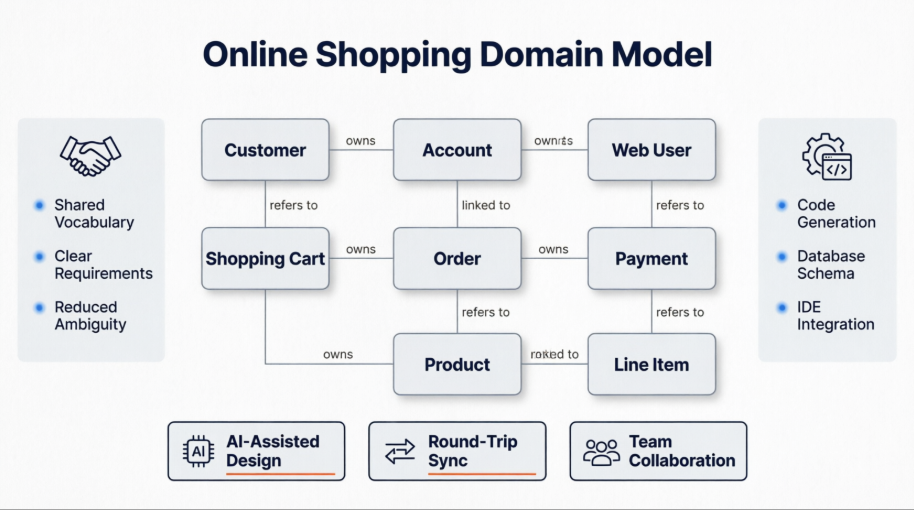
This case study explores the application of UML class diagrams in modeling an online shopping domain. By defining key entities such as Customers, Accounts, Orders, and Products, and mapping their relationships, organizations can create a robust foundation for system architecture. Furthermore, we examine how advanced tools like Visual Paradigm enhance this process through code engineering, AI-assisted design, and seamless collaboration, transforming static diagrams into dynamic assets that drive software execution.
The Online Shopping Domain Model
The primary purpose of a domain model in online shopping is to introduce common terms and define the relationships between them. This model acts as a common ground for stakeholders, ensuring that everyone from marketing teams to backend engineers speaks the same language.
Core Entities and Relationships
The domain model centers around several key classes:
-
Customer: Each customer has a unique ID and is linked to exactly one Account. It is important to note that a Customer is not required to be a Web User, as purchases can also be made via phone or catalogues.
-
Web User: A Customer may register as a Web User to buy items online. The Web User has a login name that serves as a unique ID. Web Users can exist in various states: new, active, temporarily blocked, or banned. They are linked to a Shopping Cart.
-
Account: The Account owns the Shopping Cart and all associated Orders. It serves as the central hub for a customer’s transactional history.
-
Shopping Cart: Belonging to an Account, the Shopping Cart holds items intended for purchase.
-
Order: Accounts own Customer Orders. A customer may have no orders, but when they do, these orders are sorted and unique. Each order has a current status.
-
Payment: Each Order can refer to several Payments, or possibly none. Every Payment has a unique ID and is related to exactly one Account.
-
Product: Represents the items available for sale. A Product can be associated with many Line Items or none at all.
-
Line Item: Both Orders and Shopping Carts contain Line Items. Each Line Item is linked to exactly one specific Product.
PlantUML Code:
@startuml
skinparam classAttributeIconSize 0

package "Online Shopping" {

enum UserState {
New
Active
Blocked
Banned
}

enum OrderStatus {
New
Hold
Shipped
Delivered
Closed
}

class WebUser {
+login_id: String {id}
+password: String
+state: UserState
}

class Customer {
+id: String {id}
+address: Address
+phone: Phone
+email: String
}

class Account {
+id: String {id}
+billing_address: Address
+is_closed: Boolean
+open: Date
+closed: Date
}

class ShoppingCart {
+created: Date
}

class Order {
+number: String {id}
+ordered: Date
+shipped: Date
+ship_to: Address
+status: OrderStatus
+total: Real
}

class Payment {
+id: String {id}
+paid: Date
+total: Real
+details: String
}

class LineItem {
+quantity: Integer
+price: Price
}

class Product {
+id: String {id}
+name: String
+supplier: Supplier
}

' Relationships
WebUser "1" -- "0..1" Customer
WebUser "1" -- "0..1" ShoppingCart

Customer *-- "1" Account
Account *-- "1" ShoppingCart
Account *-- "1" Order
Account *-- "0..*" Payment

Order "1" -- "1" Payment
Order *-- "*" LineItem : {ordered, unique}
ShoppingCart *-- "*" LineItem : {ordered, unique}

LineItem "*" -- "1" Product

}
@enduml
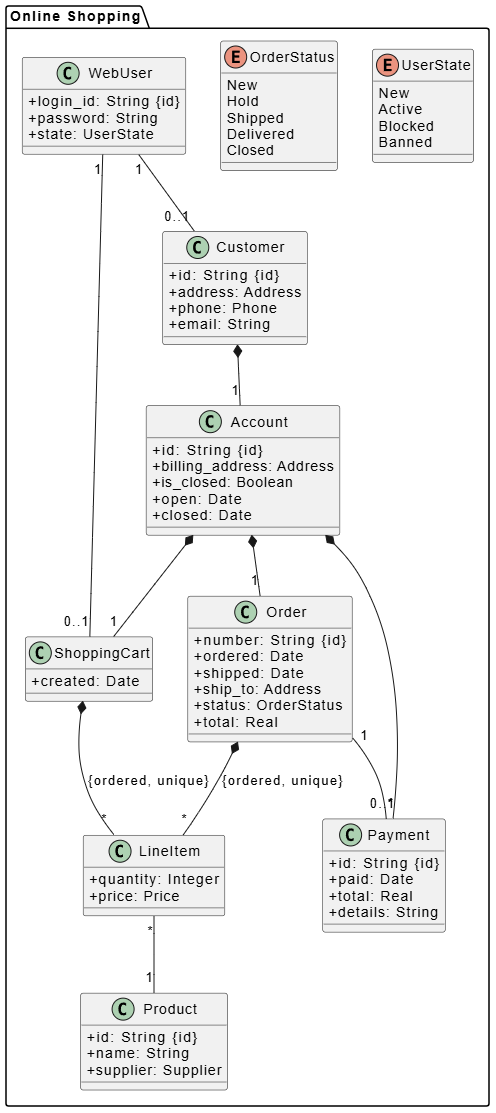
Figure 1: Online shopping domain UML class diagram example illustrating the relationships between Customer, Account, Order, and Product entities.
Advanced Notation and Relationship Modeling
To effectively capture the nuances of the online shopping domain, advanced UML notation is required. Tools like Visual Paradigm support full object-oriented syntax, allowing modelers to define granular class members including attributes, operations, visibilities (public +, private -, protected #, package ~), and specific data types.
Structural Mapping
The system provides a complete suite of relationship types essential for accurate domain modeling:
-
Associations and Association Classes: Used to link entities like Customers and Accounts, potentially adding attributes to the relationship itself.
-
Aggregations and Compositions: Critical for defining ownership. For instance, an Account composes its Orders, implying that if the Account is deleted, the Orders might also be removed or archived differently than standalone entities.
-
Generalizations (Inheritance): Useful for modeling hierarchies, such as different types of Users or Payment methods.
-
Dependencies: Highlighting where one class relies on another for functionality without direct ownership.
Specialized class types such as <<Interface>>, <<Enumeration>> (e.g., for Order Status or User State), <<Primitive>>, and ORM-Persistable objects allow for precise modeling that aligns with database schemas and code structures. Flexible presentation controls enable teams to toggle the visibility of parameters, initial values, and fully-qualified parent class naming packages, ensuring diagrams remain readable regardless of complexity.
From Diagram to Code: Engineering and Integration
A static diagram is useful for discussion, but a dynamic model drives development. Visual Paradigm features deep code engineering capabilities that serve as a robust bridge between high-level architectural design and software execution.
Round-Trip Code Synchronization
One of the most powerful features is round-trip code synchronization. This allows developers to automatically synchronize modifications on the visual canvas with code repositories in real-time or on-demand. Changes made in the diagram can generate stub code in Java, C++, or C#, while changes in the code can update the diagram, ensuring that documentation never falls out of sync with implementation.
IDE Integrations and ORM
The tool embeds natively as a full-featured visual analysis modeler inside major enterprise IDEs like Microsoft Visual Studio, Eclipse, and NetBeans. This integration ensures that modeling is part of the daily development workflow rather than a separate, isolated activity.
Additionally, Object-Relational Mapping (ORM) capabilities translate standard object-oriented class models directly into active database schemas across popular database servers. This vice-versa capability means that database changes can also reflect back into the class model, maintaining consistency between the logical design and the physical data store.
Legacy Migrations
For organizations modernizing older systems, the platform supports seamless imports of legacy class structures and properties from tools like Rational Rose, Together, and XMI projects. This ensures that historical data dependencies are preserved during migration efforts.
AI-Assisted Architecture Workflow
The integration of Artificial Intelligence into the modeling process accelerates design and improves quality.
-
10-Step AI Design Wizard: This feature builds functional system architectures dynamically from plain-text definitions. By using the AI-Assisted Class Diagram Generator, teams can rapidly prototype the online shopping domain by simply describing the entities and relationships in natural language.
-
Automated Design Critiques: An AI code architect tool reviews visually mapped data schemas to flag modeling errors and pinpoint maintainability issues. This acts as a continuous code review for the architectural layer, catching potential bottlenecks or normalization issues early.
-
Multi-Format Technical Exporting: Generated layouts can be seamlessly converted into interactive vector code formats such as PlantUML (.puml), structural SVG, or JSON states. This flexibility ensures that the models can be consumed by various downstream tools and documentation platforms.
Collaboration and Accessibility
Effective modeling requires collaboration across distributed teams. Visual Paradigm offers environments suited for various needs:
-
Visual Paradigm Desktop (Community Edition): Provides students and open-source developers with a completely free, award-winning modeling suite that covers all standard UML types.
-
VP Online Free Edition: A web-based cloud workspace optimized for fast cross-platform editing with no shape limits, no time caps, and zero advertisements. This is ideal for quick brainstorming sessions or remote team collaboration.
-
Teamwork Control: Supports distributed engineering groups via secure repository checkouts, conflict merging, and granular element-level commits. This ensures that multiple architects can work on the same domain model without overwriting each other’s work.
Conclusion
The online shopping domain model exemplifies how UML class diagrams can clarify complex business rules and technical requirements. By defining clear relationships between Customers, Accounts, Orders, and Products, organizations establish a shared vocabulary that reduces ambiguity and accelerates development.
However, the true value of these diagrams is realized when they are integrated into the software engineering lifecycle. Through advanced tools that offer code synchronization, IDE integration, and AI-assisted design, static models become living artifacts that guide implementation, ensure database consistency, and facilitate collaboration. Whether leveraging free community editions for learning or enterprise-grade features for large-scale migrations, adopting a robust UML modeling strategy is a critical step toward building resilient and scalable e-commerce platforms.
References
- UML Class Diagram Tutorial: A comprehensive guide to understanding and creating UML class diagrams.
- Step-by-Step Class Diagram Tutorial Using Visual Paradigm: Practical instructions for creating class diagrams using Visual Paradigm tools.
- What is Class Diagram?: An overview of class diagrams, their purpose, and key components in UML.
- OpenDocs AI Mind Map Integration Update: Information on recent updates regarding AI integration and mind mapping features.
- Practical Guide for Code Engineering: Insights into generating and synchronizing code from UML models.
- UML Class Diagram Tutorial: Detailed exploration of class diagram elements and best practices.
- Class Diagram Documentation: Official user guide documentation for class diagram features.
- What is Class Diagram?: Fundamental concepts of class diagrams and their role in software design.
- Visual Paradigm Gallery: A collection of examples and templates for various UML diagrams.
- Data Type Documentation: Guide to defining and using data types within class diagrams.
- Class Diagram Examples: Visual examples of class diagrams for different domains.
- UML Profile Diagram Guide: Explanation of profile diagrams and stereotypes in UML.
- Class Diagram Presentation Options: Tips for customizing the visual appearance of class diagrams.
- AI-Assisted UML Class Diagram Generator: Features and benefits of using AI to generate class diagrams.
- AI Tool for Class Diagram Generation: Direct access to the AI-powered diagram generation tool.
- Free Class Diagram Tool: Information about the free online tool for creating class diagrams.
- Basic Features User Guide: Overview of basic features available in Visual Paradigm.
This post is also available in Deutsch, Español, فارسی, Français, English, Bahasa Indonesia, 日本語, Polski, Portuguese, Ру́сский, Việt Nam, 简体中文 and 繁體中文.
Related posts:
 Visual Paradigm AI: Generate Professional UML Use Case Diagrams from Text in Seconds
 GourmetReserve Development Simplified: Transforming Requirements with the Best AI-Powered Use Case Modeling Studio
 The Best AI-Powered Database Modeling Tool for Designing Hospital Systems: Visual Paradigm Online
 Automating Student Record System Analysis: From Raw Text to Class Models with Visual Paradigm