


In the complex landscape of enterprise technology, clarity is often the most scarce resource. Organizations frequently face challenges where business strategy drifts from implementation reality. This gap creates friction, waste, and missed opportunities. To bridge this divide, a structured approach is necessary. ArchiMate provides that framework. It is not merely a diagramming tool but a language for describing, analyzing, and visualizing architecture across business and IT domains.
Solution design sits at the critical junction where requirements meet execution. Without a standardized notation, communication between architects, developers, and business stakeholders becomes fragmented. ArchiMate standardizes this communication. It allows teams to model the solution architecture in a way that is both technically precise and business-relevant. This guide explores how applying ArchiMate principles transforms the solution design process.
📚 Understanding the Architecture Framework
Before diving into the mechanics of solution design, it is essential to understand the foundation. ArchiMate is an open and independent modeling language. It is designed to support enterprise architecture by providing a structured view of the organization. Unlike programming languages, it does not execute code. Instead, it describes the static and dynamic aspects of an enterprise.
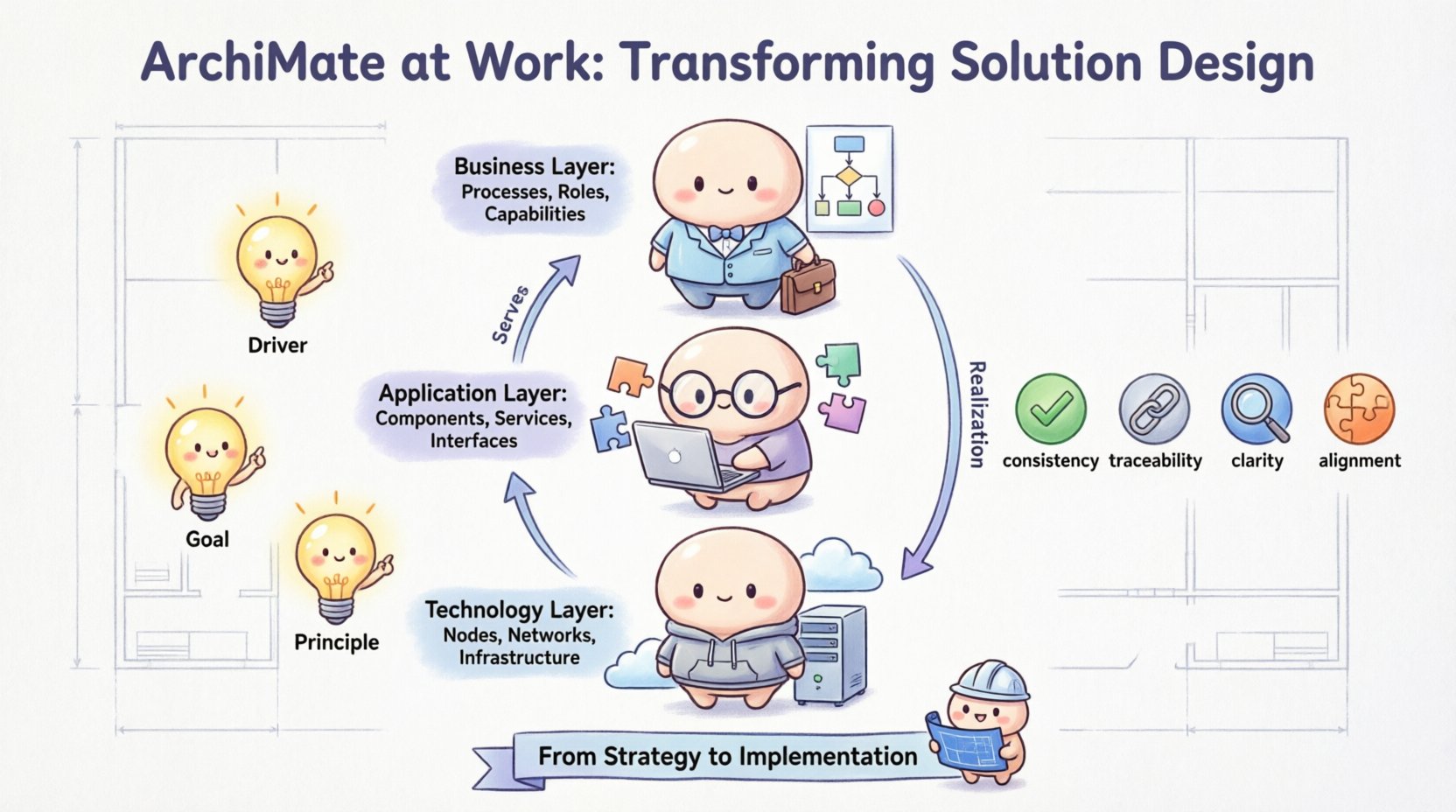
The framework is built on three core layers that align with typical organizational structures:
- Business Layer: Focuses on the organization itself. This includes business processes, roles, functions, and organizational units.
- Application Layer: Describes the software applications that support the business. It covers application components and services.
- Technology Layer: Represents the infrastructure. This includes hardware, networks, and system software.
Beyond these layers, the framework includes motivation elements. These elements explain why a change is happening. They include drivers, goals, and principles. Adding motivation to a solution design ensures that every technical decision can be traced back to a business need.
🔗 The Intersection of ArchiMate and Solution Design
Solution design is often treated as a purely technical exercise. Teams focus on components, interfaces, and deployment nodes. While important, this view often misses the broader context. ArchiMate introduces a holistic perspective. It forces designers to consider how a new application fits into the existing business landscape.
When architects use ArchiMate for solution design, they gain several distinct advantages:
- Consistency: A single notation ensures that all diagrams tell the same story.
- Traceability: Links can be drawn from high-level business goals down to specific technology nodes.
- Clarity: Complex relationships are visualized rather than described in dense text.
- Alignment: IT capabilities are directly mapped to business capabilities.
Consider a scenario where a company wants to launch a new digital service. A traditional approach might start with database schema design. An ArchiMate-driven approach starts with the business process that the service supports. It then identifies the application components required to execute that process, and finally, the technology infrastructure needed to host them.
📊 Core Layers in Solution Modeling
Effective solution design requires a clear understanding of how different architectural domains interact. The following table outlines the key concepts within each layer and their role in a solution design context.
| Layer | Key Concepts | Role in Solution Design |
|---|---|---|
| Business | Process, Role, Function, Capability | Defines what the solution must achieve for the organization. |
| Application | Component, Service, Interface, Data Object | Describes the software logic and data handling required. |
| Technology | Node, Device, System Software, Network | Specifies the physical or virtual environment for deployment. |
By separating these concerns, architects can focus on specific problems without getting overwhelmed by the entire system. However, the true power lies in the relationships between these layers. A process in the Business layer might be supported by a component in the Application layer, which runs on a node in the Technology layer.
🛠️ Practical Application in Design Cycles
Integrating ArchiMate into the design workflow requires more than just drawing diagrams. It involves a shift in how requirements are gathered and how decisions are validated. The process typically follows a logical flow from abstract to concrete.
1. Requirements and Capability Mapping
The design cycle begins with understanding the business capabilities required. Architects map these capabilities to specific business processes. This ensures that the solution is not just technically sound but also valuable. For example, if the goal is to improve customer onboarding, the model will highlight the “Onboarding Process” as a critical capability.
- Identify the business process to be supported.
- Define the actors and roles involved.
- Specify the inputs and outputs for the process.
2. Application Composition
Once the business requirements are clear, the design moves to the application layer. This involves selecting or building software components. ArchiMate helps visualize how these components interact. It defines interfaces that allow different parts of the system to communicate.
Key considerations include:
- Reusability: Can existing components be used instead of building new ones?
- Integration: How does the new solution connect with legacy systems?
- Data Flow: Where is data created, and where is it consumed?
3. Infrastructure Deployment
The final layer of design is the technology layer. This determines where the application will run. Whether it is on-premise servers, cloud instances, or containerized environments, the technology layer captures these constraints.
Architects use this layer to:
- Plan capacity and scaling requirements.
- Identify security boundaries and network zones.
- Define physical deployment nodes.
🎯 Integrating Motivation Elements
One of the most valuable features of ArchiMate is the motivation viewpoint. Often, technical teams build solutions without fully understanding the underlying drivers. This leads to solutions that are obsolete by the time they are deployed. Motivation elements provide the context.
The motivation layer includes:
- Driver: A factor that causes change. (e.g., Regulatory compliance).
- Goal: An objective to be achieved. (e.g., Reduce operational costs).
- Principle: A rule or guideline. (e.g., Cloud first strategy).
- Assessment: A measure of current status.
When designing a solution, every major component should be linked to a goal or driver. This creates an audit trail. If a stakeholder asks, “Why are we choosing this technology?”, the answer is found in the linked driver. This prevents scope creep and ensures that the solution remains aligned with strategic intent.
📈 Benefits for Stakeholders
Different stakeholders view the solution through different lenses. A unified model helps align these perspectives. ArchiMate supports various viewpoints tailored to specific audiences.
For Business Leaders
Executives are interested in capability and value. They need to know if the investment will deliver the promised business outcomes. A business-level view of the architecture highlights:
- Which business processes are being improved.
- Where capabilities are missing.
- How the solution supports strategic goals.
For Technical Teams
Developers and engineers need clarity on interfaces and dependencies. They require a detailed view of the application and technology layers. This helps them:
- Understand integration points.
- Identify potential bottlenecks.
- Plan migration paths for existing systems.
For Project Managers
Project managers need to track progress and dependencies. The architecture model acts as a baseline. It allows them to:
- Visualize the scope of the project.
- Identify critical path dependencies.
- Manage risks associated with technical debt.
⚠️ Common Pitfalls to Avoid
While ArchiMate is powerful, it is not a magic wand. Misapplication can lead to confusion rather than clarity. Here are common mistakes to watch out for during the design process.
- Over-Modeling: Trying to model every single detail in the first draft. Start with the big picture and refine over time.
- Ignoring Relationships: Drawing boxes without connecting them. The value of ArchiMate lies in the relationships, not just the objects.
- Layer Confusion: Placing business processes in the technology layer. Keep the layers distinct to maintain clarity.
- Lack of Motivation: Focusing only on structure without explaining why. Ensure drivers and goals are present.
- Static Views Only: Architecture is dynamic. Include behavior and process flows where necessary to show how the system works over time.
🔄 Managing Change and Migration
One of the most significant challenges in enterprise architecture is managing change. Solutions rarely exist in a vacuum. They evolve. ArchiMate excels at modeling transitions. It allows architects to define a current state and a target state.
Transition planning involves:
- Gap Analysis: Identifying what is missing between the current and target states.
- Migration Paths: Defining the steps to move from state A to state B.
- Impact Assessment: Determining what will break if a change is made.
By visualizing these transitions, organizations can plan rollout strategies that minimize disruption. This is particularly important for large-scale digital transformations where legacy systems must coexist with new solutions during the migration period.
🔍 Deep Dive: Relationships and Constraints
Understanding the relationships between elements is crucial. ArchiMate defines specific relationship types that add semantic meaning to the diagrams. These go beyond simple lines.
Association
An association represents a static link between two elements. It is the most basic form of connection. For example, a Role is associated with a Business Process.
Access
Access indicates that one element uses another to perform a function. An Application Component might access a Business Object. This is common in data flow scenarios.
Serves
The “serves” relationship shows that a layer supports the layer above it. A Service serves a Process. This is the primary link between the Application and Business layers.
Realization
Realization indicates that one element implements another. A Business Function might be realized by a Business Process. This is vital for understanding how abstract goals become concrete actions.
Assignment
Assignment shows which actor performs which function. A Role is assigned a Process. This helps in understanding responsibilities and resource allocation.
🚀 Future-Proofing Your Architecture
The technology landscape changes rapidly. Cloud computing, microservices, and artificial intelligence are reshaping how solutions are built. ArchiMate remains relevant because it is technology-agnostic. It describes the logical structure without locking you into specific vendors.
To future-proof your solution design:
- Abstraction: Keep the model at a level that is not tied to specific product versions.
- Modularity: Design components that can be swapped out as technology evolves.
- Documentation: Treat the model as living documentation that is updated with every release.
This approach ensures that the architecture remains a useful asset rather than an obsolete document. It allows teams to adapt quickly to new opportunities without rebuilding the entire foundation.
💡 Best Practices for Implementation
Adopting this framework is a journey. Success depends on discipline and consistency. The following practices help ensure a smooth implementation.
- Standardize Notation: Ensure everyone in the team uses the same symbols and meanings.
- Version Control: Treat architecture models like code. Track changes and maintain history.
- Collaborate: Use the models as a communication tool in workshops, not just a documentation artifact.
- Keep it Simple: A complex diagram confuses more than it clarifies. Simplify where possible.
- Link to Requirements: Always tie architectural decisions back to specific requirements or drivers.
By adhering to these practices, organizations can build a robust architectural foundation. This foundation supports innovation while maintaining stability. It turns architecture from a bureaucratic hurdle into a strategic enabler.
📝 Final Thoughts on Architecture Modeling
Solution design is a balancing act between innovation and stability. It requires a deep understanding of both business needs and technical constraints. ArchiMate provides the vocabulary to express this balance clearly. It transforms abstract concepts into concrete models that everyone can understand.
The journey from strategy to implementation is fraught with risks. Miscommunication is a major source of failure. By adopting a standardized modeling language, teams reduce these risks. They create a shared understanding of what the solution is, why it is needed, and how it will work.
As organizations continue to navigate digital transformation, the need for clear architectural guidance will only grow. Investing in this capability today pays dividends in reduced complexity and faster delivery tomorrow. The goal is not to create perfect diagrams, but to facilitate better decisions.
This post is also available in Deutsch, Español, فارسی, Français, English, Bahasa Indonesia, 日本語, Polski, Portuguese, Ру́сский, Việt Nam, 简体中文 and 繁體中文.