


Scrum is one of the most widely adopted Agile frameworks for managing complex product development. It empowers teams to deliver value incrementally, adapt quickly to change, and continuously improve. At its core, Scrum is built on a simple yet powerful structure known as the 3-3-5-5 framework — a mnemonic that encapsulates the 3 Roles, 3 Artifacts, 5 Events, and 5 Values that form the foundation of successful Scrum adoption.
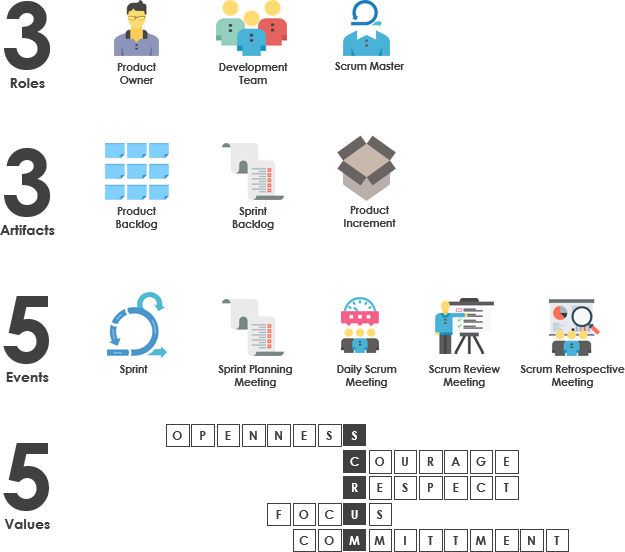
This comprehensive guide breaks down every component in detail, explains how they interrelate, and shows how tools like Visual Paradigm can help teams implement Scrum effectively and efficiently.
🧱 Part 1: The Pillars of Scrum – The 3-3-5-5 Structure
✅ 1. The 3 Roles: Who Does What?
Scrum operates with a small, self-organizing, cross-functional team of three key roles. Each role has a distinct responsibility and contributes uniquely to the success of the Sprint and the product.
1.1 Product Owner (PO) – The Visionary
“The voice of the customer and the business.”
-
Primary Responsibility: Maximize the value of the product resulting from the work of the Development Team.
-
Key Duties:
-
Maintain and prioritize the Product Backlog.
-
Clearly define and communicate user stories, acceptance criteria, and features.
-
Make decisions about scope, release timing, and feature trade-offs.
-
Collaborate with stakeholders to gather requirements and feedback.
-
-
Success Indicator: The product delivers meaningful value to users and stakeholders consistently.
💬 Pro Tip: A great Product Owner is not just a requirements gatherer — they are a strategic decision-maker who understands both business goals and user needs.
1.2 Development Team – The Builders
“The hands that turn ideas into working software.”
-
Primary Responsibility: Deliver a potentially releasable product Increment at the end of each Sprint.
-
Key Characteristics:
-
Self-organizing: They decide how to do the work.
-
Cross-functional: Includes all skills needed to deliver a complete product increment (e.g., developers, testers, UX designers).
-
Small: Typically 3–9 members.
-
-
Key Duties:
-
Estimate effort and complexity of backlog items.
-
Plan and execute work during the Sprint.
-
Collaborate daily through the Daily Scrum.
-
Ensure quality through testing and continuous integration.
-
-
Success Indicator: A high-quality, tested, and integrated Increment that meets the Definition of Done.
⚠️ Note: The Development Team is not a “group of developers.” It includes all professionals involved in building the product — including QA engineers, DevOps, designers, etc.
1.3 Scrum Master – The Coach & Facilitator
“The guardian of the process and the team’s ally.”
-
Primary Responsibility: Ensure Scrum is understood and enacted properly.
-
Key Duties:
-
Educate the team on Scrum principles and practices.
-
Remove impediments that hinder progress.
-
Facilitate Scrum events (Sprint Planning, Daily Scrum, Review, Retrospective).
-
Help the team improve by fostering transparency, inspection, and adaptation.
-
Protect the team from external distractions.
-
-
Success Indicator: A team that is self-organizing, collaborative, and continuously improving.
🛠️ Important: The Scrum Master is not a project manager or team leader. They are a servant-leader focused on process, not people management.
📦 2. The 3 Artifacts: What Do We Build?
Transparency, inspection, and adaptation are central to Scrum. These three artifacts ensure that everyone has visibility into the work and can inspect and adapt as needed.
2.1 Product Backlog – The Single Source of Truth
“Everything the product needs to be successful.”
-
A dynamic, prioritized list of all features, enhancements, bug fixes, and technical tasks.
-
Owned and managed by the Product Owner.
-
Items are called Product Backlog Items (PBIs) and include:
-
User stories
-
Epics
-
Features
-
Technical tasks
-
-
Key Principles:
-
Always ordered by priority (highest value first).
-
Continuously refined (Grooming).
-
Estimated in story points or time.
-
🔄 Example:
As a user, I want to reset my password so I don’t get locked out.
Priority: High | Effort: 5 story points
2.2 Sprint Backlog – The Plan for the Sprint
“What we commit to deliver this Sprint.”
-
A subset of the Product Backlog selected during Sprint Planning.
-
Includes:
-
Selected PBIs
-
A detailed plan for how the team will deliver them (task breakdown)
-
Definition of Done (DoD) for the Sprint
-
-
Managed by the Development Team — they decide how to break down work and assign tasks.
-
Updated daily during the Sprint as new insights emerge.
📌 Note: The Sprint Backlog is not a static document — it evolves as the team learns more about the work.
2.3 Product Increment – The Measurable Outcome
“The sum of all completed work, usable and potentially releasable.”
-
The sum of all completed Product Backlog items from the current Sprint and all previous Sprints.
-
Must meet the Definition of Done (DoD) — a shared understanding of what “done” means (e.g., code reviewed, tested, documented, deployed).
-
Must be in a usable state — even if not released.
✅ Example: After Sprint 3, the Increment includes:
Login functionality (Sprint 1)
Password reset (Sprint 2)
Two-factor authentication (Sprint 3)
🎯 Key Point: Every Sprint produces a usable product Increment — even if it’s not shipped to production.
🗓️ 3. The 5 Events: How We Work Together
Scrum events are time-boxed, regular ceremonies designed to create rhythm, transparency, and continuous improvement.
| Event | Duration | Frequency | Purpose |
|---|---|---|---|
| Sprint | 1–4 weeks | Once per Sprint | Time-boxed period to deliver a usable Increment |
| Sprint Planning | Max 4 hours (for 1-month Sprint) | At start of each Sprint | Decide what to build and how |
| Daily Scrum | 15 minutes | Daily | Synchronize work and plan next 24 hours |
| Sprint Review | Max 4 hours (for 1-month Sprint) | End of Sprint | Inspect the Increment and adapt the Product Backlog |
| Sprint Retrospective | Max 3 hours (for 1-month Sprint) | End of Sprint | Reflect on the Sprint and improve processes |
3.1 Sprint – The Heart of Scrum
-
A fixed-length time-box (typically 2–4 weeks).
-
Cannot be shortened or extended once started.
-
The entire team works together to deliver a potentially releasable product Increment.
-
The Sprint ends with the Sprint Review and Retrospective.
🔁 No changes to the Sprint Backlog during the Sprint unless the work is not progressing — only the Scrum Master and Product Owner can adjust scope under extreme circumstances.
3.2 Sprint Planning – The Launchpad
“What will we build? How will we build it?”
-
Time-boxed: Up to 4 hours for a 1-month Sprint (proportional for shorter Sprints).
-
Two Main Parts:
-
What can we deliver in this Sprint?
-
Review the Product Backlog.
-
Select items that can be completed within the Sprint.
-
Estimate effort and confirm feasibility.
-
-
How will we deliver it?
-
Break down selected items into tasks.
-
Create a task board or plan.
-
Define the Sprint Goal (a unifying objective).
-
-
🎯 Outcome: A clear Sprint Goal and a detailed Sprint Backlog.
3.3 Daily Scrum – The Daily Pulse
“What did I do yesterday? What will I do today? Any blockers?”
-
15-minute time-boxed meeting.
-
Held every day at the same time and place.
-
Only the Development Team attends (Scrum Master and PO may observe).
-
Focus: Synchronization and planning.
-
Format (commonly):
-
What did I do yesterday?
-
What will I do today?
-
Any impediments?
-
🚫 Not a status report — it’s a planning tool for the next 24 hours.
✅ Tip: Use a task board or Kanban board to visualize progress.
3.4 Sprint Review – The Inspection Point
“What did we build? What should we do next?”
-
Time-boxed: Up to 4 hours for a 1-month Sprint.
-
Hosted by the Product Owner, attended by the Scrum Team and stakeholders.
-
Purpose:
-
Demonstrate the completed Increment.
-
Gather feedback from stakeholders.
-
Adjust the Product Backlog based on feedback and changing priorities.
-
-
Outcome: Updated Product Backlog with new items, reprioritized items, or removed items.
🔄 This is where adaptation happens — based on real user feedback.
3.5 Sprint Retrospective – The Improvement Engine
“How can we improve?”
-
Time-boxed: Up to 3 hours for a 1-month Sprint.
-
Led by the Scrum Master, but all team members participate.
-
Focus: Process improvement.
-
Common Activities:
-
What went well?
-
What didn’t go well?
-
What can we improve in the next Sprint?
-
🛠️ Action Items: Create a concrete plan for improvement — e.g., “Improve test coverage to 80%,” “Hold a 5-minute pre-planning sync.”
📈 Result: Continuous process improvement across Sprints.
🌟 4. The 5 Values: The Culture of Scrum
Scrum is not just a process — it’s a culture. These five values define how team members interact and work together.
| Value | Definition | How It Shows Up |
|---|---|---|
| Commitment | Dedication to achieving the Sprint Goal and team objectives. | Team members show up ready to do their best, even under pressure. |
| Courage | Willingness to do the right thing, even when it’s hard. | Speaking up about risks, asking for help, challenging assumptions. |
| Focus | Concentrating on the work at hand and staying aligned with the Sprint Goal. | Avoiding multitasking; saying “no” to distractions. |
| Openness | Transparency about work, challenges, and progress. | Sharing impediments honestly; admitting mistakes. |
| Respect | Trusting team members as capable, independent individuals. | Valuing diverse perspectives; supporting each other. |
💬 “Scrum is not a process to be followed — it’s a framework to be lived.”
— Ken Schwaber, co-creator of Scrum
🛠️ How Visual Paradigm Enhances Scrum: The Digital Advantage
While Scrum is simple in theory, implementing it effectively at scale can be challenging. Visual Paradigm offers a powerful, intuitive platform that turns the 3-3-5-5 framework into a real-time, collaborative workflow.
✅ Why Use Visual Paradigm for Scrum?
🏗️ 1. Centralized Scrum Process Canvas
-
A single, visual workspace for all Scrum artifacts and events.
-
Real-time updates across team members — no more outdated spreadsheets or fragmented documents.
-
Drag-and-drop interface for managing PBIs, tasks, and sprints.
📊 2. Automated Artifact Management
-
Product Backlog & Sprint Backlog are managed digitally.
-
Automatically calculate:
-
Velocity
-
Burndown Charts
-
Remaining Effort
-
-
Export reports (PDF, Word, Excel) with one click.
📅 3. Guided Workflow for Scrum Events
-
Built-in templates for:
-
Sprint Planning
-
Daily Scrum
-
Sprint Review
-
Retrospective
-
-
Step-by-step walkthroughs ensure no event is skipped.
-
Pre-filled agendas and discussion prompts.
👥 4. Role-Based Access & Collaboration
-
Assign roles (PO, Scrum Master, Team Member) with permissions.
-
Assign tasks, set due dates, and track progress.
-
Comment threads on backlog items for transparent discussions.
🔄 5. Continuous Integration with Other Tools
-
Integrates with Jira, GitHub, GitLab, Confluence, and more.
-
Syncs backlog items and tracks status across platforms.
✅ Result: Teams spend less time on administration and more time delivering value.
📌 Putting It All Together: A Sample Sprint Workflow
Let’s walk through a real-world example using a mobile app development team.
🎯 Sprint Goal: “Launch the new login flow with biometric authentication.”
| Step | Action | Tool Support |
|---|---|---|
| 1. Sprint Planning | Select 5 PBIs: Login UI, Biometric Auth, Password Reset, Error Handling, Testing | Visual Paradigm Sprint Backlog |
| 2. Daily Scrum | Daily sync: “I finished the UI. Tomorrow I’ll start testing.” | Task board + chat |
| 3. Sprint Review | Demo: “We’ve added fingerprint login. Users can now log in faster.” | Feedback captured in Product Backlog |
| 4. Retrospective | “We need better test coverage.” → Add task: “Improve unit tests.” | Action items tracked in next Sprint |
🔄 This cycle repeats every Sprint — delivering value, learning, and improving.
🧩 Tips for Success: Best Practices
-
Keep Sprints Consistent – Stick to the same length (e.g., 2 weeks) for predictability.
-
Prioritize the Product Backlog – The PO should refine it regularly.
-
Define the Definition of Done – A shared agreement that a product increment is complete and release-ready
-
rigorously — it must be clear, measurable, and consistently applied across all Sprints.
-
Empower the Development Team – Avoid micromanagement. Trust them to self-organize and solve problems.
-
Protect the Sprint – No changes to the Sprint Backlog during the Sprint unless absolutely necessary (e.g., critical bugs).
-
Foster Psychological Safety – Encourage open communication, especially in Retrospectives. Team members should feel safe to admit mistakes and suggest improvements.
-
Use Visual Tools – Kanban boards, burndown charts, and task trackers help maintain transparency and visibility.
-
Rotate Roles (Optional) – For innovation and skill development, consider rotating the Scrum Master or Product Owner role in smaller teams.
-
Start Small, Scale Gradually – Begin with one team, refine the process, then expand to multiple teams using Scrum of Scrums.
-
Measure and Improve – Track metrics like:
-
Sprint velocity
-
Cycle time
-
Burndown rate
-
Team satisfaction (via surveys)
Use these insights to refine the process continuously.
-
📚 Frequently Asked Questions (FAQ)
❓ What’s the difference between Scrum and Agile?
-
Agile is a mindset or philosophy (e.g., iterative, customer-focused, adaptive).
-
Scrum is a specific Agile framework that provides structure, roles, events, and artifacts.
✅ Think of Agile as the “why,” and Scrum as the “how.”
❓ Can Scrum be used outside software development?
Absolutely! Scrum is used in:
-
Marketing campaigns
-
Product design
-
HR onboarding
-
Research and development
-
Education (e.g., curriculum planning)
🎯 Any team working on complex, changing work can benefit from Scrum.
❓ How long should a Sprint be?
-
Typical range: 1–4 weeks.
-
Most common: 2 weeks.
-
Longer Sprints (3–4 weeks): For large, complex projects or regulated industries.
-
Shorter Sprints (1 week): For fast feedback or highly volatile environments.
✅ Rule of thumb: Choose a Sprint length that allows the team to deliver a usable Increment and still have time for review and reflection.
❓ What if the Product Backlog is too big?
-
Refine it regularly (Product Backlog Grooming).
-
Break large items into smaller, testable tasks.
-
Use epics → features → user stories to structure work.
-
Prioritize ruthlessly: Focus only on what delivers value now.
❓ Who owns the Sprint Backlog?
-
The Development Team owns the Sprint Backlog.
-
The Scrum Master and Product Owner support and facilitate, but do not dictate the plan.
🏁 Final Thoughts: Scrum Is a Journey, Not a Destination
The 3-3-5-5 framework is not a rigid checklist — it’s a living, breathing system that evolves with your team. Success in Scrum comes not from following rules perfectly, but from embracing the values, fostering collaboration, and committing to continuous improvement.
🌱 Remember:
Transparency allows trust.
Inspection reveals opportunities.
Adaptation drives progress.
When teams live the 5 values — Commitment, Courage, Focus, Openness, and Respect — they don’t just deliver software. They deliver value, innovation, and trust.
✅ You’re not just following Scrum. You’re living it.
🔄 Inspect. Adapt. Deliver. Repeat.
🌟 That’s the power of Scrum.
📌Resources:
- What Is Scrum? A Complete Guide to Agile Project Management: This in-depth overview explains the core principles, roles, and processes that define the Scrum framework in agile software development.
- Agile Methodology Tutorial: Principles and Practices Explained: A comprehensive tutorial detailing fundamental Agile principles, various frameworks, and their real-world applications in software development.
- Sprint Guide in the Agile Handbook: This resource provides a thorough overview of sprints, explaining their purpose, structure, and essential role in iterative software development.
- How to Start a Sprint Using the Scrum Process Canvas: This article offers step-by-step guidance on initiating a sprint using the Scrum Process Canvas, with an emphasis on planning and team alignment.
- Sprint Planning in Agile: Step-by-Step Guide: A detailed and actionable guide to effective sprint planning, covering backlog prioritization, task breakdown, and alignment within Agile environments.
- The Scrum Sprint Cycle in 8 Clear Steps: This article provides a detailed breakdown of the Scrum sprint cycle, illustrating how teams deliver value through iterative, time-boxed increments.
- Unleash the Power of Agile and Scrum with Visual Paradigm: A comprehensive guide demonstrating how specialized tools can enhance Agile and Scrum practices to improve project planning, collaboration, and delivery.
- What Is a User Story? A Complete Guide to Agile Requirements: This guide explains the concept of user stories and their critical role in capturing user needs within the product backlog for Scrum teams.
- Scrum Process Canvas – Agile Project Management Framework: This resource highlights a structured canvas designed for managing Agile projects, supporting activities like sprint planning, backlog refinement, and team alignment.
- Scrum vs Waterfall vs Agile vs Lean vs Kanban: This article provides a comparative analysis of the most commonly used methodologies, including Scrum, Kanban, and traditional Waterfall models.
You’ve just completed the ultimate guide to Scrum — the 3-3-5-5 framework.
Now go deliver value, one Sprint at a time. 🚀
This post is also available in Deutsch, Español, فارسی, Français, English, Bahasa Indonesia, 日本語, Polski, Portuguese, Ру́сский, Việt Nam, 简体中文 and 繁體中文.