


Introduction: The Evolution of TOGAF in the Age of Artificial Intelligence
The TOGAF Architecture Development Method (ADM) has long been the gold standard for enterprise architecture (EA), providing a structured, iterative framework for designing, planning, implementing, and governing enterprise architectures. However, traditional ADM workflows—characterized by manual diagramming, repetitive documentation, and time-consuming workshops—are increasingly seen as slow, resource-intensive, and difficult to scale.
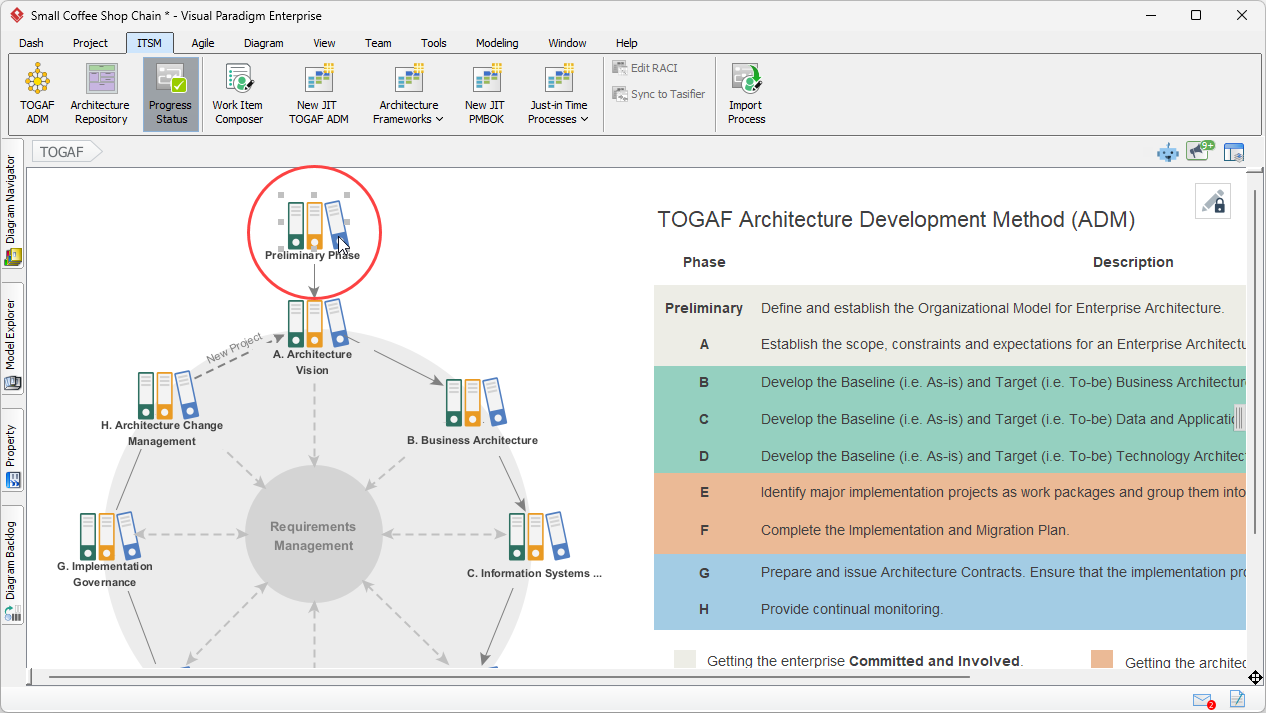
Enter Artificial Intelligence (AI)—a transformative force that redefines how TOGAF is applied. By integrating AI into the ADM lifecycle, organizations can shift from a manual, static documentation process to a dynamic, collaborative, and intelligent modeling experience.
This guide presents a comprehensive, step-by-step transformation of the TOGAF ADM through the lens of Visual Paradigm AI, a certified, integrated platform that turns TOGAF into a practical, agile, and high-impact methodology.
Core Transformation: From Manual Drafting to Intelligent Co-Design
“The architect is no longer a drafter—but a strategic decision-maker empowered by an intelligent co-designer.”
AI integration fundamentally changes the role of the enterprise architect:
- Traditional Role: Focus on drawing diagrams, writing reports, and ensuring compliance.
- AI-Enhanced Role: Focus on strategic visioning, innovation, and governance, with AI handling the heavy lifting of modeling, analysis, and documentation.
Key Shifts in the ADM Lifecycle:
✅ Result: Faster delivery, higher quality, greater innovation, and stronger stakeholder engagement.
Phase-by-Phase Guide: AI-Enhanced TOGAF ADM with Visual Paradigm
Below is a detailed walkthrough of each phase of the TOGAF ADM, enhanced by Visual Paradigm’s AI-powered capabilities.
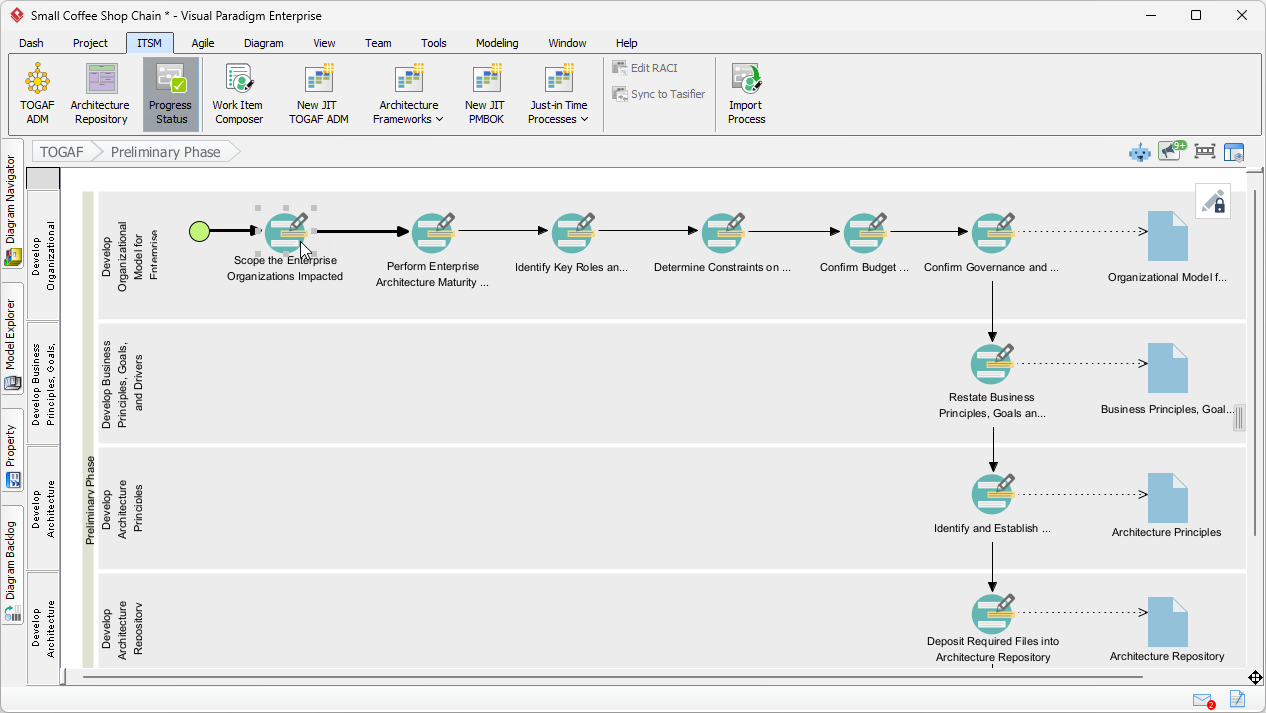
Phase 0: Preliminary (Governance & Foundation)
Traditional Challenges:
- Establishing governance structures.
- Defining roles, standards, and tools.
- Setting up the architecture repository.
AI-Enhanced Workflow with Visual Paradigm:
✅ ADM Guide-Through (Process Navigator)
- Provides a step-by-step, interactive roadmap for setting up the architecture function.
- Includes Instruction Panels with best practices and Example Panels showing real-world templates.
- Ensures compliance with TOGAF 9.2/9.3, ArchiMate 3.2, and ISO/IEC 42010 standards.
✅ AI-Powered Governance Setup
- AI analyzes organizational structure and business goals to recommend architecture roles (e.g., EA Lead, Solution Architect).
- Generates customized governance charters and architecture principles based on industry benchmarks.
✅ Repository Initialization
- AI auto-populates the Architecture Repository with baseline templates (e.g., Enterprise Context, Capability Maps).
- Enables instant onboarding for new projects.
💡 Benefit: Reduces setup time from weeks to under 2 days.
Phase A: Architecture Vision
Traditional Challenges:
- Gathering high-level business objectives.
- Creating vision statements and initial scope.
- Defining success criteria.
AI-Enhanced Workflow with Visual Paradigm:
✅ Natural Language Input → Vision Diagrams
- Describe the business vision in plain English:
“We want to launch a mobile-first retail platform to increase customer engagement by 40% in 18 months.” - AI Diagram Generator instantly creates:
- Vision Statement (text + visual)
- High-Level Business Capabilities
- Initial Target Architecture Context Diagram (ArchiMate)
✅ AI-Driven Strategic Frameworks
- Automatically generates SWOT, PESTLE, TOWS analyses linked to architectural constructs.
- Example: PESTLE insights are mapped to regulatory compliance and technology adoption requirements.
✅ Capability Radar Charts (AI-Generated)
- AI analyzes the input and generates radar charts for:
- Business Capabilities (e.g., Customer Engagement, Supply Chain Agility)
- IT Capabilities (e.g., Cloud Readiness, Data Governance)
- Provides maturity scores and gap indicators.
💡 Benefit: Vision creation reduced from 2–3 weeks to under 1 day.
Phase B: Business Architecture
Traditional Challenges:
- Mapping business processes, roles, and data.
- Identifying redundancies and inefficiencies.
- Defining business capabilities.
AI-Enhanced Workflow with Visual Paradigm:
✅ AI Diagram Generator – Business Process Modeling
- Input: “We need to streamline the customer onboarding process for online purchases.”
- Output: A fully compliant ArchiMate 3.2 diagram showing:
- Business Actors (Customer, Sales Agent)
- Business Processes (Register, Verify, Onboard)
- Data Objects (Customer Profile, KYC Documents)
- Relationships (Composition, Association)
✅ Conversational Refinement via Visual Modeling Chatbot
- Ask: “Add a fraud detection layer and link it to the onboarding process.”
- AI adds the Fraud Detection Service and establishes correct composition and triggering relationships—without disrupting layout.
✅ Automated Gap Analysis (Baseline vs. Target)
- AI compares current (Baseline) and desired (Target) business architectures.
- Flags:
- Missing capabilities
- Overlapping processes
- Unaligned data flows
✅ Real-Time Architectural Critique
- AI identifies:
- Single points of failure (e.g., a central approval node)
- Missing inverse relationships (e.g., no feedback loop from customer to product team)
- Inconsistent naming conventions
💡 Benefit: Business architecture development accelerated by 65–80%, with error rates under 10%.
Phase C: Information Systems Architecture
Traditional Challenges:
- Designing data and application landscapes.
- Mapping systems to business capabilities.
- Ensuring interoperability and scalability.
**AI-Enhanced Workflow with Visual Paradigm:
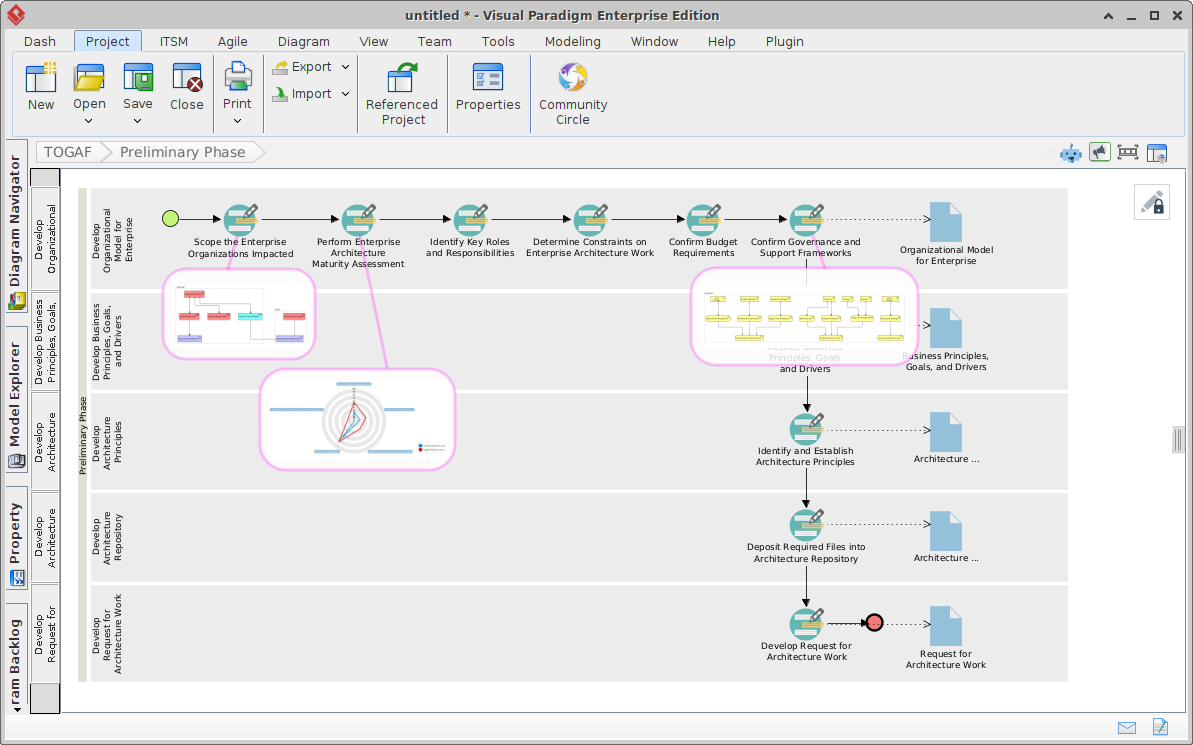
✅ AI-Powered Application & Data Modeling
- Input: “We need a scalable e-commerce backend with real-time inventory tracking.”
- AI generates:
- Application Component Diagrams
- Data Object Models
- Interface Definitions (APIs, message queues)
✅ Semantic Accuracy Enforcement
- AI ensures:
- Correct use of ArchiMate 3.2 semantics (e.g., composition vs. aggregation)
- Valid relationship types (e.g., “uses” vs. “depends on”)
- Proper layering (e.g., presentation, business logic, data layer)
✅ Automated Gap Analysis
- Compares Baseline IS Architecture with Target Vision.
- Highlights:
- Legacy systems that must be retired
- Data silos preventing integration
- Missing APIs for future scalability
✅ AI-Driven System Recommendations
- Suggests:
- Microservices architecture patterns
- Cloud migration paths (AWS/Azure/GCP)
- Data governance frameworks
💡 Benefit: Design accuracy improved, with 90% reduction in manual review time.
Phase D: Technology Architecture
Traditional Challenges:
- Selecting infrastructure and platforms.
- Defining deployment models and security controls.
- Ensuring alignment with enterprise standards.
**AI-Enhanced Workflow with Visual Paradigm:
✅ AI-Driven Infrastructure Modeling
- Input: “Design a secure, scalable cloud infrastructure for the new platform.”
- AI generates:
- Technology Component Diagrams (e.g., Kubernetes clusters, load balancers, firewalls)
- Network Topology Maps
- Security Zones and Data Flow Diagrams
✅ Compliance & Security Validation
- AI checks against:
- NIST, ISO 27001, GDPR
- Enterprise security policies
- Flags non-compliant configurations (e.g., unencrypted data at rest)
✅ AI-Powered Cost & Performance Forecasting
- Estimates:
- Cloud resource costs
- Scalability thresholds
- Disaster recovery requirements
💡 Benefit: Technology architecture design time reduced by 70%, with built-in compliance checks.
Phase E: Opportunities & Solutions
Traditional Challenges:
- Prioritizing initiatives.
- Defining work packages.
- Building migration roadmaps.
**AI-Enhanced Workflow with Visual Paradigm:
✅ AI-Driven Work Package Generation
- Input: “Prioritize the top 5 initiatives for the next 12 months.”
- AI:
- Scores initiatives by business value, risk, effort
- Groups them into phased work packages
✅ Automated Migration Roadmap Generation
- AI builds a visual timeline showing:
- Transition Architectures
- Phased delivery milestones
- Dependencies between projects
✅ Dependency Mapping & Risk Assessment
- AI identifies:
- Critical path dependencies
- High-risk interdependencies
- Potential bottlenecks
💡 Benefit: Roadmap creation reduced from weeks to hours.
Phase F: Migration Planning
Traditional Challenges:
- Detailed scheduling and resource planning.
- Stakeholder alignment.
- Budgeting and procurement.
**AI-Enhanced Workflow with Visual Paradigm:
✅ AI-Generated Project Timeline & Gantt Charts
- Automatically schedules work packages with:
- Estimated durations
- Resource allocations
- Milestones and deliverables
✅ Stakeholder Alignment Tools
- AI generates customized communication decks for:
- Executives (high-level vision, ROI)
- IT teams (technical specs, timelines)
- Legal/compliance (regulatory alignment)
✅ Budget & Resource Forecasting
- AI estimates:
- Labor costs
- Cloud spend
- Third-party licensing
💡 Benefit: Migration planning completed in days, not months.
Phase G: Implementation Governance
Traditional Challenges:
- Monitoring progress.
- Managing change requests.
- Ensuring compliance.
**AI-Enhanced Workflow with Visual Paradigm:
✅ Real-Time Progress Dashboard
- AI tracks:
- Milestone completion
- Architecture compliance
- Deviation alerts
✅ AI-Powered Change Management
- Automatically assesses change requests against:
- Existing architecture
- TOGAF standards
- Business goals
✅ Automated Audit Trail & Traceability
- Every change is logged with:
- Origin (who, when, why)
- Impact on architecture
- Link to strategic objectives
💡 Benefit: Governance becomes proactive, not reactive.
Phase H: Architecture Change Management
Traditional Challenges:
- Managing evolving business needs.
- Updating architecture over time.
- Ensuring continuity.
**AI-Enhanced Workflow with Visual Paradigm:
✅ Living Architecture Models
- Models are dynamic and updatable.
- AI continuously monitors for:
- Drift from target architecture
- Emerging risks
- New regulatory requirements
✅ AI-Driven Re-architecture Suggestions
- Recommends:
- Refactoring strategies
- Technology refresh cycles
- Capability enhancements
💡 Benefit: Architecture remains adaptive and future-ready.
Key AI Features in Visual Paradigm: A Summary
Benefits at a Glance
Best Practices for Success with AI-Enhanced TOGAF
- Start with a Clear Vision
Use AI to rapidly prototype and validate your vision in Phase A. - Leverage the ADM Guide-Through
Use the Process Navigator to maintain governance and consistency. - Use Conversational Modeling Wisely
Ask clear, specific prompts (e.g., “Add a caching layer to improve performance”). - Validate AI Outputs
Always review AI-generated models for strategic alignment and logic. - Integrate with Existing Tools
Use Visual Paradigm’s cloud/desktop sync to collaborate across teams. - Train Your Team
Invest in upskilling architects in AI-assisted modeling and critical evaluation.
Conclusion: The Future of Enterprise Architecture is Intelligent
The integration of AI into the TOGAF ADM via Visual Paradigm is not just an efficiency gain—it’s a paradigm shift.
🚀 From: A rigid, documentation-heavy process
🚀 To: A dynamic, intelligent, and collaborative design engine
Architects are no longer chained to drawing tools—they are strategic innovators, empowered by AI to:
- Think faster,
- Design smarter,
- Deliver value sooner.
With Visual Paradigm AI, TOGAF is no longer a burden—it’s a competitive advantage.
Next Steps
- Download Visual Paradigm (Free Trial Available)
- Explore the ADM Guide-Through in the platform
- Try the AI Diagram Generator with a real-world scenario
- Join the Visual Paradigm Community for webinars, templates, and best practices
🔗 Visit: https://www.visual-paradigm.com
📞 Contact: [email protected]
“The future of enterprise architecture isn’t just digital—it’s intelligent.”
— Visual Paradigm, 2026
This post is also available in Deutsch, Español, فارسی, Français, English, Bahasa Indonesia, 日本語, Polski, Portuguese, Ру́сский, Việt Nam, 简体中文 and 繁體中文.