


Creating a safe, reliable, and fault-tolerant railway signaling system demands more than technical expertise—it requires a deep understanding of safety-critical design principles, timing constraints, and fail-safe logic. The challenge lies in translating abstract safety requirements into a structured, verifiable, and traceable model.

In the era of modern systems engineering, the Visual Paradigm AI Chatbot steps in not merely as a passive drawing tool, but as an intelligent modeling collaborator. This guide explores how to leverage AI to move from abstract concepts to rigorous SysML requirement diagrams, ensuring compliance with international safety standards.
Key Concepts
Before diving into the design process, it is essential to understand the foundational concepts that drive safety-critical modeling in SysML.
- SysML Requirement Diagram: A modeling standard used to specify system requirements, showing the dependencies between text-based requirements and other model elements.
- Fail-Safe: A design feature that ensures the system defaults to a safe state (e.g., “STOP”) in the event of a specific failure, preventing harm.
- Fault Tolerance: The ability of a system to continue operating without interruption when one or more of its components fail.
- Traceability: The ability to link requirements to test cases ($verify), derived requirements ($deriveReqt), and implementation logic ($trace), ensuring every design choice is justified and testable.
- Containment: A hierarchical relationship where one requirement is composed of or “contains” sub-requirements, helping to organize complex systems.
From Concept to Requirement Diagram: A Conversational Design Journey
The traditional approach to systems engineering often involves hours of manual drafting. With AI, the process transforms into a conversational journey. In this blueprint, the design process began with a single, clear prompt: “Create a SysML requirement diagram for a railway signaling system focusing on safety, timing, and fault tolerance.”
The AI Chatbot immediately interpreted the intent, generating a fully structured SysML requirement diagram using PlantUML syntax. However, the true power of this approach lies in the iterative refinement.
The Power of “Why” and “How”
When asked, “Can you explain how the fail-safe default state is implemented in the signaling system during a power loss?”, the AI provided a technically grounded explanation covering:
- Hardware-level power monitoring.
- Software-based fail-safe logic and state transitions.
- Integration with redundant power supplies.
- Alignment with standards like EN 50126 and IEC 61508.
This dialogue did not just produce text; it refined the diagram itself, adding traceability links and containment relationships to reflect the explained behaviors.
Guidelines for AI-Assisted Safety Modeling
To replicate this success in your own projects, follow these best practice guidelines when interacting with the Visual Paradigm AI Chatbot:
- Start with a Specific Scope: Define your domain (e.g., Railway Signaling) and key constraints (Safety, Timing, Fault Tolerance) in your initial prompt.
- Iterate for Depth: Don’t accept the first draft as final. Ask follow-up questions about specific mechanisms (e.g., “How does the system handle power loss?”) to deepen the model’s logic.
- Enforce Traceability: Explicitly request the AI to link requirements to test cases or use cases. This ensures that every requirement is verifiable.
- Verify Hierarchies: Use the AI to organize requirements into clusters (e.g., Signal Integrity, Maintenance) to maintain a clean architecture.
- Validate Against Standards: Ask the AI how specific requirements align with industry standards (like IEC 61508) to ensure compliance is baked into the design.
Examples: Decoding the Signaling Logic
The resulting SysML diagram serves as a living model of system safety. Below are examples of how specific requirements were defined, structured, and linked within the model.
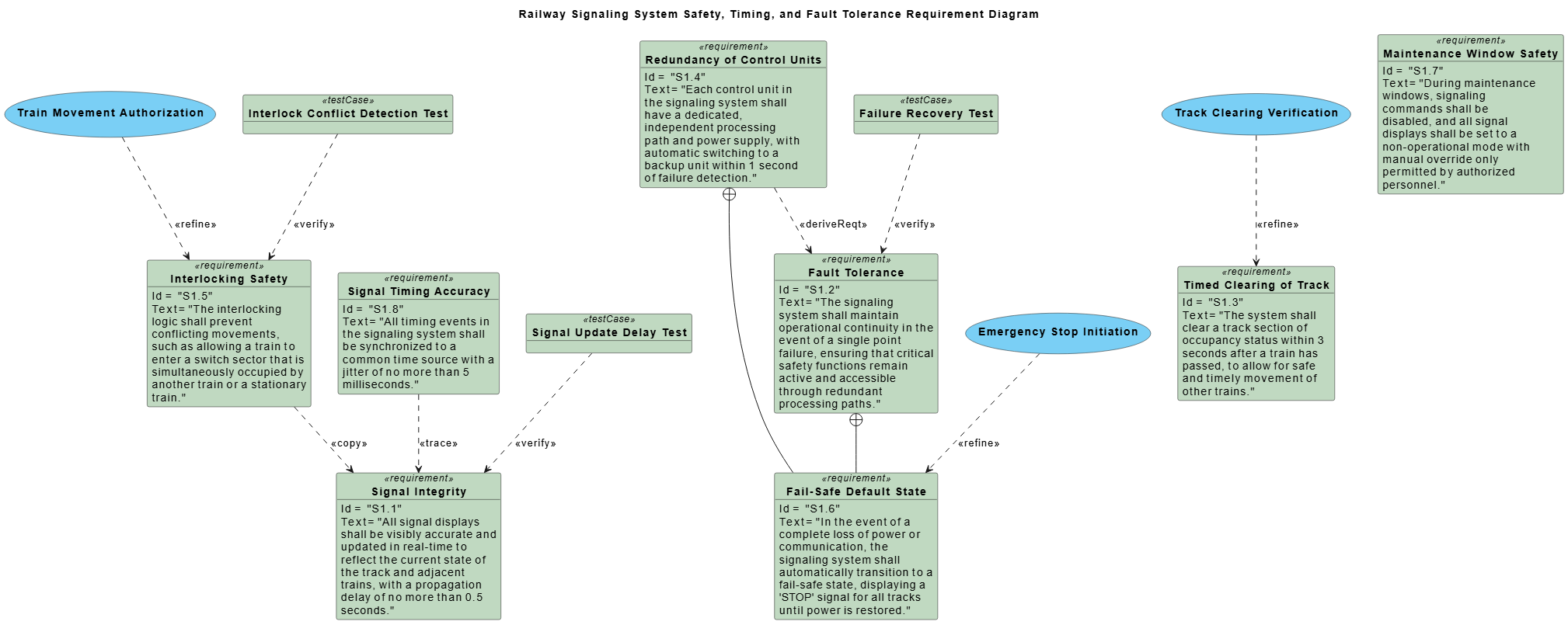
1. Requirement Clusters and Logic
The AI organized the system into logical functional blocks:
- Signal Integrity (req01): Ensures signals update in real-time with a maximum delay of 0.5 seconds. Why it matters: Prevents train collisions caused by outdated data.
- Fault Tolerance (req02): Mandates operational continuity after a single-point failure through redundant paths.
- Timed Clearing of Track (req03): Limits track clearing time to 3 seconds after passage to ensure availability.
- Redundancy of Control Units (req04): Requires automatic failover within 1 second. Relationship: This directly supports req02.
- Fail-Safe Default State (req06): Triggers a system-wide “STOP” during power loss.
- Signal Timing Accuracy (req08): Enforces synchronization with a jitter of ≤5ms.
2. Traceability and Validation Examples
The model uses SysML constructs to validate the design. Here is how the AI mapped these relationships:
$verify(testCase01, req01):
The Signal Update Delay Test is explicitly linked to the Signal Integrity requirement to validate the 0.5-second propagation delay.
$containment(req04, req06):
The AI established that Redundancy (req04) is a containment of the broader Fail-Safe Default State (req06) strategy, showing that fail-safe behavior is a systemic outcome of redundancy.
$refine(useCase01, req05):
The Train Movement Authorization use case is refined by the Interlocking Safety requirement, bridging the gap between operational logic and safety constraints.
Beyond SysML: A Unified Modeling Platform
While this guide focuses on SysML for safety-critical systems, the Visual Paradigm AI Chatbot is a versatile architect capable of supporting a full suite of modeling standards:
- UML: For detailed software and system design.
- ArchiMate: For enterprise architecture and business-IT alignment.
- C4 Model: For visualizing software architecture at different levels of abstraction.
- Strategic Models: Including Organizational Charts, SWOT analysis, and Mind Maps.
Conclusion
Designing a railway signaling system requires precision, foresight, and strict adherence to safety standards. The Visual Paradigm AI Chatbot transforms this high-stakes challenge into a collaborative design journey. By combining AI-powered intelligence with industry-standard modeling, engineers can build systems that are not only properly documented but are safer, more reliable, and fully traceable.
Resources
- Comprehensive Guide to Data Flow Diagrams in Software …
- Visual Paradigm Online
- User’s Guide – Visual Paradigm Community Circle
- AI Archives – Visual Paradigm Guides
- Visual Paradigm AI: Advanced Software & Intelligent Apps
- AI Generated Requirement Diagram: Metro Train Navigation …
- AI Sequence Diagram Example: Software Update Download and …
- AI Generated PERT Chart: Nationwide 5G Network Rollout Example
- AI Generated Requirement Diagram: Swarm Delivery Drones …
- Restaurant service flowchart | Diagram Alir Template
- VP Online – Online Drawing Tool
This post is also available in Deutsch, Español, فارسی, Français, English, Bahasa Indonesia, 日本語, Polski, Portuguese, Ру́сский, Việt Nam, 简体中文 and 繁體中文.