


What is ArchiMate?
ArchiMate is an open and independent enterprise architecture modeling language by The Open Group, supported by various tool vendors and consulting firms. ArchiMate provides tools that enable enterprise architects to describe, analyze, and visualize relationships between different architecture domains in an unambiguous way, similar to established disciplines such as civil engineering, architecture, and construction, which use internationally accepted standards to describe their designs.
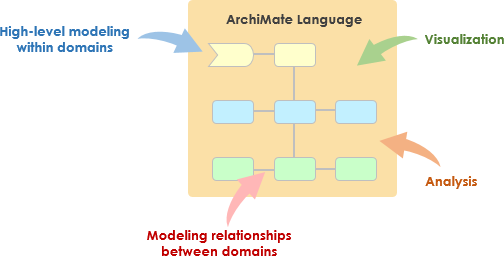
ArchiMate is a modeling technique (a ‘language’) for describing enterprise architecture. It provides a clear set of concepts and relationships between architecture domains, and offers a simple and unified structure for describing the content of these domains. Just as architectural drawings in classical architecture describe various aspects and uses of a building, ArchiMate provides a common language for describing the construction and operation of the following:
- Business processes
- Organizational structures
- Information flows
- IT systems
- Technical infrastructure
This insight helps stakeholders design, evaluate, and communicate the impact of decisions and changes within and across these business domains.
Drawing ArchiMate using certified EA tools
Visual Paradigm Enterprise Edition is a certified ArchiMate 3 enterprise architecture tool. It supports all ArchiMate 3 vocabulary, symbols, grammar, and semantics.
Why choose ArchiMate?
Models have already played a significant role in business. Process models, information and data models, application architectures, strategic models, operational models. Organizations strive to connect their models to gain insights into how the business operates from multiple different perspectives. Typically, models become more abstract, focusing on the essence of the organization. These developments led to the creation of the ArchiMate language, which enables high-level modeling within domains as well as modeling across domains.
Why choose ArchiMate
As shown in the above figure, the main reasons enterprise architects adopt ArchiMate are as follows:
- Capturing stakeholders’ concerns
- Addressing concerns by identifying and refining requirements
- Creating EA models
- Creating model views for stakeholders
- Demonstrating how concerns and requirements are addressed
- Illustrating trade-offs arising from conflicting concerns
Benefits of ArchiMate
The main benefits of using ArchiMate for enterprise architecture modeling are:
- It is an international, vendor-independent standard by The Open Group, freeing you from vendor-specific tools and frameworks. The ArchiMate Forum of The Open Group provides active support.
- Its solid foundational concepts and models provide precision. It helps move away from the ‘fuzzy picture’ image of architecture.
- It is a concise and simple language. It includes sufficient concepts to model enterprise architecture without bloating to include everything possible. Its unified structure makes it easy to learn and apply.
- It has clear connections to existing methods in specific architecture domains (such as software or business processes). Several concepts in ArchiMate are intentionally borrowed from other languages (such as UML or BPMN) to provide a simple bridge.
- It does not prescribe a way of working, but can be easily integrated with existing methods (such as TOGAF).
- It has been tested and used by many different user organizations and is supported by numerous consulting firms and software tools.
The latest ArchiMate 3 specification
The latest version of the language is the ArchiMate 3.0 specification, released in June 2016. ArchiMate 3.0 is a major update to the standard, introducing many new concepts.
New features included in version 3.0 include:
- Elements for modeling enterprises at the strategic level, such as capabilities, resources, and outcomes.
- It also includes support for modeling materials and equipment in the physical world.
- Additionally, the language’s consistency and structure have been improved, definitions aligned with other standards, and its usability enhanced in various other ways.
The new version of the language was created in response to a series of requirements:
- Increased demand to link business strategy with business and IT operations
- Technological innovations combining IT and the physical world
- Use in new domains; for example, manufacturing and logistics
- Improved consistency and comprehensibility
- Improved alignment with The Open Group standards, particularly with the TOGAF framework
Related resources:
The ArchiMate specification can be downloaded from The Open Group’s ArchiMate Forum.
ArchiMate core framework
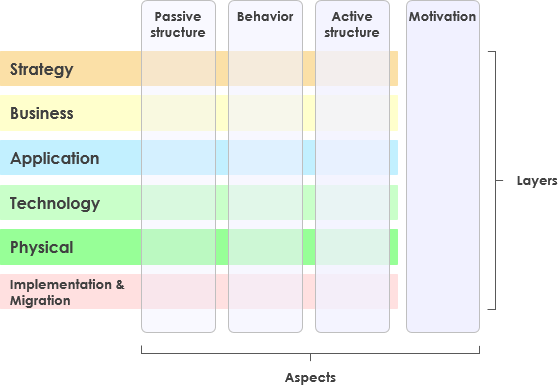
The aspects and layers defining business, application, and technology elements can be organized into a framework of nine units, as shown in the figure below.
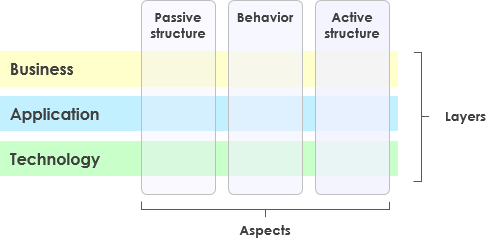
The framework’s structure allows modeling enterprises from different perspectives, with the position within each cell highlighting stakeholders’ concerns. Stakeholders typically have concerns spanning multiple cells.
Aspects and layers
The main concepts and relationships of the ArchiMate language can be viewed as a framework, known as the ArchiMate full framework.
It divides enterprise architecture into business, application, and technology layers.
Within each layer, three aspects are considered: active elements that exhibit behavior (such as processes and functions), internal structure, and elements that define the use or communication of information.
Aspects
The active structural aspect represents structural concepts (business actors, application components, and devices that exhibit actual behavior; i.e., the ‘subjects’ of activities). The behavioral aspect represents actions performed by actors (processes, functions, events, and services). Behavioral concepts are assigned to structural concepts to show who or what performs the behavior. The passive structural aspect (information) represents the objects on which behavior is performed. These are typically information objects in the business layer and data objects in the application layer, but they can also represent physical objects.
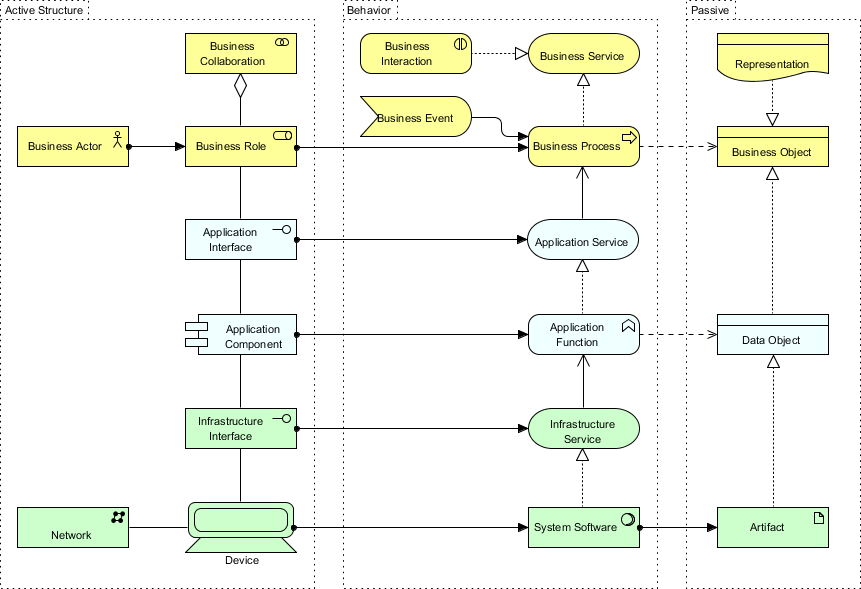
Layers
Higher layers use services provided by lower layers. The business layer delivers products and services to external customers, which are realized through business processes carried out by business actors. The application layer supports the business layer through application services, which are implemented by (software) applications. The technology layer provides infrastructure services (such as processing, storage, and communication services), which are required to run applications, and are implemented by computer and communication hardware as well as system software.
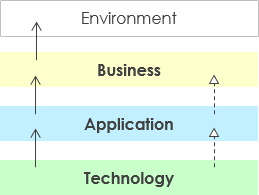
ArchiMate full framework
The complete ArchiMate language adds several layers and one aspect to the core framework. Physical elements are added to the technology layer for modeling physical facilities and equipment, distribution networks, and materials. Additionally, a motivation aspect and implementation and migration elements are added. The resulting complete ArchiMate framework is shown in the figure below.
Core layers:
ArchiMate core – enables modeling of the architecture domains defined by TOGAF. Extensions: Motivation extension – enables modeling of stakeholders, change drivers, business objectives, principles, and requirements. Implementation and migration extension – enables modeling of portfolio management, gap analysis, and transition and migration planning. The most important ArchiMate concepts are shown in the figure below. You can clearly see the unified approach across layers.
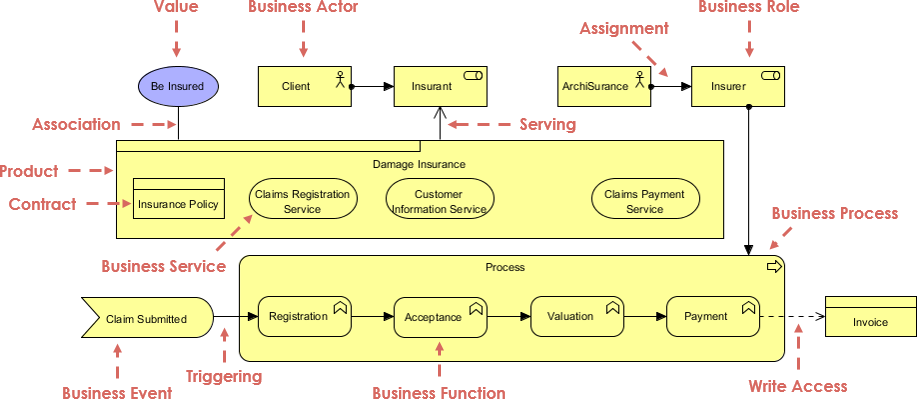
Core layers (business, application, technology)
The layered view provides a natural way of looking at service-oriented models. Higher layers use services provided by lower layers. ArchiMate distinguishes three main (core) layers:
- The business layer delivers products and services to external customers, which are realized within the organization through business processes, executed by business actors and roles.
- The application layer supports the business layer through application services, which are realized by (software) application components.
- The technology layer provides infrastructure services required to run applications (e.g., processing, storage, and communication services), realized by computer and communication hardware as well as system software.
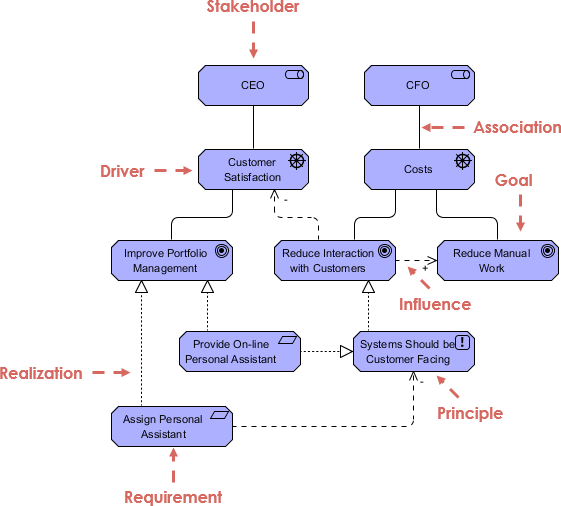
Motivation Extension
ArchiMate motivation elements make it possible to model stakeholders, change drivers, business objectives, principles, and requirements.
Implementation and Migration Extension
ArchiMate implementation and migration elements make it possible to model portfolio management, gap analysis, and transition and migration planning.
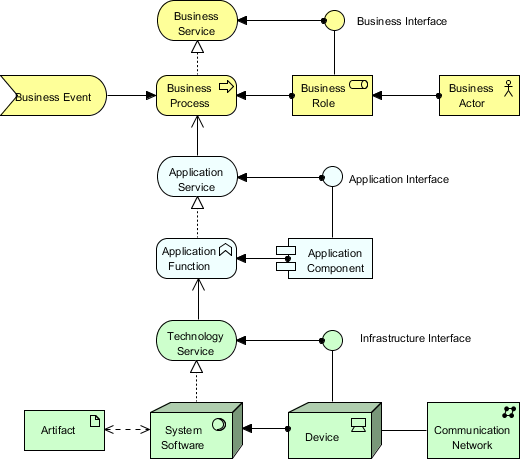
ArchiMate Example – Core Layers
In the ArchiMate example model below, you can see the integration of various ArchiMate layers.
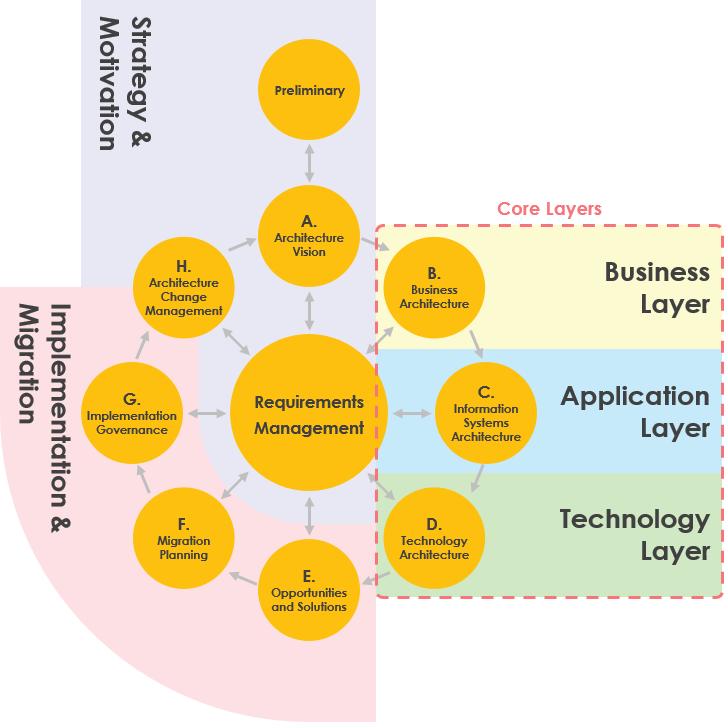
ArchiMate and TOGAF ADM
As stated in this technical standard, the ArchiMate language complements TOGAF because it provides a set of vendor-independent concepts, including graphical representations, which help create consistent, integrated models ‘below the waterline,’ which can be expressed as TOGAF views.
Want to create ArchiMate diagrams?
Try Visual Paradigm Enterprise Edition, an enterprise architecture software with powerful ArchiMate diagramming tools, ArchiMate viewpoint management tools, and TOGAF-guided processes.
This post is also available in Deutsch, Español, فارسی, Français, English, Bahasa Indonesia, 日本語, Polski, Portuguese, Ру́сский, Việt Nam, 简体中文 and 繁體中文.