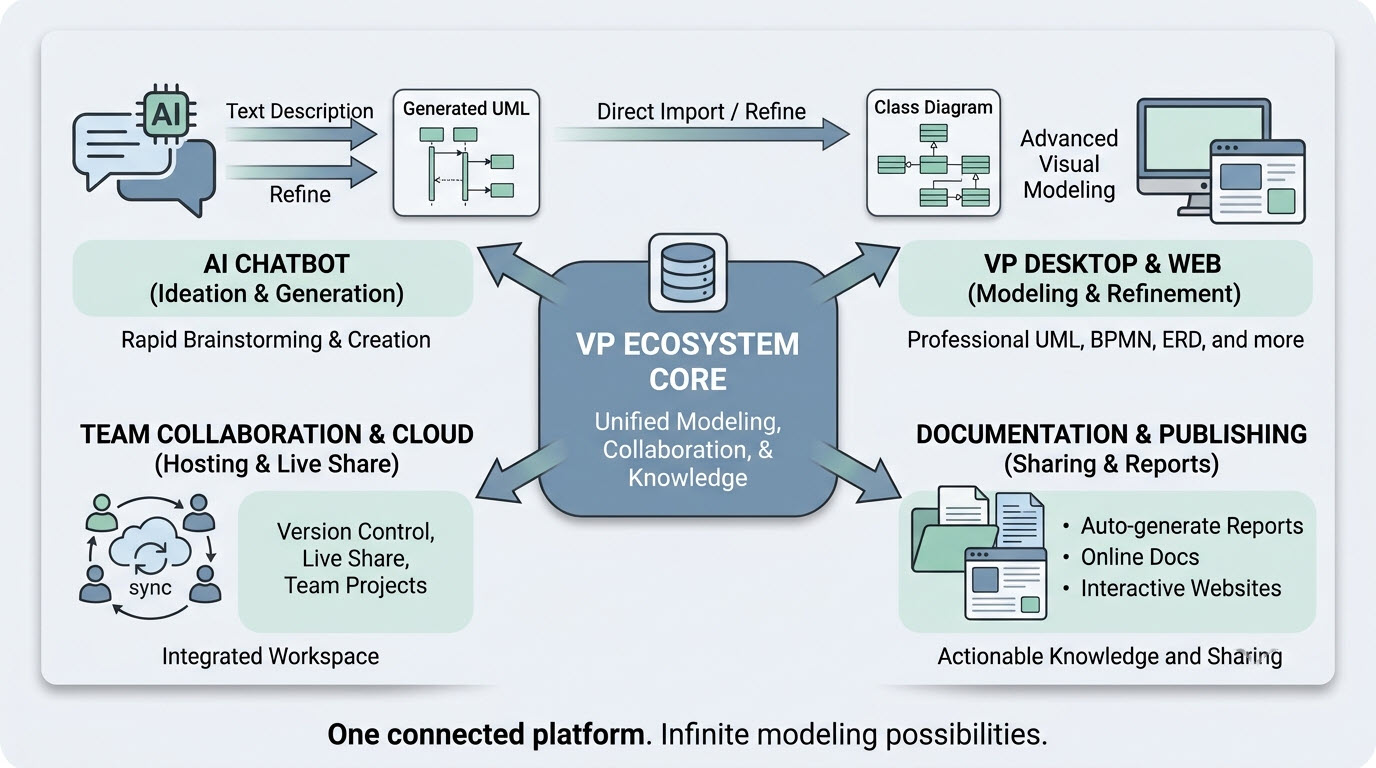
In the rapidly evolving landscape of business process management, the gap between abstract strategy and technical execution has traditionally been bridged by complex documentation and manual diagramming. Visual Paradigm has revolutionized this workflow by introducing a unified ecosystem where Artificial Intelligence acts as the catalyst. This tutorial explores the architecture of the Visual Paradigm AI Ecosystem, explaining how it transforms text descriptions into production-ready BPMN models and fosters seamless collaboration.
The Foundation: BPMN 2.0 and the Universal Language
Before diving into the tools, it is essential to understand the standard at the core of this ecosystem: BPMN 2.0 (Business Process Model and Notation). BPMN serves as the universal language for business processes, providing a visual syntax that is easily understood by business stakeholders and executable by technical systems alike. It bridges the gap between business strategy and technical implementation, ensuring that a “Customer Order” process looks the same to the CEO as it does to the IT developer.
Visual Paradigm does not just support this standard; it enhances it. By integrating AI capabilities, the platform moves beyond simple drag-and-drop diagramming. It becomes an active engineering environment where models can be generated, refined, and optimized through natural interactions.
Architecture of the Visual Paradigm AI Ecosystem
The ecosystem is built upon a central VP Ecosystem Core, which acts as the repository for Unified Modeling, Collaboration, and Knowledge. This core connects four distinct but integrated environments, each serving a specific stage of the modeling lifecycle.
1. AI Chatbot: Ideation & Generation
The journey of a new process often begins with a text description or a rough idea. The AI Chatbot serves as the entry point for “Rapid Brainstorming & Creation.” Instead of staring at a blank canvas, users can interact with a conversational agent to generate initial diagrams.
- Input: Users provide text descriptions of a process (e.g., “An order process where a customer places an order, the system checks stock, and then ships the item”).
- Refinement: The AI parses the text and generates a preliminary model, such as a UML sequence or a BPMN flow. Users can then “Refine” this output through further conversation, asking the AI to add error handling or specific gateway logic.
- Output: A “Generated UML” or BPMN diagram that serves as a high-fidelity draft, ready for import into the main modeling tools.
2. VP Desktop & Web: Modeling & Refinement
Once the initial concept is generated, it requires professional precision. This is the domain of VP Desktop and VP Web. These tools are designed for “Advanced Visual Modeling,” allowing users to take the AI-generated drafts and apply the rigorous standards of BPMN 2.0.
- Direct Import: The ecosystem allows for a seamless transition from the chatbot’s generated text to the desktop application. Users can import the generated models and refine them with advanced editing capabilities.
- Comprehensive Standards: The platform supports professional modeling of UML, BPMN, ERD (Entity Relationship Diagrams), and more. It ensures that the models are not just pictures, but structured data that can be validated against industry standards.
3. Team Collaboration & Cloud: Hosting & Live Share
Modeling is rarely a solitary activity. The ecosystem emphasizes an “Integrated Workspace” where teams can work together in real-time. The Cloud component handles “Version Control, Live Share, and Team Projects.”
- Synchronization: Changes made by one team member are synchronized across the platform, ensuring everyone works on the latest version of the process.
- Live Sharing: Stakeholders can be granted access to view or edit specific processes without needing to understand the underlying technical complexity.
4. Documentation & Publishing: Sharing & Reports
The final stage of the lifecycle is communication. The ecosystem provides robust tools for “Actionable Knowledge and Sharing,” ensuring that the work done in the modeling tools is accessible to the wider organization.
- Auto-Generate Reports: The system can automatically compile diagrams into professional reports, saving hours of manual formatting.
- Online Docs & Interactive Websites: Models can be published as interactive websites, allowing users to navigate through complex processes via a browser, making the documentation accessible to non-technical staff.
Workflow Integration: From Text to Production
The true power of this architecture lies in the connectivity between these pillars. The workflow typically follows this path:
- Ideation: A user asks the AI Chatbot to generate a process flow based on a text requirement.
- Refinement: The generated model is imported into VP Desktop or Web for detailed editing and standardization.
- Collaboration: The model is shared with the team via the Cloud for review and versioning.
- Publication: The final, approved process is published as a report or an interactive web page for the business.
Conclusion
The Visual Paradigm AI Ecosystem represents a shift from static diagramming to dynamic process engineering. By unifying AI-driven generation, advanced professional modeling, team collaboration, and automated publishing, it provides a complete solution for modern business process management. Whether you are starting with a text description or refining a complex BPMN 2.0 model, this ecosystem offers the tools necessary to move from concept to production instantly.