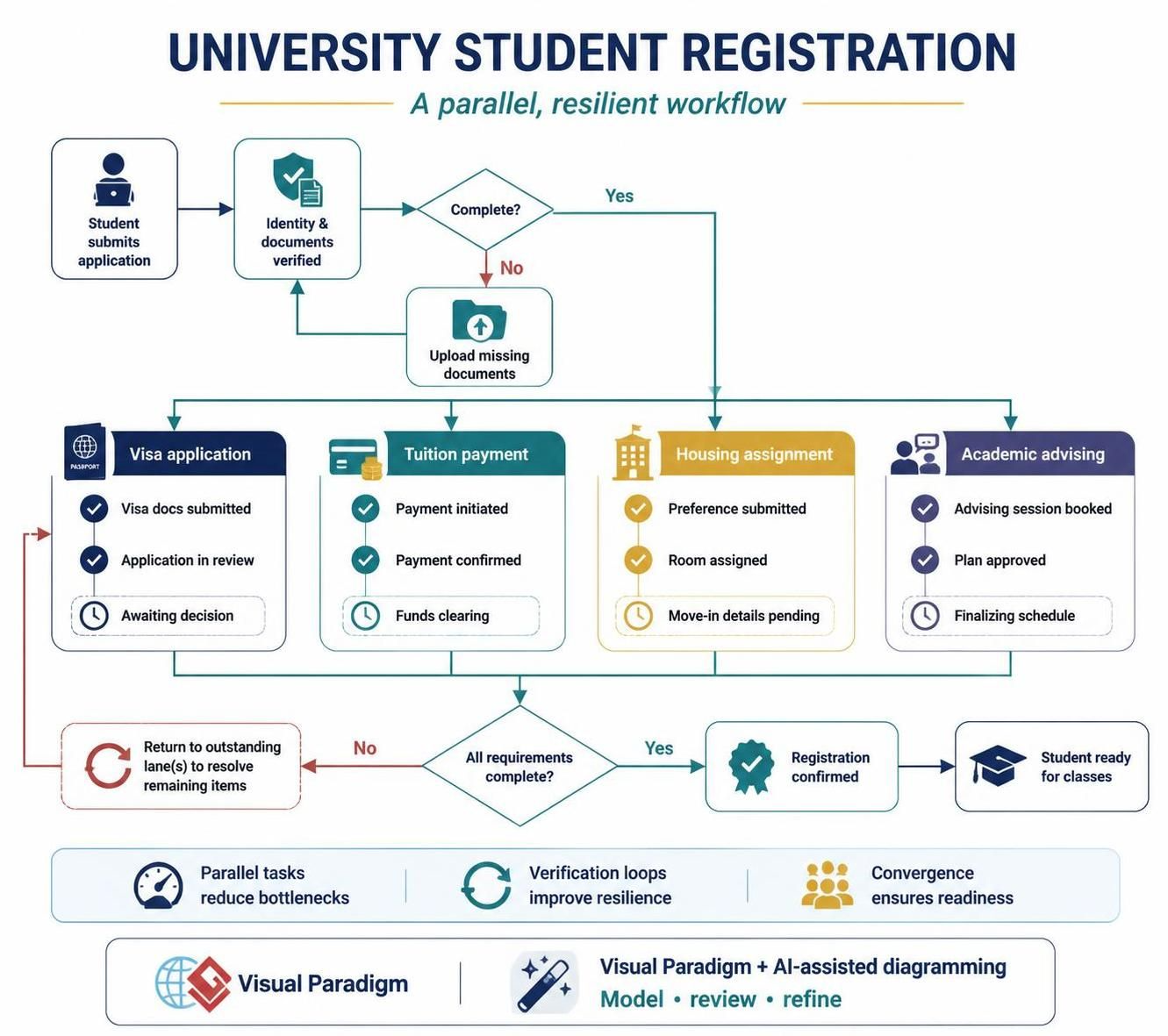
In modern institutional operations, efficiency hinges on the ability to manage complex, multi-path workflows. The University Student Registration Process serves as a prime example of how organizations can move beyond linear, sequential processing to embrace parallel execution. By identifying independent tasks—such as visa applications, tuition payments, housing assignments, and academic advising—institutions can significantly reduce bottlenecks and improve the student experience.
This tutorial explores the architecture of a robust registration system, highlighting how verification loops, parallel pathways, and convergence points create a resilient and scalable process. We will also examine how modern tooling, including Visual Paradigm and AI-assisted diagramming, can help product managers and systems analysts visualize and refine these workflows.
Core Architecture: From Linear to Parallel
Traditional registration systems often follow a “waterfall” approach, where a student must complete one task before the next begins. However, as shown in the diagram, a modern system utilizes a Parallel Pathway architecture. This allows multiple departments to work on a student’s profile simultaneously.
1. The Verification Loop (Data Integrity)
Before the workflow splits into parallel tracks, a critical Verification Loop ensures data integrity. This prevents “garbage in, garbage out” scenarios in downstream departments.
- Input: The student submits an application.
- Decision Point: The system checks for identity and document completeness.
- Handling “No”: If documents are missing, the workflow redirects to an Upload missing documents task. The student is prompted to provide the missing data, and the loop restarts until the data is valid.
- Handling “Yes”: Once verified, the data flows into the parallel processing stage.
2. Parallel Pathways (Concurrent Processing)
Once verified, the workflow splits into independent tracks. In this architecture, delays in one area (e.g., visa processing) do not necessarily halt progress in others (e.g., tutor assignment), provided the system allows for asynchronous updates.
- Visa Track: Conditional logic based on international status. Statuses include “Visa docs submitted,” “Application in review,” and “Awaiting decision.”
- Financial Track: Mandatory payment confirmation. This includes “Payment initiated,” “Payment confirmed,” and “Funds clearing.”
- Housing Track: Conditional assignment based on accommodation requests. Steps include “Preference submitted,” “Room assigned,” and “Move-in details pending.”
- Academic Track: Tutor assignment and course selection. Key steps are “Advising session booked,” “Plan approved,” and “Finalizing schedule.”
3. Convergence and Completion
The process only concludes when all parallel paths reach their terminal states. This “Join” point ensures that no student is marked as “fully registered” until every requirement—financial, legal, residential, and academic—is satisfied.
Modeling with VPasCode and AI
Visualizing this architecture requires more than just drawing boxes; it requires defining the logic that governs the flow. Using VPasCode (Visual Paradigm’s coding-to-diagram tool), analysts can define the workflow structure using code, which is then rendered into a diagram.
Here is how you might structure the logic for the initial verification and parallel split:
// Define the Start and Verification
Start: Student submits application
Verify: Identity & Documents
Decision: Complete?
  If No -> Upload missing documents (Loop back)
  If Yes -> Split to Parallel Tracks

// Parallel Tracks
Track 1: Visa Application
Track 2: Tuition Payment
Track 3: Housing Assignment
Track 4: Academic Advising

// Convergence
Join: All requirements complete?
  If No -> Return to outstanding lane(s) to resolve remaining items
  If Yes -> Registration confirmed -> Student ready for classes
Key Takeaways
- Parallelism: Reduces overall cycle time by allowing independent tasks to run concurrently.
- Resilience: Verification loops prevent bad data from entering the system, reducing errors downstream.
- Convergence: Ensures a comprehensive “readiness” check before finalizing the student’s status.
By leveraging tools like Visual Paradigm combined with AI-assisted diagramming, teams can model, review, and refine these complex workflows efficiently, ensuring a smooth registration experience for students.