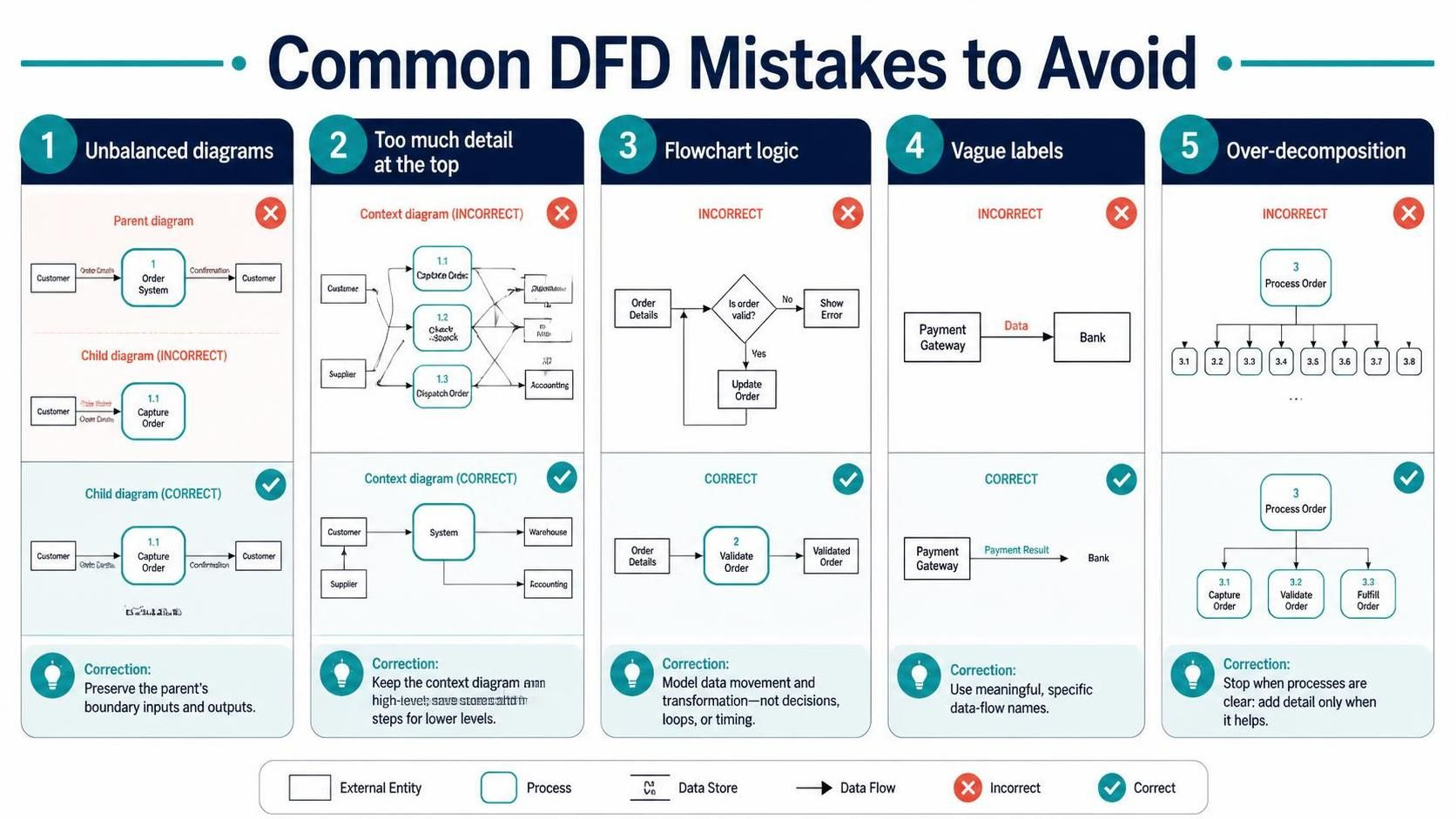
Designing a system architecture requires more than just drawing boxes and arrows; it requires a disciplined approach to how data moves through a system. Data Flow Diagrams (DFDs) are a powerful tool for visualizing this movement, helping analysts understand the boundaries of a system and the transformations that occur within it. However, even experienced modelers can fall into traps that obscure the true nature of the system.
Based on best practices in structured analysis, here is a guide to the five most common mistakes to avoid when creating DFDs, and how to correct them using tools like Visual Paradigm.
1. Unbalanced Diagrams
The concept of “balancing” is the bedrock of DFD consistency. When you decompose a high-level process into a child diagram (a lower level), the inputs and outputs must match exactly. If your parent diagram shows data entering Process 1, your child diagram must also show that same data entering the sub-processes.
- The Mistake: A child diagram adds new data flows that were not present in the parent, or omits existing ones. This creates a logical disconnect where the system seems to receive data it cannot process or output data that was never generated.
- The Correction: Strictly preserve the parent’s boundary inputs and outputs. Every data flow crossing the boundary in a high-level view must be accounted for in the detailed view.
2. Too Much Detail at the Top
A Context Diagram (Level 0) is meant to be the “helicopter view.” It answers the question: What does the system exchange with the outside world?
- The Mistake: Crowding the context diagram with internal steps, data stores, or specific sub-processes (e.g., “Capture Order,” “Check Stock”). This defeats the purpose of the diagram, which is to define the system boundary, not the internal logic.
- The Correction: Keep the context diagram simple and high-level. It should contain only one process representing the entire system and the external entities it interacts with. Save the stores and specific steps for the lower-level decomposition.
3. Using Flowchart Symbols or Logic
This is a frequent confusion for beginners. A DFD is not a flowchart. Flowcharts describe control flow, timing, and decision logic (loops, if-then statements). DFDs describe data flow and transformations.
- The Mistake: Using decision diamonds (e.g., “Is order valid?”) or showing loops. This introduces the concept of “when” the system does something, rather than “what” data is moved.
- The Correction: Model data movement and transformation. Instead of a decision diamond, you simply show the data flowing into a process and the resulting data flowing out. If an order is invalid, the data simply flows to a different process (like “Handle Error”) or a data store. Avoid logic symbols entirely.
4. Vague Labels
Clarity is king in system modeling. If a stakeholder looks at your diagram and cannot immediately understand what is happening, the model has failed.
- The Mistake: Labeling data flows with generic terms like “Data,” “Info,” or “Details.” This provides zero insight into the actual business transaction occurring.
- The Correction: Use meaningful, specific names. Instead of “Data,” label the flow “Payment Result” or “Order Details.” This makes the diagram self-documenting and easier to validate against business requirements.
5. Over-Decomposition
While it is tempting to break down every tiny action into its own process box, there is a limit to useful detail. A diagram that is too granular becomes unreadable and loses the “big picture.”
- The Mistake: Splitting a process like “Process Order” into tiny, atomic steps (e.g., 3.1, 3.2, 3.3… all the way down to 3.8). This creates a cluttered web of boxes that adds no new clarity.
- The Correction: Stop decomposing when the processes are clear. If a level of detail is sufficient for a developer or business analyst to understand the data transformation, do not go deeper. Add detail only when it helps clarify a complex logic or data transformation.
Conclusion
Top-down decomposition is a structured way to move from a broad view of a system to focused descriptions of its internal processes. By maintaining balance between levels and avoiding flowchart logic, you ensure that your DFDs remain consistent and readable. Whether you are building a bookstore system or a complex banking platform, adhering to these rules will result in architecture models that truly serve their purpose.