
A comprehensive comparison between ArchiMate 3 (specifically v3.2) and ArchiMate 4 reveals a fundamental philosophical shift in how enterprise architecture (EA) modeling is approached. While ArchiMate 3 solidified the standard’s core layers, motivation extensions, and physical elements, it faced criticism for a steep, front-loaded learning curve and structural rigidity.
ArchiMate 4 rethinks the language to tackle accidental complexity, better accommodate modern working environments (such as human-AI collaboration), and improve overall accessibility.
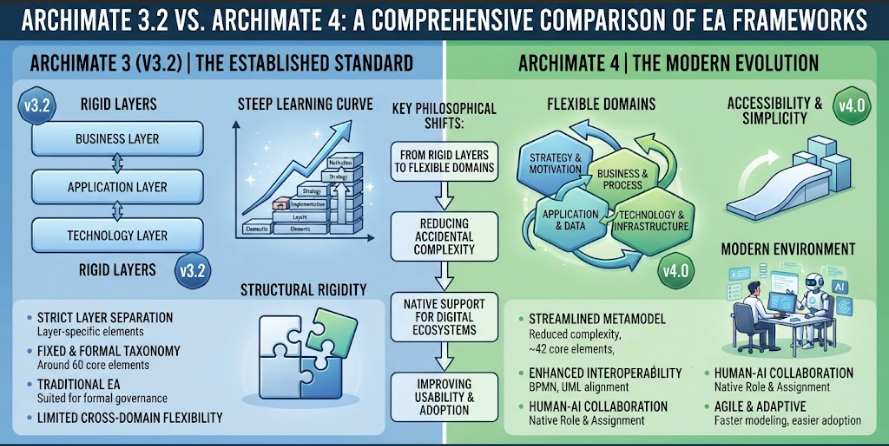
1. Core Architectural & Paradigm Shifts
| Feature / Dimension | ArchiMate 3 / 3.2 | ArchiMate 4 |
|---|---|---|
| Organizational Metaphor | Rigid Layers (Business, Application, Technology layers stacked vertically). | Flexible Domains (Moved away from strict layering to domain-oriented classification and hexagon visualizations). |
| Metamodel Scope | Heavier, containing around 60 core elements with duplicated behaviors across layers. | Streamlined, reduced to around 42 core elements by eliminating redundancy. |
| Learning Curve | Front-loaded: Required mastery of layers, aspects, full taxonomy, and relationship rules before safe adoption. | Specialization-first: Allows teams to start small with generic building blocks and specialize as maturity grows. |
| Relationship Rules | Fixed validity matrices with implicit cardinality constraints. | Clearer relationship rules supported by explicit cardinality on relationships for tighter validation. |
2. Key Enhancements in ArchiMate 4
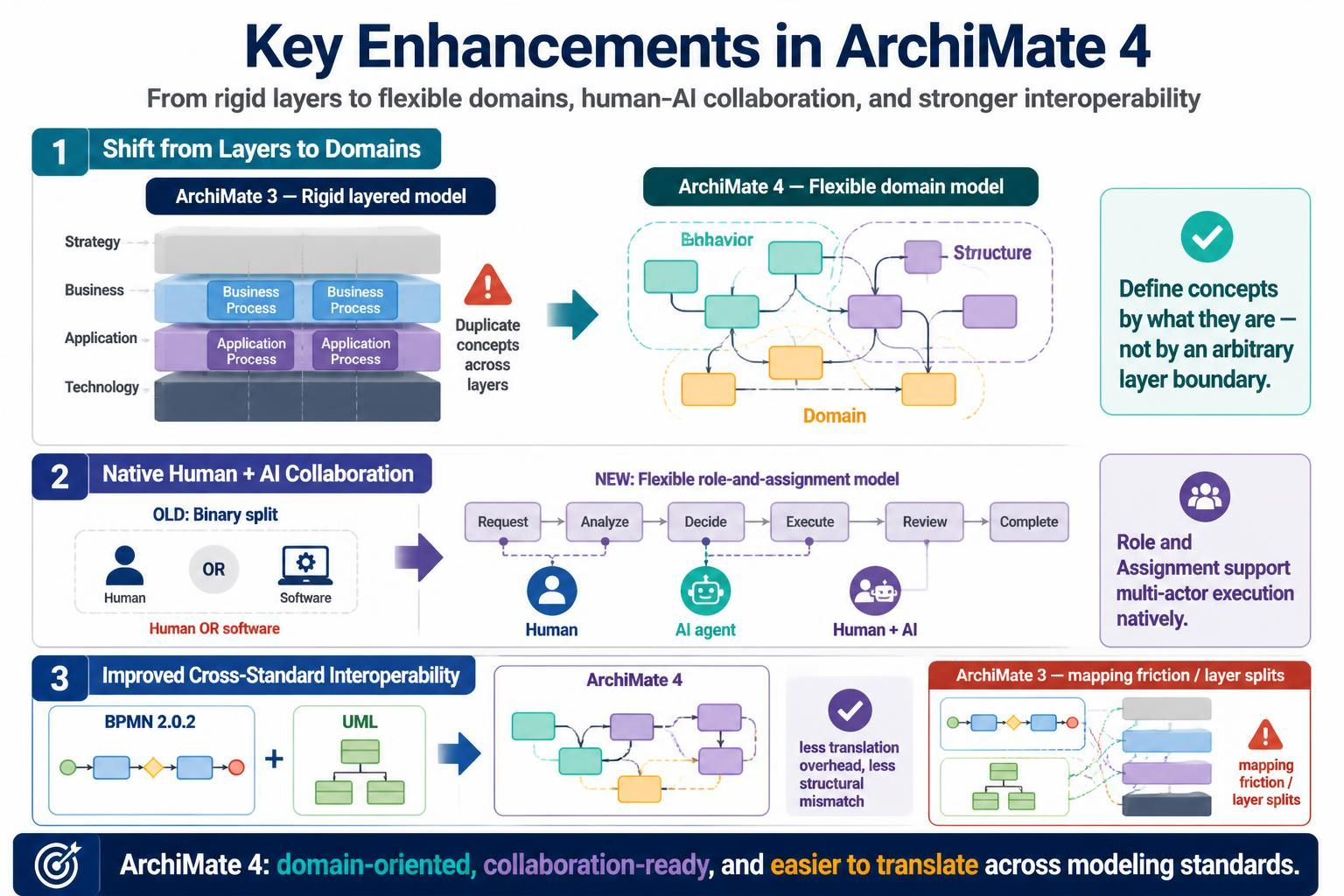
Shift from Layers to Domains
ArchiMate 3 enforced a strict mental model where elements were bound tightly to a specific layer (e.g., Business Process vs. Application Process). ArchiMate 4 shifts this toward a domain-oriented language structure.
-
The Benefit: It prevents the artificial duplication of concepts. Behaviors and structures are defined by what they are rather than strictly forcing an early, arbitrary decision about which layer boundary they sit in.
Native Support for Human + AI Collaboration
One of the most dated assumptions in ArchiMate 3 was the binary nature of execution: processes were performed either by humans (Business layer) or software/systems (Application layer).
-
In ArchiMate 4, the generic Role and Assignment model handles modern multi-actor environments natively. Processes can be executed by humans, AI agents, or fluid combinations of both without requiring messy cross-layer realization relationships.
Improved Cross-Standard Interoperability (BPMN & UML)
Translating models from other popular standards into ArchiMate 3 often introduced heavy mapping friction (e.g., forcing a mixed human-automated BPMN process into awkward layer splits). ArchiMate 4 aligns much more naturally with standards like BPMN 2.0.2 and UML, significantly minimizing translation overhead and structural mismatch.
3. Practical Implications for Enterprise Architects
-
Adoption & Governance: ArchiMate 3 encouraged an all-or-nothing approach, making it difficult to convince incremental stakeholders to adopt the language. ArchiMate 4 enables a gradual adoption path (similar to the C4 model philosophy: start simple with core building blocks, add depth later). However, because the language relies less on rigid element names to enforce semantic precision, local architecture governance becomes more vital to maintain modeling discipline.
-
Backward Compatibility / Coexistence: Modern EA modeling tools (such as Visual Paradigm) support side-by-side compatibility, allowing teams to open, edit, and export projects using automated translation bridges between ArchiMate 3.2 and 4.0 specifications without forcing an abrupt enterprise-wide rewrite.
Summary Verdict
-
ArchiMate 3 remains a robust, highly formal framework suited for organizations heavily invested in strict compliance, traditional TOGAF-aligned layer separation, and deep structural compliance checks.
- ArchiMate 4 is a necessary modernization that successfully slashes accidental complexity, embraces modern engineering practices (AI integration, decoupled domains, and cleaner relationship cardinality), and makes enterprise architecture vastly more approachable for agile teams.
Reference
-
-
Part II: Hands-on Modeling with Visual Paradigm: A practical guide covering first steps with the tool, core modeling techniques, and clean diagram habits for ArchiMate.
-
Comprehensive Tutorial: How to Draw ArchiMate Diagrams: A step-by-step tutorial that walks through creating an ArchiMate diagram from scratch, using a hospital patient discharge example.
-
Comprehensive Tutorial: AI-Powered ArchiMate Diagram Generation in Visual Paradigm Desktop: Explains how to use the AI Diagram Generator to instantly create fully compliant ArchiMate models and official viewpoints.
-
Hands-on: Generating a Multi-Layer Model from a Single Topic: Demonstrates how to generate a multi-layer ArchiMate model from a single topic or scenario using AI.
-
ArchiMate Viewpoint: Migration Viewpoint: Describes the Migration Viewpoint, its stakeholders, concerns, and how to apply it for modeling transitions from baseline to target architectures.
-
Creating Custom Viewpoints for Unique Organizational Standards: Explains how to design user-defined viewpoints for specific organizational needs using the Manage Viewpoint tool.
-
Part V: Advanced Integration and Frameworks: Covers integrating ArchiMate with TOGAF ADM, UML, SysML, and BPMN for cross-standard traceability.
-
Build an ArchiMate Library System Diagram with PlantUML: A tutorial for diagram-as-code workflows, building a multi-layer ArchiMate model using PlantUML.
ArchiMate 4 is a necessary modernization that successfully slashes accidental complexity, embraces modern engineering practices (AI integration, decoupled domains, and cleaner relationship cardinality), and makes enterprise architecture vastly more approachable for agile teams.
-
Native AI ArchiMate 4 Generation & Viewpoints | Visual Paradigm Desktop: Official release announcing AI-powered generation of native ArchiMate 4 diagrams with full viewpoint support in the desktop application.
-
ArchiMate 4: A New Era in Enterprise Architecture Modeling: Overview of ArchiMate 4’s key changes, including the shift to Domains, unified behavior elements, and the Hexagonion framework.
-
Mastering Enterprise Architecture with Visual Paradigm: A User’s Journey to AI-Driven ArchiMate Modeling: Practical user experience covering AI generation, element reuse, syntax validation, and the Common Domain shift.
-